
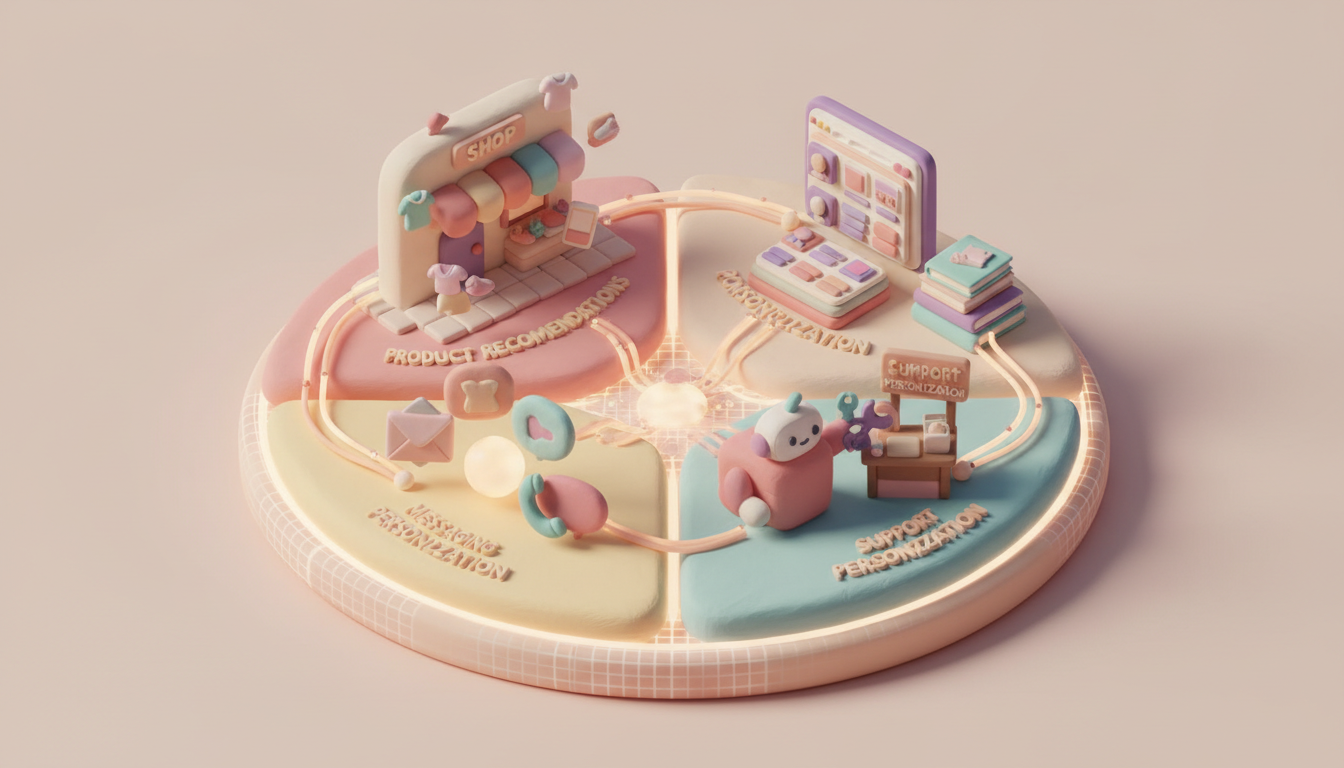
AI personalization uses machine learning to tailor what each customer sees, the messages they get, and the offers they receive. It pulls from their behavior, purchase history, and preferences. By 2026, ecommerce brands that skip personalization are leaving serious money on the table. Customers expect every interaction to feel like it was made just for them, from that first site visit right through to after the sale. A generic email blast or a cookie-cutter product grid just doesn’t cut it anymore. This guide breaks down how AI personalization boosts ecommerce revenue, why it needs to cover the whole customer journey, and how a unified platform like Parallel AI makes it possible.
The Four Pillars of AI Personalization
Real revenue-driving personalization isn’t just about “you might also like” widgets. It sits on four pillars that cover the complete buyer journey:
- Product Recommendations – now powered by real-time behavior, purchase history, and even support interactions.
- Content Personalization – landing pages, blog posts, and in-app guides that adapt to each visitor.
- Messaging Personalization – emails, SMS, push notifications, and on-site messages that change tone, offer, and timing based on what each person prefers.
- Support Personalization – proactive chat, voice support, and self-serve help that remembers past issues and suggests fixes before the customer even asks.
When these engines work together on a single customer data foundation, you get more than a conversion lift. You get a real increase in customer lifetime value.
How Parallel AI Uses AI Agents to Personalize Across Channels
Most tools focus on one thing. A product recommendation engine lives on the site. An email tool handles campaigns. A chatbot answers questions. The problem? These silos create a disconnected experience. A customer who abandons a cart might get a generic win-back email, even though she just chatted with support about sizing on that exact item.
Parallel AI solves this by deploying AI agents that work across email, SMS, voice, and chat, all connected to a unified customer profile.
- AI Email Agents craft subject lines, body copy, and send times that match each subscriber’s engagement patterns.
- SMS and Messaging Agents send hyper-relevant texts when someone walks into a geo-fenced store or spends time on a product page.
- Voice AI Agents handle support calls with full context of past purchases and browsing, and they offer upsells that feel like helpful suggestions.
- Chat Agents act on real-time intent signals, not just keyword matching, to recommend the right products or content.
Since Parallel AI centralizes data from sales, marketing, and support, these agents share context. So a discount offered in a chat won’t clash with a VIP loyalty reward sent via email. Every touchpoint reinforces the same tailored experience.
Setting Up Personalized Sequences: From Welcome to Post-Purchase Upsell
AI personalization really shines in automated sequences, where each customer moves through a journey that adapts as new data comes in. Here’s what a typical lifecycle sequence looks like on Parallel AI:
| Stage | Personalization Element | AI Action |
|---|---|---|
| Welcome | Dynamic onboarding content | Analyzes referral source and browsing to show the most relevant product categories |
| Browse abandonment | Product recommendation + incentive | Sends an SMS or email with items the user viewed, plus a personalized discount if they’re price-sensitive |
| Cart abandonment | Urgency + social proof | Injects countdown timers and trending product alerts, matched to the items in the cart |
| Post-purchase | Thank-you, cross-sell, support | Triggers a sequence that asks for a review, suggests complementary products, and anticipates delivery questions |
| Re-engagement | Personalized win-back | Uses last purchase date and category to recommend new arrivals or a VIP-only offer via the customer’s preferred channel |
All this runs on behavioral triggers, not fixed rules. The AI keeps testing and optimizing which message, channel, and timing drives the most revenue for each micro-segment.
Case Study: How an Ecommerce Brand Increased AOV by 20% Using Parallel AI
Background: GlowHome, a mid-sized home décor retailer, had inconsistent messaging. Their product recommendation widget worked well, but email and support teams used separate tools. Average order value sat at $58.
Implementation with Parallel AI:
1. Unified all customer data from Shopify, Gorgias, and Klaviyo into Parallel AI’s data layer.
2. Deployed AI agents for email, chat, and voice.
3. Built a sequence that catches when a support conversation reveals a style preference (like “I love minimalist designs”) and then automatically sends a curated collection email 24 hours later.
4. Enabled AI upsells and cross-sells during support calls. So when a customer calls about a damaged lamp, the agent might suggest a matching lampshade from the same collection.
Results (30-day pilot):
– AOV climbed from $58 to $69.60, a 20% increase.
– Email click-through rates jumped 34%.
– Customer lifetime value rose 15% because repeat purchases became more relevant.
– Support deflection improved by 22% since proactive emails answered common post-purchase questions.
Common Pitfalls and How to Avoid Them with a Unified Data Approach
Personalization can backfire if data is fragmented. Here are the most frequent pitfalls and how Parallel AI sidesteps them:
| Pitfall | Symptom | Unified Data Solution |
|---|---|---|
| Data silos | A customer who just bought a high-end sofa gets a discount offer for budget futons | Single customer view across channels makes sure offers match purchase history |
| Stale profiles | Winter coat recommendations in July | Real-time behavior ingestion updates interests immediately |
| Channel conflict | Email offers 10% off while live chat offers 15% | AI agents share a dynamic offer pool so no double-discounting |
| Over-personalization | Customer feels “watched” or spammed | Frequency capping and channel preferences are built into the AI logic |
| Ignoring support context | Upsell email sends right after a complaint | Journey triggers pause promotional messages until support issues are resolved |
Parallel AI’s unified data approach makes sure every personalization action, whether it’s product recommendations, content, messaging, or support, pulls from the same real-time source. The result is a smooth customer experience that builds trust and boosts revenue.
FAQ: AI Personalization in Ecommerce
How does AI personalization work in ecommerce?
AI personalization in ecommerce uses machine learning to analyze customer data, including browsing history, purchase patterns, support tickets, and demographics, to tailor product recommendations, marketing messages, and content in real time. Platforms like Parallel AI connect these sources into a single customer view, so you can personalize across email, SMS, voice, and chat.
What are the best AI personalization tools for ecommerce?
The best tools depend on what you need. Standalone solutions like Dynamic Yield or Recombee are great for product recommendations. Klaviyo personalizes email marketing. If you want a unified approach that spans the entire customer journey—recommendations, messaging, content, and support—Parallel AI is a top choice because its AI agents work across channels using a shared data layer.
Can AI personalization increase customer lifetime value?
Yes, absolutely. When you do it right across all touchpoints, AI personalization can boost CLV by 15–30%. By delivering relevant recommendations, timely support, and consistent cross-channel experiences, brands see more repeat purchases and higher average orders. Parallel AI’s lifecycle sequences make sure every interaction strengthens loyalty, directly impacting long-term revenue.
How does Parallel AI enable personalization across multiple channels?
Parallel AI unifies data from sales, marketing, and support into a single customer profile. Its AI agents for email, SMS, voice, and chat all read from and write to that same profile. So a chat with support can influence the next email offer, and an abandoned cart can trigger a personalized SMS, all without mixed messages. That creates a smooth, end-to-end personalized journey.
Ready to accelerate your ecommerce revenue with unified AI personalization? Explore Parallel AI today and see how AI agents can transform every customer interaction.