
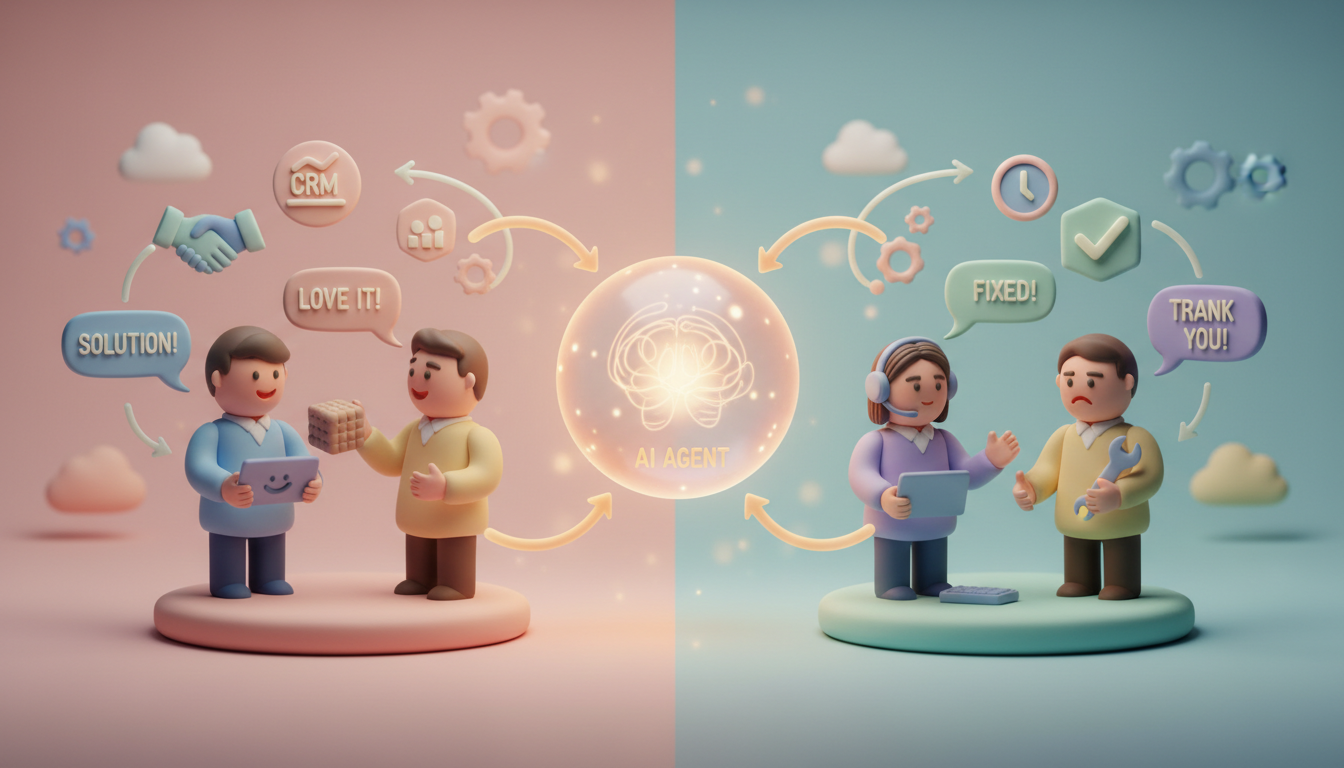
The average B2B company now juggles 12 separate SaaS tools just to manage customer communication. Marketing has a chatbot. Sales has a sequencer. Support has a ticketing system. And that spreadsheet holding it all together? That’s the thirteenth tool nobody admits they depend on.
This fragmentation is the invisible tax on your revenue engine. When a prospect asks a pricing question on your website, the bot captures the lead, but the sales team has no context. When a customer replies to a sales email with a support issue, the thread goes dark for three days because it landed in the wrong inbox.
AI chat agents are closing these gaps. Not the rigid, decision-tree chatbots of 2022 that frustrated everyone into clicking “Speak to a human.” We’re talking about autonomous, reasoning agents that switch between sales qualification and support resolution within the same conversation thread, while writing back to your CRM and triggering downstream workflows.
For growth-stage teams stuck in tool sprawl purgatory, the AI chat agent is becoming the single front door to every customer interaction. This guide explains what these agents are, how they work across sales and support, and how to evaluate them.
What is an AI chat agent?
An AI chat agent is an autonomous software assistant that uses large language models (LLMs) and retrieval-augmented generation (RAG) to hold human-like, multi-turn conversations with customers and prospects. Unlike scripted chatbots that follow rigid if-then logic, AI chat agents understand intent, reason through ambiguous questions, pull answers from your knowledge base, and execute actions, like updating records in your CRM or booking meetings on a rep’s calendar.
The key distinction is grounding. An AI chat agent isn’t a generic ChatGPT wrapper bolted onto your website. It’s trained on your product documentation, pricing pages, past support tickets, and sales collateral. When it answers a question, it’s citing your data, not improvising from the internet. This makes it suitable for customer-facing roles where a hallucinated answer could cost you a deal or violate a compliance requirement.
Modern AI chat agents operate across four layers:
1. Conversation layer, natural language understanding and generation with memory across sessions
2. Knowledge layer, retrieval from connected docs, FAQs, CRM records, and knowledge bases
3. Action layer, API calls to CRMs, calendars, ticketing systems, and workflows
4. Orchestration layer, routing logic that decides whether to answer, escalate to a human, or trigger an automated sequence
For B2B operators, the practical implication is this: one AI chat agent can replace the standalone chatbot, the email auto-responder, the meeting scheduler, and the tier-1 support queue, all while feeding structured data back into the revenue stack.
Sales Use Cases
How do AI chat agents improve sales?
AI chat agents improve sales by engaging inbound leads within seconds, not hours, and qualifying them against your ICP criteria before a human rep ever touches the conversation. Speed-to-lead is the most critical variable in B2B conversion. The average response time for a web form submission across industries is still over 12 hours. An AI chat agent reduces that to under five seconds, while simultaneously asking the qualification questions that a BDR would have to cover in a discovery call.
Here’s what that looks like in practice:
Real-time buyer qualification. A visitor lands on your pricing page at 10 p.m. The AI chat agent initiates a conversation, asks about company size, use case, and timeline, and, based on the responses, either books a meeting with the right AE or routes the prospect into a nurture sequence. All responses are logged to the contact record in your CRM.
Product recommendations at scale. For companies with complex SKUs or service tiers, the AI chat agent acts as an always-on sales consultant. It asks needs-assessment questions, maps requirements to specific products, and surfaces relevant case studies or ROI calculators, all in a conversational flow that feels consultative, not transactional.
Meeting scheduling without the back-and-forth. The agent checks real-time calendar availability across the sales team, offers slots, and confirms bookings instantly. No email ping-pong. No manual Calendly link sharing. The meeting appears in the CRM with full conversation context attached.
Lead re-engagement. When a previously qualified lead returns to the site, the AI chat agent recognizes them (via CRM integration), picks up the conversation where it left off, and can reference past interactions like “Last time we spoke, you were evaluating solutions for a team of 50. Is that still the scope?”
For growth-stage teams where every BDR hour costs $40–$75 fully loaded, an AI chat agent that handles 60–80% of initial qualification conversations doesn’t just cut costs; it frees reps to spend their time on deals that already have momentum.
Support Use Cases
Can AI chat agents replace human support?
AI chat agents can replace between 50–80% of tier-1 human support volume, but they’re not yet a substitute for complex, high-stakes customer interactions that require judgment, empathy escalation, or cross-departmental coordination. The realistic target for 2026 is containment (what percentage of conversations the agent resolves without human intervention), not full replacement.
Here’s where AI chat agents are winning in support today:
Instant resolution for common questions. “How do I reset my password?” “What’s your refund policy?” “Does the API support webhooks?” The agent pulls answers from your knowledge base or documentation and responds in under a second. These queries make up 40–60% of most support queues.
Triage and routing. When an issue needs a human, the AI chat agent collects the relevant details like account info, error messages, steps already taken, and routes the ticket to the right team with full context. This eliminates the “can you tell me more about the problem?” back-and-forth that kills CSAT scores.
24/7 coverage without a follow-the-sun team. For B2B companies with global customers, an AI chat agent covers overnight and weekend inquiries, ensuring that a customer in Singapore doesn’t wait 14 hours for a response because your support team is in Austin. The agent handles what it can, and queues the rest for morning.
Proactive support. By monitoring product usage signals or account health metrics, the AI chat agent can initiate conversations when it detects a problem: a failed integration, an expiring credit card, an unused feature that matches the customer’s stated goals. This turns support from a cost center into a retention engine.
Voice integration for phone support. Leading AI chat agents now extend to voice, handling inbound support calls with natural speech synthesis. A customer calls about a billing question, the agent authenticates the account, looks up the invoice, and walks them through the answer, all without a queue.
Omnichannel Integration
A standalone AI chat agent on your website is useful. An AI chat agent connected to your email, SMS, voice, CRM, and ticketing system is transformative. The difference is whether the agent has persistent memory and context across channels.
Omnichannel integration means:
– A customer starts a conversation on web chat, follows up via email, and the agent retains full history across both channels.
– A prospect who abandoned a sales call gets a follow-up SMS from the same agent that handled the initial qualification, referencing the exact stage of the conversation.
– Voice conversations are transcribed, summarized, and logged to the CRM with action items automatically extracted and assigned.
This requires deep two-way integrations with CRM platforms like HubSpot and Salesforce. When the agent updates a contact record, it’s not pushing data into a black box, it’s writing to the same fields your sales team uses, triggering the same automations, and respecting the same lead routing rules.
For teams evaluating AI chat agents, the CRM integration question is often the make-or-break criterion. Ask: does the agent read and write to our CRM in real time? Can it respect our existing lead scoring and routing logic? Will conversation transcripts and summaries appear natively in the contact timeline?
Comparing Leading AI Chat Agents for Business
What are the best AI chat agents for business?
The answer depends on whether you need a point solution or a unified platform. Here’s how the market breaks down in 2026:
| Platform | Best For | Key Strengths | Limitations |
|---|---|---|---|
| Parallel AI | B2B teams consolidating sales, support, and GTM into one platform | Native CRM integrations, autonomous voice and chat agents, knowledge base grounding, multi-channel orchestration | Newer entrant; smaller third-party integration marketplace than incumbents |
| Intercom Fin | SaaS companies using Intercom for support | Tight Intercom ecosystem integration, resolution rate transparency, simple setup | Limited outside Intercom; weak CRM integration; no voice |
| Zendesk AI | Enterprise support teams on Zendesk | Deep ticketing integration, intent detection, large automation library | Heavy platform commitment; complex pricing; sales-focused features are limited |
| HubSpot Breeze AI | HubSpot-native teams wanting basic AI chat | Included in HubSpot tiers, native CRM context, easy deployment | Limited autonomy; more of a chatbot upgrade than a true AI agent; weak outside HubSpot |
| Salesforce Einstein | Enterprise Salesforce orgs with dedicated admin resources | Deep Salesforce integration, workflow automation, analytics | Expensive; requires significant configuration; overkill for teams under 200 employees |
For the growth-stage operator managing tool sprawl, the evaluation hinges on consolidation value. A platform like Parallel AI replaces the website chatbot, email auto-responder, meeting scheduler, and tier-1 support tool in one subscription, while feeding all conversation data back into the CRM the team already uses. The point solutions (Intercom, Zendesk) are stronger in their niche but create the same integration tax that drives teams to consolidate in the first place.
Key evaluation criteria for any AI chat agent:
1. CRM integration depth: real-time read/write, not Zapier-delayed CSV pushes
2. Knowledge grounding: can it cite your docs, or does it improvise?
3. Channel coverage: web, email, SMS, voice; not just a website widget
4. Autonomy level: can it execute actions (book meetings, update records) or just answer questions?
5. Pricing model: per-seat, per-conversation, or flat platform fee? Does it penalize growth?
The 2026 Bottom Line
AI chat agents have crossed the threshold from “interesting experiment” to “operational necessity.” The companies winning in this environment aren’t the ones with the biggest support teams or the most BDRs, they’re the ones that deployed autonomous agents to handle the conversations that don’t need a human, so their humans can focus on the conversations that do.
The consolidation story is central. When one AI chat agent replaces four point solutions and writes back to the CRM you already trust, you’re not just saving on SaaS subscriptions; you’re eliminating the data gaps that leak revenue every day. If you’re ready to unify your customer conversations, AI chat agents like Parallel AI offer free trials so you can see the impact firsthand. Start with a pilot on your website and watch how much time your team gets back.
Related reading
- The Essential AI Resource Toolkit: 12 Free and Premium Tools Every Solo Consultant Needs in Their Stack
- Conversational AI for Sales: AI Voice & Chat Agents That Book More Meetings
- AI Customer Support Platform: Unify Chat, Voice & Email Automation
- AI Marketing Platform: How to Unify Sales, Marketing, and Support Under One Roof