
Every unanswered customer question, every abandoned cart, and every generic marketing message is a leak in your e-commerce revenue bucket. The cost of poor customer engagement isn’t just a support ticket backlog. It’s lost upsells, churned customers, and a brand reputation that feels impersonal at scale. Yet most e-commerce teams are stuck juggling a patchwork of tools: one for live chat, another for email support, a third for SMS campaigns, and a completely separate setup for voice calls. That fragmentation creates data silos, inconsistent experiences, and a hidden operational tax that slows growth just when you need to accelerate.
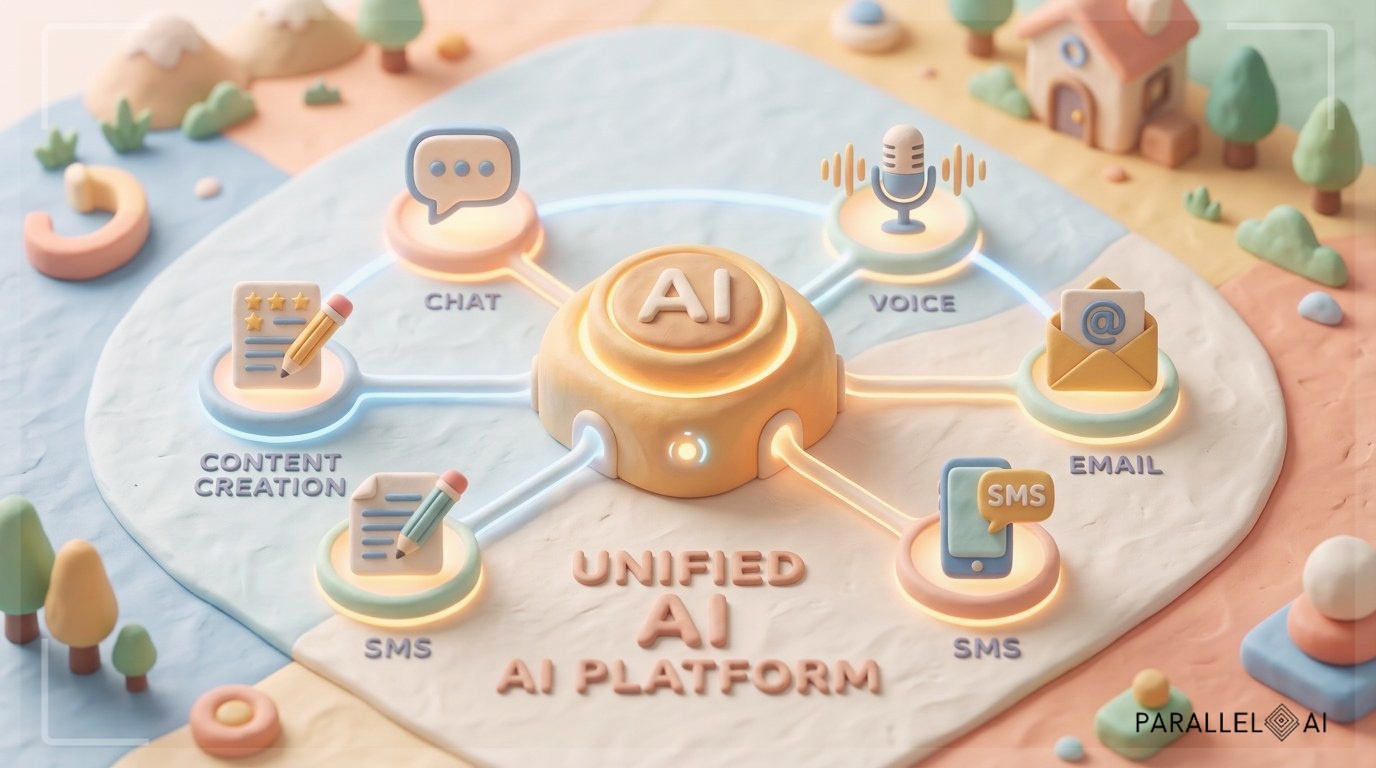
The answer isn’t more tools. It’s a single AI platform that can handle chat, voice, email, SMS, and even content creation, all trained on your brand, your products, and your customer data. This is the promise of AI for e-commerce done right, and it’s exactly what Parallel AI delivers.
The Fragmented Reality of E-Commerce Customer Engagement
Walk through the typical e-commerce tech stack and you’ll find a dizzying array of point solutions:
– Live chat widget for website visitors (often with a separate mobile app for agents)
– Help desk for email tickets and support workflows
– Voice solution (maybe a VoIP provider or call center software) for phone orders and inquiries
– SMS marketing tool for promotional blasts and transactional updates
– Social media management platform to handle DMs and comments
– Content creation tools for product descriptions, blog posts, and ad copy
Each tool has its own login, its own data store, and its own learning curve. The result is disjointed customer interactions. A customer who asks a question via chat, then follows up by phone, often has to repeat their entire story. The marketing team sends an SMS promotion that contradicts the email offer sent the day before. And your support team spends hours switching between tabs, copying and pasting information.
This isn’t just an inconvenience. For growth-stage e-commerce brands, it’s a competitive disadvantage. You’re paying for 5–8 subscriptions, each with per-seat pricing, and you’re still not delivering a smooth experience. Worse, the data trapped in each silo prevents you from building a complete picture of your customer journey, making personalization nearly impossible.
How AI Agents Unify Customer Engagement
Parallel AI’s approach is to replace that fragmented toolset with a single, intelligent platform. The core building blocks are AI-powered agents that work across every channel your customers use:
Chat Agent on Your Website
An AI chat agent doesn’t just answer FAQs. It can browse your product catalog, check order status, and even recommend upsells based on browsing behavior. It’s available 24/7, speaks your brand’s tone, and hands off to a human agent when needed, with full conversation context.
Voice Agent for Order Support
Customers still pick up the phone when they have a complex issue or want to place an order by voice. Parallel AI’s voice agents can handle those calls: taking orders, answering questions about inventory, and providing order updates, all without a dedicated call center. The voice agent integrates with the same backend as the chat agent, so the customer’s entire history is available in real time.
SMS and Email for Personalized Marketing
Instead of generic blasts, AI agents can trigger SMS and email campaigns based on specific customer actions, like abandoned carts, post-purchase follow-ups, or re-engagement for lapsed buyers. The messaging is personalized using the customer’s purchase history and browsing data, all managed within one platform.
Unified Customer Context
Because all channels feed into a single data layer, you get a 360-degree view of every customer. The AI knows if someone just chatted on the website, called in, or clicked an SMS link, and it adjusts the conversation accordingly. No more ‘Can I have your order number again?’
Fueling Engagement with AI-Generated Content
Personalized engagement isn’t just about conversations. It’s also about the content that attracts and converts customers. Parallel AI’s Content Engine can generate product descriptions, blog posts, social media copy, and ad text, all optimized for your brand voice and SEO.
Imagine launching a new product line and needing 50 unique descriptions across multiple channels. Instead of hiring a copywriter or slogging through it manually, you feed the AI your product specifications, brand guidelines, and target keywords. In minutes, you get on-brand descriptions ready for your website, Amazon listings, and social posts. The same engine can produce blog articles that answer your customers’ most common questions, driving organic traffic and building authority.
This content capability also feeds directly into your engagement strategy. The AI can use the same product knowledge to power chat responses and SMS recommendations, so you get consistency across every touchpoint.
Use Case in Focus: Abandoned Cart Recovery via Personalized SMS + Voice
Cart abandonment rates hover around 70% for most e-commerce stores. Traditional recovery tactics, like a single email reminder, recover only a fraction of those lost sales. With Parallel AI, you can orchestrate a multi-channel, personalized recovery sequence:
- Immediate SMS: Within 30 minutes of abandonment, the AI sends a personalized SMS with the exact items left behind, using the customer’s name and a tailored incentive (e.g., a 10% discount code if they’re a first-time buyer).
- Voice Follow-up: If the SMS isn’t acted on within 2 hours, the AI voice agent can place a call. The agent identifies the customer, references the abandoned cart, and offers to help, whether answering a sizing question or completing the order over the phone.
- Email Backup: If the customer misses the call, an email is sent with the same offer and a link to revive the cart.
Because all three channels are powered by the same AI and share the same data, the messaging is consistent and never feels spammy. A leading apparel brand using this approach saw a 28% recovery rate on abandoned carts, compared to 8% with email alone, while keeping support headcount flat.
Integration with E-Commerce Platforms
Parallel AI plugs directly into the platforms you already use: Shopify, WooCommerce, BigCommerce, and many others. The integration is bidirectional, so the AI can pull product catalogs, inventory levels, and order histories, and it can push updates, create orders, and log interactions back to your e-commerce backend. That means your team doesn’t have to learn a new system; they continue working in the tools they know, while the AI operates behind the scenes.
For businesses with custom tech stacks, the 1,000+ native integrations and open APIs make it simple to connect Parallel AI to CRMs, payment processors, and analytics tools. Setup takes hours, not weeks.
Measuring the ROI of AI for E-Commerce
How do you know if AI-powered engagement is paying off? Track these metrics before and after implementation:
- CSAT (Customer Satisfaction Score): Look for a 15–20 point increase as response times drop and personalization improves.
- First Response Time: AI agents reduce this from hours to seconds, even during off-hours.
- Abandoned Cart Recovery Rate: Multiply the revenue from recovered carts by your average order value to see direct ROI.
- Support Ticket Volume: Deflecting routine queries to AI reduces the load on human agents, often by 30–50%.
- Revenue from Reactivation: Measure the lift from personalized SMS and email campaigns aimed at lapsed customers.
One mid-sized beauty brand consolidated four tools into Parallel AI and saw a 40% reduction in total software spend, a 22% increase in customer lifetime value from personalized follow-ups, and a 65% drop in average response time, all within the first quarter.
Case Example: Scaling Support Without Adding Headcount
Consider a home goods e-commerce store that grew from $3M to $12M in annual revenue over 18 months. Their 5-person support team was drowning in 300+ daily inquiries across chat, email, and phone. Hiring more staff wasn’t an option due to budget constraints.
After implementing Parallel AI, the brand deployed a chat agent on their website that handled 70% of routine questions instantly. The voice agent took over after-hours calls, and the SMS engine automated order confirmations and shipping updates. The content engine also generated SEO-optimized FAQ pages, reducing the need for repetitive support tickets.
Within three months, the team was handling the same volume with zero new hires. CSAT scores climbed from 76% to 93%, and the AI-generated upsell recommendations during chat added $48,000 in incremental monthly revenue. The brand now runs a lean, AI-augmented support operation that scales with their growth.
How to Use AI in E-Commerce for Customer Engagement: A Quick Guide
If you’re ready to start, here’s a practical path:
- Define your customer journey: Map out every touchpoint (website, email, SMS, voice) and identify where AI can add value.
- Choose a unified platform: Look for a solution that handles multiple channels and integrates with your e-commerce stack, not just a chatbot.
- Train your AI on your brand: Feed it your product catalog, FAQs, support scripts, and brand voice guidelines so it sounds like you.
- Start with high-volume, low-complexity tasks: Automate order status checks, return inquiries, and basic FAQs first.
- Layer in proactive engagement: Use the AI to trigger personalized SMS or email based on customer behavior (abandoned carts, restocks, back-in-stock alerts).
- Monitor and iterate: Track the metrics above and continuously refine the AI’s responses based on customer feedback and new data.
E-Commerce Use Cases vs. Parallel AI Features
| E-Commerce Use Case | Parallel AI Feature |
|---|---|
| 24/7 website chat support | AI Chat Agent with product catalog integration |
| Phone order handling and inquiries | AI Voice Agent with order management |
| Abandoned cart recovery | Multi-channel SMS, voice, and email sequences |
| Personalized promotional campaigns | AI-powered SMS and email marketing |
| Product description generation | Content Engine with brand voice customization |
| SEO blog and social content | Content Engine with keyword optimization |
| Post-purchase follow-ups | Automated SMS and email triggers |
| Customer feedback collection | AI chat and voice surveys |
Frequently Asked Questions
Can AI chatbots handle e-commerce sales?
Yes. AI chatbots can handle e-commerce sales by recommending products, answering pre-purchase questions, and even completing transactions directly in the chat window. When integrated with inventory and order systems, they can upsell, cross-sell, and guide customers through the checkout process, all while learning from each interaction to improve over time.
What is the best AI tool for e-commerce customer support?
The best AI tool is one that unifies chat, voice, email, and SMS into a single platform, rather than a standalone chatbot. Parallel AI is purpose-built for this, offering AI agents that work across all channels, deep integration with e-commerce platforms like Shopify and WooCommerce, and a content engine to reduce support ticket volume through self-service content.
How to automate SMS marketing for e-commerce?
Automate SMS marketing by using an AI platform that can trigger personalized messages based on customer behavior, like cart abandonment, purchase history, and browsing patterns. Parallel AI’s SMS marketing module lets you build sequences that send the right message at the right time, without manual list uploads or disjointed tools.
What AI tools can generate product descriptions?
Parallel AI’s Content Engine can generate on-brand product descriptions, ad copy, and social media content. It learns your brand voice from your existing materials and can produce dozens of unique, SEO-optimized descriptions in minutes, far faster than manual copywriting or generic AI writers.
How to use AI in e-commerce for customer engagement?
Use AI to unify your customer engagement channels (chat, voice, SMS, email) on a single platform, train the AI on your product data and brand voice, automate routine inquiries, and trigger personalized marketing campaigns based on customer behavior. This approach reduces tool sprawl, improves response times, and creates a consistent, personalized experience at every touchpoint.
Conclusion
Every unanswered question and abandoned cart is a missed opportunity. By unifying your engagement channels with AI, you can stop the leaks and start building a brand that feels personal at any scale. Parallel AI gives you the tools to do that, from chat and voice to SMS and content, all working together on one platform. Ready to see how it works for your store? Explore Parallel AI and start personalizing at scale today.
Related reading
- The Essential AI Resource Toolkit: 12 Free and Premium Tools Every Solo Consultant Needs in Their Stack
- AI Customer Support Platform: Unify Chat, Voice & Email Automation
- AI for Startups: Affordable Automation to Scale Revenue Without Headcount
- How Aviation Consultants Are Using AI to Scale Safety Compliance Services and Build Seven-Figure Independent Practices