
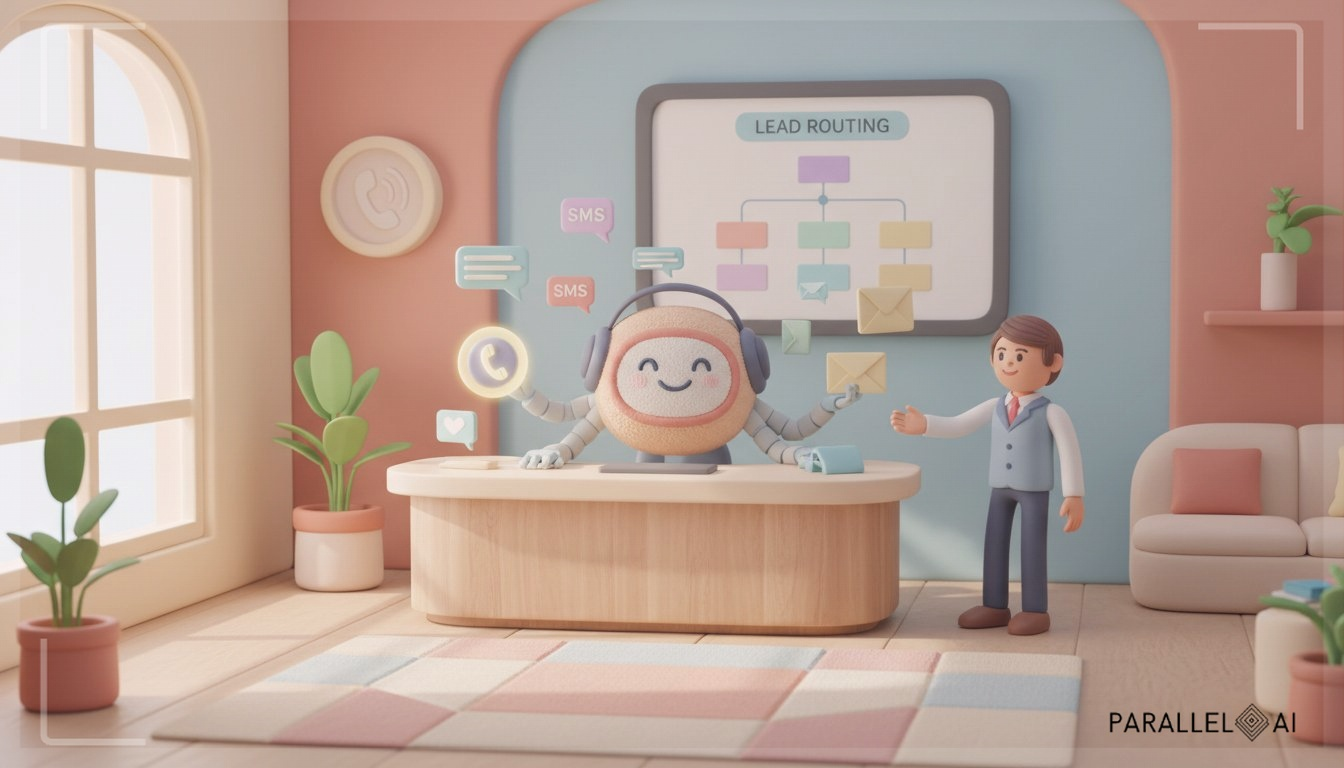
What is an AI answering service for businesses?
An AI answering service is an intelligent, multi-channel system that replaces traditional live-receptionist or voicemail-only setups. It doesn’t just pick up the phone. It qualifies inbound leads over voice calls, follows up via SMS and email, routes inquiries to the right human agent when needed, and even books appointments directly. Unlike a single-purpose AI phone agent for business, a full featured AI answering service operates across voice, chat, and SMS to capture, nurture, and convert opportunities 24/7. If you’re a growing team considering AI voice automation for customer support, this means fewer missed connections, consistent qualification logic, and instant handoff to a human only when empathy or complex judgment is needed.
Parallel AI’s platform gives you this as one unified solution, pulling together what would normally require separate software for AI call centers, chatbots, and email automation.
Capabilities checklist: what an AI answering service should do
When comparing providers, use this checklist to ensure you’re getting more than a basic phone bot. Bold labels mark critical capabilities that support lead intake, qualification, and follow-up at scale.
- Voice call answering with natural language understanding: Understands caller intent in real time, not just keyword matching, reducing friction from the very first interaction.
- Intelligent call routing and escalation: Directs calls to live agents, departments, or self-service flows based on context and business rules, with no blind transfers.
- SMS and email follow-up automation: Sends personalized text or email sequences immediately after a call, including appointment confirmations, links, or next steps.
- Lead qualification and intent detection: Asks targeted questions to score leads (BANT or custom frameworks) and identifies purchase intent, so only sales-ready conversations reach your team.
- Real-time appointment booking: Syncs with your calendar (Google, Outlook) to propose, confirm, and reschedule meetings without human involvement.
- Chat and web widget routing: Captures leads from your website and routes them through the same qualification logic, connecting web chat to voice if needed.
- Call recording, transcription, and analytics: Provides searchable transcripts, sentiment analysis, and QA scorecards so managers can continuously improve the bot’s performance.
- Custom fallback and handoff rules: Allows you to define exactly when the AI agent bows out (e.g., complaint, VIP caller, unrecognized intent) and how the live agent receives context.
- Multi-model AI engine: Parallel AI’s system uses multiple top-tier models (OpenAI, Anthropic, Gemini, and others) for strong, accurate, and safe responses.
- Privacy and compliance guardrails: Keeps data secure with AES-256 encryption, TLS protocols, and a strict policy that your conversations are never used for model training.
Agent flow: how calls move from intake to booking
Understanding the step-by-step journey helps you evaluate automation depth. Here’s the exact flow Parallel AI’s voice agents follow.
1. Intake and identification
When a call comes in, the AI answering service picks up instantly. It identifies the caller (new or returning), captures key details like name and reason for calling, and accesses your knowledge base to personalize the greeting. On the web side, the same bot handles live chat or SMS-based intake.
2. Intent detection and qualification
Using the opening context, the AI switches to a qualification mode. It detects whether this is a sales inquiry, a support request, or a general question. For leads, it starts asking qualification questions: budget, timeline, need, and decision-making role, just as your best SDR would. The AI voice agent adapts the sequence based on responses, skipping irrelevant questions.
3. Booking or routing
If the lead qualifies and the goal is a meeting, the AI offers available time slots from your connected calendar and confirms the appointment. For support inquiries, it either resolves the issue using your help articles or routes the case to a human agent with a full summary. If a caller declines to book, the AI captures the objection and notes it in your CRM.
4. Multi-channel follow-up
Immediately after the interaction, the system triggers SMS and/or email follow-ups: confirming the appointment, sending a case number, or sharing a resource. If the call was missed, the AI can also automatically text the caller a link to reschedule or continue the conversation asynchronously.
Three use-case bundles that go beyond basic answering
Thinking of the AI answering service as just a call-pickup tool misses half the value. Here’s how Parallel AI supports three common commercial scenarios.
Inbound lead intake and qualification
The classic pain point: calls go to voicemail during peak hours, and hot leads cool off. Our AI voice agent answers every call, qualifies intent, and either books a meeting or forwards a scored lead directly to sales, complete with a transcript. SMS nudges reduce no-shows, and missed-call texts bring leads back into the pipeline without extra headcount.
Customer support deflection
Tier-1 questions (password resets, order status, hours) shouldn’t tie up human agents. The AI answering service resolves these instantly via voice or chat while escalating complex issues to your helpdesk. This aligns with AI call center software best practices: deflection rates of 40-60% are common, cutting live-agent volume without sacrificing CSAT.
Appointment reminders and rescheduling
SMS and email sequences powered by the AI agent automatically remind leads and customers of upcoming appointments. If someone replies “reschedule,” the bot handles the interaction: checking calendars, proposing new times, and updating records, all without human intervention. This reduces no-shows by as much as 30% in service-based industries.
How qualification works under the hood
A true AI answering service treats qualification as a logic flow, not a script. Parallel AI’s system combines intent detection (trained on real-world sales conversations) with adaptive question sequences. When a caller says “I’m looking for pricing for a team of 20,” the voice agent infers commercial interest and asks about budget and timeline. If the caller seems hesitant, it softens into education mode, sharing a resource and offering a follow-up.
Key mechanics include:
– Custom qualification frameworks: Define your own BANT, CHAMP, or MEDDIC-inspired questions.
– Real-time lead scoring: Assign a score based on responses; route hot leads directly to a live agent or Slack notification.
– Context preservation: Every answer is saved, so when a human takes over, they don’t ask the same questions twice.
Handoff and quality assurance: knowing when to escalate
AI that never escalates creates risk. An effective AI answering service knows its limits and passes control smoothly.
When the AI agent hands off to a human
Parallel AI monitors for triggers you define: high-value VIP callers, cancellation requests, expressed frustration, or any intent the model isn’t confident about. In those moments, the system instantly transfers the call to the right team member, or drops a notification in your CRM if no one is available, with a promise to get back to them.
QA and fallback rules
Every call is recorded and transcribed. Managers can review logs, listen to call recordings, and tune the AI’s behavior using a simple QA scorecard. Fallback rules ensure the AI never invents an answer; if it can’t find a verified response in your knowledge base, it admits it and offers a human callback instead of guessing.
Integrations: connecting the AI answering service to your stack
A standalone phone bot creates silos. Parallel AI’s AI answering service is designed to plug into the tools you already use, through both native and API connections.
- CRM: Log calls, transcripts, lead scores, and booking status in Salesforce, HubSpot, Pipedrive, or any CRM with an open API.
- Helpdesk: Create tickets automatically in Zendesk, Intercom, or Freshdesk when a support request needs human attention.
- Calendar: Two-way sync with Google Calendar and Outlook/Office 365 for real-time availability checking and booking.
- Custom APIs and webhooks: Extend the AI’s capabilities to internal systems, e-signature tools, or payment processors.
- Knowledge base: Ingest Confluence, Notion, or Google Drive documents so the AI stays tightly aligned with your latest policies and product info.
Deployment timeline and success metrics
From kickoff to taking calls, a typical Parallel AI implementation follows a clear path:
- Week 1: Knowledge base ingestion, voice persona setup, qualification flows configured.
- Week 2: Integration mapping (CRM, calendar) and internal testing with sample calls.
- Week 3: Soft launch with a subset of calls; QA review and tuning.
- Week 4: Full rollout with active monitoring and weekly optimization sprints.
Once live, track these metrics to gauge success:
– Service Level Agreement (SLA): The percentage of calls answered within X seconds; target 95%+.
– Missed-call rate: Ideally under 2%; aim for zero missed sales calls during business hours.
– Booked rate: The share of qualified leads that convert to a scheduled appointment; often improves by 20-30% with instant booking.
– Resolution time: Average time from initial contact to resolution or handoff; should drop sharply as tier-1 issues are handled by AI.
– Handoff rate: Percentage of conversations escalated to humans; benchmarks range from 20-40%, depending on complexity.
Frequently Asked Questions
What is an AI answering service for businesses?
An AI answering service is a cloud-based system that uses conversational AI and multi-channel automation to handle calls, SMS, emails, and chat. It qualifies leads, books appointments, and hands off to a human only when necessary. It replaces old-school answering services with always-on, scalable intelligence that plugs directly into your CRM and calendar.
Can an AI answering service qualify leads and book appointments?
Absolutely. By asking either preset or adaptive qualification questions, the AI voice agent spots sales-ready leads and can propose and confirm meetings right then, using your calendar. This works over voice, chat, or SMS, so prospects book instantly without waiting for a person.
How do AI answering services handle missed calls and follow-up (SMS/email)?
When a call is missed (e.g., after hours), the AI can automatically send an SMS or email to the caller with options to reschedule, continue the conversation via text, or request a callback. If the AI was already in a conversation and the line drops, it can re-engage via the same channel to complete the interaction.
When should the AI agent hand off to a human?
Handoff triggers include high emotional sentiment, cancellation intent, VIP customer status, compliance-sensitive topics, or any query the AI is not confident it can answer correctly. Fallback rules ensure the AI never impersonates a human; it announces the transfer and gives the agent a full context summary.
What metrics show it’s working (SLA, booking rate, resolution time)?
Key indicators include service-level adherence (e.g., 95% of calls answered within 10 seconds), booked rate (percentage of qualified leads that schedule a meeting), resolution time (how quickly inquiries are closed or escalated), and deflection rate (percentage of tier-1 issues resolved without human intervention). These metrics track directly with ROI.
What integrations are typically required?
Essential integrations for a full-featured AI answering service include a CRM (for logging and lead management), a calendar system (for scheduling), and a helpdesk platform (for ticket creation). Additional integrations via API allow connection to internal tools like invoicing, e-signature, or custom databases.
How do you prevent incorrect or unsafe answers?
Parallel AI’s system blends multiple language models for cross-checking, limits answers to your approved knowledge base, and uses human-in-the-loop QA with recorded transcripts. If the confidence score dips below a set threshold, it escalates or gives a safe fallback response instead of guessing.
See the AI answering service in action
Ready to move from missed calls to qualified, booked appointments without adding headcount? Parallel AI’s all-in-one AI automation platform brings together voice, SMS, email, and chat in a single, secure answering service that qualifies leads, books meetings, and hands off only when it adds value.
Request a personalized demo and blueprint. Our team will map your current intake process to an AI-driven flow, showing you exactly how it fits your tools and your targets.