
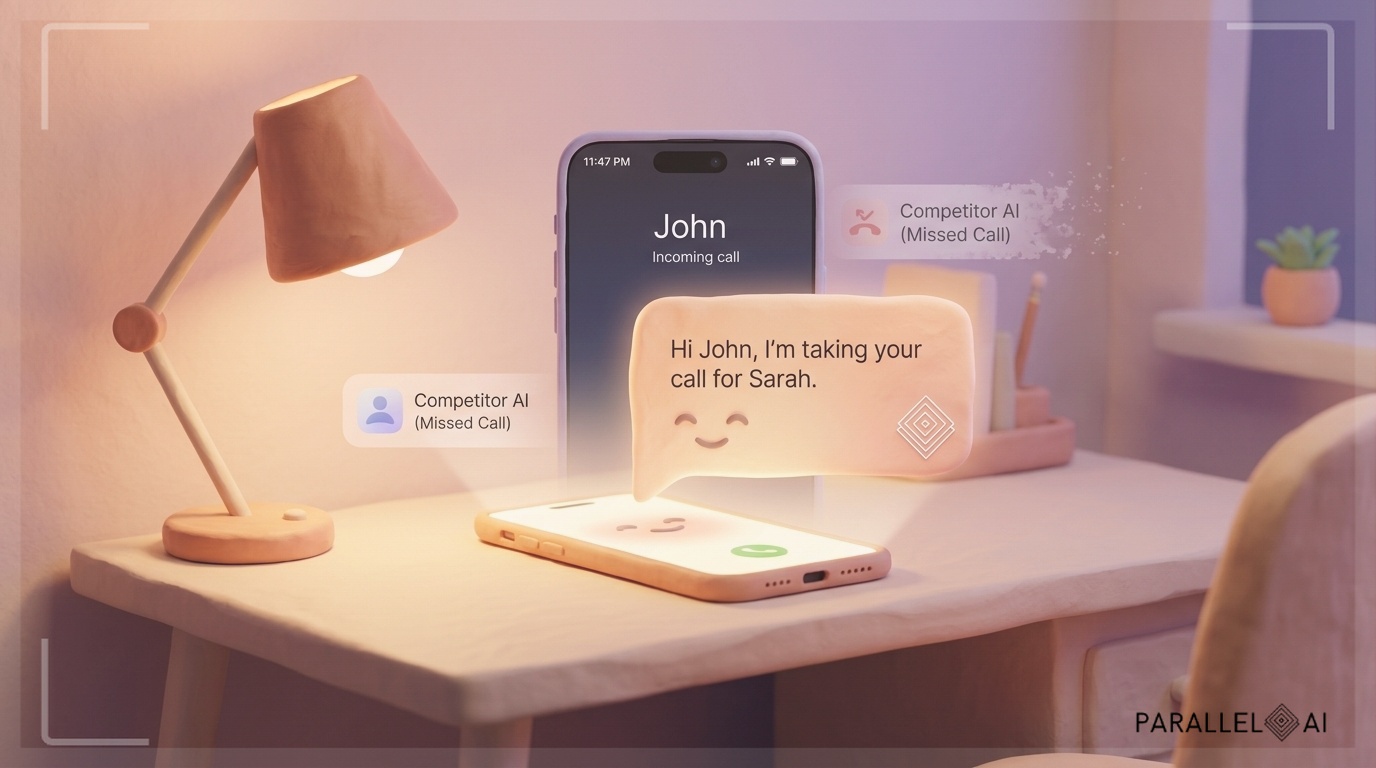
Picture this: a potential client calls your agency at 11:47 PM on a Tuesday. They have a question, a budget, and a deadline. Your phone rings into voicemail. By morning, they’ve booked a discovery call with your competitor.
This isn’t a hypothetical. According to the Customer Experience Technology Report, 68% of missed leads occur outside standard business hours. And yet, most businesses are still operating like answering machines are a reasonable fallback. The assumption that AI receptionists are glorified call routers — sophisticated IVR systems with better voices — is costing companies real revenue every single day.
Here’s the thing: that assumption is flat-out wrong. Today’s best AI receptionist platforms don’t just answer calls. They qualify leads, book meetings, sync with your CRM, follow up across multiple channels, and, for agencies, can be rebranded and resold as a proprietary service. The gap between what people think AI receptionists do and what they actually do has never been wider.
This post breaks down exactly where the myth falls apart, how modern AI voice and chat agents actually function, how Parallel AI compares to leading alternatives like Smith.ai, Dialpad, and traditional IVR platforms, and why agencies specifically should be paying close attention to the white-label opportunity hiding inside this technology.
The “Just a Call Router” Myth, Debunked
The outdated mental model of an AI receptionist looks like this: caller dials in, robotic voice presents a numbered menu, caller presses 2, gets transferred, waits on hold, repeats their question to a human. That’s IVR. That’s not what modern AI receptionists do.
Modern AI voice and chat agents are context-aware conversational systems. They don’t just route calls — they respond to them. They pull from live knowledge bases, adapt to the specific question being asked, and carry conversation history across channels. When a caller asks a nuanced question about pricing or availability, the agent doesn’t read from a script. It reasons through the answer using your business’s actual data.
The 2024 Customer Experience Technology Report found that 73% of consumers expect immediate, 24/7 routing and resolution for service inquiries. Not messages, not callbacks, not hold music. Immediate resolution. That shift in expectation is what’s driven a 42% year-over-year increase in AI voice agent adoption. The market isn’t moving toward smarter call routers. It’s moving toward AI agents that can close the loop without human involvement.
What Modern AI Receptionists Actually Do
- Lead qualification in real time: Agents ask discovery questions, score responses, and flag high-intent callers for priority follow-up
- Appointment booking: Direct calendar integration means meetings get scheduled during the call, not after three email exchanges
- CRM sync: Every interaction is logged, tagged, and enriched without manual data entry
- Multi-channel continuity: A conversation started via voice can continue over SMS or chat without losing context
- Knowledge base grounding: Responses are anchored in your actual business data, including pricing, policies, and team availability, not generic model outputs
None of this is call routing. This is revenue automation.
Parallel AI vs. The Competition: A Direct Comparison
When evaluating AI receptionist platforms, the comparison quickly reveals that most tools were built to solve one problem well. Everything else becomes an integration project, a workaround, or an additional subscription.
Parallel AI vs. Smith.ai
Smith.ai is a well-regarded virtual receptionist service that combines human agents with AI-assisted call handling. It excels at warm, personalized call experiences and is a legitimate option for businesses that want a human fallback. That said, Smith.ai operates as a standalone call-handling service. It doesn’t connect to a broader automation ecosystem, doesn’t offer white-label reselling, and its pricing scales on a per-call or per-minute model that gets hard to predict at volume.
Parallel AI’s AI Voice and Chat Agents handle the same inbound qualification and appointment-booking functions, but within a unified platform that also manages outbound sequences, content generation, CRM enrichment, and lead list building. When a call ends in Parallel AI, the lead doesn’t sit in a separate call log. It flows directly into a multi-channel follow-up sequence. That downstream continuity is what separates a receptionist from a revenue system.
Parallel AI vs. Dialpad
Dialpad is a strong UCaaS (Unified Communications as a Service) platform with AI transcription, sentiment analysis, and call coaching built in. For sales teams making high-volume outbound calls, Dialpad adds real value. But it’s fundamentally a communications infrastructure tool, not an automation platform. It doesn’t build lead lists, write content, or run multi-channel outreach.
Businesses evaluating Dialpad for AI receptionist functionality are often solving for call intelligence, things like better transcripts and smarter coaching. Businesses evaluating Parallel AI are solving for revenue continuity, making sure every inbound touchpoint connects to the broader pipeline, automatically.
Parallel AI vs. Traditional IVR Systems
This comparison almost doesn’t need to be made, but it does because a significant portion of the market is still running legacy phone trees. Traditional IVR systems are static, menu-driven, and completely disconnected from modern CRM and automation infrastructure. They create friction, not resolution.
The move from IVR to a context-aware AI agent isn’t a gradual upgrade. It’s a category change. Callers who interact with Parallel AI’s voice agents don’t feel like they’re navigating a phone menu. They feel like they’re talking to someone who actually knows the business.
Comparison Matrix
| Capability | Parallel AI | Smith.ai | Dialpad | Legacy IVR |
|---|---|---|---|---|
| 24/7 AI voice handling | ✅ | ✅ (human+AI) | ✅ | ✅ |
| Lead qualification | ✅ | Partial | ❌ | ❌ |
| CRM native sync | ✅ | Via Zapier | ✅ | ❌ |
| Multi-channel follow-up | ✅ | ❌ | ❌ | ❌ |
| White-label reselling | ✅ | ❌ | ❌ | ❌ |
| Predictable flat pricing | ✅ | ❌ (per-call) | Partial | Varies |
| Knowledge base integration | ✅ | ❌ | ❌ | ❌ |
| Content generation | ✅ | ❌ | ❌ | ❌ |
The Tool Sprawl Problem AI Receptionists Expose
Here’s a scenario that’s more common than most operations leaders want to admit: a business has a separate tool for call handling, another for CRM, another for email sequences, another for SMS follow-up, and another for content creation. Each tool has its own login, its own billing cycle, and its own support queue.
Businesses managing five or more disconnected AI tools report losing an average of 18 hours per week to context switching and integration troubleshooting, according to the SaaS Operations Benchmark Study. That’s nearly half a full-time employee’s week, every week, just to keep the tools talking to each other.
An AI receptionist that lives in isolation from the rest of the revenue stack is just another node in that fragmentation problem. The lead gets captured on a call, the data gets exported to a spreadsheet, someone manually uploads it to the CRM, a sales rep eventually follows up three days later. That’s not automation. That’s automation theater.
Parallel AI consolidates the entire motion. Smart Lists build and refresh targeted prospect databases. Sequences run outreach across email, SMS, voice, and advertising. AI Voice and Chat Agents handle inbound at every hour. The Content Engine produces blog posts, social copy, and marketing collateral from the same knowledge base that grounds every agent conversation. Every function connects to every other function because they all live inside the same platform.
“Fragmented AI stacks are the new technical debt. Consolidation isn’t a cost play — it’s a velocity multiplier.” — CX Automation Research Group
The Real Cost of Per-Minute Pricing
One detail worth examining closely: most standalone AI voice platforms charge per minute or per call. At low volume, the math feels manageable. At scale, it becomes unpredictable and expensive.
Parallel AI runs on flat-tier subscription pricing, starting at $19/month for Pay As You Go, $99/month for the Entrepreneur plan, and $297/month for full Business plan access. No per-minute surprises. No usage overages mid-month. For agencies handling client call volume, predictable pricing isn’t a nice-to-have. It’s a margin protection strategy.
White-Label AI Receptionists: The Agency Revenue Opportunity
This is where the conversation shifts from tool selection to business model.
Agencies that have discovered white-label AI receptionists aren’t just using the technology — they’re reselling it. They take Parallel AI’s platform, brand it under their own name, configure the voice and chat agents for each client, and charge a monthly retainer for AI-powered receptionist and customer engagement services. The agency owns the client relationship. Parallel AI powers the infrastructure. The client never sees the underlying platform.
According to the Agency Growth & Automation Index, white-label AI service providers report 40–60% gross margin improvement compared to traditional agency retainers. And 81% of agencies now cite white-label AI as their fastest-growing revenue stream.
The economics make sense. Traditional agency services are labor-intensive and margin-compressed. White-label AI services are configured once and scale without adding headcount. A single operator can manage the AI receptionist setup for dozens of clients without the delivery overhead of a traditional managed service.
What White-Label AI Receptionists Look Like in Practice
- A marketing agency offers “AI Receptionist Pro” as a branded product to their local business clients
- A consulting firm deploys client-specific voice agents that answer with the client’s business name, policies, and team context
- A HighLevel/GoHighLevel agency bundles AI receptionist services into their existing SaaS offering
Parallel AI’s White Label solution supports full platform rebranding, custom domains, and feature configuration. The entire platform becomes the agency’s own product. Setup takes less than an hour.
Data Privacy Is Non-Negotiable
One concern that comes up consistently in enterprise and agency evaluations: what happens to client call data? Parallel AI operates under a strict no-training-on-customer-data policy. All interactions are protected with AES-256 encryption and TLS protocols. The platform is GDPR and CCPA compliant, with on-premise deployment options available for enterprise clients that need data sovereignty.
For agencies managing client data, this isn’t just a compliance checkbox. It’s the foundation of client trust.
From Receptionist to Revenue Engine: What the Full Stack Looks Like
The most important reframe when evaluating AI receptionists is this: the receptionist isn’t the product. The receptionist is the front door.
What happens after someone walks through that door determines whether you have a customer service tool or a revenue system. With Parallel AI, the post-call journey is automated. A qualified lead captured by the voice agent flows into a follow-up sequence. That sequence adapts based on the lead’s responses. The Content Engine produces personalized outreach. The CRM updates in real time. The sales team gets a priority alert.
No manual handoffs. No context lost between systems. No leads falling through the gaps because someone forgot to follow up.
This is what “AI receptionist” means at full capability, and it’s a significant distance from the call-routing myth that still dominates the conversation.
The businesses winning with AI receptionists right now aren’t the ones with the best phone tree. They’re the ones who understood early that voice and chat agents are entry points into a fully automated revenue journey, and built their stack accordingly.
Parallel AI consolidates that entire journey into one platform, with white-label capabilities for agencies ready to turn their AI investments into recurring client revenue. Most customers are live in under 60 minutes.
If your current AI receptionist stops at the call log, it’s time to see what the full stack looks like. Start free or explore pricing at web.parallellabs.app/signup and find out how far past “just answering calls” your AI can actually go.