
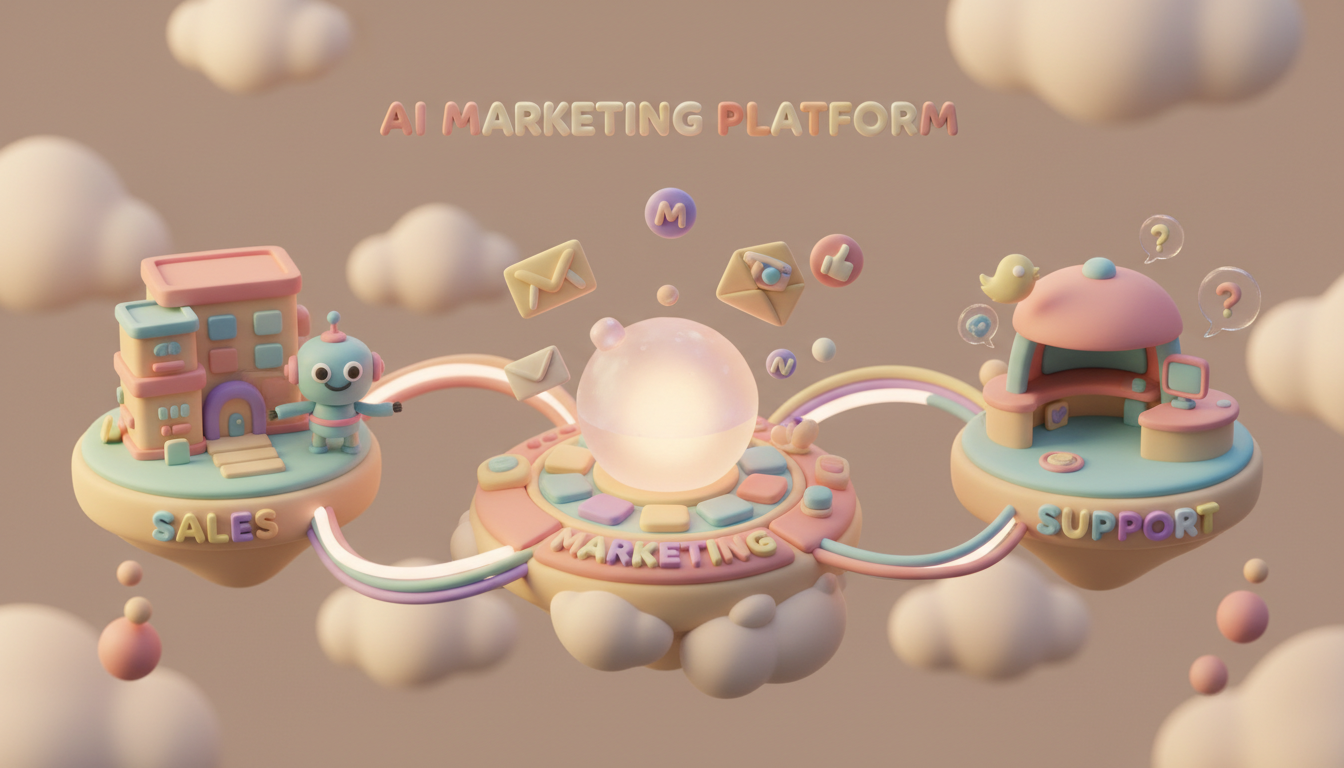
A unified AI marketing platform like Parallel AI consolidates sales, marketing, and customer support into one system, replacing costly bolt-on tools and automating revenue generation end-to-end. As teams expand their tech stacks, fragmentation becomes the silent killer of productivity. Sales uses one CRM, marketing runs campaigns in another suite, and support tickets live in a third. Data never fully connects, costs balloon, and customers slip through the cracks. This article explores how a modern AI marketing platform solves that by bringing everything under a single, intelligent roof.
The problem with fragmented sales and marketing stacks
Most businesses operate with a patchwork of tools: a CRM for sales, an email marketing platform, a social media scheduler, a separate chatbot, a help desk, and manual handoffs in between. This fragmentation leads to:
- Data silos that prevent a 360° view of the customer.
- Duplicate work (e.g., the same lead gets entered in three places).
- Inconsistent messaging because marketing and support aren’t aligned.
- Higher costs from paying for overlapping subscriptions and integrations.
- Slower response times across sales and support, damaging revenue and retention.
Even with an ai-powered CRM, many teams still bolt on third-party tools for content generation, lead scoring, and chatbot automation, creating a web of APIs that break and require constant maintenance. The result? A less efficient engine for revenue growth.
What is an AI marketing platform and what should it include?
An AI marketing platform is a unified software solution that uses artificial intelligence to automate and optimize marketing campaigns, sales outreach, and customer support, all from a single interface. Rather than just sending emails or storing contacts, it acts as a revenue intelligence ai layer that learns from customer behavior to drive actions across the entire lifecycle.
A complete AI marketing platform should include:
- Unified Sales and Marketing AI: AI-driven lead scoring, outreach automation, and content personalization that engage prospects without switching tools.
- Built-in CRM: A customer data platform that logs every interaction automatically.
- AI marketing automation: Campaign builders that adapt messaging based on engagement and intent signals.
- Conversational AI: Voice and chat agents that handle inbound queries, qualify leads, and book meetings 24/7.
- Content generation: AI that writes emails, social posts, ads, and support articles on-brand.
- Analytics and revenue intelligence: Dashboards that tie marketing spend to closed revenue, not just vanity metrics.
- White-label capability: For agencies, the ability to rebrand the entire stack as their own.
When these functions are natively integrated, the business gains a single source of truth and can act on insights instantly, without juggling five different tabs.
Top unified platforms in 2026: Salesforce Agentforce, HubSpot AI, Parallel AI
Three platforms currently lead the conversation around unified AI marketing platforms: Salesforce (with Agentforce), HubSpot (with its AI-powered CRM suite), and Parallel AI. Here’s how they compare:
| Feature | Salesforce Agentforce | HubSpot AI | Parallel AI |
|---|---|---|---|
| Core AI marketing automation | Yes, via Marketing Cloud + Einstein | Yes, Marketing Hub + Breeze AI | Yes, advanced AI agent orchestration |
| AI sales (SDR) agents | Available as add-on (Agentforce SDR) | Limited to sequences and Breeze AI | Full AI SDR employee included |
| AI voice & chat agents | Requires Service Cloud + bots | Basic chatbot builder | Native voice and chat AI agents |
| AI content generation | 3rd-party or custom | Built-in for emails/blogs/social | Built-in for all channels with brand voice cloning |
| White-label / agency rebranding | No | No | Yes, complete white-label platform |
| Unified dashboard | Siloed between Sales, Service, Marketing clouds | Reasonably unified, but still separate Hubs | Single dashboard for SDR, marketing, support, and analytics |
| Pricing model | Per user + add-ons, complex | Tiered Hubs with add-ons | Platform-based, often lower total cost |
| Deployment | Complex enterprise setup | Quick to moderate setup | Fast rollout with ready-to-deploy AI agents |
While Salesforce and HubSpot are powerful, they were originally built as point solutions that later expanded. Parallel AI, on the other hand, was designed from day one as a unified AI marketing platform where AI employees work alongside humans, not just as a layer on top of legacy tools. Its white-label feature is a standout for agencies that want to offer a proprietary, branded solution.
How Parallel AI’s AI agents cover SDR, content generation, voice/chat, and customer support from one dashboard
Parallel AI replaces the fragmented toolkit with a team of AI agents that handle each revenue-critical function:
- AI SDR (Sales Development Rep): Automates lead prospecting, email/LinkedIn outreach, and follow-ups. It learns from replies, qualifies leads, and books meetings, directly into the integrated calendar.
- AI Content Writer: Generates blog posts, ad copy, social media updates, and email sequences, all consistent with your brand style. It can even repurpose content across channels.
- Voice & Chat AI Agents: Handle inbound calls, website chats, and messaging apps. They answer FAQs, qualify leads, and escalate complex issues to human support seamlessly.
- Customer Support AI: Resolves tickets by suggesting knowledge base articles or automatically drafting responses. It logs interactions in the unified CRM so sales and marketing have full context.
All these agents operate from a single dashboard, sharing data in real time. If a support call reveals an upsell opportunity, the AI SDR gets that signal immediately. Marketing campaigns adapt based on the types of questions the voice agents are receiving. This closed-loop system is true unified sales and marketing ai in action.
Case study: A marketing agency scaling with white-label Parallel AI
Consider a mid-size digital agency serving 20+ clients. Before Parallel AI, they managed separate tools for email (Mailchimp), CRM (Pipedrive), social scheduling (Hootsuite), and a basic chatbot (ManyChat). Each client required onboarding across five platforms, and reporting was a manual nightmare.
After adopting Parallel AI as their ai marketing platform:
- They rebranded the entire system as their own white-label offering, strengthening client relationships and charging a premium.
- AI SDR agents ran multi-channel outreach for client lead gen, saving 15 hours per client per week.
- The AI content engine produced 3x more on-brand social posts and newsletters.
- Support response times dropped 60% because the AI agent handled tier-1 queries.
- Monthly tool costs fell by 40%, and they gained a new recurring revenue stream by reselling the platform to clients.
This shift turned the agency from a service vendor into a scalable AI-enablement partner.
Cost comparison: standalone tools vs. unified platform
Let’s crunch the numbers for a typical 10-person team that needs email marketing, CRM, chatbot, social scheduling, and a help desk.
| Tool | Standalone Monthly Cost (10 users) |
|---|---|
| Email marketing (e.g., Mailchimp Premium) | $350 |
| CRM (e.g., Salesforce Essentials or HubSpot Starter) | $500 |
| Chatbot (e.g., Intercom) | $740 (for 10 seats) |
| Social media management (e.g., Hootsuite Team) | $249 |
| Help desk (e.g., Zendesk Team) | $550 |
| Total | $2,389/month |
Many unified AI marketing platforms cost significantly less because they bundle these capabilities. Parallel AI’s platform, for instance, starts at a fraction of that sum and includes AI agents that replace costly human hours for SDR and support tasks. Beyond direct savings, the hidden ROI comes from reduced integration maintenance, faster response times, and eliminating data sync errors, easily saving an additional $1,000+ in lost productivity.
Implementation checklist for migrating to an all-in-one AI platform
Transitioning to a unified ai marketing platform needn’t be disruptive. Follow this checklist:
- Audit your current stack: List every tool, its cost, and the specific jobs it does. Identify overlaps and gaps.
- Define must-have capabilities: Map the checklist from the “What should it include?” section against your needs.
- Prioritize native integrations: Ensure the platform can replace your core tools (email, CRM, chat, support) without relying on fragile APIs.
- Check white-label options: If you’re an agency, confirm full branding control and multi-client management.
- Pilot with one team: Roll out the AI SDR and support agents to a single department first; gather feedback.
- Train the AI agents on your brand: Feed them your tone, product info, and common tickets to improve accuracy from day one.
- Consolidate tools gradually: Turn off old tools as the new platform proves coverage, don’t rip everything out at once.
- Monitor ROI and adjust: Track time saved, conversion rates, and support resolution times; fine-tune AI prompts.
- Scale with AI employees: Once comfortable, expand the AI team to handle more workflows, outbound sales, content generation, and proactive support.
- Iterate monthly: Use the platform’s revenue intelligence ai dashboards to understand what’s working and double down.
FAQs
What is the best AI marketing platform that also handles sales and support?
The best platform depends on your needs, but a truly unified solution like Parallel AI stands out because it integrates sales (AI SDR), marketing automation, and customer support into one native system, without relying on separate clouds or third-party apps. Salesforce Agentforce and HubSpot AI also offer broad capabilities, but often at higher cost and with less white-label flexibility.
How does a unified AI platform compare to using separate tools for each function?
A unified platform eliminates data silos, reduces total software costs, and enables real-time collaboration between sales, marketing, and support. Separate tools require manual data syncing, multiple logins, and often duplicate effort. With a unified system, AI agents can share context instantly, for example, a support interaction can trigger a marketing nurture campaign without any manual setup.
Can I rebrand a white-label AI marketing platform for my agency?
Yes. Parallel AI offers complete white-label capabilities, allowing agencies to replace the vendor’s branding with their own logo, domain, email notifications, and client-facing dashboards. This lets you offer a proprietary AI-powered marketing and sales platform to your clients, strengthening your brand and creating a new recurring revenue stream.
What integrations does a unified AI platform need to replace existing tools?
Ideally, the platform should natively cover email marketing, CRM, live chat, voice calls, social media scheduling (or publishing), and help desk ticketing, so you don’t need third-party integrations. If you must keep certain legacy tools, look for open APIs and native connectors, but prioritize platforms that can replace rather than just connect to your old stack to fully remove friction.
How much can a business save by consolidating onto one AI platform?
A business can save 30 to 50% on software costs compared to subscribing to separate point solutions. Beyond license savings, consolidation reduces integration maintenance, data errors, and manual work, often translating to thousands of dollars per month in recovered productivity. Many teams also see faster sales cycles and higher customer retention when all functions run on one ai marketing platform.