
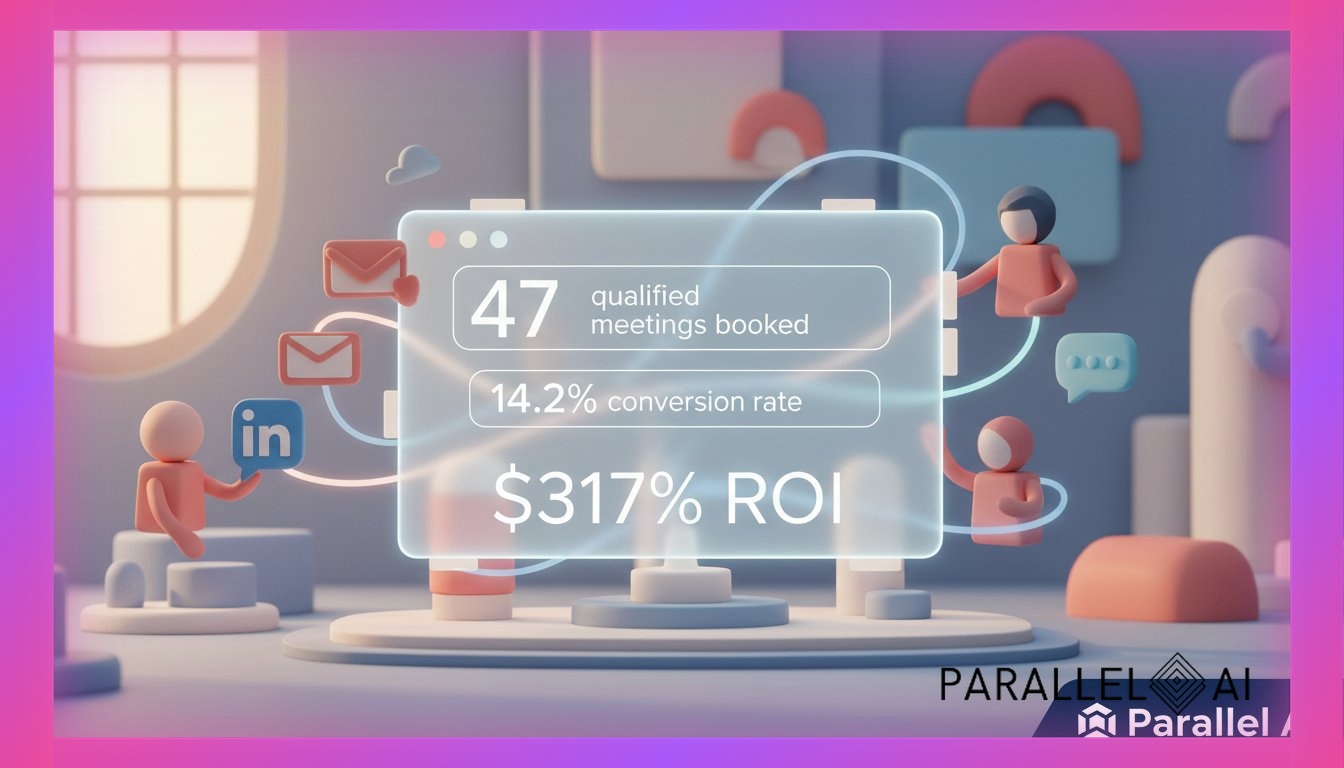
Imagine waking up to 47 qualified meetings booked while you slept. Not from a team of expensive sales reps burning through your budget, but from AI SDR agents working across email, LinkedIn, and chat. They respond to prospects in minutes instead of hours, personalize outreach at scale, and convert leads at 14.2% instead of the industry-standard 3%.
This isn’t speculation. It’s happening right now for solopreneurs and micro-agencies who’ve cracked the code on deploying AI SDR agents at scale. The gap between businesses using AI sales development and those still relying on traditional methods has never been wider. It’s measured in hundreds of thousands of dollars.
Here’s what changed. Building AI SDR agents is no longer reserved for enterprise companies with dedicated engineering teams. The barrier to entry collapsed. A 317% average annual ROI with a 5.2-month payback period is now achievable, according to 2026 implementation data.
The AI SDR Revolution: What the 2026 Data Actually Shows
The transformation of sales development isn’t coming. It already arrived. Over 70% of sales teams have deployed AI in their SDR workflows, and the market for AI-powered sales tools hit $3.1 billion in 2026, growing at a 42% CAGR.
But raw adoption numbers don’t tell the full story. The performance gap does.
AI-Enabled Teams vs. Traditional SDR Approaches:
– 25% increase in productivity (more qualified conversations per day)
– 30% shorter sales cycles (from first contact to closed deal)
– 20% higher average deal sizes (better qualification and targeting)
– 14.2% conversion rate on AI-led outbound messages vs. 3% for human-only outreach
The median time to first positive response with AI SDRs is just 22.7 days, a critical metric when you’re building pipeline momentum.
According to Salesforce’s 2026 State of Sales report, AI agents have reduced research and content creation time by up to 36%, with high performers more likely to deploy AI agents specifically for prospecting. The shift isn’t from productivity metrics to busy work. It’s from activity tracking to demonstrable financial impact: top-line revenue growth and bottom-line profitability.
The Cost Reality: $110K Salaries vs. $6K-$60K AI Agents
Let’s address the elephant in the room: economics.
A human SDR costs between $65,000 and $110,000 annually when you factor in salary, benefits, training, tools, and management overhead. An AI SDR agent typically runs $6,000 to $60,000 per year depending on platform sophistication and usage volume.
Annual savings range: $5,000 to $104,000 per SDR position.
But here’s where it gets interesting for solopreneurs. You’re not just saving money on headcount you can’t afford to hire anyway. You’re gaining access to capabilities that were previously impossible. Running 24/7 outreach across multiple channels, responding to inbound inquiries within minutes regardless of timezone, and scaling from 50 to 500 personalized touches per day without linear cost increases.
The one-time setup investment ($10,000-$25,000 for traditional enterprise implementations) becomes the barrier, unless you’re using platforms designed for rapid deployment.
Building AI SDR Agents: The Multi-Agent Architecture Approach
Here’s where most businesses stumble. They treat AI SDR deployment like hiring a single super-employee instead of building a specialized team.
The winning approach in 2026 is multi-agent architecture where specialized AI agents handle specific tasks.
The Core Agent Team Structure:
- Research Agent: Scrapes LinkedIn profiles, company websites, and news sources to build enriched prospect profiles with talking points
- Outreach Agent: Crafts personalized first-touch messages across email, LinkedIn, and other channels based on research findings
- Follow-Up Agent: Manages sequences, timing, and channel-switching based on engagement signals
- Qualification Agent: Handles inbound responses, asks qualifying questions, and determines meeting readiness
- Scheduling Agent: Coordinates calendars and books meetings when prospects are qualified
This isn’t theoretical. According to implementation guides from leading platforms, this multi-agent approach delivers superior results because each agent is optimized for its specific function rather than trying to handle the entire sales development process in one monolithic system.
Why Traditional AI SDR Platforms Fall Short for Solopreneurs
Most AI SDR platforms are built for enterprise teams with three critical assumptions that break down for solopreneurs:
- They assume dedicated technical resources for integration and customization
- They’re priced per seat with minimums that don’t make sense for solo operators
- They’re single-channel focused (email OR LinkedIn, not orchestrated multi-channel)
The result? Solopreneurs end up with a fragmented stack:
– One tool for email automation ($50-150/month)
– Another for LinkedIn outreach ($80-200/month)
– A third for conversation intelligence ($99-300/month)
– CRM subscription ($25-100/month)
– Data enrichment service ($99-500/month)
Total monthly cost: $353-$1,250 across 5+ platforms that don’t talk to each other.
And you’re still the integration engineer, the workflow designer, and the person manually moving data between systems.
The Parallel AI Approach: Unified Multi-Agent SDR Deployment
This is where Parallel AI fundamentally changes the economics and feasibility of AI SDR deployment for solopreneurs.
Instead of stitching together fragmented tools, Parallel AI provides a unified platform for building, deploying, and scaling multi-agent SDR systems with three core advantages:
1. Integrated Knowledge Base as Your SDR’s Brain
The difference between generic outreach and conversion-driving personalization is context. Parallel AI’s knowledge base integration connects directly to your Google Drive, Notion, and Confluence, giving your AI SDR agents access to:
- Your ideal customer profile documentation
- Case studies and success stories
- Product positioning and messaging frameworks
- Competitive differentiation points
- Industry-specific talking points
Your research agent doesn’t start from zero. It starts with your accumulated business intelligence, then enriches it with prospect-specific research.
2. Multi-Channel Orchestration Without Tool Fragmentation
Parallel AI’s omni-channel architecture enables your AI SDR agents to coordinate across email, LinkedIn, SMS, chat, and voice. This creates unified, context-aware conversations instead of disconnected touchpoints.
Here’s what that looks like in practice:
Day 1: Research agent builds prospect profile, outreach agent sends personalized LinkedIn connection request
Day 3: Connection accepted, follow-up agent sends message referencing specific company news
Day 5: No response, follow-up agent switches to email with different angle
Day 7: Prospect responds via email, qualification agent continues conversation in that channel
Day 10: Qualified, scheduling agent offers meeting times
All from one platform. All tracked in one conversation history. No data lost between channel switches.
3. White-Label Deployment for Agency Revenue
Here’s the multiplier effect most solopreneurs miss. Once you’ve built effective AI SDR agents for your own business, you can deploy white-labeled versions for clients.
Parallel AI’s white-label capabilities let you:
– Rebrand the platform with client logos and colors
– Deploy client-specific AI SDR agents using your proven templates
– Charge $500-2,000/month for “AI-powered sales development” services
– Scale to 10-20 clients without proportionally increasing your time investment
New revenue model: Your AI SDR system becomes both your internal sales engine AND a productized service offering.
One solopreneur running a marketing consultancy deployed this exact model. They built AI SDR agents for their own lead generation, achieved 180+ qualified conversations monthly, then packaged it as a $1,200/month service for 8 clients. That added $9,600 in monthly recurring revenue.
The Implementation Framework: 90 Days to 317% ROI
Based on successful 2026 deployments, here’s the proven framework for building and scaling AI SDR agents:
Phase 1: Foundation (Days 1-14)
Week 1: Knowledge Base Setup
– Upload ideal customer profiles to Parallel AI knowledge base
– Connect Google Drive/Notion with case studies and positioning docs
– Document your current sales conversation patterns and objection handling
– Define qualification criteria (budget, authority, need, timeline)
Week 2: Agent Configuration
– Build research agent with LinkedIn and company website scraping protocols
– Configure outreach agent with messaging templates and personalization variables
– Set up follow-up agent with multi-channel sequencing logic
– Create qualification agent with conversation flows and BANT questions
Phase 2: Testing and Optimization (Days 15-45)
Week 3-4: Controlled Testing
– Deploy to 50-100 prospects in your target segment
– Monitor response rates, conversation quality, and qualification accuracy
– Identify messaging patterns that generate engagement
– Refine personalization variables based on what prospects respond to
Week 5-6: Channel Optimization
– Test email vs. LinkedIn first-touch performance
– Optimize timing (day of week, time of day) for outreach
– Experiment with follow-up cadence and channel-switching triggers
– A/B test subject lines, opening hooks, and CTAs
Phase 3: Scaling (Days 46-90)
Week 7-10: Volume Expansion
– Scale from 100 to 500+ prospects per month
– Segment prospects by industry/role for tailored messaging
– Deploy multiple agent teams for different customer segments
– Implement automated reporting on key metrics
Week 11-13: Revenue Validation
– Track meetings booked, opportunities created, and revenue closed
– Calculate ROI: (revenue generated – platform cost) / platform cost
– Document success patterns for replication
– Build white-label deployment template for client offerings
Expected 90-Day Results Based on 2026 Benchmarks:
– 180-250 qualified conversations
– 40-60 meetings booked
– 8-15 opportunities created
– 2-5 deals closed (depending on sales cycle length)
– 14.2% average conversion rate on outbound sequences
Avoiding the 60% Failure Rate: Common Pitfalls
Not every AI SDR implementation succeeds. In fact, approximately 60% fail to deliver meaningful results. Here’s why and how to avoid becoming a statistic:
Failure Point 1: Generic Messaging at Scale
The Mistake: Deploying AI SDR agents with template-based messages that don’t actually personalize beyond {{FirstName}} and {{CompanyName}}.
The Fix: Use Parallel AI’s knowledge base integration to give agents context about:
– Recent company news and funding announcements
– Specific pain points by industry and role
– Relevant case studies and proof points
– Competitive landscape awareness
Personalization isn’t about inserting variables. It’s about demonstrating relevant understanding.
Failure Point 2: Single-Channel Dependence
The Mistake: Running AI SDR outreach exclusively through email, where inbox filters and declining open rates kill performance.
The Fix: Orchestrate multi-channel sequences through Parallel AI:
– LinkedIn connection requests for relationship building
– Email for detailed information sharing
– SMS for urgent or time-sensitive follow-ups
– Chat for website visitors showing intent signals
Prospects who don’t respond on one channel often engage on another.
Failure Point 3: No Human Handoff Strategy
The Mistake: Expecting AI SDR agents to close deals without human involvement.
The Fix: Design clear qualification criteria and handoff protocols. AI SDRs excel at:
– Initial research and prospecting
– First-touch outreach and engagement
– Qualification and needs assessment
– Meeting scheduling
Humans excel at:
– Complex needs discovery
– Solution customization
– Negotiation and objection handling
– Relationship deepening
The winning formula is AI handles the 0-to-meeting journey, humans take over from meeting-to-close.
Failure Point 4: Insufficient Data Quality
The Mistake: Feeding AI SDR agents poor prospect data such as outdated emails, incorrect job titles, wrong company information.
The Fix: Integrate Parallel AI with quality data sources and implement validation protocols:
– Email verification before outreach
– LinkedIn profile matching for accuracy
– Company website verification for current positioning
– Periodic list cleaning to remove bounces and unsubscribes
Your AI SDR is only as good as the data it works with.
Multi-Channel Orchestration: The 70% Conversion Lift
According to 2026 data from Landbase, AI SDR agents that orchestrate multi-channel outreach deliver 70% higher conversions than single-channel approaches. Here’s the tactical framework:
The Multi-Channel Sequence Architecture
Touch 1 (Day 0): LinkedIn Connection Request
– Research agent identifies decision-makers
– Outreach agent sends personalized connection request with specific relevance statement
– No pitch, pure relationship building
Touch 2 (Day 3): LinkedIn Message (If Connected)
– Follow-up agent sends message acknowledging shared interests/connections
– Asks one low-commitment question about their current priorities
– Positions you as peer, not vendor
Touch 3 (Day 5): Email Introduction
– Outreach agent sends email with different angle than LinkedIn
– References specific company initiative or challenge
– Includes relevant case study or resource
Touch 4 (Day 8): Email Follow-Up
– Follow-up agent checks in with value-add (article, insight, introduction)
– No “just checking in.” Always brings something new.
Touch 5 (Day 12): LinkedIn Engagement
– Agent comments on prospect’s recent post or company news
– Demonstrates genuine interest and domain expertise
Touch 6 (Day 15): Email with Clear CTA
– Direct ask for 15-minute conversation
– Three specific time slots offered
– One-click scheduling link
Touch 7+ (Days 20-60): Long-Term Nurture
– Monthly valuable content sharing
– Engagement on their posts
– Event invitations
– Keeps relationship warm for future timing
This isn’t spray-and-pray. It’s strategic, coordinated outreach across channels with Parallel AI managing timing, context, and engagement signals automatically.
Compliance and Ethics: The 2026 Standards
As AI SDR adoption grows, compliance and ethical considerations have become critical. Here’s the framework:
GDPR and CAN-SPAM Compliance
Parallel AI’s privacy-first architecture ensures:
– Data is never used for model training (your prospect data stays yours)
– Automatic unsubscribe handling across all channels
– Opt-out respect within 24 hours
– Clear identification in email footers
– Consent tracking for EU prospects
Transparency Standards
The ethical question: should you disclose that outreach is AI-generated?
2026 Best Practice: Transparency about AI assistance in early conversations, with immediate human handoff at qualification stage. Examples:
Email Signature: “This initial outreach was AI-assisted to ensure timely, personalized communication at scale. Looking forward to connecting personally.”
LinkedIn Message: “I use AI to help me identify and reach out to relevant professionals like you, but this conversation is genuinely about [specific value proposition].”
Most prospects care about relevance and value, not whether the first message was human-typed or AI-generated, as long as they’re not being deceived.
The White-Label Revenue Multiplier
Here’s where Parallel AI becomes a business model, not just a tool.
Once you’ve built effective AI SDR agents for your own pipeline, you can deploy white-labeled versions for clients and create a new revenue stream:
The Agency Play
Service Offering: “AI-Powered Sales Development as a Service”
Pricing Model: $1,200-2,000/month per client for:
– Custom AI SDR agent deployment
– 500-1,000 personalized outreach touches monthly
– Multi-channel orchestration (email + LinkedIn + chat)
– Monthly qualified meeting targets (8-15 meetings)
– Performance reporting and optimization
Your Cost: Parallel AI platform + your time for initial setup and monthly optimization
Margin: 60-75% after platform costs
Scalability: 10-20 clients manageable for one person with proper agent templates
Math: 15 clients × $1,500/month = $22,500 monthly recurring revenue
The SaaS Play
Offering: White-labeled Parallel AI platform for specific industries
Target: Agencies, consultants, or niche service providers who need AI SDR capabilities but don’t want to build from scratch
Pricing: $297-497/month for branded platform access with pre-built agent templates
Your Value-Add: Industry-specific templates, training, and support
This transforms Parallel AI from an expense to a revenue-generating asset.
Real-World Implementation: The $1M Pipeline in 90 Days
According to case study data from 2026, one implementation generated over $1 million in qualified pipeline within 90 days using AI SDR agents. Here’s the breakdown:
Business: B2B SaaS targeting mid-market companies
Setup:
– 4 specialized AI SDR agents (research, outreach, follow-up, qualification)
– Multi-channel sequences across email and LinkedIn
– Integration with existing CRM and calendar
– 2 weeks for setup and testing
Execution:
– 1,200 prospects targeted monthly
– 14.2% conversion to qualified conversation
– 170 qualified conversations in 90 days
– 52 meetings booked
– 18 opportunities created
– Average deal size: $58,000
– Win rate: 28%
Results:
– $1,044,000 in pipeline created
– $292,320 in closed revenue within 6 months
– 317% ROI on platform investment
– 5.2-month payback period
Key Success Factors:
1. Highly specific ideal customer profile (no generic targeting)
2. Deep personalization using company and role-specific research
3. Multi-channel orchestration with intelligent timing
4. Clear qualification criteria and immediate human handoff
5. Continuous improvement based on response data
The Decision Framework: When to Deploy AI SDR Agents
AI SDR agents aren’t right for every business or situation. Here’s the honest assessment:
You’re Ready for AI SDR Deployment If:
✅ You have a clearly defined ideal customer profile (industry, role, company size, pain points)
✅ Your sales process includes outbound prospecting (not purely inbound)
✅ You’re spending 10+ hours weekly on prospecting, outreach, or follow-up
✅ You have proven messaging that converts (AI will scale it, not fix fundamentally broken positioning)
✅ You’re comfortable with a 30-45 day testing period before expecting results
✅ You have capacity to handle the meetings AI SDRs will book (don’t deploy if you can’t service the pipeline)
You’re Not Ready If:
❌ You’re still figuring out product-market fit and messaging
❌ Your sales process is 100% relationship-driven with no outbound component
❌ You have fewer than 100 targetable prospects (not enough volume)
❌ You’re looking for a “set it and forget it” solution (AI SDRs require monitoring and optimization)
❌ You can’t articulate why a prospect should take a meeting with you
Be honest about where you are. AI SDR agents amplify what’s working. They don’t fix what’s broken.
Getting Started: Your First 30 Days
If you’re ready to deploy AI SDR agents using Parallel AI, here’s your first-month action plan:
Week 1: Foundation
Day 1-2: Define your ideal customer profile with specificity
– Industry and sub-segments
– Company size and growth stage
– Key decision-maker roles
– Common pain points and initiatives
– Disqualification criteria
Day 3-4: Document your current sales conversations
– What questions do prospects typically ask?
– What objections do you encounter?
– What proof points close deals?
– What differentiators matter most?
Day 5-7: Set up Parallel AI knowledge base
– Upload ICP documentation
– Connect Google Drive/Notion with case studies
– Add competitive positioning materials
– Include product documentation and messaging frameworks
Week 2: Agent Configuration
Day 8-10: Build your research agent
– Configure LinkedIn profile scraping
– Set up company news monitoring
– Define enrichment data points
– Test on 10 sample prospects
Day 11-12: Configure outreach agent
– Create message templates with personalization variables
– Define channel prioritization logic
– Set timing and frequency parameters
– Build A/B testing variants
Day 13-14: Set up follow-up and qualification agents
– Design multi-touch sequences
– Configure channel-switching rules
– Build qualification conversation flows
– Integrate calendar for scheduling
Week 3: Controlled Deployment
Day 15-18: Launch to 50-100 prospects
– Monitor every interaction closely
– Note what generates responses
– Identify conversation breakdown points
– Track qualification accuracy
Day 19-21: First optimization cycle
– Refine messaging based on response data
– Adjust timing and frequency
– Improve personalization depth
– Fix any technical integration issues
Week 4: Scale and Measure
Day 22-25: Expand to 200-300 prospects
– Apply learnings from initial deployment
– Segment by industry or role for tailored messaging
– Test different outreach channels
Day 26-30: Performance analysis and planning
– Calculate key metrics (response rate, meeting rate, cost per meeting)
– Identify patterns in successful conversions
– Plan next month’s scaling strategy
– Document processes for replication
Target Week 4 Metrics:
– 200-300 prospects engaged
– 8-12% response rate
– 6-10 meetings booked
– 2-4 qualified opportunities
The Competitive Advantage: Why This Matters Now
Here’s the uncomfortable truth. The businesses deploying AI SDR agents effectively in 2026 are pulling away from those who aren’t.
The gap isn’t incremental. It’s exponential.
Traditional SDR approach:
– 1 person can handle ~50-80 quality outreach touches per week
– 200-300 per month
– ~2,400 annually
– Linear scaling (more people = more cost)
AI SDR approach with Parallel AI:
– 1 person can orchestrate 500-1,000 quality touches per week
– 2,000-4,000 per month
– ~24,000-48,000 annually
– Exponential scaling (same person, 10-20x output)
That’s not a 10% advantage. That’s an order of magnitude difference in pipeline generation capacity.
And it’s happening right now. The businesses that will dominate their niches in 2027 are the ones deploying this sophisticated infrastructure in 2026.
Your Next Steps
You have three options:
Option 1: Continue with traditional outreach methods, accepting the time and scaling limitations that come with manual prospecting.
Option 2: Piece together fragmented AI tools such as ChatGPT for message writing, a LinkedIn automation tool, an email sequencer, a CRM. You’ll spend $300-1,000 monthly and countless hours integrating systems that don’t talk to each other.
Option 3: Deploy unified AI SDR agents through Parallel AI, consolidating your sales development infrastructure while accessing multi-agent capabilities that were previously enterprise-only.
The businesses generating 317% ROI and building $1M+ pipelines in 90 days aren’t smarter or more experienced. They just made a different infrastructure choice.
Parallel AI offers the integrated knowledge base, multi-channel orchestration, and white-label deployment capabilities you need to build AI SDR agents that actually work, without the enterprise price tag or technical complexity.
Start with the foundation. Connect your existing sales intelligence to Parallel AI’s knowledge base. Build your first research agent. Deploy a controlled test to 50 prospects. Measure what works. Improve. Scale.
The 70% of sales teams already using AI aren’t waiting for permission. Neither should you.
Related reading
- The Top 10 AI SDR Software Platforms of 2026
- AI SDR Revolution: How Solopreneurs Are Building Multi-Channel Sales Development Agents That Generate 500+ Daily Prospect Touchpoints Without $85K Salaries or Enterprise Sales Stack Complexity
- AI SDR Transformation: How Solopreneurs Are Building Autonomous Sales Agents That Generate 300+ Qualified Leads Monthly Without $85K Salaries, Enterprise CRMs, or Multi-Tool Complexity
- AI SDR Deployment Guide: How Solopreneurs Are Building 24/7 Sales Agents That Generate 150+ Qualified Leads Monthly (Without Enterprise SDR Budgets or Technical Teams)