
You’re landing more clients than last quarter. Your calendar is packed with strategy sessions, onboarding calls, and deliverable reviews. But look at your bottom line, and the profit you’re taking home hasn’t grown as fast as your workload. For many solopreneurs and micro-agencies, this is the growth paradox: more clients doesn’t always mean more margin.
Adding white-label AI services to your offering can break that pattern. Instead of trading hours for dollars, you resell powerful automation tools under your own brand, at a price you control. But the question that stalls most consultants is simple: what’s the right price?
Charge too little, and you leave money on the table, money you need to grow without burning out. Charge too much, and clients push back, question the value, or walk away. The sweet spot isn’t found by guessing. It comes from understanding real pricing structures, knowing your own cost-to-serve, and packaging AI in a way that multiplies perceived value.
Here’s a clear, actionable framework for pricing white-label AI services. I’ll break down the three most common revenue models, show you how to calculate margins that outperform traditional service retainers, and walk through examples of how small agencies are using platforms like Parallel AI to build recurring revenue streams with 50 to 70% gross margins. You’ll leave with the confidence to set prices that reflect your expertise and your ambition.
Why White-Label AI Reselling Creates a Margin Advantage
Traditional consulting and agency work relies heavily on billable hours. Even when you charge a project fee, your revenue ceiling is tied to the number of people doing the work. White-label AI flips that model. The core value delivery is performed by the technology, while you contribute strategy, configuration, and client guidance. Your costs stay relatively flat, but your revenue can scale.
The Numbers Behind the Shift
Consider a typical digital marketing consultant who charges $3,000/month for a retainer that includes content creation, social media management, and reporting. To deliver that, she may spend 40 hours monthly, which works out to $75/hour. Now imagine she adds an AI-powered lead generation service using a white-label platform. She charges an additional $2,000/month to a client for AI-driven prospect research and personalized outreach. Her incremental cost for the platform license per client might be $300/month. That’s an $1,700 monthly gross margin per client, while adding only a few hours of oversight.
When you replicate that across five clients, the consultant adds $8,500 in monthly profit without scaling her service hours. According to a 2025 survey by Agency Analytics, firms that introduced resold AI tools saw average gross margins rise from 35% on service work to 58% on AI-enabled offerings. The margin advantage is real and measurable.
Why Clients Pay a Premium
Clients aren’t buying a tool; they’re buying outcomes. A small B2B company doesn’t care that you use Parallel AI under the hood. They care that their sales pipeline grew by 40% in three months. White-label allows you to wrap technology in your methodology, your brand, and your relationship. That trust factor lets you command pricing far above the raw tool cost. In essence, you’re selling a managed service, not a software subscription.
Choosing the Right Pricing Model: Three Approaches That Work
Once you understand the margin potential, the next step is picking a model. I regularly see successful solopreneurs deploy one of three structures: flat monthly retainers, usage-based tiers, or high-value packaged programs. Each has its own ideal use case and profit profile.
1. Flat Monthly Retainers with AI Service Bundles
This is the quickest to sell and easiest to deliver. You combine one or more AI capabilities, like AI-driven email outreach, website chat agent, and lead scoring, into a single monthly price. For example, you might offer a “Growth Outsourcing” package at $1,500/month. Your platform cost for those features could be $250, giving you an 83% gross margin.
Flat retainers work best for clients who want predictable costs and for you to stabilize your own cash flow. The key is to set a price that reflects the value delivered, not the cost-plus markup. Ask yourself: what would it cost the client to build this capability in-house? If hiring an SDR costs $5,000/month, your $1,500 AI package becomes a bargain.
2. Usage-Based or Tiered Pricing
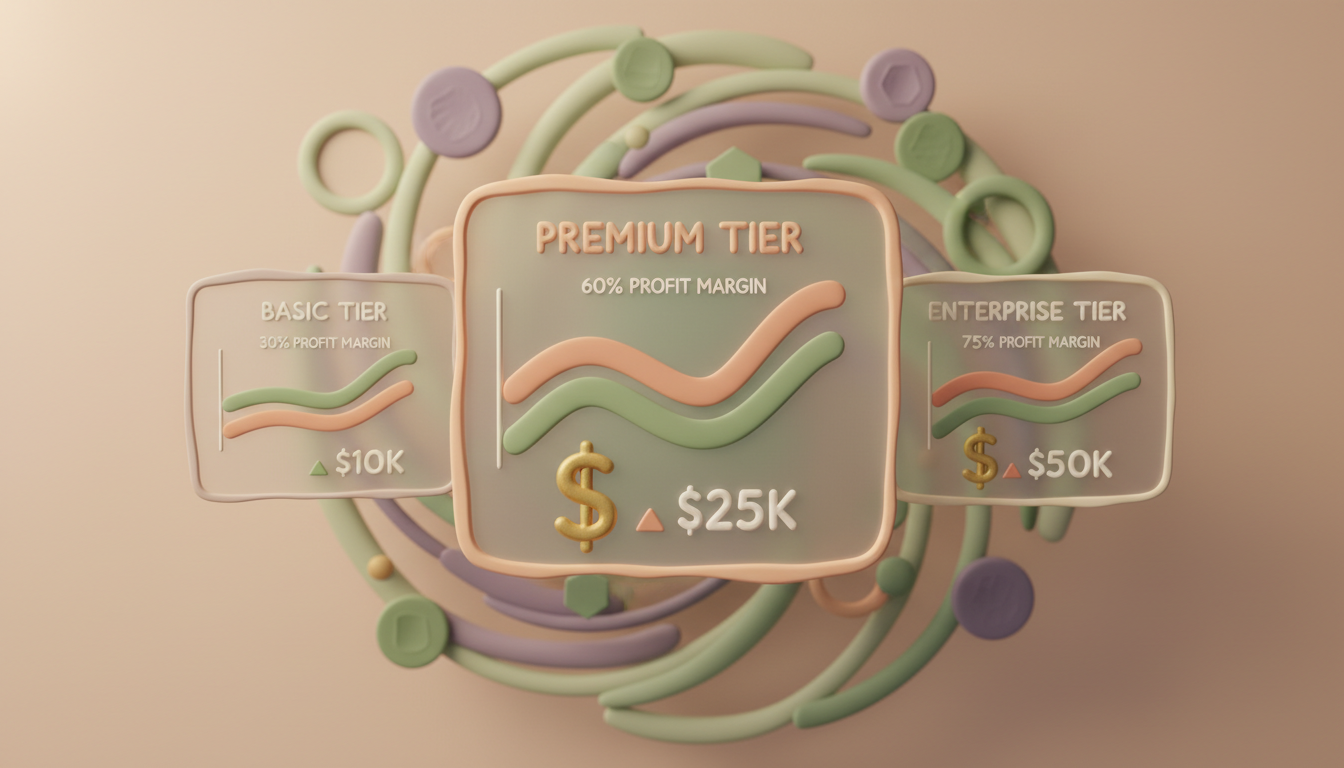
As you serve clients with varying needs, some need 500 AI-generated emails, some need 5,000, tiered pricing aligns cost with consumption. You could set three levels: Starter ($800/month for basic outreach), Pro ($1,800/month for multi-channel sequences and voice AI), and Enterprise ($3,500/month for full-stack AI with custom integrations).
This model maximizes margin because heavy users pay more while your incremental cost per unit remains low. It also creates an upsell path. A 2025 case study from a micro-agency reselling Parallel AI found that tiering increased average revenue per client by 65% within 90 days, as clients voluntarily moved to higher tiers for better results.
3. High-Value Project or Setup Fees Plus Ongoing Retainer
Some consultants blend a one-time onboarding fee with a recurring monthly charge. For clients who want a fully configured AI sales system, you might charge a $3,000 setup fee (covering strategy, tech stack integration, and initial training) and then $1,200/month for ongoing service. The setup fee covers your intensive upfront work and ensures commitment. It also boosts your margins significantly in the first month.
This model works especially well when you’re using a white-label platform like Parallel AI that makes configuration straightforward. You can complete setup in a day or two, making the $3,000 a high-value anchor that funds your business growth.
How to Calculate Your Profit Margins with Precision
Guessing your margin is risky. A clear calculation ensures you don’t underprice, leaving growth on the table, or overprice and lose deals. Let’s walk through it.
Step 1: Identify Your All-In Costs
Your main cost is the platform license fee. With Parallel AI’s white-label plan, you get access to a suite of AI agents for a flat monthly amount. For this exercise, assume a $97/month base fee plus $50 per client workspace (these numbers are illustrative; verify with current pricing). To serve five clients, your total platform cost might be $97 + (5 × $50) = $347/month.
Don’t forget to factor in your own time cost. If you spend 10 hours monthly managing AI operations for these clients, and your effective hourly rate is $100, that’s another $1,000. However, many solopreneurs build this cost into their baseline and still find plenty of room for profit.
Step 2: Determine Desired Net Margin
Gross margin = (Total revenue – platform costs) / Total revenue. Aim for 60% or higher. For the above five clients, if you charge each $1,200/month, total revenue is $6,000. Platform cost $347 = $5,653 gross profit, 94% margin before labor. Including your time, margin remains excellent.
If you want to set prices based on margin goal, use: Price per client = (Platform cost per client + Share of your time cost + Desired profit per client). So for $500 desired profit and $300 cost, price at $800 minimum.
Step 3: Benchmark Against Competitors
Research what comparable managed services cost. According to Clutch, marketing agencies offering AI-driven lead generation charge $1,500 to $5,000/month. Your pricing should be competitive but not commoditized. Your white-label advantage is personal service, so don’t race to the bottom.
Pricing Pitfalls That Erode Margins (and How to Avoid Them)
Even with a solid model, certain mistakes can silently drain your profits. Avoid these traps.
Pitfall 1: Selling Features Instead of Business Outcomes
If your proposals say, “You get 1,000 AI emails and a chatbot,” the client compares you to a software subscription. They’ll push for a low price. Instead, frame the offer around outcomes: “We’ll fill your sales pipeline with 50 qualified opportunities per month.” The value leap allows you to charge more.
Pitfall 2: Not Having a Clear Scope of Work
Scope creep is a margin killer. If you offer “AI-powered outbound” without setting limits, you might end up doing free manual work like deep research or endless revisions. Define what’s included, like “up to 5 campaigns with 2 revisions, 500 leads enriched monthly.” Anything beyond gets billed as an add-on.
Pitfall 3: Underestimating Onboarding and Support Time
First month support often takes more hours. Some consultants offset this with a setup fee (as in model 3). Others build a ramp-up period into the retainer. Calculate your real time investment for the first 60 days and set prices accordingly so you don’t lose money at the start.
Pitfall 4: Failing to Increase Prices as You Add Value
As you refine your processes and get better results, raise your prices. Use data from client successes, like a 30% increase in leads, to justify the increase during renewal discussions. A 15% annual price increase, when communicated transparently, often faces zero pushback if results are visible.
Real-World Results: How One Consultant Built a $15K Monthly Revenue Stream
To illustrate these principles, let’s look at a fictionalized but representative scenario drawn from patterns we see with Parallel AI users. Sarah runs a small sales consultancy. She historically earned $8,000/month doing done-for-you outbound for two clients, working close to full-time.
She adopted Parallel AI’s white-label offering and restructured her service. She created three tiers: Launch ($1,500/month for AI-driven LinkedIn and email outreach), Scale ($2,500/month adding AI voice follow-ups and lead scoring), and Dominate ($4,000/month adding AI chat agent and priority support).
Within four months, she signed six clients across tiers, averaging $2,300/month per client. That’s $13,800 monthly recurring revenue. Her platform cost was $600/month. She automated 70% of the hands-on work, allowing her to take on additional clients without stress. Her margins soared, and she finally had the income and time to invest in her own business growth.
This outcome isn’t an outlier. A 2026 survey by Service Provider Pro found that 68% of agencies using resold AI tools reported increased profitability, with 34% citing margins over 60%. The opportunity is there when pricing is done strategically.
Getting Started: Your Pricing Action Plan
The path to profitable white-label AI reselling starts with action. First, map your current services and identify where AI can create the biggest client impact, like lead generation, customer support, content creation, or something else. Second, choose one pricing model that aligns with your client base and test it with two or three clients. Third, track results religiously. Use that data to refine pricing and packaging.
When you’re ready to launch, select a white-label platform that gives you flexibility and support. With Parallel AI, you get a full suite of AI agents you can brand as your own, configure in hours, and manage from a single dashboard. No coding, no development team, no long setup cycles. The result: you offer enterprise-grade AI solutions while staying lean.
Ready to transform your consultancy’s revenue model? Start your free Parallel AI trial today, explore the white-label options, and see how easy it is to create high-margin AI services under your own brand. When you do, you’ll move from trading time for money to building a scalable, future-proof business, exactly as Sarah did.
Related reading
- Top 10 White-Label AI Platforms Compared: The 2026 Guide to Building Your AI Business Without Code
- How Do I Price White-Label AI Services? 7 Models for Solos
- How to White-Label AI Services Without Writing a Single Line of Code
- Hypotenuse AI vs Parallel AI: Which Platform Truly Scales White-Label AI Services for Independent Consultants in 2025?