
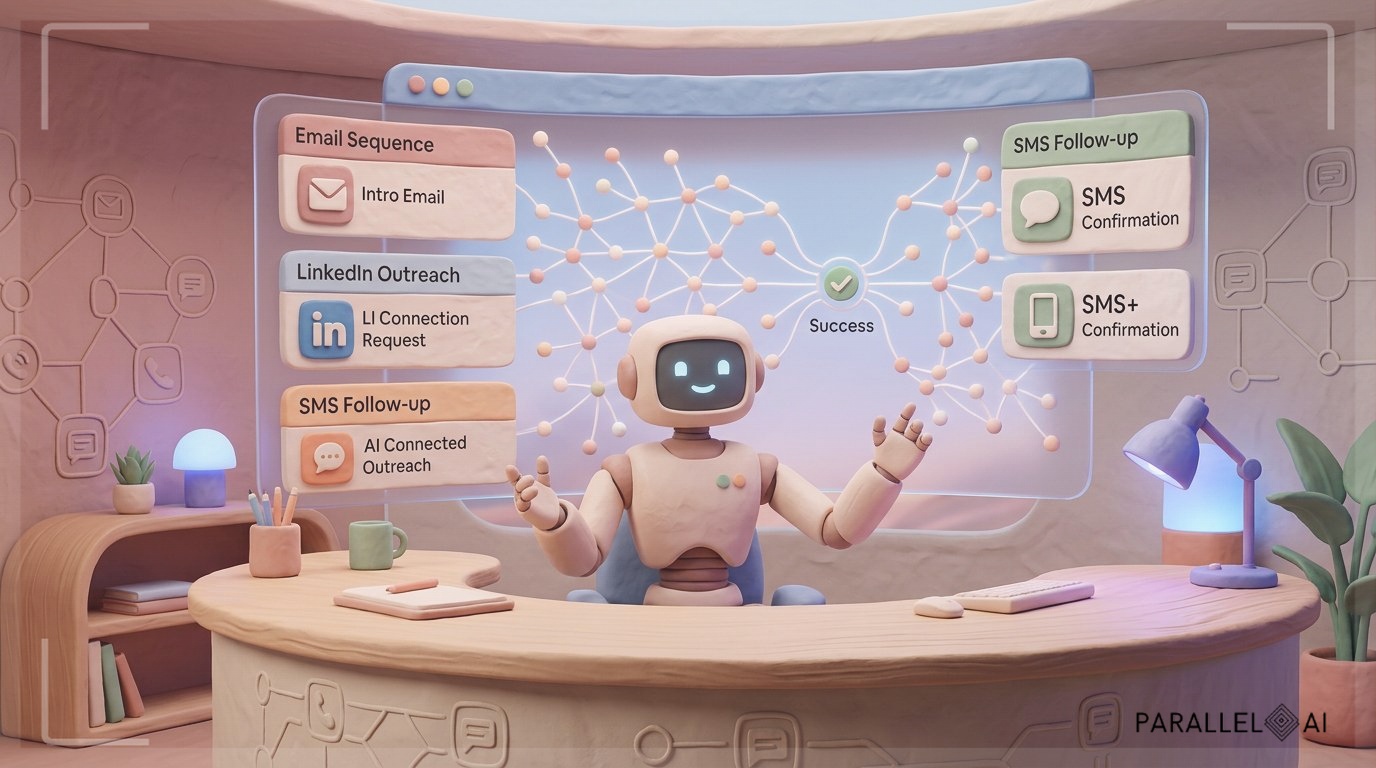
Sales development has always been a numbers game. More outreach equals more opportunities. But for solopreneurs and micro-agencies, scaling outreach means choosing between hiring expensive SDRs at $60K+ salaries or burning out trying to do everything yourself. AI SDR systems are rewriting this equation entirely.
The breakthrough isn’t just automation. It’s sophisticated, multi-channel orchestration that identifies prospects, personalizes messaging at scale, and maintains consistent follow-up across email, LinkedIn, SMS, and phone, all while you focus on closing deals. Forward-thinking business owners are building AI SDR engines that generate 300+ qualified conversations monthly without adding headcount.
This shift matters because the cost of not implementing AI SDR systems grows daily. While you’re manually researching prospects and crafting individual emails, competitors are deploying AI agents that handle 50+ personalized outreach sequences simultaneously. The gap between manual and automated outreach isn’t just about efficiency. It’s about survival.
What Makes AI SDR Systems Different From Basic Automation
Traditional sales automation tools send templated emails on schedules. AI SDR systems think, adapt, and improve. That distinction matters enormously for results.
Context-Aware Intelligence
Modern AI SDR agents analyze prospect behavior, engagement patterns, and response signals to adjust messaging in real time. When a prospect opens your email three times but doesn’t reply, the AI recognizes buying intent and triggers a different follow-up sequence than it would for someone who hasn’t engaged at all.
This contextual awareness extends across channels. If a prospect ignores emails but engages on LinkedIn, the AI shifts primary outreach there. If they respond well to case studies but ignore feature lists, subsequent messages emphasize social proof over technical capabilities.
Multi-Channel Orchestration
The average buyer needs 8 to 12 touchpoints before responding. AI SDR systems coordinate these touches across email, LinkedIn messages, connection requests, profile views, SMS, and even voice outreach. Each channel reinforces the others without creating awkward overlap or spam.
One marketing consultant built an AI SDR sequence that sends an initial email, follows up with a LinkedIn connection request mentioning the email, shares a relevant case study via LinkedIn message, sends a second email referencing the LinkedIn interaction, and finally delivers a personalized video message. All of it triggers automatically based on engagement signals.
Dynamic Personalization at Scale
First-generation automation inserted name fields and company names. AI SDR systems analyze prospect websites, recent news, social media activity, and industry trends to craft genuinely personalized messages that reference specific challenges and opportunities.
A sales consultant targeting SaaS companies configured her AI SDR to analyze each prospect’s recent blog posts, identify their current marketing challenges, and reference specific articles in outreach messages. Open rates jumped from 18% to 47% compared to generic templates.
Building Your AI SDR Engine: The Technical Reality
Creating effective AI SDR systems requires three core components: intelligent data aggregation, multi-model AI orchestration, and omni-channel execution infrastructure.
Smart List Architecture
AI SDR effectiveness starts with intelligent prospect identification. Modern systems go beyond basic demographic filtering to analyze behavioral signals, technographic data, and engagement patterns. The goal is building dynamic lists that automatically add prospects matching specific criteria and remove those who no longer fit.
Parallel AI’s Smart Lists make this continuous refinement possible. You define ideal customer profiles using multiple data points, including industry, company size, technology stack, recent funding, hiring patterns, and content engagement, and the system keeps prospect lists updated automatically. When a company expands into your target market or adopts technology that signals buying intent, they appear in your outreach queue without any manual research on your end.
One business consultant built Smart Lists monitoring companies posting job listings for roles his services support. His AI SDR automatically begins outreach sequences within 24 hours of these hiring signals appearing, reaching decision-makers during active buying windows.
Multi-Model AI Orchestration
Effective AI SDR systems use different AI models for different tasks. GPT-4 excels at creative messaging and storytelling. Claude produces more analytical, data-driven content. Gemini handles complex research and synthesis. Grok brings real-time awareness. DeepSeek offers specialized reasoning.
Parallel AI integrates all these models with uncapped access and context windows reaching one million tokens. Your AI SDR can analyze extensive prospect research, maintain conversation context across weeks of interaction, and switch between AI models based on task requirements, all within unified workflows.
A digital agency built a sophisticated AI SDR system using Claude for initial prospect research and qualification, GPT-4 for crafting personalized outreach messages, and Gemini for analyzing response patterns to fine-tune sequences. This multi-model approach increased meeting booking rates by 34% compared to single-model systems.
Sequence Engineering
AI SDR sequences orchestrate timing, messaging, and channel selection based on prospect behavior. Effective sequences include 8 to 15 touchpoints over 4 to 6 weeks, varying message length, value proposition, and call-to-action based on engagement signals.
Parallel AI’s Sequences enable multi-channel orchestration with conditional logic. If email A generates opens but no clicks, the AI sends follow-up B via LinkedIn. If the prospect engages on LinkedIn but doesn’t reply, the system triggers email C with different positioning. If specific phrases appear in responses like “not right now” or “check back in Q2,” the sequence automatically adjusts timing.
One consultant built a nurture sequence that identifies prospects showing interest but not booking meetings. These prospects enter a 90-day education sequence delivering case studies, industry insights, and tool recommendations, maintaining the relationship without aggressive selling. When engagement spikes, the AI automatically triggers booking-focused outreach.
Integration: Making AI SDR Work With Your Existing Stack
AI SDR systems deliver maximum value when they connect smoothly with your CRM, knowledge base, and communication platforms.
Knowledge Base Integration
Your AI SDR should have access to your company’s collective intelligence, including case studies, service descriptions, pricing information, objection handling frameworks, competitor comparisons, and past proposal templates. This keeps messaging accurate and brand-consistent across thousands of outreach touches.
Parallel AI integrates with Google Drive, Confluence, and Notion, allowing your AI SDR to reference up-to-date materials automatically. When prospects ask about specific services, the AI pulls accurate information from your knowledge base rather than making things up. When objections come up, the system references proven responses from your sales playbook.
A marketing agency stores all client case studies, service packages, and pricing frameworks in Notion. Their AI SDR automatically references relevant examples based on prospect industry and challenges, making sure every message includes applicable social proof.
CRM Synchronization
AI SDR activities should automatically log to your CRM, creating thorough interaction histories without manual data entry. Every email sent, LinkedIn message delivered, and response received becomes part of the prospect record.
This synchronization keeps sales and AI SDR aligned. When human intervention becomes necessary, whether it’s a hot lead needing immediate attention or a complex question beyond AI capability, the system flags the opportunity and provides complete context. Sales teams see entire conversation histories, engagement patterns, and AI-generated insights without switching platforms.
Communication Platform Orchestration
Effective AI SDR requires executing across multiple channels from unified infrastructure. Email, LinkedIn, SMS, and other channels should operate from coordinated workflows rather than disconnected systems.
Parallel AI’s omni-channel capabilities make true multi-platform orchestration possible. A single sequence can include email via your domain, LinkedIn outreach via your profile, SMS to mobile contacts, and even voice messages, all coordinated by AI logic responding to engagement signals. The system maintains context across channels, making sure messages complement rather than contradict each other.
ROI Math: What AI SDR Systems Actually Deliver
The business case for AI SDR becomes clear when you compare costs and results against traditional approaches.
Cost Comparison
A junior SDR costs $60,000 annually plus benefits, training, tools, and management overhead, bringing the total investment to around $80,000. This SDR typically manages 50 to 100 active prospects, sends 40 to 60 personalized messages daily, and books 15 to 25 qualified meetings monthly.
An AI SDR system costs $99 to $297 monthly depending on scale, under $3,600 annually. This system manages 500+ active prospects, sends 200+ personalized messages daily, and books 30 to 50 qualified meetings monthly. The AI never sleeps, takes vacation, or needs motivation. It operates across time zones, maintains perfect follow-up discipline, and continuously improves based on response data.
One sales consultant replaced two contract SDRs costing $6,000 monthly with an AI SDR system costing $297 monthly. Monthly savings: $5,700. Meeting volume increased 40% despite the headcount reduction. Annual savings: $68,400 while actually improving results.
Time Recovery
Beyond direct cost savings, AI SDR systems give founders and consultants back the time they used to spend on prospecting. A typical solopreneur spends 10 to 15 hours weekly on prospect research, list building, message crafting, and follow-up coordination.
AI SDR automation cuts this down to 2 to 3 hours weekly reviewing AI-generated insights, approving sequences, and handling conversations that need a human touch. That’s 8 to 12 hours weekly recovered, effectively adding 400 to 600 hours annually to focus on high-value activities like client delivery, relationship building, and strategic planning.
A business consultant calculated her hourly value at $300 based on client billing rates. Recovering 10 hours weekly via AI SDR saved the equivalent of $156,000 annually in opportunity cost, time she redirected to serving existing clients and developing new service offerings.
Pipeline Velocity
AI SDR systems speed up pipeline development through consistent, intelligent follow-up that human SDRs struggle to maintain. The average sales cycle shortens 20 to 30% when AI orchestrates nurture sequences that respond immediately to engagement signals.
When prospects show buying intent, whether it’s visiting pricing pages, downloading resources, or engaging with multiple messages, AI SDR systems trigger accelerated sequences and alert human sales teams right away. This real-time responsiveness captures opportunities that manual processes miss.
Common Implementation Mistakes to Avoid
Building effective AI SDR systems means steering clear of predictable pitfalls that undermine results.
Over-Automation Without Human Judgment
The biggest mistake is removing humans entirely from sales development. AI SDR excels at scale, consistency, and data analysis. Humans excel at relationship building, complex problem-solving, and strategic thinking. Effective systems blend both.
Build AI SDR workflows that escalate to humans at critical moments, whether it’s a hot lead showing strong buying intent, a complex question requiring a nuanced response, or an objection that needs strategic handling. The AI handles volume and consistency; humans provide judgment and relationship depth.
Generic Messaging Despite AI Capabilities
Some organizations implement AI SDR but keep using generic templates rather than taking advantage of AI’s personalization capabilities. If your AI-generated messages could apply to any prospect in your target market, you’re wasting the technology.
Invest time configuring your AI SDR to analyze prospect-specific information and craft genuinely relevant messages. Reference their recent content, industry challenges, company news, and growth indicators. Personalization drives response rates from the industry-average 1 to 2% up to top-performer levels of 8 to 12%.
Insufficient Testing and Optimization
AI SDR systems need continuous refinement. Message variations, sequence timing, value propositions, and calls-to-action all affect results. Organizations that launch once and never revisit miss 50 to 100% performance improvements available through systematic testing.
Build optimization rhythms: review performance weekly, test new approaches monthly, and refine based on response data quarterly. Track open rates, click rates, response rates, meeting booking rates, and conversion rates across different segments and messages. Let data guide the evolution.
Scaling AI SDR: From First Campaign to Sophisticated System
AI SDR implementation follows a predictable maturity curve, from initial experiments to sophisticated, multi-sequence systems.
Phase 1: Single Sequence Validation (Weeks 1-4)
Start with one well-defined target segment and one focused value proposition. Build a 10-touch sequence across email and LinkedIn. Monitor results daily, gather feedback from prospects who respond, and refine messaging based on what connects.
This validation phase proves the concept, identifies messaging that works for your specific market, and builds confidence in AI-generated content quality. Many consultants book their first AI-sourced meetings within two weeks of launching initial sequences.
Phase 2: Multi-Sequence Expansion (Months 2-3)
Once your initial sequence proves effective, expand to additional target segments and value propositions. Build specialized sequences for different industries, company sizes, and buyer roles. Create nurture sequences for prospects who aren’t ready to buy immediately.
This expansion phase typically grows meeting volume 3 to 5x compared to single-sequence approaches. Different segments respond to different messaging, timing, and channels. Multi-sequence systems capture this variation.
Phase 3: Advanced Orchestration (Months 4-6)
Mature AI SDR systems incorporate sophisticated logic: behavioral triggers, engagement scoring, cross-sequence coordination, and predictive analytics. Prospects move between sequences based on engagement patterns. High-intent prospects enter accelerated booking sequences. Low-engagement prospects receive education content before sales messaging.
This advanced orchestration stage is where AI SDR systems truly outperform human SDRs. The AI manages complexity that’s impossible for humans to track manually, including hundreds of prospects across dozens of sequences with individualized timing and messaging.
Building Your AI SDR System With Parallel AI
Parallel AI provides the thorough infrastructure required for effective AI SDR deployment without building custom technology.
Getting Started: The 48-Hour Setup
Day 1 focuses on foundation building. Connect your knowledge base containing service descriptions, case studies, and sales materials. Configure Smart Lists defining your ideal customer profiles. Build your initial outreach sequence with 8 to 10 touchpoints across email and LinkedIn.
Day 2 focuses on refinement and launch. Test AI-generated messages for quality and brand alignment. Configure escalation rules for high-intent prospects requiring human attention. Launch your first sequence with 50 to 100 prospects to validate effectiveness before scaling.
This compressed timeline works because Parallel AI handles the technical complexity. You don’t build AI infrastructure, configure model APIs, or develop custom integrations. The platform provides ready-to-deploy capabilities that only need strategic configuration.
Ongoing Optimization
Effective AI SDR requires regular attention despite the automation. Block 2 to 3 hours weekly for sequence review, message refinement, and prospect engagement analysis. This weekly rhythm maintains quality, captures optimization opportunities, and keeps AI-generated content aligned with your brand voice.
Parallel AI’s analytics surface key insights: which messages generate the highest response rates, which sequences book the most meetings, which prospect segments convert best. Use these insights to refine targeting, improve messaging, and allocate resources more effectively.
White-Label Opportunities
Agencies and consultants can offer AI SDR as a service using Parallel AI’s white-label capabilities. Build proven sequences for specific industries, customize them for individual clients, and deploy under your brand. This creates recurring revenue streams from AI SDR management without per-client technology costs.
One digital agency built standardized AI SDR sequences for SaaS companies, e-commerce brands, and professional services firms. They charge $2,000 to $4,000 monthly for AI SDR management, generating $40,000+ in monthly recurring revenue while using Parallel AI’s infrastructure.
The Competitive Reality: AI SDR Adoption Is Accelerating
AI SDR implementation is no longer an experimental edge. It’s becoming table stakes for competitive sales development. Organizations deploying AI SDR systems are outpacing traditional approaches by margins that compound monthly.
Consider the math: Company A relies on manual prospecting, sending 10 personalized messages daily and booking 3 to 4 meetings monthly. Company B deploys AI SDR, sending 50+ personalized messages daily and booking 12 to 15 meetings monthly. After six months, Company B has 4x the pipeline, 3x the customer relationships, and significantly better market knowledge.
This advantage accelerates over time. Company B’s AI learns from more interactions, improves faster, and captures more market share. Company A falls further behind despite working harder.
The solopreneurs and micro-agencies winning in 2026 aren’t working longer hours. They’re using sophisticated AI SDR systems that operate 24/7, maintain perfect follow-up discipline, and scale without headcount. The technology exists. The platforms work. The only question is how quickly you implement.
AI SDR systems represent the most significant shift in sales development since email automation. Organizations that adopt early capture disproportionate advantages. Those that delay face increasingly difficult competitive positions. The choice isn’t whether to implement AI SDR. It’s whether to lead or follow.
Parallel AI makes this choice simple. The platform provides everything required to build, deploy, and scale sophisticated AI SDR systems without custom development, complex integrations, or enterprise budgets. You can launch your first sequence this week, book your first AI-sourced meeting next week, and build a pipeline machine generating 50+ monthly meetings within 90 days. The only remaining question: when do you start?