
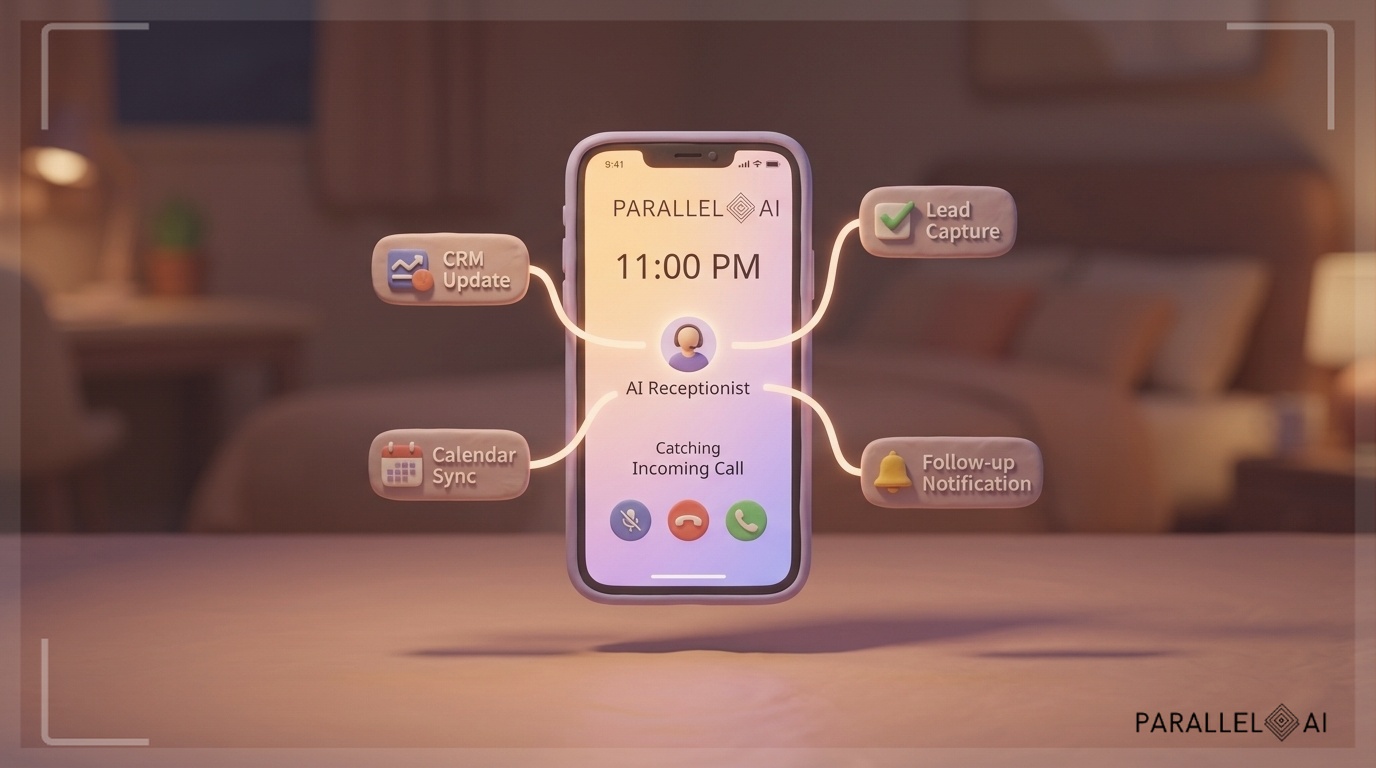
Picture this: a prospect calls your business at 11 PM on a Friday. Your team is offline, your calendar tool doesn’t connect to your phone system, and your CRM won’t update until Monday morning. By then, the lead has already booked with a competitor who had a smarter setup.
This is the quiet revenue leak most businesses ignore. They invest in an AI receptionist, celebrate the automation win, and then discover six months later that the tool only handled the call. It didn’t capture the lead, update the CRM, trigger a follow-up, or help them understand who was actually calling and why.
The AI receptionist market is crowded, but most platforms are solving the wrong problem. They’re fine-tuning voice quality when they should be fixing the entire post-call revenue workflow. This post breaks down how the leading AI receptionist platforms compare, where each one falls short, and why Parallel AI’s unified approach delivers something the others simply can’t.
The Real Problem With Standalone AI Receptionists
Most AI receptionist tools were built to answer one question: Can we replace a human answering the phone? Technically, yes. But that framing misses everything that makes a receptionist valuable in the first place.
A great receptionist doesn’t just answer calls. They qualify the caller, log the interaction, update the relevant team, follow up with the right information, and make sure the prospect feels heard. Strip away the post-call workflow and you’re left with an expensive voicemail system.
The Tool Sprawl Problem
Organizations using five or more disconnected AI tools report a 40% increase in operational overhead and a 25% drop in team productivity due to context-switching and fragmented data. The pattern is familiar: one tool for voice, another for lead capture, a third for CRM sync, a fourth for follow-up sequences, and a fifth for content generation. Each subscription adds cost and complexity without adding cohesion.
For agencies, the problem gets worse. You can’t rebrand a third-party AI receptionist and sell it to clients as your own. You can’t train it on your client’s proprietary knowledge base without jumping through technical hoops. And you can’t build a recurring revenue stream on a platform that locks you into its own branding.
AI Receptionist Platform Comparison
Here’s how the major players stack up across the dimensions that actually matter for scaling teams and agencies.
Bland AI
Bland AI is built specifically for AI phone calls at scale. It offers programmable voice agents, solid latency performance, and developer tooling for teams that want to build custom call flows. For technical founders with engineering resources, it’s a capable foundation.
The limitation? Bland AI is a voice infrastructure layer, not a business automation platform. It doesn’t include a native Knowledge Base for grounding responses in your actual documents, it doesn’t generate follow-up content, and it has no white-label resale model. You’re building on top of it, not with it.
Best for: Engineering teams building custom telephony workflows.
Gap: No post-call automation, no white-label capability, no content engine.
Synthflow
Synthflow targets non-technical users with a no-code interface for building AI voice agents. It’s approachable, and for small businesses that just need basic call handling, it delivers. Onboarding is fast and the interface is clean.
That said, Synthflow’s context awareness is limited. It doesn’t natively connect with tools like Google Drive, Notion, or Confluence, which means your AI agent answers questions based on what you manually programmed rather than your live business data. For dynamic businesses with evolving pricing, services, or FAQs, this creates accuracy problems fast.
Best for: Solopreneurs and small businesses with simple, static call scripts.
Gap: Limited Knowledge Base integration, no multi-channel outreach, no white-label solution.
Air AI
Air AI markets itself as an autonomous sales and support agent capable of handling long-form conversations. It’s one of the more ambitious platforms in the space, with a focus on conversational depth and natural language quality.
The challenge with Air AI is cost predictability. Usage-based pricing can spike unexpectedly when call volume increases, making it difficult to budget for agency clients or high-volume environments. It also operates as a standalone voice tool. There’s no integrated content generation, no Smart List prospecting, and no white-label infrastructure for agencies.
Best for: Sales teams focused exclusively on outbound voice automation.
Gap: Unpredictable pricing, no unified platform, no agency resale model.
VAPI
VAPI is a developer-first API platform for building voice AI applications. If you have a strong engineering team, VAPI gives you fine-grained control over every aspect of your voice agent. It supports multiple AI models and offers the technical flexibility that enterprise builders need.
But VAPI is infrastructure, not a finished product. It requires significant development investment to build anything client-ready, and it has zero out-of-the-box features for content generation, lead nurturing, or white-label deployment. For agencies or growth-stage teams without dedicated developers, it’s the wrong tool.
Best for: Engineering teams building proprietary AI voice applications.
Gap: Requires heavy development investment, no business automation features, not reseller-ready.
Why Parallel AI Wins for Agencies and Growth Teams
Parallel AI wasn’t designed to be just an AI receptionist. It was built to be the entire revenue engine, from the first call to the closed deal to the retained client. The AI receptionist is one component of a unified platform that handles prospecting, outreach, content creation, customer support, and white-label deployment.
Context-Aware Conversations Grounded in Your Data
Parallel AI’s native Knowledge Base integration connects directly to Google Drive, Notion, and Confluence. When a prospect calls and asks about your pricing, service tiers, or onboarding timeline, the AI agent pulls from your actual documentation, not a static script you programmed six months ago.
This matters because your business changes. New services launch, pricing updates, team structures shift. With Parallel AI, your AI receptionist stays current without manual reprogramming.
Full Post-Call Workflow Automation
Most platforms stop at the call. Parallel AI keeps the conversation going. After a voice interaction, the platform can:
- Automatically qualify and score the lead
- Sync contact details and call notes to your CRM
- Trigger a personalized email or SMS follow-up sequence
- Generate custom content for the prospect based on their inquiry
- Route high-intent leads to your sales team in real time
That’s the difference between an answering machine and a revenue engine.
White-Label Ready for Agencies
Parallel AI’s white-label solution is built for agencies and SaaS operators who want to deliver AI-powered services under their own brand. You can replace every instance of Parallel AI’s logo, domain, and color scheme with your own. Your clients interact with your branded platform, powered by Parallel AI’s infrastructure.
Agencies that reposition AI receptionists as premium client retainers are seeing 30-50% margin expansion without adding headcount. Instead of competing on hourly rates in a saturated market, you’re selling a high-margin, AI-powered growth system that your clients can’t easily replicate themselves.
Multi-Model Flexibility Without Premium Surcharges
Single-model AI platforms are facing adoption pushback due to cost unpredictability and output inconsistency. Parallel AI offers uncapped access to OpenAI, Anthropic, Gemini, Grok, and DeepSeek within a single interface. You’re not locked into one provider’s pricing changes or model updates. You route to the best model for each task, automatically.
Enterprise Security at Every Tier
Parallel AI enforces a strict no-training-on-customer-data policy. Your client conversations, business documents, and proprietary workflows are never used to train external models. AES-256 encryption, TLS protocols, single sign-on, and full GDPR and CCPA compliance are standard across all plans, not locked behind enterprise tiers.
For agencies handling sensitive client data, this isn’t optional. It’s the foundation of every client relationship.
Platform Comparison at a Glance
| Capability | Bland AI | Synthflow | Air AI | VAPI | Parallel AI |
|---|---|---|---|---|---|
| Voice Agent | ✅ | ✅ | ✅ | ✅ | ✅ |
| Knowledge Base Integration | ❌ | Limited | ❌ | ❌ | ✅ Native (Drive, Notion, Confluence) |
| Post-Call CRM Sync | Manual/API | Limited | Manual/API | API only | ✅ Automated |
| Multi-Channel Outreach | ❌ | ❌ | ❌ | ❌ | ✅ Email, SMS, Voice, Direct Mail |
| Content Generation | ❌ | ❌ | ❌ | ❌ | ✅ Built-in Content Engine |
| White-Label Resale | ❌ | ❌ | ❌ | ❌ | ✅ Full rebrand + resale |
| Multi-Model Access | Limited | Limited | Limited | ✅ | ✅ OpenAI, Anthropic, Gemini, Grok, DeepSeek |
| No Training on Customer Data | ❌ | ❌ | Unclear | ❌ | ✅ Strict policy |
| Entry Price | Custom | ~$500/mo | Custom | Custom | $99/mo |
Frequently Asked Questions
Can Parallel AI’s receptionist handle complex, multi-part questions?
Yes. Because the AI agent is grounded in your Knowledge Base, it can accurately answer nuanced questions about your services, pricing, availability, and processes. It doesn’t guess or route the caller to voicemail. It answers.
How long does white-label setup take?
Most agencies are fully operational in under an hour. Connect your documents, configure your brand assets, and your first AI agent is live.
Is Parallel AI secure enough for client-facing deployments?
Absolutely. AES-256 encryption, TLS, SSO, GDPR/CCPA compliance, and a strict no-training-on-customer-data policy are standard across all plans. Enterprise teams can add on-premise deployment and custom SLAs.
What AI models does Parallel AI use for voice?
Parallel AI routes to the best model for each interaction, with access to OpenAI, Anthropic, Gemini, Grok, and DeepSeek. Industry leaders confirm that AI voice latency under 500ms is the new baseline for conversational agents. Parallel AI meets that standard across its full model stack.
Can I resell Parallel AI to my clients as my own product?
Yes. The white-label solution includes full branding customization across the platform. Your clients never see Parallel AI. They see your brand, powered by enterprise-grade AI infrastructure.
One Platform, Not Five Subscriptions
The AI receptionist space has a visibility problem. Most platforms show you a polished demo of a voice agent handling a simple call, and they stop there. They don’t show you what happens after the call ends, because for most of them, nothing happens.
Parallel AI is different because it was built to answer a different question: what does a complete AI-powered revenue operation actually look like? The answer includes a voice agent that understands your business, a follow-up system that turns conversations into action, a content engine that keeps your brand visible, and a white-label infrastructure that lets agencies profit from the entire stack.
That Friday night call that started this story? With Parallel AI, the lead gets qualified, logged, and followed up with before your competitor even knows they called. That’s not a feature. That’s the whole point.
If you’re ready to stop paying for five disconnected tools and start running one intelligent platform that prospects, calls, follows up, publishes, and supports, Parallel AI is your next move.
Start your free evaluation today at web.parallellabs.app/signup and see how a unified AI workforce replaces the fragmented stack you’ve been managing.