
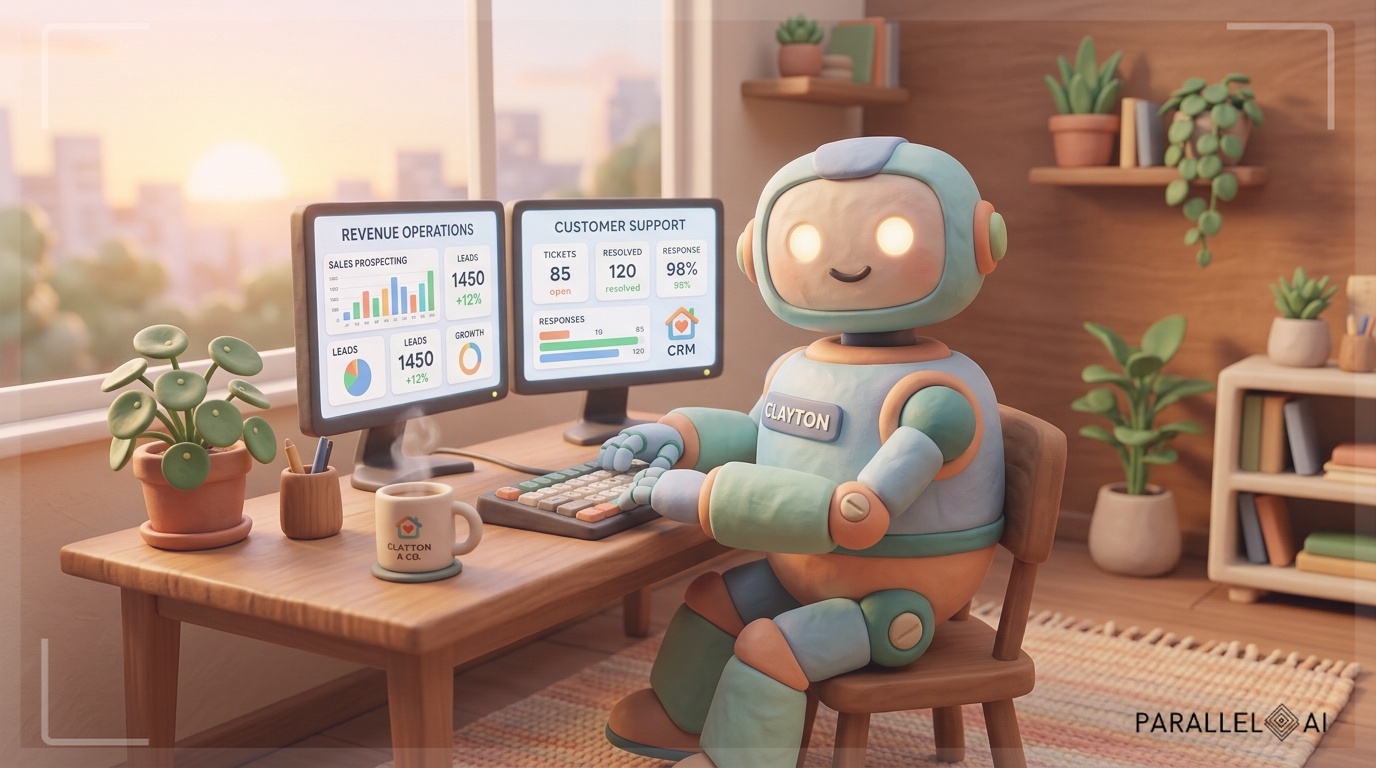
Definition: An AI Employee is a dedicated, role-specific autonomous agent built to handle core business functions, like sales prospecting, content production, or customer support. It uses large language models grounded in your company’s proprietary data, processes, and brand voice. Unlike temporary AI tools, an AI employee owns a defined seat on the organizational chart, operates 24/7, and is measured against clear performance benchmarks, just like a human team member.
Not all AI employees are created equal. The market is flooded with generic chatbot overlays that spray out canned responses across your website. But growth-stage GTM teams don’t need a better FAQ widget. They need a dedicated AI Sales Development Rep (SDR) that combs through a B2B database, researches accounts, writes context-aware cold emails, and logs every action in the CRM without human intervention. They need an AI Content Writer that learns from product documentation, case studies, and competitor briefs to publish on-brand material, not hallucinated generic blog posts. In short, they need specialized agents built for specific revenue functions, not a single, confused bot trying to do it all.
This is the shift from AI assistants to AI employees. And for companies stuck in tool-sprawl purgatory, managing 8 to 17 disconnected point solutions, deploying a workforce of dedicated AI agents on a single, consolidated platform is the quickest way to scalable and efficient pipeline generation.
Types of AI Employees: Building Your Specialized Digital Workforce
Just as you wouldn’t ask a graphic designer to close enterprise deals, you shouldn’t assign a single generic AI to handle every task. A high-performing AI workforce is made up of specialized agents, each owning a distinct role within your go-to-market engine.
1. The AI Sales Development Rep (SDR)
This is the tip of the spear for outbound pipeline. The AI SDR builds target account lists from a large B2B database on its own, checks contact data, does pre-call research, and runs multi-channel outreach sequences (email, SMS, voice) at scale. It personalizes each message using intent data and engagement history, then smartly routes hot leads to human account executives, creating a smooth handoff.
2. The AI Content Writer & Marketer
A dedicated AI content employee is built on your brand’s knowledge base. It takes in your product specs, battle cards, customer interview transcripts, and style guides. It then produces SEO-optimized blog posts, social media threads, case studies, and email copy that truly sound like your brand, eliminating the generic “GPT-3.5 tone” that plagues most AI content. This agent fixes the chronic content bottleneck that leaves demand generation engines starved for fresh material.
3. The AI Customer Support Agent
This agent operates 24/7 across chat, email, and even voice channels, handling everything from “reset my password” to complex technical troubleshooting. Because it’s built on your internal documentation, ticket history, and product knowledge base, it gives consistent, accurate answers instead of making things up. It smoothly escalates to human agents when sentiment analysis detects confusion or frustration, keeping the customer experience intact while cutting response times way down.
4. The AI Voice Agent
Often overlooked, the AI voice agent handles inbound qualification calls, after-hours lead follow-up, and even outbound warm outreach. It talks naturally, understands complex requests, and puts conversation summaries right into your CRM, so no lead goes cold because of a missed callback.
How AI Employees Differ from Chatbots and Assistants
The distinction is critical and directly impacts ROI. A general AI assistant is a prompt-and-response tool; it helps a human do a task faster. An AI employee owns the execution of an entire business process.
- Chatbots: Rule-based or simple intent-matching systems stuck in pre-defined conversation trees. They can handle simple queries but fall apart with anything complex, can’t run multi-step workflows, and have no memory of past interactions.
- AI Assistants: Co-pilots like ChatGPT or Claude that individuals use on the fly. They boost personal productivity but create organizational chaos with inconsistent outputs, data leakage risks, and no centralized reporting. They help one person; they don’t act as a cross-departmental team member.
- AI Employees (Dedicated Agents): Autonomous agents assigned a persistent role with clear goals, like “generate 500 qualified leads this month.” They are connected to your CRM, knowledge base, and communication channels. They don’t just suggest email copy; they send the email at the best time, log the activity, track the reply, and update the lead status. They’re managed based on performance outcomes, not prompt inputs.
Deployment Guide: Assigning AI Employees to Specific Roles Without the Chaos
Deploying AI employees isn’t about flipping a switch on a “super-agent.” It requires the same structured onboarding you’d give a new human hire, but done in under an hour.
Step 1: Audit Your Revenue Workflow for “AI-Ready” Seats
Identify repetitive, rules-based, or high-volume tasks that are eating up human time. These are your AI employee roles. Common candidates include top-of-funnel prospecting, lead enrichment, first-touch qualification, content first drafts, and tier-1 support.
Step 2: Onboard with Your Proprietary Intelligence
This is your moat. Give your AI employee access to your knowledge base, CRM playbooks, brand voice guides, product documentation, and ideal customer profile data. The goal is to make sure its “brain” is indistinguishable from a trained human employee’s on day one.
Step 3: Define Clear Handoff Protocols
AI employees don’t operate in a vacuum. Map out exactly what happens when the AI SDR books a meeting: CRM event, calendar invite, Slack notification to AE, enrollment in a post-meeting sequence. A consolidated platform makes sure this orchestration happens natively, without brittle third-party integrations that break.
Step 4: Monitor and Iterate with Performance Benchmarks
Treat AI employees like human reports. Review their dashboards weekly, not daily. Check output quality against benchmarks, refine the knowledge base as your product evolves, and adjust targeting parameters based on conversion data.
Performance Benchmarks: How to Measure an AI Workforce
A dedicated AI employee should be evaluated on hard output metrics tied to revenue operations.
| Role | Key Performance Indicator (KPI) | Typical AI Employee Benchmark |
|---|---|---|
| AI SDR | Qualified Meetings Booked / Month | 40-80 per agent (running 24/7) |
| AI SDR | Response Rate on Personalized Outreach | 8-15% (vs. generic 2-3%) |
| AI SDR | Time from Lead to Meeting | Under 5 minutes (instant follow-up) |
| AI Content Writer | Published Blog Posts / Week | 5-10 (fully on-brand, SEO-optimized) |
| AI Content Writer | Content Production Cost / Article | 90-95% reduction vs. freelance/human writer |
| AI Support Agent | Average First Response Time | Instantaneous (< 5 seconds) |
| AI Support Agent | Ticket Resolution Rate (no human handoff) | 60-80% for tier-1 issues |
Cost Comparison: AI Employee vs. Human Employee
The economic argument for dedicated AI employees is becoming undeniable, particularly for growth-stage companies carrying the burden of high salary costs plus a sprawling SaaS tool stack.
| Cost Factor | Human SDR (US Average) | Dedicated AI SDR Agent | Human Content Writer (Freelance) | Dedicated AI Content Agent |
|---|---|---|---|---|
| Base Cost / Month | $5,000 – $7,000 (salary) | $200 – $1,500 (platform) | $3,000 – $6,000 (retainer) | Included in platform |
| Software Licenses | $150 – $450 (CRM, Sales Nav, Sequencer) | $0 (consolidated) | $100 (SEO tools, Grammarly) | $0 (consolidated) |
| Onboarding & Training | $3,000 – $5,000 (ramp time) | $0 (instant knowledge base sync) | $500 (briefing time) | $0 (brand voice training) |
| Operational Overhead | Management, HR, Payroll Tax, Benefits (~30%) | $0 | Invoicing, revisions, management | $0 |
| Scalability | Linear cost increase per hire | Non-linear; scale output without linear cost increases | Linear cost increase per assignment | Scale output to match demand |
| Total Effective Cost | $7,500 – $10,500+ / month | $200 – $1,500 / month | $3,600 – $6,600+ / month | Included in platform |
Note: The AI employee platform cost is typically an all-in subscription that simultaneously replaces multiple human-adjacent costs, like SDR, writer, and support agent, in addition to consolidating 5+ separate software licenses.
Case Study: Scaling a GTM Team with Dedicated AI Agents
Company: A Series A B2B SaaS company selling a vertical-specific project management tool.
Problem: The company had 3 human SDRs swamped with lead research and manual data entry, a marketing team that couldn’t produce enough content to fuel outbound and SEO, and a tool stack that cost $4,200/month across its CRM, sequencer, AI writer, lead database, and chatbot.
Deployment: The team moved to a single AI employee platform, deploying three dedicated agents:
1. AI SDR: Connected to the platform’s B2B database, it started prospecting into their ICP (construction and engineering firms), doing account research, and sending personalized sequences.
2. AI Content Writer: Trained on their case studies and product docs, it took over the blog, producing three in-depth articles per week.
3. AI Support Agent: Deployed on the website and in-app chat, handling tier-1 product questions and triaging feature requests.
Results (90 Days Post-Deployment):
– Pipeline Generated: The AI SDR sourced 35% of all new qualified pipeline, operating at 1.5 times the output of a single human SDR at a fraction of the cost.
– Content Output: Organic traffic grew 60% thanks to a consistent publishing cadence; content cost per article dropped from $650 (freelance) to nearly zero marginal cost.
– Tool Spend: Total monthly software spend dropped from $4,200 to $800 after consolidating four tools into the single AI platform.
– Team Efficiency: Human SDRs were refocused entirely on closing high-intent inbound leads and running complex outbound sequences, improving their quota attainment by 40%. No one was replaced; capacity was amplified.
Future of Work: AI Employees as a Permanent Part of the Team
The story that AI will “replace” human workers misses the real transformation. Forward-looking GTM teams aren’t firing their workforce; they’re giving every human seller, marketer, and support agent a team of dedicated AI specialists. The Head of Growth’s org chart is expanding, not contracting. They’re just adding digital headcount that scales without exploding the burn rate.
In an organization ready for consolidation, the AI employee platform becomes the central operating system for revenue. It’s where the brand voice lives, where data is unified, and where AI agents handle the repetitive, high-volume work that drains both human potential and revenue. Companies that build this dedicated AI workforce now will survive the efficiency mandates from investors and boards, out-executing competitors stuck in tool-switching, spreadsheet-pasting purgatory.
The AI employee isn’t a concept; it’s a deployable asset. It’s the AI SDR booking meetings while your team sleeps. It’s the AI writer publishing your case study at 2 AM. It’s the support agent resolving a churn-risk customer’s issue on a Saturday. This is the new workforce: always on, always on-brand, and relentlessly focused on scalable revenue operations.
Frequently Asked Questions
What is an AI employee and how does it work?
An AI employee is a dedicated, role-specific autonomous agent built to handle core business functions like sales prospecting, content writing, or customer support. It works by using large language models grounded in a company’s proprietary knowledge base, documents, and processes to perform tasks independently, 24/7, without needing constant human prompting.
How do AI employees differ from AI assistants?
An AI assistant is a co-pilot tool that helps a human complete a single task, like drafting an email, requiring manual prompts and lacking organizational memory. An AI employee owns an entire business process end-to-end. It identifies the task, executes it across integrated systems (like a CRM), and is managed based on performance outcomes (like meetings booked), not prompt quality.
Can AI employees replace human workers?
For growth-stage GTM teams, the goal is usually amplification, not replacement. AI employees automate the high-volume, repetitive tasks that eat up human productivity, like lead research, data entry, and first-draft content generation. This lets human employees focus on high-value activities like strategy, complex negotiation, and creative direction, effectively scaling output without linearly scaling headcount.
What tasks can an AI employee handle?
A dedicated AI employee can handle a wide range of revenue operations tasks on its own, including lead generation and enrichment, multi-channel outbound prospecting (email, SMS, voice), on-brand content creation (blog posts, social copy), 24/7 customer support and ticket resolution, inbound lead qualification, and CRM data entry and hygiene.
How much does an AI employee cost per month?
The cost of a dedicated AI employee is usually bundled into a consolidated platform subscription, ranging from $200 to $1,500 per month for a full platform that can house multiple agents (SDR, writer, support). Compare that to a fully loaded cost of $7,500 to $10,500+ per month for a single human SDR, not including their associated software licenses.