
The AI market is shifting fast. While most businesses are still figuring out how to use ChatGPT, a new breed of entrepreneurs is building entire companies around white-label AI platforms. They’re not building AI from scratch. They’re not coding complex systems. They’re reselling intelligence.
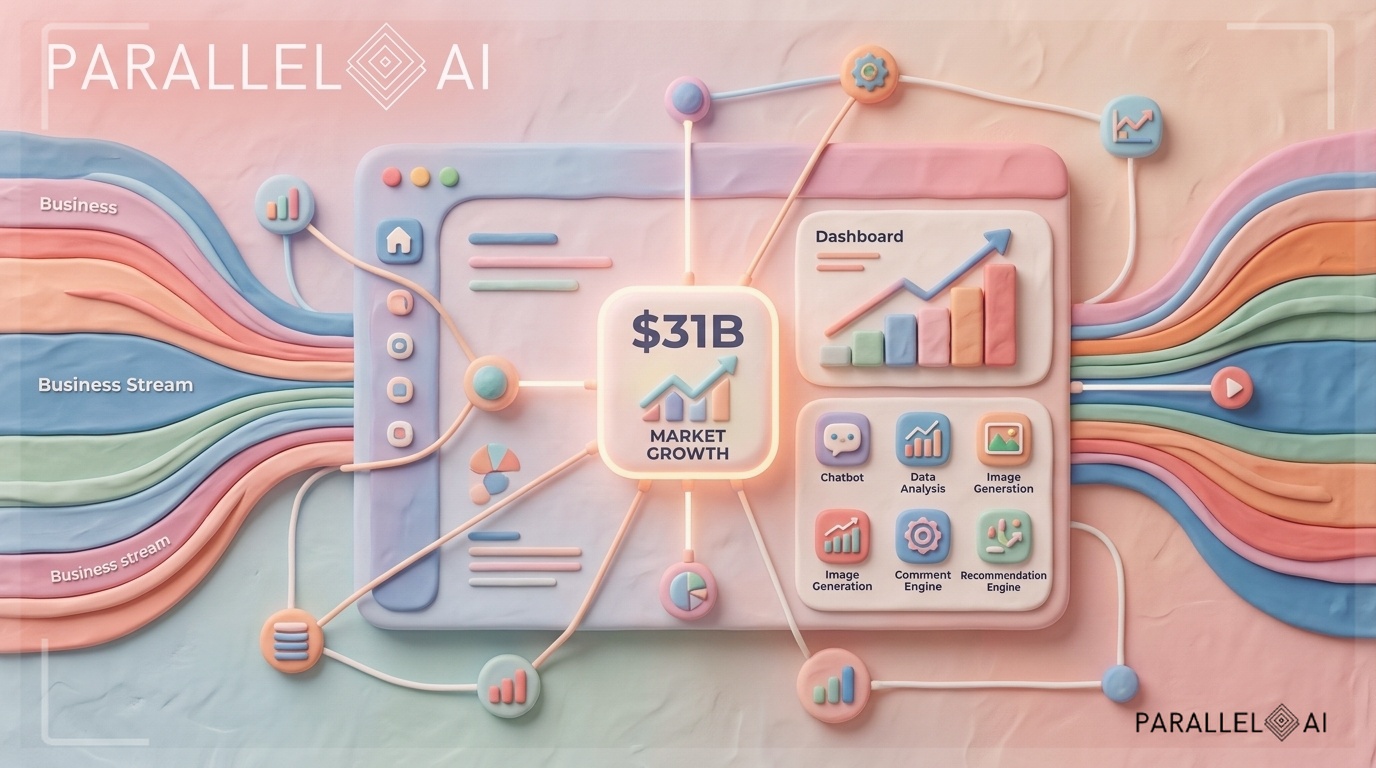
And the market opportunity is staggering. The white-label AI services market is projected to grow from $8.6 billion in 2024 to over $31 billion by 2029, a 260% expansion in just five years. For context, that’s faster growth than the entire SaaS market experienced during its breakout decade. This isn’t hype. This is capital following genuine demand.
But here’s what matters most: the window to establish yourself as an AI service provider is still wide open. The market is growing faster than supply can keep up. Most agencies haven’t added AI services to their offering. Most consultants haven’t figured out how to monetize AI. And most entrepreneurs don’t realize they can build a six-figure AI business without writing a single line of code.
If you’ve been watching AI reshape industries from the sidelines, waiting for the “right time” to make your move, that time is now. This post walks you through why, and exactly how to capitalize on it.
The Consolidation Problem That Created an Opportunity
Start with a simple observation: every business is drowning in AI subscriptions.
A typical mid-market company manages somewhere between 10 and 20 different AI tools. One for content creation. One for email. One for outreach. One for customer support. One for data analysis. One for video generation. Each tool costs $20 to $500 per month. Each requires separate logins, separate integrations, and separate learning curves. The total bill? Often $5,000 to $15,000 monthly, for tools that frequently overlap in function and create more friction than they solve.
This is the problem that created the white-label AI opportunity.
Business leaders are exhausted. They want a unified platform, one that handles content creation, lead generation, customer support, and knowledge integration under a single roof. They want it secure, private, and branded as their own solution. They want it fast to implement and simple to use.
And they’re willing to pay for it.
According to Marcus Lin, VP of Operations at SaaS Growth Alliance, “Tool sprawl is costing mid-market teams 15-20% of their operational budget. Consolidation isn’t just a cost play; it’s a speed-to-market advantage.” Companies replacing seven or more fragmented AI subscriptions with a unified platform report 30-50% cost reductions and 5-10x productivity gains within 90 days.
That gap, between what companies need and what they’re currently getting, is where the white-label AI agency opportunity lives.
Why Now? Three Catalysts Converging
1. Model Democratization
Three years ago, accessing advanced AI models required significant technical infrastructure. Today, APIs make enterprise-grade AI accessible to anyone with a credit card. GPT-4, Claude 3, Gemini, Grok, and DeepSeek are all available through unified platforms. The moat around “owning” AI models has collapsed. What matters now is integration, customization, and the ability to package AI into outcomes clients actually care about.
This democratization is the green light for non-technical founders. You don’t need to train models. You don’t need machine learning expertise. You need to understand your market, recognize a problem, and assemble the right tools into a branded solution.
2. Enterprise Compliance Requirements
Consumer AI tools like ChatGPT train on user data. They’re not GDPR compliant. They don’t encrypt data at rest. They’re not suitable for handling sensitive business information. Yet companies need AI today, not after a two-year procurement process.
White-label platforms that offer enterprise-grade security, AES-256 encryption, strict no-training-on-customer-data policies, GDPR/CCPA compliance, and on-premise deployment options, are filling that gap. According to TechTrust Compliance Survey data, 74% of B2B buyers cite data privacy and no-training policies as non-negotiable when selecting AI vendors.
For agencies, this means your clients get secure, compliant AI without the enterprise price tag. You deliver peace of mind alongside intelligence.
3. The Proven Business Model
White-label AI agencies are no longer theoretical. Real businesses are already generating real revenue. Marketing agencies are launching $3,000/month content retainers. Consulting firms are scaling from 3 clients to 12 using white-label AI, maintaining 95% retention. SaaS founders are acquiring 200+ paying users in their first quarter.
These aren’t outliers. According to the Agency Growth Index 2026, 68% of digital agencies plan to add AI-powered services to their offerings. The infrastructure exists. The demand exists. What’s missing is execution.
The Three Paths to White-Label AI Revenue
Path 1: Agency Owner Adding AI Services
If you already run a marketing, SEO, or social media agency, white-label AI is a horizontal expansion that deepens client relationships and increases account value.
The play: Package Parallel AI’s content engine as a premium content production service. Instead of delivering one blog post per month, deliver four. Instead of social copy for one channel, deliver for five. Your costs don’t scale. Your margins expand. Your client retention improves because you’re delivering more value.
Real math: A marketing agency charges $2,000/month for content creation. With Parallel AI, they can produce 4x the content with the same team. They either: (a) charge the same and massively improve retention, or (b) charge $4,000 and dramatically expand margins. Most do both, increasing price modestly to $2,800 and landing 3x more clients because they can actually serve them at scale.
The beauty? Your existing clients are already paying you for service. You’re just delivering it more efficiently and keeping the difference.
Path 2: Consultant Building a Standalone AI Services Business
If you’re a freelance copywriter, marketer, strategist, or consultant, white-label AI is a productization play. Instead of trading hours for dollars, you build a system that delivers value without your direct involvement in every project.
The play: A freelance copywriter typically earns $50-$150/hour. Capped. They can only write so many words per day. A copywriter using Parallel AI can generate 10x the content, quality-control it, and deliver it under their own brand, to 5 or 10 simultaneous clients instead of just one or two.
Real math: A solo copywriter builds an AI-powered content agency. They sign 8 clients at $1,500/month each ($12,000 monthly recurring revenue). Parallel AI costs them $300/month. Their time investment drops from 40 hours/week to 8 hours/week, covering quality control, client communication, and strategy. They’ve essentially created an $11,700/month recurring income stream.
Over 12 months, that’s $140,400 in revenue from a business they built themselves, without hiring, without significant capital investment, and without needing to scale headcount.
Path 3: Entrepreneur Launching a Branded AI SaaS
If you have no existing business but understand a specific market need, white-label AI platforms let you launch a branded SaaS product in weeks instead of years.
The play: A former real estate agent recognizes that real estate teams waste 20+ hours per week on administrative tasks, email responses, buyer qualification, listing descriptions, follow-up sequences. She launches an AI-powered real estate assistant using Parallel AI’s white-label solution, rebrands it as “RealEstate.AI,” and charges $500/month per user.
Real math: In month one, she acquires 10 users ($5,000 MRR). By month three, she has 40 users ($20,000 MRR). Parallel AI’s costs are fixed and tiered. Her margin per user is roughly $400/month. She’s building a SaaS business without writing a single line of code, without managing servers, and without the 18-month development cycle most SaaS founders face.
This model is already working. SaaS founders using white-label AI platforms are acquiring paying customers in weeks, not quarters.
The Mechanics: How White-Label AI Becomes Your Business
Understanding the opportunity is one thing. Knowing how to execute it is another.
With Parallel AI’s white-label solution, here’s what happens:
1. Rebrand the entire platform. Your logo. Your colors. Your domain. Your clients log into a dashboard that’s completely branded as your product. They have no idea they’re using Parallel AI underneath. From their perspective, they’re using your AI system.
2. Access unified AI capabilities. One interface connects to multiple leading AI models (GPT-4, Claude, Gemini, Grok, DeepSeek). Your clients get the best model for their specific task without managing multiple subscriptions or interfaces.
3. Integrate their knowledge. Parallel AI’s knowledge base integration lets you plug in your client’s Google Drive, Notion, or Confluence. Every AI output is grounded in their actual business data, their products, their tone, their processes. The AI gets smarter about their specific context.
4. Automate their workflows. Smart Lists build targeted prospect lists. Sequences run multi-channel outreach across email, SMS, voice, direct mail, and ads. The Content Engine produces months of copy in minutes. AI Voice and Chat Agents handle customer interactions 24/7. All of this runs under your brand.
5. Set your own pricing. Parallel AI’s white-label plan gives you access to the full platform at a fixed monthly rate (typically $297-$500/month depending on scale). You set your own pricing for clients. You keep the difference. If you charge a client $3,000/month and Parallel AI costs you $300/month, your margin is $2,700. Scale that to 10 clients, and you’ve got $27,000 in monthly recurring revenue.
6. Maintain data separation. Each client’s data is completely isolated. Your AI training doesn’t leak across accounts. Your clients’ proprietary information stays private. This is critical for compliance and trust.
The infrastructure is already built. You’re not starting from zero. You’re assembling a proven system into a branded offering.
The Economics Make Sense
Let’s ground this in real numbers.
A white-label AI agency owner with 10 clients, charging $2,000/month per client:
- Monthly recurring revenue: $20,000
- Parallel AI white-label cost: $300
- Gross margin per month: $19,700
- Annual revenue: $240,000
- Annual profit (before taxes, negligible operating costs): $236,400
That’s a six-figure business with minimal overhead. No employees. No office. No inventory. No complex infrastructure.
Now add 5 more clients (not difficult, agencies typically land 1-2 new clients per month):
- Monthly recurring revenue: $30,000
- Gross margin: $29,700
- Annual revenue: $360,000
- Annual profit: $354,600
You’re well into six figures, with a business that runs mostly on autopilot. The time investment drops significantly after the first 90 days, mostly account management and onboarding, not production.
Compare this to traditional consulting. A consultant billing $150/hour, working 40 hours/week, takes home roughly $300,000 annually, but only if they’re fully booked, which is rare. Unbilled time, sales time, and administrative overhead typically cut that number in half. A white-label AI agency owner with 10 clients generates $240,000 with 8 hours/week of effort after month one.
The unit economics are better. The time efficiency is dramatically better. The scalability is exponential.
The Timeline: From Zero to First Client
Here’s what a realistic launch timeline looks like:
Week 1: Sign up for Parallel AI’s white-label plan. Customize the branding (your logo, colors, domain). Integrate your knowledge base. You now have a functioning white-label platform with your name on it. Total time investment: 3 hours.
Week 2: Build your first client offering. Decide what service you’ll package (content creation, lead generation, customer support, or a combination). Create a one-page service description. Set a price. Total time: 4 hours.
Week 3: Launch a simple landing page. Write a few LinkedIn posts about your new offering. Reach out to 20 people in your network. Total time: 5 hours.
Week 4: Close your first client (statistically likely if you’ve properly networked). Onboard them into your white-label platform. Show them how to use it. Total time: 3 hours.
Timeline summary: You can be live with a paying customer in 30 days with roughly 15 hours of work.
By month three, if you execute consistently, you’ll likely have 3-5 paying clients. That’s $6,000-$10,000 in monthly recurring revenue. By month six, a conservative estimate puts you at 8-12 clients ($16,000-$24,000 MRR). By month 12, you’re likely looking at 15-25 clients, depending on your sales effort.
That trajectory takes you from zero to a six-figure business in under a year, without external funding, without hiring, and without needing technical skills.
What Makes This Moment Different
The white-label AI opportunity isn’t new. What’s new is the convergence of three factors that make it accessible and profitable in a way it wasn’t 18 months ago:
-
Unified platforms exist. Before, white-label AI meant building custom integrations, managing API keys, and handling complex infrastructure. Now, platforms like Parallel AI have already done that work. You rebrand and resell.
-
The market is proven. We’re past the “Is there really demand for this?” phase. Companies are actively seeking white-label AI solutions. The demand is real, measurable, and growing at 260% annually.
-
The barrier to entry has collapsed. You don’t need technical skills, startup capital, or years of development time. You need a market understanding, a willingness to sell, and access to a white-label platform. That’s genuinely different from the SaaS world of five years ago.
For solopreneurs and consultants, this moment is as close to a real shortcut as you’ll find in business. The infrastructure is built. The market is ready. The unit economics work. What’s missing is execution.
The Risks Worth Acknowledging
This isn’t a guaranteed path. It’s an opportunity. Like any business, it requires:
Sales skills: You need to actually close clients. That means talking to prospects, understanding their pain points, and explaining how your service solves a real problem. If you’re not comfortable selling, you’ll struggle regardless of how good your platform is.
Client management: Running a service business means managing expectations, delivering consistently, and handling support requests. This is not passive income. It’s recurring revenue, which is different.
Market fit: Not every niche will support $2,000+ monthly AI retainers. Some markets are price-sensitive. You need to pick a niche where your target clients have real budget and real pain around the problems your service solves.
Competition: As the white-label AI market grows, more players will enter. Early movers have a significant advantage, but there’s still room for multiple successful operators. The market is large enough, and most people won’t execute.
These aren’t show-stoppers. They’re just realities of running a business. The people who succeed in white-label AI won’t be those who simply sign up and wait for clients. They’ll be those who actively sell, actively learn, and actively improve.
Getting Started: The Practical Next Step
If this resonates, here’s exactly what to do:
Step 1: Go to parallellabs.app and sign up for the free plan. Spend 15 minutes exploring the platform. Get a feel for the interface, the capabilities, and the white-label customization options.
Step 2: Download the free “AI Agency Launch Checklist” (available on the Parallel AI website). This 10-page guide walks you through niche selection, pricing strategy, client acquisition, and the first 90 days of operation.
Step 3: Join the Parallel AI community (Slack, forum, or user group). Talk to existing white-label agency owners. Ask them what worked, what didn’t, and what they’d do differently. That peer insight is invaluable.
Step 4: If you’re serious, upgrade to Parallel AI’s white-label plan ($297-$500/month depending on scale). Customize your branding. Build your first service offering. Set a goal to reach out to 20 prospects in your network within the first two weeks.
That’s it. You don’t need a business plan. You don’t need investor funding. You don’t need months of preparation. You need clarity on what you’re selling, confidence that the market wants it, and willingness to take the first call.
The $31 billion white-label AI market isn’t abstract. It’s real companies solving real problems and generating real revenue. The question is whether you’ll be one of them.
The infrastructure exists. The market is proven. The economics work. The only thing between you and a six-figure AI business is the decision to start.
Related reading
- Top 10 White-Label AI Platforms Compared: The 2026 Guide to Building Your AI Business Without Code
- White-Label AI Agencies: The $15K/Month Opportunity
- Botpress vs Parallel AI: Which White-Label Platform Actually Delivers Complete Business Automation for Agencies in 2025?
- Botsonic vs Parallel AI: Which White-Label Platform Delivers Complete Business Automation Beyond Chatbots for Agencies in 2025?