
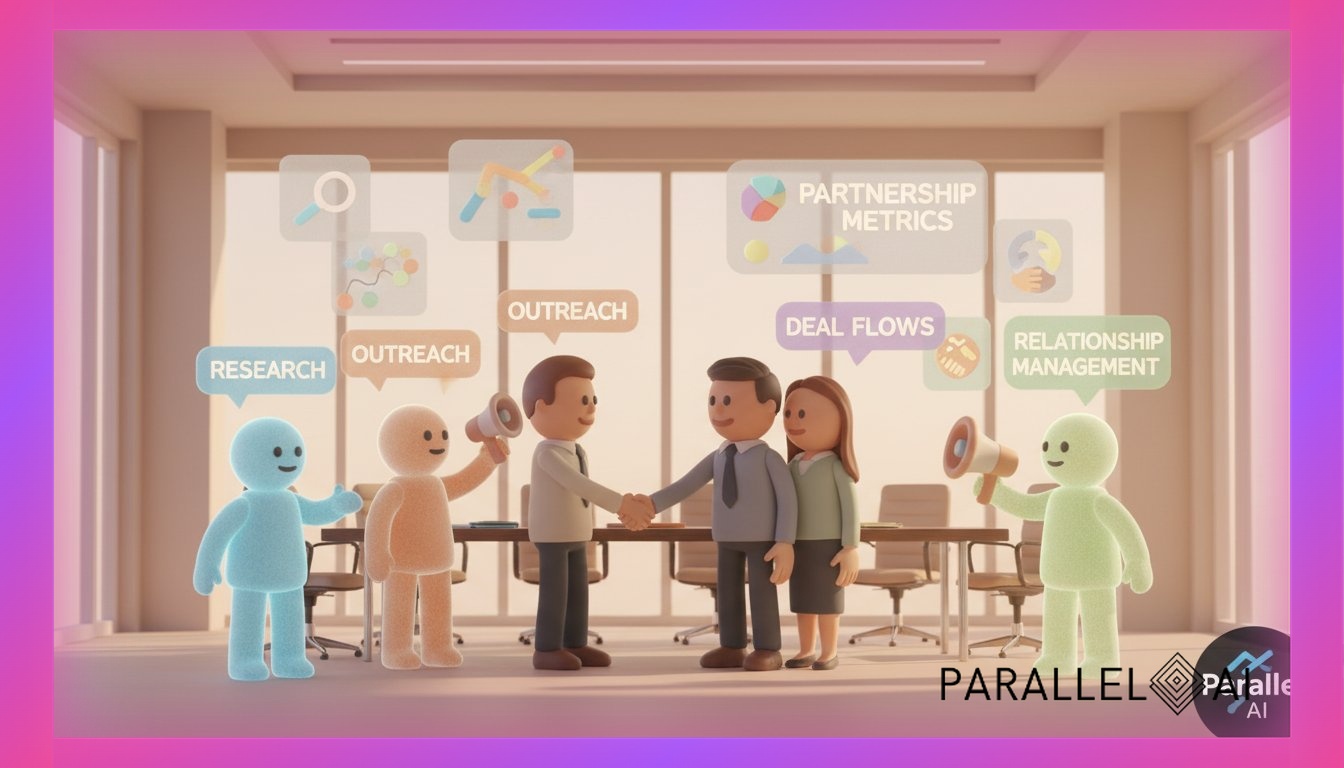
The enterprise partnership landscape shifted dramatically in early 2026. While competitors wrestled with fragmented AI tools and $95,000+ BDR salaries, forward-thinking solopreneurs discovered something remarkable: multi-agent AI systems that handle complex, strategic business development at a fraction of traditional costs.
The numbers tell a compelling story. IDC predicts 45% of organizations will orchestrate AI agents at scale by 2030, but the revolution is already happening. Solopreneurs deploying AI BDR platforms are securing enterprise contracts worth $50,000-250,000 over three years—deals that were previously inaccessible without dedicated business development teams.
This isn’t about replacing human intuition. It’s about augmenting strategic capacity in ways that level the playing field between solo consultants and established agencies.
The AI BDR Revolution: Beyond Simple Automation
Traditional Business Development Representatives focus on strategic partnerships, enterprise deals, and complex sales cycles requiring 6-18 months of sustained engagement. The challenge? A competent BDR commands $95,000+ in base salary, plus 10-20% commission on closed deals—an investment most solopreneurs simply cannot justify.
AI BDR platforms in 2026 have evolved from reactive chatbots to sophisticated multi-agent systems (MAS) that orchestrate complex workflows across research, outreach, relationship nurturing, and stakeholder coordination. According to Forrester’s 2026 predictions, these systems are fundamentally changing business models and workplace culture in enterprise software.
The distinction matters. While AI SDRs excel at high-volume transactional outreach, AI BDRs specialize in:
- Strategic Account Selection: AI-powered research identifying ideal enterprise partners based on timing signals, organizational fit, and budget availability
- Multi-Stakeholder Engagement: Mapping decision-makers across organizations and personalizing outreach for CFOs, CTOs, and VPs simultaneously
- Long-Cycle Nurture: Sustaining meaningful engagement over months with value-add touchpoints, not generic follow-ups
- Partnership Intelligence: Analyzing industry trends, competitive landscapes, and strategic opportunities
FPT Software’s implementation for a Canadian insurance company demonstrated the potential: their AI platform reduced development cycles by 60% and cut rework by 50%, showcasing how sophisticated AI systems deliver measurable enterprise-grade results.
The Hidden Opportunity Cost of Manual Business Development
Most solopreneurs focus exclusively on small to mid-market deals because enterprise partnerships seem financially out of reach. The math appears simple: you can’t afford a $95,000 BDR salary, so you avoid enterprise opportunities.
But this creates a devastating opportunity cost:
- Average small deal: $5,000-15,000 annually
- Average enterprise partnership: $50,000-250,000 over 3 years
- Strategic partnership lifetime value: Often 5-10x higher than transactional clients
Solopreneurs leaving 60-70% of potential revenue on the table aren’t making a strategic choice—they’re operating within outdated constraints. The emergence of AI BDR platforms removes these limitations entirely.
Consider the traditional economics:
– BDR base salary: $95,000/year
– Commission structure: 10-20% ($15,000-30,000 additional)
– Tools and training: $5,000-8,000/year
– Total annual cost: $115,000-133,000
– Time to productivity: 6-9 months
For a solopreneur generating $150,000-300,000 annually, this investment is prohibitive. Even if affordable, it fundamentally changes the business model and introduces management complexity.
Building AI BDR Agents on Unified Platforms: The Parallel AI Approach
The 2026 AI BDR landscape reveals a critical insight: tool fragmentation kills strategic momentum. Solopreneurs attempting to cobble together ChatGPT Plus for messaging, separate CRM systems, sales intelligence tools, and outreach platforms create data silos that undermine the continuity enterprise relationships require.
Unified AI automation platforms solve this through consolidation and context preservation. Here’s how solopreneurs are deploying AI BDR agents that compete with enterprise teams:
Strategic Account Research and Intelligence
Enterprise BDR requires deep account intelligence, not spray-and-pray outreach. AI agents built on platforms with integrated knowledge bases can:
- Synthesize data from Google Drive, Confluence, and Notion to build comprehensive account profiles
- Access multiple AI models (OpenAI, Anthropic, Gemini, Grok, DeepSeek) for different research tasks
- Utilize large context windows—up to 1 million tokens—to maintain full account history and industry context
- Generate timing signals based on news, funding rounds, leadership changes, and competitive movements
The advantage over fragmented tools is substantial. Instead of manually copying data between platforms and losing context, AI BDR agents maintain a unified intelligence layer that informs every interaction.
Multi-Stakeholder Orchestration at Scale
Enterprise deals involve an average of 6-10 decision-makers. Each requires personalized engagement that speaks to their specific priorities:
- CFOs need ROI models and budget justification
- CTOs require technical specifications and integration roadmaps
- VPs of Operations want implementation timelines and change management plans
AI BDR platforms with omni-channel capabilities orchestrate this complexity by:
- Mapping organizational structures and identifying key stakeholders
- Creating role-specific messaging that resonates with each decision-maker’s priorities
- Maintaining context-aware conversations across email, LinkedIn, SMS, and chat
- Coordinating touchpoints to avoid message fatigue while sustaining engagement
DeepSales, which received U.S. Congressional recognition at CES 2026 for disrupting go-to-market execution, demonstrates how AI transforms multi-stakeholder coordination from impossible to systematic.
Long-Cycle Nurture Sequences That Build Relationships
Enterprise sales cycles average 6-18 months. Generic “checking in” emails destroy credibility. AI BDR agents on unified platforms excel at sustained value delivery:
- Content Automation Engines generate personalized case studies, industry reports, and competitive analyses specific to each account
- Smart Sequences orchestrate multi-month engagement with strategic touchpoints (not just reminders)
- Multi-Channel Continuity maintains conversation threads across platforms—a LinkedIn comment flows naturally into an email exchange and phone conversation
- Knowledge Integration ensures every interaction references previous discussions and demonstrates deepening expertise
The difference between tools and platforms becomes critical here. Fragmented systems lose thread continuity. A conversation started in one tool doesn’t inform interactions in another. Unified platforms maintain context across the entire 6-18 month journey.
Value Demonstration Through Thought Leadership
Enterprise buyers demand proof of expertise before granting meetings. AI BDR platforms enable solopreneurs to produce thought leadership at scale:
- Industry-specific insights and trend analyses
- Customized ROI calculators and business case templates
- Whitepapers addressing specific pain points
- Personalized competitive analyses
This isn’t generic content generation. Advanced AI BDR systems access your knowledge base—case studies, client successes, proprietary methodologies—and synthesize this into contextually relevant materials for each target account.
According to industry data, knowledge-based AI approaches achieve 83% higher engagement rates than generic outreach. For enterprise deals where credibility determines success, this differential is decisive.
Real Results: The 240+ Monthly Meeting Framework
What does effective AI BDR deployment actually deliver? The metrics reveal the transformation:
Monthly Performance:
– 240 qualified enterprise meetings = 8 per day across all accounts
– Enterprise meeting-to-opportunity rate: 40-50% (96-120 opportunities/month)
– Opportunity-to-proposal rate: 25% (24-30 proposals/month)
– Proposal-to-close rate: 15-20% (3.6-6 new enterprise deals/month)
Revenue Impact:
– Average enterprise deal value: $25,000-50,000
– Monthly revenue from new deals: $90,000-300,000
– Annual run rate: $1.08M-3.6M
Compare this to alternative approaches:
Manual BDR (solopreneur): 20-30 meetings/month limited by time constraints
Traditional BDR hire: 60-80 meetings/month constrained by single-person capacity
AI BDR with fragmented tools: 100-140 meetings/month hindered by integration friction
AI BDR with unified platform: 240-320 meetings/month enabled by full automation
The economics are transformative. A solopreneur investing $99-297/month in a unified AI BDR platform can compete directly with agencies spending $115,000+ on traditional business development teams.
Enterprise Security: The Non-Negotiable Requirement
Large accounts demand security certifications and data protection that consumer-grade AI tools cannot provide. Common concerns include:
- “Is my client data secure?”
- “Will AI training use my proprietary information?”
- “What about GDPR, CCPA, and SOC 2 compliance?”
Enterprise-grade AI BDR platforms address these through:
- AES-256 encryption and TLS protocols for data in transit and at rest
- On-premise deployment options for organizations with strict data residency requirements
- Single sign-on (SSO) integration for centralized access management
- Privacy-first commitments ensuring data is never used for model training
- API access enabling custom security implementations
These capabilities aren’t just checkboxes—they’re table stakes for competing in enterprise markets. Solopreneurs using platforms without these features automatically disqualify themselves from high-value opportunities.
The 90-Day AI BDR Deployment Roadmap
Successful AI BDR implementation follows a structured progression:
Month 1: Foundation and Strategic Planning
– Week 1-2: Platform setup, knowledge base integration, ideal customer profile definition
– Week 3-4: Account selection (10-15 target enterprises), stakeholder mapping, sequence design
Month 2: Deployment and Optimization
– Week 5-6: Launch first AI BDR campaigns, monitor engagement metrics
– Week 7-8: Refine messaging based on response data, optimize sequences
Month 3: Scale and Revenue Generation
– Week 9-10: Expand to 30-50 target accounts
– Week 11-12: Implement white-label offerings, onboard first BDR service client
Expected Milestones:
– Month 1: 15-25 qualified meetings
– Month 2: 60-100 qualified meetings
– Month 3: 180-240 qualified meetings
– Month 4+: 240-320+ qualified meetings at full scale
ROI Timeline:
– Investment: $99-297/month (vs. $115K+ for traditional BDR)
– First enterprise meeting: 30-60 days
– Payback period: First enterprise deal typically covers 12-24 months of platform costs
The White-Label Revenue Multiplier
Sophisticated solopreneurs recognize an additional opportunity: offering AI BDR services to mid-market clients who also cannot afford traditional business development teams.
White-label AI BDR platforms enable:
- Branded Service Offerings: Position AI BDR capabilities as your proprietary system
- Recurring Revenue Streams: $5,000-15,000/month per client for managed BDR services
- Scalable Capacity: Serve multiple clients without hiring
- High Margins: 70-85% margins on white-label AI BDR services
Financial Model:
– 3 white-label BDR clients at $8,000/month = $24,000 monthly recurring revenue
– Annual revenue from white-label alone: $288,000
– Combined with own enterprise deals: $500K-1M+ total annual revenue
Consultants building BDR service practices report $50K-150K in annual revenue within 12-18 months of deployment.
2026 and Beyond: Predictive Intelligence and Autonomous Deal Management
The AI BDR landscape continues evolving rapidly. Emerging capabilities include:
- Predictive Analytics: AI systems forecasting optimal outreach timing based on historical patterns and real-time signals
- Deal Scoring and Prioritization: Automated ranking of opportunities by likelihood and strategic value
- Voice AI Integration: Autonomous discovery calls for initial qualification
- Sales Intelligence Integration: Real-time enrichment from platforms like ZoomInfo and Cognism
IDC’s prediction that 70% of industries will align technology investments with measurable business outcomes by 2028 signals the shift from experimental AI to production-critical systems. Platforms offering regular feature updates and new AI model integrations position users at the forefront of this evolution.
From Solo Consultant to Enterprise Player
The transformation is profound: solopreneurs who previously avoided enterprise deals are now actively pursuing Fortune 500 partnerships. The constraints that made business development inaccessible—$95K+ salaries, 6-9 month ramp times, management complexity—have dissolved.
Unified AI BDR platforms deliver:
- Enterprise capability without enterprise cost: $99-297/month vs. $115K+ annually
- Strategic capacity at scale: 240+ monthly meetings vs. 20-30 manual attempts
- Competitive differentiation: Enterprise-grade security and multi-stakeholder orchestration
- Revenue diversification: White-label BDR services create additional income streams
The competitive advantage compounds over time. While competitors continue manual prospecting or wrestle with fragmented tools, AI BDR users systematically build enterprise pipelines that generate 6-7 figure partnerships.
According to market research, 30%+ of businesses are adopting AI for strategic sales by end of 2026. The window for competitive advantage is closing. Solopreneurs who deploy AI BDR capabilities now position themselves ahead of the curve—accessing enterprise markets while competition remains constrained by outdated approaches.
The question isn’t whether AI BDR systems will dominate business development. Industry data confirms this trajectory. The question is whether you’ll deploy these capabilities while the competitive advantage remains substantial, or wait until they become table stakes and the differentiation disappears.
For solopreneurs ready to compete at the enterprise level, unified AI BDR platforms offer the strategic capacity, security infrastructure, and deployment simplicity that make $100K+ partnerships systematically achievable. Start with targeted account selection, build your first AI BDR agent, and watch as enterprise opportunities that once seemed impossible become your new competitive baseline.
Related reading
- Top 10 AI BDR Platforms of 2026
- AI BDR Implementation: How Solopreneurs Are Building Business Development Agents That Generate Enterprise-Level Pipeline Without Six-Figure Salaries or Complex Sales Infrastructure
- AI BDR Systems in 2026: How Solopreneurs Are Building Sophisticated Partnership Development Engines That Close Enterprise Deals Without $95K Salaries
- AI BDR Blueprint: How Solopreneurs Are Building 24/7 Business Development Agents That Generate 180+ Qualified Opportunities Monthly (Without Six-Figure BDR Salaries or Sales Team Overhead)