
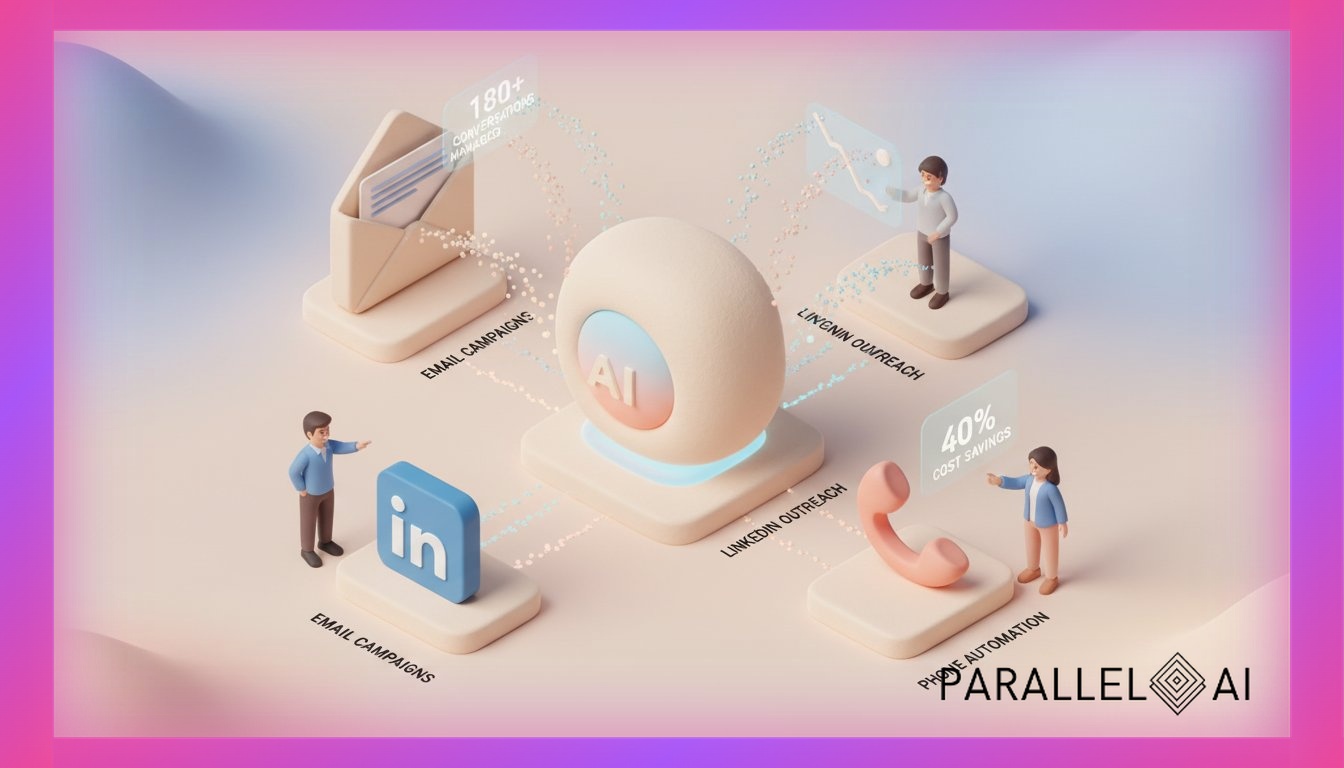
The sales development landscape just shifted dramatically. While 81% of sales teams scrambled to integrate AI into their strategies by early 2026, a quiet revolution emerged among solopreneurs and micro-agencies. They’re not just using AI SDR platforms—they’re building custom, multi-channel sales agents that operate 24/7, generating qualified conversations at a fraction of traditional costs.
The difference? They’re deploying these agents without enterprise price tags, without technical teams, and without the complexity that’s kept AI SDR capabilities locked behind corporate walls. Here’s how the AI SDR architecture evolved in 2026—and how independent professionals are leveraging platforms like Parallel AI to compete at enterprise scale.
The AI SDR Market Transformation: What Changed in 2026
The AI SDR space exploded with innovation over the past 18 months. Market adoption crossed the 81% threshold among sales teams, but the real story isn’t just adoption—it’s democratization.
Traditional AI SDR platforms like Gong, Outreach, and 11x.ai advanced their capabilities significantly. Gong now leverages over 40 proprietary AI models trained on billions of sales interactions. 11x.ai introduced Alice, an autonomous AI-powered SDR that operates with minimal human intervention. Floworks released Alisha, powered by their ThorV2 engine boasting 90.1% accuracy—outperforming mainstream models like GPT-4 and Claude-3 in sales-specific scenarios.
But here’s the gap these enterprise platforms created: they’re designed for companies with dedicated sales teams, $50K+ annual budgets, and technical resources to manage complex integrations. The solopreneur running a consulting practice or the micro-agency serving 15 clients? They’re priced out and overwhelmed by feature bloat they’ll never use.
That’s where the 2026 shift occurred. Platforms emerged that let independent professionals build AI SDR agents tailored to their exact needs—without developer resources, without enterprise contracts, and without paying for capabilities designed for 500-person sales teams.
What AI SDRs Actually Do in 2026: Beyond Automated Emails
If you think AI SDRs are just glorified email automation, you’re working with 2023 technology. Modern AI SDR agents in 2026 orchestrate across multiple channels simultaneously, make autonomous decisions about engagement timing, and personalize at a level that’s indistinguishable from human outreach.
Here’s what today’s AI SDR agents handle:
Intelligent Lead Qualification: They analyze prospect behavior across touchpoints, scoring leads based on engagement patterns, company signals, and intent data. No more manual list scrubbing or guessing which prospects are worth pursuing.
Multi-Channel Orchestration: The best AI SDRs coordinate outreach across email, LinkedIn, SMS, voice calls, and even chat platforms. They don’t just blast messages—they adapt channel selection based on prospect preferences and response patterns.
Hyper-Personalization at Scale: Using company knowledge bases, recent news, industry context, and conversation history, AI SDRs craft messages that reference specific pain points and relevant case studies. This isn’t mail merge with name tags—it’s contextual, timely communication.
Autonomous Conversation Management: Advanced AI SDRs can handle objections, answer qualification questions, and even book meetings without human intervention. They know when a conversation requires human escalation and when they can resolve it independently.
Predictive Engagement Timing: Leveraging historical engagement data, AI SDRs optimize send times, follow-up cadences, and channel switching to maximize response rates. They’re not following static sequences—they’re adapting in real-time.
CRM Integration and Data Enrichment: Seamless bi-directional sync with CRM systems ensures every interaction is logged, every lead is updated, and sales teams always have current information without manual data entry.
The performance benchmarks are compelling. Organizations using modern AI SDR platforms report 30% improvement in response rates over traditional methods, 60% reduction in time-to-first-contact, and 25% higher conversion rates from qualified leads to opportunities.
The Solopreneur Problem: Enterprise Tools, Solo Budgets
Here’s the reality for most independent professionals and micro-agencies in 2026: they recognize AI SDR’s potential, but the economics don’t work.
A human SDR costs $85,000+ annually when you factor in salary, benefits, training, and tool subscriptions. For a solopreneur or three-person agency, that’s not just expensive—it’s impossible. You can’t justify an $85K expense when you’re still building your client base.
So they turn to AI SDR platforms, only to discover:
- Enterprise pricing models: $500-$2,000+ monthly for platforms designed for 50+ person teams
- Per-seat or per-contact fees: Usage-based pricing that punishes scale and creates unpredictable costs
- Complex integration requirements: Technical setup that requires developer resources
- Feature bloat: Paying for sales forecasting, territory management, and team analytics they don’t need
- Long-term contracts: Annual commitments that lock them into platforms before proving ROI
The result? Solopreneurs either skip AI SDR entirely (falling behind competitors who’ve adopted it), cobble together fragmented tools (creating workflow chaos), or overpay for enterprise platforms they’re using at 20% capacity.
This is the gap Parallel AI addresses directly.
Building Your AI SDR on Parallel AI: The Solopreneur Architecture
Parallel AI flips the AI SDR model. Instead of buying a pre-packaged SDR tool designed for enterprise teams, you build a custom AI SDR agent tailored to your exact business—your ideal customer profile, your messaging, your sales process, your channels.
Here’s the architecture solopreneurs are deploying:
The Foundation: AI Knowledge Base Integration
Your AI SDR needs context—information about your services, case studies, pricing, common objections, industry insights, and client success stories. Parallel AI integrates directly with Google Drive, Confluence, and Notion, pulling this information into your AI agent’s knowledge base.
This means when your AI SDR engages a prospect, it’s not working from generic templates. It’s referencing your actual client results, your specific service packages, and your unique positioning. The conversations sound authentically like your business because they’re trained on your business.
Solopreneurs are uploading:
– Service descriptions and pricing guides
– Case studies and client testimonials
– Industry research and whitepapers
– Objection handling scripts
– Qualification criteria and ideal customer profiles
– Company positioning documents
The AI agent accesses this knowledge base in real-time during conversations, ensuring accurate, relevant responses without you manually updating scripts every time your services evolve.
Multi-Channel Outreach Orchestration
Here’s where Parallel AI’s architecture shines for AI SDR deployment. You’re not limited to email-only automation. You can build agents that coordinate across:
Email Sequences: Automated, personalized email campaigns that adapt based on engagement. Your AI SDR monitors opens, clicks, and replies, adjusting follow-up timing and messaging accordingly.
LinkedIn Outreach: Connection requests, InMail messages, and profile engagement—all coordinated with your email sequences. If a prospect ignores emails but engages on LinkedIn, your AI SDR shifts channel focus.
SMS and Messaging: For time-sensitive follow-ups or prospects who prefer text communication, your AI SDR can deploy SMS messages as part of coordinated sequences.
Voice Calls: Advanced implementations can include AI voice capabilities for phone outreach, handling initial qualification calls and appointment setting.
Chat and Instant Messaging: Website chat integration allows your AI SDR to engage inbound visitors in real-time, qualifying them before they leave your site.
The critical capability here is orchestration. Your AI SDR doesn’t just send messages on each channel independently—it coordinates them based on prospect behavior. Email → LinkedIn → Email → SMS becomes an intelligent sequence, not a spam barrage.
One marketing consultant using Parallel AI described their AI SDR’s multi-channel approach: “It starts with a value-first email referencing a recent article the prospect’s company published. If no response in three days, it sends a LinkedIn connection request with a personalized note. If they accept but don’t reply, it follows up via LinkedIn message with a case study relevant to their industry. If they engage there, it shifts back to email for scheduling. The AI handles all of this—I just review the conversations it flags for my attention.”
Smart Lists and Dynamic Segmentation
Parallel AI’s Smart Lists capability allows your AI SDR to maintain dynamic prospect segments that update automatically based on engagement and characteristics.
You can create lists like:
– “Engaged but not qualified” (replied to outreach but haven’t met qualification criteria)
– “High-intent prospects” (visited pricing page, downloaded resources, engaged multiple times)
– “Dormant opportunities” (qualified previously but conversation stalled)
– “Referral candidates” (successful clients who might introduce others)
Your AI SDR treats each segment differently, deploying appropriate messaging and cadences. High-intent prospects get more frequent, direct outreach. Dormant opportunities receive periodic check-ins with new case studies or offers. Referral candidates get relationship-nurturing content.
This dynamic segmentation ensures your AI SDR is always delivering contextually appropriate outreach, not one-size-fits-all sequences.
Autonomous Qualification and Routing
One of the biggest time-savers: your AI SDR qualifies leads automatically using criteria you define, then routes qualified conversations to you while continuing to nurture others.
You set qualification parameters:
– Company size and industry
– Budget indicators
– Timing and urgency signals
– Decision-maker access
– Project scope alignment
When a prospect meets these criteria through conversation, your AI SDR escalates to you with a summary: “Qualified lead: 50-person B2B SaaS company, looking for marketing automation implementation, $30K budget, decision-maker engaged, wants proposal within two weeks.”
For prospects who don’t qualify yet, your AI SDR keeps them warm with value content, periodic check-ins, and relationship building—without consuming your time.
A solo sales consultant shared their results: “My AI SDR on Parallel AI handles about 200 initial conversations monthly. Of those, it qualifies 25-30 that meet my criteria and routes them to me. The other 170? It keeps them engaged with relevant content so when their situation changes, they’re already familiar with my services. I’ve closed three clients from prospects my AI SDR nurtured for 4+ months before they were ready.”
Content Automation for Personalized Outreach
Parallel AI’s Content Engine integrates with your AI SDR to generate personalized messaging at scale. This isn’t template-based—it’s dynamic content creation based on prospect context.
Your AI SDR can:
– Draft personalized email sequences referencing prospect-specific pain points
– Create custom case study summaries relevant to each prospect’s industry
– Generate follow-up messages that reference previous conversation context
– Produce LinkedIn posts and comments that engage your target audience
– Write proposal summaries and qualification questions
The content quality is what separates modern AI SDRs from older automation. Recipients can’t tell they’re engaging with an AI because the messages are contextual, relevant, and conversational—not obviously templated.
White-Label Deployment for Agency Revenue
Here’s where Parallel AI’s architecture creates a revenue opportunity many solopreneurs miss: white-labeling.
You can build AI SDR agents on Parallel AI, then deploy them for clients under your brand. A marketing agency might offer “AI-powered lead generation services” as a monthly retainer, using Parallel AI’s infrastructure behind the scenes.
The economics are compelling:
– You pay $200-500/month for Parallel AI (depending on usage)
– You charge clients $2,000-5,000/month for “AI SDR services”
– Your margin: $1,500-4,700 monthly per client
Multiply this across 5-10 clients, and you’ve built a six-figure revenue stream without hiring a sales team. You’re essentially reselling AI SDR capabilities you’ve configured on Parallel AI, packaged as a done-for-you service.
One digital marketing agency founder explained: “We built an AI SDR agent for ourselves first, testing and optimizing it for our own lead generation. Once we proved it worked—we were generating 40+ qualified conversations monthly—we packaged it as a service for clients. Now we run AI SDR agents for 12 clients, each paying $3,500/month. That’s $42K monthly recurring revenue from a capability we built once on Parallel AI.”
Real Implementation: 30-Day AI SDR Launch Plan
Theory is interesting. Implementation is what matters. Here’s the 30-day roadmap solopreneurs are using to build and deploy AI SDR agents on Parallel AI:
Week 1: Foundation and Knowledge Base
– Day 1-2: Sign up for Parallel AI, connect your email and CRM
– Day 3-4: Upload service documents, case studies, and positioning materials to knowledge base
– Day 5-7: Define ideal customer profile, qualification criteria, and target segments
Week 2: Agent Configuration and Messaging
– Day 8-10: Build your AI SDR agent in Parallel AI, configuring personality and capabilities
– Day 11-12: Develop initial email sequences and LinkedIn message templates
– Day 13-14: Test messaging with 10-20 prospects, refine based on responses
Week 3: Multi-Channel Setup and Integration
– Day 15-17: Configure LinkedIn integration and connection request automation
– Day 18-19: Set up Smart Lists for different prospect segments
– Day 20-21: Build qualification workflows and escalation rules
Week 4: Launch and Optimization
– Day 22-24: Launch initial campaign to 50-100 prospects
– Day 25-27: Monitor conversations, response rates, and qualification accuracy
– Day 28-30: Optimize messaging, timing, and sequences based on early results
By day 30, you should have:
– An AI SDR agent handling 50-100 active prospect conversations
– 10-15 qualified leads routed to you
– Clear data on which messages and sequences perform best
– Refined qualification criteria based on actual conversations
From there, you scale. Month two, you expand to 200-300 prospects. Month three, 500+. The AI SDR handles the volume increase without additional cost or complexity.
Performance Benchmarks: What to Expect
Setting realistic expectations is critical. Here’s what solopreneurs using Parallel AI for AI SDR deployment are achieving:
Response Rates:
– Cold email sequences: 8-15% response rate (vs. 2-5% for generic automation)
– LinkedIn outreach: 15-25% connection acceptance, 10-18% message response
– Multi-channel coordinated sequences: 20-30% total engagement rate
Qualification and Conversion:
– 150-200 monthly outreach conversations → 25-35 qualified leads
– Qualified leads → 5-8 sales conversations
– Sales conversations → 1-2 new clients monthly
Time Investment:
– Initial setup: 20-25 hours over 30 days
– Ongoing management: 3-5 hours weekly (reviewing qualified leads, optimizing sequences)
– Time saved vs. manual outreach: 15-20 hours weekly
Cost Comparison:
– Human SDR: $85,000+ annually
– Enterprise AI SDR platform: $12,000-24,000 annually
– Parallel AI for AI SDR: $2,400-6,000 annually
– Savings: $79,000-82,600 annually vs. human SDR
One business consultant shared specific results: “In my first 90 days with my AI SDR on Parallel AI, I generated 47 qualified conversations from 380 prospects contacted. That led to 11 sales calls and 3 new clients worth $42,000 in contracts. My total investment was about 30 hours of setup and configuration, plus $600 in Parallel AI subscription. That’s a 70:1 ROI even before factoring in the ongoing pipeline my AI SDR continues to build.”
Compliance and Best Practices: Staying Legal While Scaling
As you deploy AI SDR capabilities, compliance isn’t optional—it’s essential. Here’s how to stay legal while scaling:
Email Compliance (CAN-SPAM, GDPR):
– Always include unsubscribe links in automated emails
– Honor opt-out requests immediately (within 24 hours)
– Use accurate sender information and subject lines
– For EU prospects, ensure GDPR-compliant data handling
LinkedIn Automation:
– Stay within LinkedIn’s connection request limits (20-25 daily maximum)
– Avoid aggressive automation that triggers platform detection
– Personalize connection requests (generic mass requests get flagged)
– Use LinkedIn Sales Navigator for expanded outreach if budget allows
Data Privacy:
– Store prospect data securely with AES-256 encryption (Parallel AI provides this)
– Don’t share prospect data across clients if you’re white-labeling
– Maintain clear data retention and deletion policies
– Be transparent about AI involvement when legally required
Quality and Brand Protection:
– Review AI-generated messages before large-scale deployment
– Set up approval workflows for new sequences
– Monitor conversations regularly to catch any inappropriate responses
– Train your AI agent to escalate sensitive or complex situations to humans
Compliance isn’t just about avoiding legal issues—it’s about protecting your brand reputation and building sustainable outreach practices.
The Competitive Advantage: Why AI SDR Matters Now
If you’re a solopreneur or micro-agency still doing manual outreach in 2026, you’re competing with one hand tied behind your back. Here’s why:
Volume Asymmetry: While you’re sending 10-15 personalized emails daily, competitors with AI SDRs are sending 100-150. You can’t win on effort alone.
Response Time: AI SDRs respond to inbound inquiries and follow up on engagement within minutes. You’re responding within hours or days. Speed matters in sales.
Consistency: Your AI SDR never has a bad day, never forgets a follow-up, never gets overwhelmed. It maintains perfect consistency at scale.
Data-Driven Optimization: AI SDRs continuously improve based on performance data. Your manual approach relies on intuition and limited testing.
Client Expectations: B2B buyers increasingly expect fast, personalized, multi-channel engagement. If you’re not delivering it, competitors are.
The businesses winning in 2026 aren’t necessarily the ones with the best services—they’re the ones whose AI SDR gets to prospects first, engages them most effectively, and converts them before competitors even make contact.
Getting Started: Your AI SDR Launch Checklist
Ready to build your AI SDR on Parallel AI? Here’s your implementation checklist:
Prerequisites:
– [ ] Defined ideal customer profile with specific firmographic and behavioral criteria
– [ ] Clear value proposition and positioning documents
– [ ] 2-3 case studies or client success stories
– [ ] CRM or prospect management system (even a spreadsheet works initially)
– [ ] Initial target list of 50-100 prospects
Parallel AI Setup:
– [ ] Create Parallel AI account and connect email
– [ ] Integrate knowledge base sources (Google Drive, Notion, etc.)
– [ ] Upload service documents, case studies, and positioning materials
– [ ] Configure AI agent with appropriate personality and capabilities
– [ ] Set up CRM integration for prospect tracking
Campaign Configuration:
– [ ] Develop 3-5 email sequence variations
– [ ] Create LinkedIn connection request and message templates
– [ ] Build Smart Lists for different prospect segments
– [ ] Configure qualification criteria and routing rules
– [ ] Set up compliance safeguards (unsubscribe handling, rate limits)
Launch and Optimization:
– [ ] Test sequences with 10-20 prospects before full launch
– [ ] Monitor initial conversations and response rates
– [ ] Refine messaging based on early feedback
– [ ] Scale to 50-100 active conversations
– [ ] Establish weekly optimization routine
The barrier to entry is lower than you think. You don’t need technical expertise. You don’t need enterprise budgets. You need clarity on your target market, compelling messaging, and the willingness to let AI handle what AI does best—consistent, personalized outreach at scale.
The Future Is Already Here
AI SDR technology isn’t coming—it’s already transforming how solopreneurs and micro-agencies compete. The question isn’t whether to adopt AI SDR capabilities, but how quickly you can deploy them before competitors establish insurmountable advantages.
Platforms like Parallel AI democratized what was once exclusively enterprise technology. You can now build, deploy, and scale AI SDR agents that operate 24/7, engage hundreds of prospects monthly, and generate qualified conversations without the complexity or costs that previously made this impossible for independent professionals.
The solopreneurs winning in 2026 aren’t the ones working harder—they’re the ones who built AI SDR agents that work while they sleep, systematically filling their pipeline with qualified opportunities.
Your competitors are already building theirs. The only question is: when will you start?
Ready to build your AI SDR agent? Parallel AI offers free plans to get started—no credit card required. Connect your knowledge base, configure your first sequences, and launch your AI SDR in the next 30 days. The qualified conversations waiting in your pipeline won’t generate themselves.
Related reading
- The Top 10 AI SDR Software Platforms of 2026
- AI SDR Transformation: How Solopreneurs Are Building Autonomous Sales Agents That Generate 300+ Qualified Leads Monthly Without $85K Salaries, Enterprise CRMs, or Multi-Tool Complexity
- AI SDR Mastery: How Solopreneurs Are Building Autonomous Sales Development Agents That Generate 240+ Qualified Leads Monthly Without $85K SDR Salaries or Enterprise Tool Complexity
- AI SDR Revolution: How Solopreneurs Are Building Multi-Channel Sales Development Agents That Generate 500+ Daily Prospect Touchpoints Without $85K Salaries or Enterprise Sales Stack Complexity