
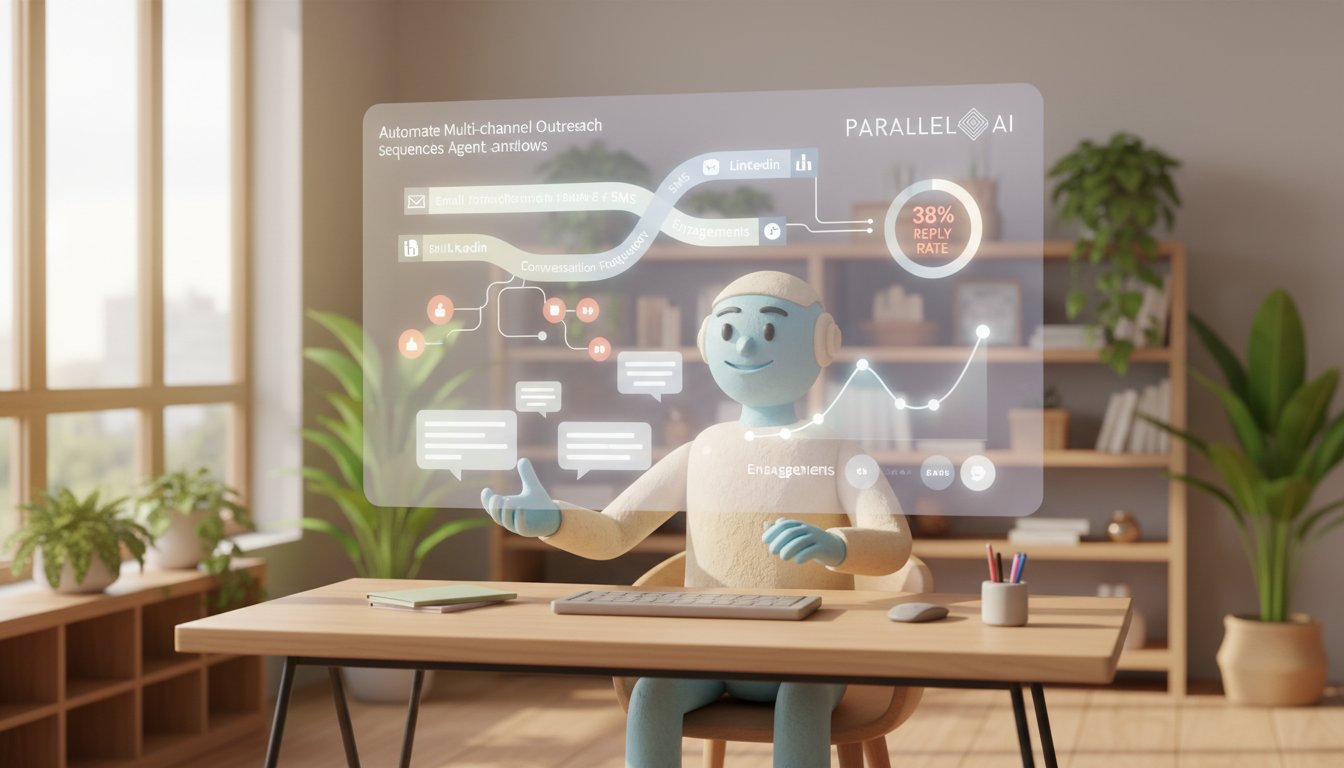
The business development landscape has reached an inflection point. While traditional BDRs command $120,000+ in total compensation annually (salary, benefits, training, and overhead), AI-powered BDR agents are generating qualified opportunities 24/7 at a fraction of the cost—with documented cases showing up to $500,000 in annual savings and 38% reply rates that rival the best human performers.
For solopreneurs and micro-agencies caught between growth ambitions and budget constraints, this isn’t theoretical innovation—it’s the difference between scaling your business or watching competitors leave you behind.
The data tells a compelling story: AI BDRs are now handling up to 70% of routine prospect inquiries autonomously, coordinating sophisticated multi-channel sequences across email, LinkedIn, SMS, voice, and chat, while maintaining the personalization and brand consistency that used to require dedicated sales teams. Companies implementing AI BDR solutions report 18x ROI within three months and 8.8x faster personalized outreach compared to manual processes.
But here’s what the platform comparison articles won’t tell you: the real transformation isn’t about replacing human BDRs—it’s about unlocking capabilities that were previously impossible for small businesses to access.
What Makes AI BDR Different from Traditional Prospecting (And Why It Matters for Your Business)
Traditional business development follows a predictable—and expensive—pattern. You hire a BDR at $60,000-$85,000 base salary, invest 2-3 months in training, purchase CRM licenses, prospecting databases, email sequencing tools, LinkedIn automation software, and analytics platforms. Total first-year cost: $120,000-$150,000 before generating a single qualified opportunity.
Then reality hits. Your BDR works 8-hour days, handles 40-60 outreach activities daily, manages one channel at a time, takes vacations, gets sick, and might leave for a competitor after you’ve invested in their development.
AI BDR agents operate differently:
24/7 availability without fatigue. While you sleep, your AI BDR researches prospects, personalizes outreach, sends sequences, qualifies responses, and schedules meetings for when you wake up.
Multi-channel orchestration at scale. A single AI BDR agent coordinates simultaneous campaigns across email (initial outreach), LinkedIn (connection requests and engagement), SMS (timely reminders), voice (automated qualifying calls), and chat (website visitor engagement)—something that would require a team of 3-5 human BDRs to execute.
Consistent quality without human variability. Every prospect receives the same level of research depth, personalization quality, and response speed. No Monday morning slumps, no burnout, no inconsistent messaging.
Instant knowledge base access. AI BDRs integrate with your Google Drive, Confluence, Notion, and other knowledge repositories, ensuring every response draws from your complete product information, case studies, pricing details, and competitive positioning—information most human BDRs struggle to retain.
The result? Documented success metrics show AI BDR platforms achieving 38% reply rates, $500K annual savings, and pipeline generation that scales with business growth rather than headcount.
The Cost Reality: AI BDR vs. Traditional BDR Total Ownership
Let’s break down what business development actually costs:
Traditional BDR Annual Cost:
– Base salary: $60,000-$85,000
– Benefits and taxes (30%): $18,000-$25,500
– Training and onboarding: $5,000-$10,000
– CRM licenses: $1,200-$2,400
– Prospecting database: $3,000-$12,000
– Email automation tools: $1,200-$3,600
– LinkedIn automation: $600-$1,200
– Analytics and reporting: $1,200-$2,400
– Total Year 1: $90,200-$142,100
AI BDR Annual Cost:
– Platform subscription: $3,000-$10,000
– Integration setup (one-time): $500-$2,000
– Knowledge base configuration: $300-$1,000
– Ongoing optimization: $1,200-$3,000
– Total Year 1: $5,000-$16,000
The math is undeniable: AI BDRs deliver 85-95% cost savings compared to traditional hiring, with the additional advantage of scaling capacity without proportional cost increases.
But cost alone doesn’t tell the complete story. The real transformation happens in what becomes possible when you remove the constraints of human capacity.
How AI BDR Agents Actually Work: From Research to Qualified Opportunity
Understanding the AI BDR workflow reveals why they’re outperforming traditional approaches:
Phase 1: Intelligent Prospect Identification
AI BDR platforms use Smart Lists technology to continuously identify and qualify prospects based on your ideal customer profile. Rather than manually building lists from databases, the AI monitors signals like:
- Company growth indicators (funding rounds, hiring patterns, expansion announcements)
- Technology stack changes (new tool adoption, platform migrations)
- Buyer intent signals (content consumption, website visits, competitor research)
- Job posting analysis (new role creation indicating budget allocation)
- Industry trend alignment (regulatory changes, market shifts)
This automated research happens continuously, ensuring your prospect list stays current without manual database searches or list purchases.
Phase 2: Deep Research and Personalization
Before sending a single message, AI BDR agents conduct comprehensive prospect research:
- Company background and recent news
- Decision-maker role and responsibilities
- Content they’ve published or engaged with
- Mutual connections and warm introduction opportunities
- Pain points indicated by their technology stack or hiring patterns
- Competitive landscape and current solution limitations
This research depth—which would take a human BDR 30-45 minutes per prospect—happens in seconds, enabling true personalization at scale.
Phase 3: Multi-Channel Sequence Orchestration
Here’s where AI BDR capabilities diverge dramatically from traditional single-channel approaches. A sophisticated sequence might look like:
Day 1: Initial email with personalized insights based on prospect research
Day 2: LinkedIn connection request with context-specific message
Day 4: Follow-up email if no response, referencing specific company initiative
Day 5: LinkedIn message to accepted connections
Day 7: SMS reminder for high-value prospects (“Saw your recent post about [topic]—quick question…”)
Day 10: Voice message or automated call offering specific value
Day 14: Final email with case study relevant to their industry
Each touchpoint is informed by previous interactions, engagement signals, and updated prospect research. If a prospect opens an email but doesn’t respond, the next LinkedIn message references the content they viewed. If they engage on social media, the sequence adapts to continue that conversation.
This level of coordination requires sophisticated workflow automation that would overwhelm manual processes—but it’s exactly what AI BDR platforms deliver natively.
Phase 4: Intelligent Qualification and Routing
When prospects respond, AI BDR agents don’t just forward emails to your inbox. They:
- Analyze response sentiment and urgency
- Ask qualifying questions based on your criteria
- Extract key information (timeline, budget, decision-making process)
- Score leads based on fit and intent
- Route high-priority opportunities to your calendar with context
- Continue nurturing medium-fit prospects automatically
- Disqualify poor fits without wasting your time
The qualification framework adapts based on your feedback, learning which characteristics predict successful deals and adjusting targeting accordingly.
Building Your AI BDR Agent with Parallel AI: The 48-Hour Implementation Blueprint
While traditional BDR hiring takes 60-90 days from job posting to productive output, Parallel AI enables complete AI BDR deployment in 48 hours. Here’s the exact process solopreneurs are using:
Hour 1-4: Foundation and Knowledge Base Setup
Connect your knowledge sources. Parallel AI integrates with Google Drive, Confluence, Notion, and other repositories where your product information, case studies, pricing, and competitive positioning live. This gives your AI BDR instant access to the same information you’d spend weeks training a human BDR to understand.
Define your ideal customer profile. Input firmographic criteria (industry, company size, revenue range), technographic signals (current tools, technology stack), and behavioral indicators (content consumption, engagement patterns). The AI uses this to build and continuously refine your prospect lists.
Upload successful examples. Provide samples of your best-performing outreach, winning proposals, and effective qualification conversations. The AI analyzes patterns in what works and incorporates those insights into its approach.
Set brand voice parameters. Configure tone (professional, conversational, technical), personality traits (consultative, direct, relationship-focused), and prohibited language to ensure every message sounds authentically like your brand.
Hour 5-12: Multi-Channel Sequence Design
Map your buyer journey. Identify typical touchpoints from awareness to qualified opportunity. Most successful AI BDR sequences include 7-12 touchpoints across 3-4 channels over 14-21 days.
Build your sequence architecture in Parallel AI’s Sequence Builder:
- Email sequences: Initial outreach, value-add follow-ups, case study shares, meeting requests
- LinkedIn sequences: Connection requests, engagement on posts, direct messages, InMail for premium accounts
- SMS sequences: High-value prospect reminders, event invitations, time-sensitive offers
- Voice sequences: Automated qualifying calls, meeting confirmations, appointment reminders
Configure response handling. Set up automated replies to common questions, qualification pathways for different response types, and escalation triggers for high-intent prospects.
Design nurture tracks. Create separate sequences for prospects who aren’t ready now but show future potential—keeping your solution top-of-mind without aggressive sales pressure.
Hour 13-24: Integration and Automation Setup
Parallel AI’s power comes from eliminating the tool fragmentation that plagues traditional sales stacks:
CRM integration: Connect your existing CRM (or use Parallel AI’s built-in pipeline management) to ensure all prospect interactions, qualification data, and opportunities sync automatically. No manual data entry, no lost information.
Calendar integration: Link your Google Calendar or Outlook so qualified prospects can book directly into your available slots without back-and-forth scheduling emails.
Communication platform integration: Connect email accounts, LinkedIn profiles, SMS capabilities, and voice systems so your AI BDR can execute multi-channel sequences from one unified platform.
Analytics dashboard configuration: Set up tracking for the metrics that matter—reply rates, qualification rates, meeting bookings, pipeline value, cost per qualified opportunity.
The key advantage: While traditional setups require integrating 5-8 separate tools (prospecting database, email sequencer, LinkedIn automation, CRM, analytics, scheduling, voice platform), Parallel AI consolidates these capabilities into one platform—eliminating integration headaches, reducing costs, and ensuring data consistency.
Hour 25-36: Quality Assurance and Testing
Send test sequences to yourself. Experience your AI BDR’s outreach as prospects will, checking for personalization accuracy, brand voice consistency, and message flow.
Review qualification logic. Test how the AI responds to different prospect replies, ensuring it asks appropriate qualifying questions and routes opportunities correctly.
Validate knowledge base accuracy. Ask your AI BDR questions about your product, pricing, and competitive advantages to confirm it’s accessing correct information from your knowledge sources.
Adjust and refine. Based on testing, fine-tune messaging, adjust qualification criteria, and optimize sequence timing.
Hour 37-48: Launch and Initial Optimization
Start with a limited audience. Launch your AI BDR to a small segment of your ideal customer profile (50-100 prospects) to validate performance before scaling.
Monitor early responses. Watch reply rates, sentiment, and qualification accuracy closely in the first 48 hours.
Implement rapid improvements. Use early feedback to adjust messaging, refine targeting, and optimize sequences based on real prospect behavior.
Scale gradually. As performance validates, expand your AI BDR’s reach to larger prospect segments, additional industries, or new buyer personas.
Within 48 hours, you’ve gone from concept to actively generating qualified opportunities—a process that would take 60-90 days with traditional BDR hiring.
Real Results: What AI BDR Performance Actually Looks Like
The documented success metrics from early adopters reveal what’s possible:
BDR.ai case study: A sales training company deployed AI BDR agents and achieved a 38% reply rate across thousands of prospects—significantly higher than the 15-25% typical for human BDRs. The AI handled connection requests, personalized messages, and profile engagement simultaneously across multiple channels.
Autobound AI implementation: Skuid reported 18x ROI within three months of deployment, with sellers ramping 8.8x faster and generating personalized emails at scale that previously required hours of manual research.
11x platform users: Companies implementing AI BDR solutions reported up to $500,000 in annual savings compared to traditional BDR teams, while maintaining or improving qualified opportunity generation.
Multi-channel performance metrics:
– Email open rates: 45-60% (vs. 20-30% for traditional cold email)
– Reply rates: 25-38% (vs. 15-25% for human BDRs)
– LinkedIn connection acceptance: 35-50% (vs. 20-35% traditional)
– Meeting booking rates: 8-15% of engaged prospects (vs. 5-10% traditional)
– Cost per qualified opportunity: $15-$45 (vs. $150-$300 traditional)
The pattern is clear: AI BDRs don’t just match human performance—they exceed it in consistency, scale, and cost-efficiency.
Why These Results Matter for Solopreneurs
For businesses operating without dedicated sales teams, these metrics translate into tangible growth:
180+ qualified opportunities monthly from a single AI BDR agent (compared to 40-80 from a human BDR working standard hours).
$1.2M+ annual pipeline generation assuming conservative close rates and average deal values—all without hiring, training, or managing sales personnel.
15-25 hours reclaimed weekly that you’d otherwise spend on manual prospecting, outreach, and qualification.
Scalable capacity that grows with your business—adding coverage for new markets, industries, or buyer personas by expanding your AI BDR’s scope rather than your payroll.
How Parallel AI Simplifies AI BDR Deployment at Scale
The fundamental challenge with AI BDR implementation isn’t the technology—it’s the complexity of integrating multiple platforms, maintaining data consistency, and coordinating workflows across fragmented tools.
Parallel AI solves this through consolidation:
All-in-One Platform Architecture
Rather than connecting separate tools for prospecting (Apollo, ZoomInfo), email sequencing (Outreach, SalesLoft), LinkedIn automation (Dux-Soup, Phantombuster), voice outreach (Dialpad, RingCentral), and analytics (Salesforce, HubSpot), Parallel AI provides these capabilities in one unified platform.
The result: No integration complexity, no data sync issues, no conflicting subscriptions—just seamless AI BDR operation from a single dashboard.
Multiple AI Model Access
Unlike platforms locked to a single AI provider, Parallel AI gives you access to OpenAI, Anthropic, Gemini, Grok, and DeepSeek models from one interface. This means:
- Best-of-breed capabilities: Use the AI model that performs best for specific tasks (one for research, another for personalization, a third for qualification)
- No vendor lock-in: Switch models as technology evolves without rebuilding your entire system
- Cost optimization: Select models based on performance vs. cost for different use cases
- Resilience: If one model experiences issues, seamlessly shift to alternatives without disrupting operations
Uncapped Usage for Predictable Scaling
Most AI platforms impose token limits or usage caps that restrict your outreach volume just as your business starts gaining traction. Parallel AI offers uncapped usage—meaning your AI BDR’s capacity scales with your growth ambitions, not arbitrary platform restrictions.
For solopreneurs moving from 100 prospects monthly to 1,000+ as your business expands, this removes the growth ceiling that traditional per-seat or per-usage pricing creates.
Knowledge Base Integration for Brand Consistency
Parallel AI’s deep integration with Google Drive, Confluence, and Notion ensures your AI BDR always accesses current product information, updated case studies, latest pricing, and refined positioning. When you update a document in your knowledge base, your AI BDR automatically incorporates that information—no manual retraining required.
This eliminates the knowledge lag that plagues human BDR teams, where updated information takes weeks to permeate through training and adoption.
White-Label Capabilities for Agency Revenue
For consultants and agencies, Parallel AI’s white-label option transforms AI BDR from an internal tool into a revenue-generating service offering. You can:
- Brand the platform as your proprietary technology
- Offer AI BDR services to clients without building infrastructure
- Create recurring revenue streams from AI automation services
- Scale client services without proportional team growth
Agencies report adding $15,000-$30,000 monthly recurring revenue by offering white-labeled AI BDR services to clients—effectively turning Parallel AI into a profit center rather than just an operational tool.
Enterprise Security Without Enterprise Pricing
Parallel AI provides bank-level security (AES-256 encryption, TLS protocols) and commits to not using your data for model training—giving you enterprise-grade data protection at solopreneur-friendly pricing.
For consultants handling sensitive client information or operating in regulated industries, this security posture enables AI BDR adoption without compliance concerns.
Getting Started: Your AI BDR Implementation Action Plan
The gap between understanding AI BDR potential and actually implementing it comes down to a clear starting path. Here’s your immediate next steps:
Week 1: Foundation and Setup
Day 1-2: Create your Parallel AI account and complete the knowledge base integration. Connect Google Drive, Confluence, or Notion repositories containing your product information, case studies, competitive positioning, and pricing details.
Day 3-4: Define your ideal customer profile with specific firmographic, technographic, and behavioral criteria. The more precise your targeting, the better your AI BDR’s prospect identification.
Day 5-7: Build your first multi-channel sequence in Parallel AI’s Sequence Builder. Start with a simple 7-touchpoint sequence (3 emails, 2 LinkedIn interactions, 1 SMS, 1 voice message) over 14 days. You can add sophistication after validating the foundation.
Week 2: Testing and Optimization
Day 8-10: Launch a limited pilot to 50-100 prospects in your target market. Monitor reply rates, qualification accuracy, and brand voice consistency.
Day 11-12: Analyze early results and implement rapid improvements. Adjust messaging based on prospect feedback, refine qualification logic based on response patterns, and optimize sequence timing based on engagement data.
Day 13-14: Expand to a larger prospect segment (200-300) incorporating lessons from your pilot. Begin building your second sequence for different buyer personas or market segments.
Month 2: Scaling and Advanced Implementation
Week 3-4: Add sophisticated qualification pathways, nurture sequences for not-ready-now prospects, and automated follow-up for engaged opportunities. Integrate your CRM fully to track pipeline impact.
Week 5-6: Expand AI BDR coverage to additional markets, industries, or buyer personas. Build specialized sequences for different segments based on what’s working.
Week 7-8: Implement advanced analytics to track cost per qualified opportunity, pipeline velocity, and revenue impact. Use these insights to continuously refine targeting and messaging.
Month 3 and Beyond: Optimization and Expansion
By month three, your AI BDR should be generating consistent qualified opportunities with minimal manual intervention. Focus on:
- Continuously testing new messaging approaches
- Expanding to additional channels or platforms
- Refining ideal customer profiles based on closed deals
- Exploring white-label opportunities if you’re an agency
- Documenting processes for team growth when ready
The transformation from manual prospecting to automated AI BDR operation happens faster than most expect—but only if you start.
The Business Development Inflection Point
We’re at a unique moment in business development history. The technology that enables AI BDRs to outperform human teams at a fraction of the cost is mature, proven, and accessible to businesses of any size. Companies implementing AI BDR solutions are reporting 38% reply rates, $500K annual savings, and 18x ROI within months.
Meanwhile, competitors still relying on manual prospecting, single-channel outreach, and traditional BDR hiring are falling further behind—constrained by capacity limitations, inconsistent quality, and unsustainable cost structures.
For solopreneurs and micro-agencies, this isn’t about replacing human connection—it’s about amplifying your reach, consistency, and impact beyond what manual processes allow. It’s about generating 180+ qualified opportunities monthly instead of the 40-80 that human capacity permits. It’s about reclaiming 15-25 hours weekly to focus on high-value activities instead of repetitive outreach tasks.
Parallel AI makes this transformation accessible: consolidating the 5-8 tools that traditional AI BDR implementation requires, providing access to multiple AI models for best-of-breed performance, eliminating usage caps that restrict your growth, and offering white-label options that transform AI BDR from an operational tool into a revenue stream.
The only question that matters: will you implement AI BDR while it still provides competitive advantage, or wait until it becomes table stakes for survival?
The data suggests waiting isn’t an option. The companies moving now are building pipeline, closing deals, and scaling operations while their competitors debate whether AI is ready. They’re generating $1.2M+ annual pipeline from AI BDR agents that cost less than a single human BDR’s salary.
Your next move determines whether you lead this transformation or spend years catching up. Start your Parallel AI implementation today—your first AI BDR agent can be generating qualified opportunities within 48 hours, fundamentally changing what’s possible for your business development.