
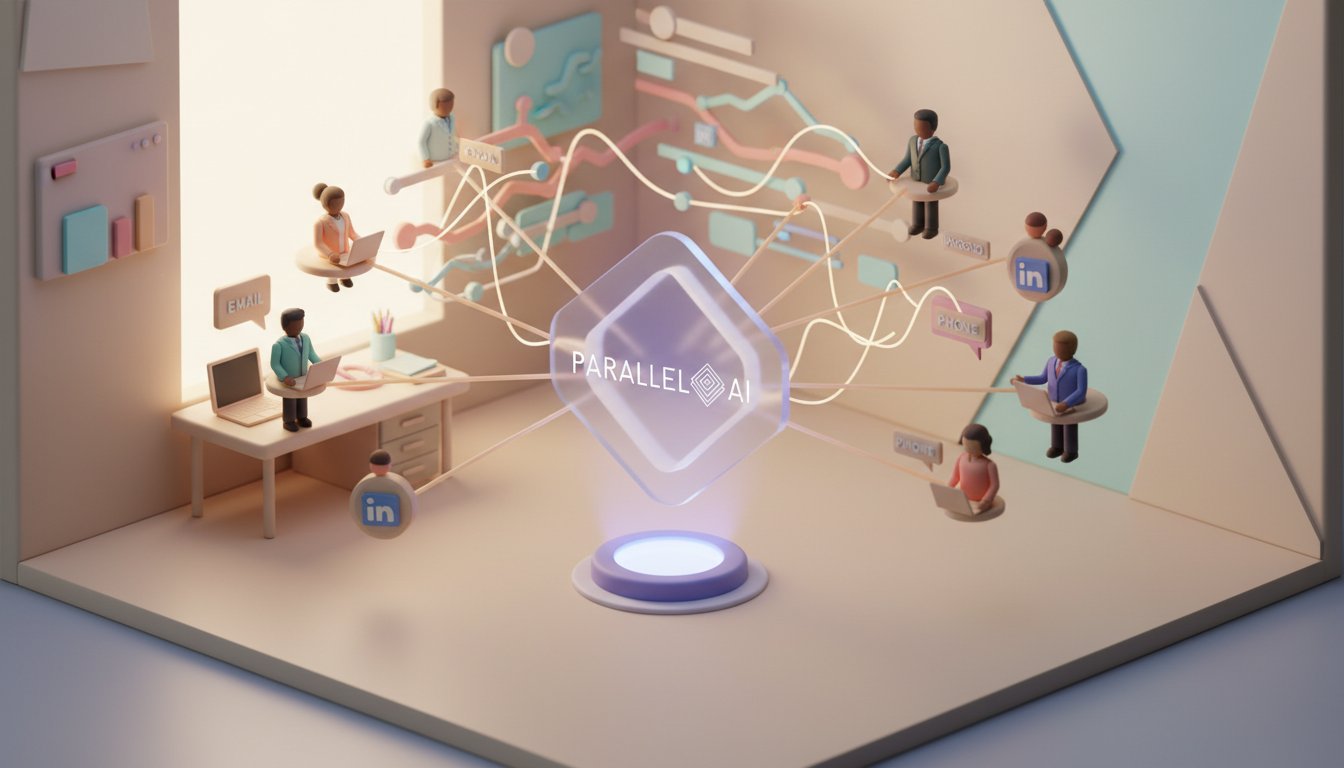
The business development landscape is experiencing a seismic shift. While traditional companies continue hiring $120K+ BDRs who can only work 40 hours per week, forward-thinking solopreneurs are deploying AI-powered business development representatives that operate 24/7, engage thousands of prospects simultaneously, and generate qualified opportunities at a fraction of the cost.
This isn’t theoretical. Real solopreneurs and micro-agencies are building autonomous AI BDR systems that handle 15,000+ prospect engagements monthly, achieve 3.6% reply rates on cold outreach, and book meetings while they sleep. The gap between those leveraging AI BDR technology and those relying on traditional methods is widening rapidly—and it’s not just about efficiency. It’s about survival in an increasingly competitive market where your competitors are scaling without the constraints of headcount.
If you’re a solopreneur or micro-agency owner still manually researching prospects, crafting individual outreach messages, and struggling to maintain consistent follow-up across multiple channels, you’re competing with one hand tied behind your back. The businesses winning in 2026 have discovered how to deploy AI BDR agents that handle the heavy lifting of business development—freeing them to focus on closing deals and serving clients.
Here’s what you need to know about building your own AI BDR system, the performance benchmarks you can expect, and how platforms like Parallel AI are making enterprise-grade business development accessible to solo businesses.
What Makes AI BDR Different from Traditional Business Development (And Why It Matters Now)
An AI BDR (Artificial Intelligence Business Development Representative) is an autonomous system that handles the complete business development workflow—from prospect identification and research to multi-channel outreach, qualification, and meeting scheduling. Unlike simple email automation tools that blast generic templates, modern AI BDR platforms execute sophisticated research, craft personalized messaging, and adapt their approach based on prospect behavior.
The distinction matters because business development has always been a numbers game constrained by human capacity. A talented human BDR might research 20-30 prospects daily, send 50-75 personalized messages, and manage follow-up sequences for a few hundred active prospects. They work 8 hours, take weekends off, and handle one conversation at a time.
An AI BDR system eliminates these constraints entirely. It can research thousands of prospects in hours, personalize outreach at scale across email, LinkedIn, SMS, and voice channels, and manage simultaneous conversations with hundreds of prospects. It never sleeps, never takes vacation, and maintains perfect consistency in messaging and follow-up timing.
The performance gap is staggering. Recent benchmarks show AI-personalized cold email achieving 2-5% response rates compared to 0.5-1% for generic outreach. Multi-channel sequences combining email and LinkedIn generate 5-8% overall response rates. When AI BDR systems focus on qualified prospects from existing relationships or warm referrals, response rates jump to 15-30%.
More importantly, AI BDR platforms execute research tasks in 10 seconds that would take humans 20-30 minutes. This research depth enables hyper-personalization at scale—mentioning specific company initiatives, recent funding rounds, technology stack details, or industry challenges that resonate with prospects. The result is messaging that feels thoughtful and relevant rather than automated.
For solopreneurs, this shift is revolutionary. You can now compete with agencies that have dedicated BDR teams. You can serve more clients, enter new markets, and scale pipeline generation without the financial risk and management overhead of hiring. The question isn’t whether AI BDR will transform business development—it’s whether you’ll adopt it before your competitors gain an insurmountable advantage.
The Multi-Channel Orchestration Advantage: Why Single-Channel Outreach No Longer Works
The days of email-only business development are over. Decision-makers receive hundreds of emails daily, and inbox algorithms are increasingly aggressive about filtering automated outreach. If you’re relying solely on email, you’re invisible to prospects who primarily engage on LinkedIn, ignore cold emails entirely, or prefer SMS communication.
Modern AI BDR systems excel at multi-channel orchestration—coordinating outreach across email, LinkedIn, SMS, voice calls, and chat platforms to reach prospects where they’re most responsive. This isn’t about spamming prospects across every channel simultaneously. It’s about intelligent sequencing that respects prospect preferences while maximizing visibility.
A sophisticated multi-channel sequence might start with a LinkedIn connection request that includes a personalized note referencing a mutual connection or shared interest. If accepted, the AI BDR sends a brief LinkedIn message introducing your value proposition. Two days later, it follows up with a personalized email that expands on the initial message. If there’s no response after a week, it might send a brief SMS or make a voice call offering specific value.
The key is coordination. The AI BDR tracks all interactions across channels, adapts the sequence based on engagement signals, and ensures messaging remains consistent while avoiding redundancy. If a prospect responds on LinkedIn, the system automatically pauses email and SMS outreach to that contact.
This orchestration delivers measurable results. While cold email alone generates 0.5-1% response rates, multi-channel sequences achieve 5-8% overall engagement—a 5-8x improvement. For solopreneurs competing against larger teams, this multiplication effect is transformative. Your AI BDR can generate as many qualified opportunities as a 5-person human BDR team.
Platforms like Parallel AI make multi-channel orchestration accessible through unified sequence builders that coordinate email, LinkedIn, SMS, and voice outreach from a single interface. You design the sequence logic once, and the AI handles execution across all channels while maintaining perfect timing and personalization.
Building Your AI BDR System: The Implementation Blueprint That Actually Works
The biggest barrier to AI BDR adoption isn’t technology—it’s knowing where to start. Most solopreneurs see the potential but feel overwhelmed by the apparent complexity of implementation. The reality is far simpler than it appears.
Successful AI BDR deployment follows a proven blueprint that takes 14-30 days from initial setup to generating qualified opportunities. Here’s the framework that’s working for solopreneurs in 2026.
Step 1: Define Your Ideal Prospect Profile
Before configuring any technology, crystallize who you’re targeting. Your AI BDR will be dramatically more effective when it knows exactly who to research and how to personalize messaging. Define specific criteria: company size, industry, technology stack, growth indicators, geographic location, and job titles of decision-makers.
The more specific you are, the better your results. “Marketing directors at Series B SaaS companies with 50-200 employees that recently raised funding” will outperform “marketing professionals at tech companies” by a factor of 10x. Your AI BDR can execute sophisticated research when given clear parameters.
Step 2: Build Your Prospect Database Using AI-Powered Smart Lists
Traditional prospecting meant hours spent manually searching LinkedIn, company websites, and databases to build contact lists. AI BDR platforms like Parallel AI offer Smart Lists that automate this research entirely. You define criteria, and the AI discovers prospects, enriches contact data, and continuously updates the list as new companies match your parameters.
Smart Lists integrate with sales intelligence databases containing 100M+ B2B contacts and company profiles. They filter by technographic data (what technologies companies use), funding events, hiring patterns, company growth signals, and competitive landscape positioning. The result is a constantly refreshed pipeline of ideal prospects without manual work.
Step 3: Design Your Multi-Channel Sequence
This is where AI BDR becomes powerful. Map out the journey you want prospects to experience across email, LinkedIn, SMS, and voice channels. A typical high-performing sequence might include:
Days 1-2: LinkedIn connection request with personalized note
Day 3: LinkedIn message introducing your solution to a specific challenge they’re likely facing
Day 5: Personalized email expanding on the value proposition with a case study
Day 8: Follow-up email offering a specific resource or insight
Day 12: LinkedIn message checking if they saw your emails
Day 15: Brief SMS or voice message offering to answer a specific question
Day 20: Final email offering to connect them with a client in their industry
The sequence should feel natural and valuable rather than pushy. Each touchpoint should offer something useful—insights, resources, introductions—not just ask for meetings.
Parallel AI’s Sequence Builder allows you to design these workflows visually, set timing and conditions, and incorporate AI-generated personalization at each step. The platform handles execution while you focus on refining messaging based on response data.
Step 4: Configure AI Personalization Parameters
Generic outreach dies in 2026. Your AI BDR must personalize messaging based on prospect research. Configure your AI to reference specific details: recent company news, funding announcements, technology adoption, competitive positioning, industry challenges, mutual connections, or content the prospect has published.
Modern AI BDR platforms access multiple AI models (OpenAI, Anthropic, Gemini) to analyze prospect data and generate personalized messaging. You provide the framework and key talking points; the AI researches each prospect and customizes messaging accordingly.
The best implementations use large context windows (up to 1 million tokens) to analyze extensive prospect data—entire LinkedIn profiles, company websites, recent news, published content—and generate messaging that demonstrates genuine understanding of the prospect’s situation.
Step 5: Integrate Your CRM and Communication Channels
Your AI BDR needs to connect with your existing tools: CRM (Salesforce, HubSpot, Pipedrive), email infrastructure, LinkedIn account, SMS provider, and calendar for meeting scheduling. These integrations ensure prospect data stays synchronized, responses trigger appropriate actions, and meetings automatically appear on your calendar.
Platforms like Parallel AI offer pre-built integrations with major CRMs and communication tools, plus API access for custom workflows. The goal is seamless data flow—when a prospect responds positively, they’re automatically tagged in your CRM, removed from cold outreach sequences, and added to your meeting scheduling flow.
Step 6: Launch Pilot Campaigns and Monitor Performance
Start small. Launch your first AI BDR sequence with 100-200 prospects and monitor daily performance for the first week. Track open rates, response rates, meeting booking rates, and message quality. Review actual AI-generated messages to ensure personalization is on-brand and relevant.
This pilot phase reveals what’s working and what needs adjustment before you scale to thousands of prospects. Pay attention to which channels generate the most engagement, which message angles resonate, and which personalization elements drive responses.
Step 7: Optimize Based on Real Data
AI BDR success comes from continuous optimization. Review performance data weekly and run A/B tests on subject lines, message angles, sequencing timing, and personalization approaches. The beauty of AI systems is their ability to learn and improve—what works today might need refinement next month as market conditions shift.
Successful solopreneurs treat their AI BDR as a system that requires ongoing attention and optimization rather than a “set it and forget it” solution. The businesses generating 180+ qualified opportunities monthly are constantly testing, refining, and improving their AI BDR workflows.
Real Performance Benchmarks: What to Expect from Your AI BDR Implementation
Understanding realistic performance expectations is critical for AI BDR success. The market is full of inflated claims, but real-world data from successful implementations provides a clearer picture.
For cold email outreach, expect 0.5-1% response rates with generic messaging. With AI-personalized messaging that references specific prospect details, response rates improve to 2-5%. The difference is research depth—AI that analyzes prospect companies and customizes each message outperforms templates dramatically.
LinkedIn outreach performs significantly better. Connection requests with personalized notes achieve 10-15% acceptance rates. Once connected, initial messages generate 10-15% response rates when they offer clear value and demonstrate research. This makes LinkedIn a critical channel for AI BDR systems.
Multi-channel sequences combining email and LinkedIn deliver 5-8% overall response rates. The key is intelligent coordination—each channel reinforces the others without creating redundancy. Prospects who ignore email might engage on LinkedIn, and vice versa.
Warm outreach to existing relationships, referrals, or prospects who’ve engaged with your content achieves 15-30% response rates. This highlights the importance of combining AI BDR with content marketing and relationship nurturing. Your AI BDR should prioritize warm prospects who already know your brand.
In terms of volume capacity, well-configured AI BDR systems can handle 15,000+ prospect engagements monthly—researching prospects, sending personalized messages, managing multi-touch sequences, and responding to initial replies. This is 50-100x the capacity of a human BDR.
Time to ROI typically ranges from 30-60 days. Most solopreneurs begin seeing qualified meetings booked within the first 2-3 weeks of launching their AI BDR system. By month two, the system is generating consistent pipeline that exceeds the platform cost by 10-20x.
Cost comparison makes the value proposition clear. A mid-level human BDR costs $85,000-$120,000 annually (salary, benefits, training, tools, management time). An AI BDR platform like Parallel AI costs $99-$297 monthly—a 95-98% cost reduction while delivering comparable or superior results.
Successful implementations report generating 180-240+ qualified opportunities monthly, with 15-25 hours weekly reclaimed from manual prospecting tasks. The businesses achieving these results aren’t doing anything revolutionary—they’re following the implementation blueprint outlined above and continuously optimizing based on performance data.
How Parallel AI Enables Solopreneurs to Build Enterprise-Grade AI BDR Systems
Most AI BDR platforms were designed for enterprise sales teams with dedicated implementation resources and technical expertise. Solopreneurs need something different—a unified platform that handles the complete business development workflow without requiring a technical team or months of setup.
Parallel AI addresses this gap by consolidating functionality that typically requires 5-8 separate tools into a single integrated platform. Instead of juggling separate subscriptions for sales intelligence, email automation, LinkedIn outreach, AI copywriting, CRM enrichment, and conversation management, solopreneurs access all capabilities through one unified interface.
The platform’s AI-powered Smart Lists automate prospect research and list building. You define ideal customer criteria, and the AI continuously discovers new prospects, enriches contact data, and updates lists as companies match your parameters. This eliminates hours of manual research and ensures you’re always reaching out to fresh, qualified prospects.
The multi-channel Sequence Builder allows you to design sophisticated outreach workflows that coordinate email, LinkedIn, SMS, and voice touchpoints from a single visual interface. You define the sequence logic once, and Parallel AI handles execution across all channels while maintaining perfect timing and personalization.
AI Agents handle customer interactions, qualification, and meeting scheduling. When prospects respond to your outreach, AI agents can answer questions, assess qualification criteria, handle objections, and book meetings directly on your calendar. This automation extends beyond initial outreach to the complete business development workflow.
The Content Engine generates personalized messaging at scale using multiple AI models (OpenAI, Anthropic, Gemini, Grok, DeepSeek). You provide key talking points and value propositions; the AI researches each prospect and creates customized messages that reference specific company details, recent news, or industry challenges. The result is outreach that feels genuinely personal rather than automated.
Knowledge base integration with Google Drive, Confluence, and Notion ensures your AI BDR has access to all relevant company information, case studies, product details, and industry insights. This context enables more sophisticated personalization and accurate responses to prospect questions.
For agencies and service providers, white-label capabilities allow you to brand the platform as your own and offer AI BDR services to clients. This transforms AI from a cost center into a revenue stream—you can deliver business development as a service without building custom technology or hiring BDR teams.
The platform emphasizes data security and privacy with AES-256 encryption, TLS protocols, and a commitment not to use customer data for model training. This addresses a critical concern for solopreneurs handling sensitive client and prospect information.
Perhaps most importantly, Parallel AI offers unlimited access without usage caps. Unlike platforms that charge per contact, per email, or per AI query, you get uncapped access to all AI models and features. This eliminates the anxiety of hitting limits mid-campaign and allows you to scale business development without proportionally increasing costs.
The implementation timeline is compressed compared to enterprise platforms. Most solopreneurs have their first AI BDR sequences running within 3-7 days of signup. The platform includes pre-built templates for common use cases (SaaS prospecting, agency outreach, consulting lead generation) that you can customize rather than building from scratch.
The Compliance and Ethics Considerations You Can’t Ignore
As AI BDR adoption accelerates, compliance and ethical considerations become increasingly critical. Solopreneurs deploying these systems must navigate CAN-SPAM regulations, GDPR requirements, LinkedIn terms of service, and emerging AI transparency expectations.
Email compliance requires including physical business addresses in messages, providing clear unsubscribe mechanisms, honoring opt-out requests immediately, and avoiding deceptive subject lines. AI BDR platforms should automatically include these elements in every email. Parallel AI embeds compliance features directly into sequence builders to prevent violations.
GDPR and data privacy regulations mandate that you have lawful basis for processing prospect data, provide transparency about data usage, and honor data deletion requests. When building prospect lists, ensure you’re using legitimate business interest as your legal basis and document your compliance procedures.
LinkedIn automation exists in a gray area. LinkedIn’s terms of service technically prohibit automation tools, though enforcement is inconsistent. The safest approach is limiting LinkedIn activity to human-like volumes (20-30 connection requests daily, 50-75 messages daily) and avoiding aggressive automation that could trigger account restrictions.
AI transparency is an emerging consideration. Should you disclose that AI is handling initial outreach and qualification? There’s no legal requirement yet, but transparency may become expected. Some solopreneurs include subtle indicators (“researched using AI” or “automated initial contact”) while others only disclose AI involvement if asked directly.
The ethical question centers on authenticity. Is AI-personalized outreach that references specific prospect details fundamentally different from templates that humans customize? Most prospects care about relevance and value, not whether a human or AI wrote the message. The key is ensuring AI-generated outreach is genuinely helpful rather than manipulative.
Deliverability deserves special attention. High-volume automated email can damage sender reputation and land messages in spam folders. Best practices include warming up email accounts gradually, limiting daily send volumes, using multiple sending domains, monitoring bounce and spam complaint rates, and maintaining clean contact lists.
Parallel AI addresses these concerns through built-in deliverability protection, compliance templates, and volume limits that prevent account damage. The platform helps you maintain the balance between aggressive prospecting and sustainable email practices.
The Competitive Reality: Adapt Now or Watch Your Market Share Disappear
The solopreneurs and micro-agencies winning in 2026 share a common characteristic: they’ve embraced AI BDR not as an experiment but as core business infrastructure. They’re generating 3-5x more qualified opportunities than competitors still relying on manual prospecting. They’re serving more clients without adding headcount. They’re reclaiming 15-25 hours weekly that they’re reinvesting in client delivery and strategic growth.
Meanwhile, businesses hesitating on AI BDR adoption are falling further behind every week. Their competitors are reaching prospects first, at higher volume, with more personalized messaging. The performance gap compounds over time—initial advantages in pipeline generation create revenue growth that funds further AI investment, creating a widening gap that becomes nearly impossible to close.
This isn’t alarmism. It’s market reality. The same dynamic played out with email marketing in the 2000s, social media in the 2010s, and content marketing in the 2020s. Early adopters gained sustainable advantages while late adopters struggled to catch up in increasingly saturated channels.
AI BDR is following the same pattern, but the timeline is compressed. What took years in previous technology shifts is happening in months with AI. The businesses implementing AI BDR systems today are establishing pipeline advantages that will define their competitive position for years.
The good news is that AI BDR is more accessible than previous technology shifts. You don’t need custom development, enterprise budgets, or technical teams. Platforms like Parallel AI make enterprise-grade business development accessible for $99-297 monthly—less than the cost of one mediocre sales dinner.
The question isn’t whether AI BDR will transform business development. That transformation is already happening. The question is whether you’ll lead the change in your market or spend the next three years playing catch-up to competitors who moved faster.
Your Next Steps: Building Your AI BDR System This Week
If you’re ready to stop competing with one hand tied behind your back, here’s how to move from reading about AI BDR to actually deploying a system that generates qualified opportunities:
Start with a free Parallel AI account and explore the platform without commitment. Set up your first Smart List using your ideal customer criteria and see how the AI discovers and enriches prospect data. The initial setup takes 20-30 minutes and immediately demonstrates the research automation advantage.
Design your first multi-channel sequence using proven templates as a starting point. Customize the messaging to your value proposition and target audience, but don’t overthink it—you’ll optimize based on real performance data. Focus on creating 5-7 touchpoints across email and LinkedIn that offer genuine value at each step.
Launch a pilot campaign with 100-200 prospects and commit to monitoring daily for two weeks. Review the AI-generated messages, track engagement metrics, and gather qualitative feedback from prospects who respond. This pilot reveals what resonates with your market and where optimization is needed.
Optimize and scale based on pilot data. Double down on what’s working, eliminate what’s not, and gradually increase volume as you validate your approach. The businesses generating 180+ qualified opportunities monthly started exactly where you are now—with a small pilot that they systematically refined and scaled.
The AI BDR revolution isn’t coming. It’s here. The only question is whether you’ll deploy these systems before your competitors gain an insurmountable pipeline advantage. Every week you wait, competitors are booking meetings with prospects who should be talking to you.
Visit Parallel AI today, start your free account, and begin building the AI BDR system that will define your competitive position for the next three years. The businesses thriving in 2026 made this decision months ago. It’s time to join them.
Related reading
- Top 10 AI BDR Platforms of 2026
- AI BDR Breakthrough: How Solopreneurs Are Building Business Development Agents That Generate 180+ Qualified Opportunities Monthly Without $120K Salaries or Enterprise Sales Infrastructure
- AI BDR Blueprint: How Solopreneurs Are Building 24/7 Business Development Agents That Generate 180+ Qualified Opportunities Monthly (Without Six-Figure BDR Salaries or Sales Team Overhead)
- AI BDR Revolution: How Solopreneurs Are Building Business Development Agents That Generate 240+ Monthly Qualified Meetings Without $95K Salaries or Enterprise CRM Lock-In