
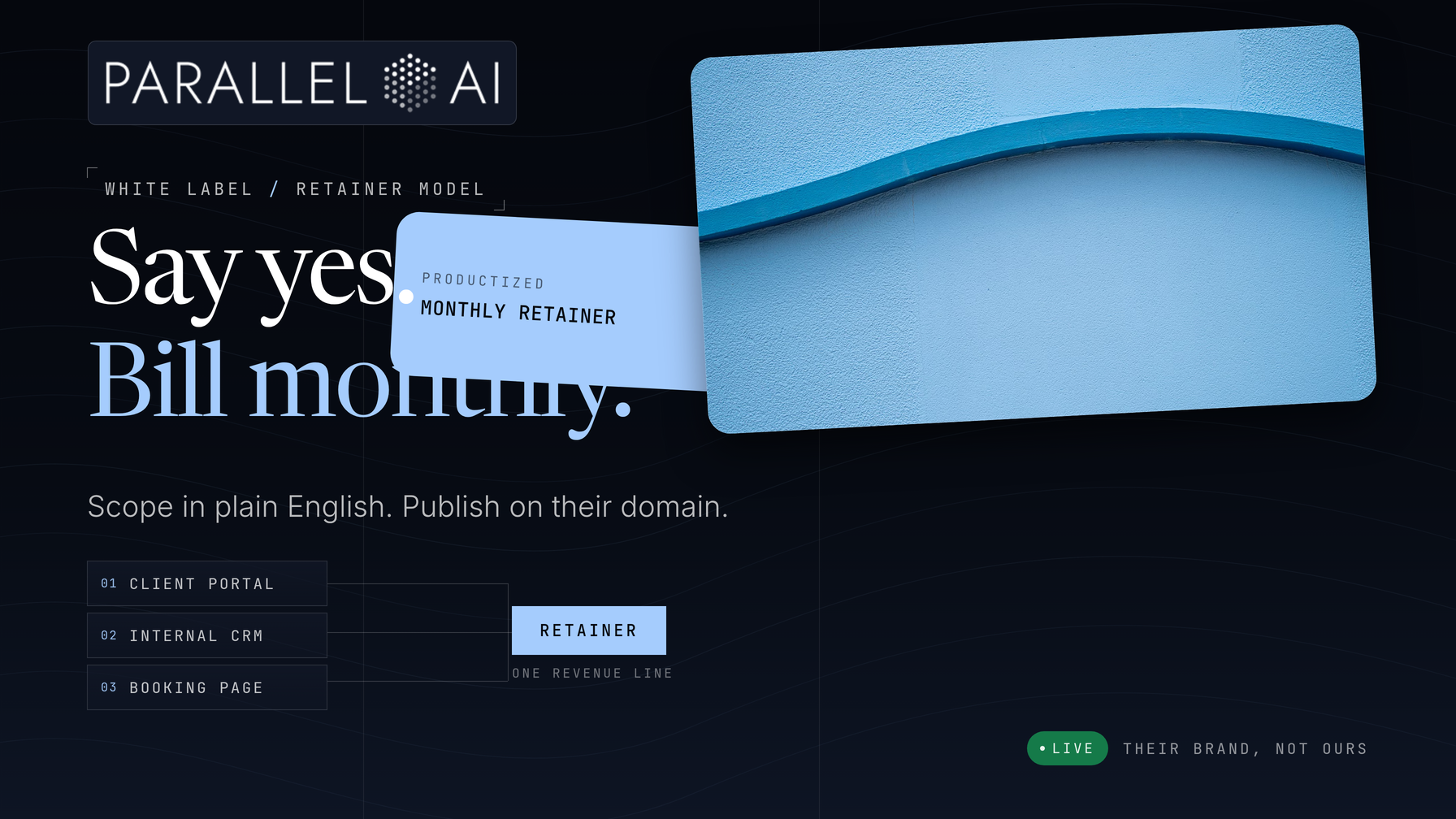
Saying yes to "can you build us an app?" used to force a choice. You could hire developers you can't afford, or refer the work out and lose the client. A white label app builder removes that trade-off. You scope the app in plain English. The platform generates a working product. You publish it on the client's domain, and the client never sees the vendor behind the tool. You bill it like any other service. That's the whole model, and this post walks through it step by step.
If you run a founder-led agency, an AI automation consultancy, or a small services firm, you know the question. It lands when your delivery calendar is already full. A white label app builder turns those requests into a repeatable, productized service. Packaged right, it becomes a monthly retainer. Here's how the workflow runs, what you can honestly deliver, and where Parallel AI fits.
Why agencies resell a white label app builder instead of building in-house
Most agencies resell because clients keep asking for apps while the agency has no developers on payroll. The demand is real. Small and mid-sized businesses want client portals, booking pages, internal CRMs, and operations dashboards. These tools feel custom, but the buyers don't have enterprise software budgets.
You have three ways to respond. Refer the work out, and you lose the margin and the client relationship. Hire developers, and you take on fixed costs your revenue can't yet carry. Or resell a white label builder. The agency keeps the client, controls the pricing, and ships a working app with the team it already has.
The economics favor the third path for lean teams. App development becomes a productized service. You charge a scoped build fee for delivery, then a monthly retainer for hosting, updates, and changes. Your brand sits on everything the client sees. The retainer turns one-off projects into a revenue line that grows as you add clients.
What apps can you realistically deliver?
A white label app builder produces web apps. That means apps that run in a browser on desktop and mobile. Within that boundary, the practical list is broader than most agencies expect:
| App type | What it does for the client | How agencies package it |
|---|---|---|
| Client portal | Secure logins where the client's customers view files, status, and invoices | Build fee plus monthly retainer for hosting and updates |
| Internal CRM | Pipeline, contacts, and notes for the client's sales team | Build fee plus retainer for changes and support |
| Booking page | Scheduling tied to the client's calendar and services | Flat build fee, retainer for edits |
| Job board | Postings, applications, and applicant tracking | Build fee plus retainer as needs evolve |
| Operations dashboard | Live views of the numbers the client's team checks daily | Build fee plus retainer for new metrics |
One boundary matters, and stating it up front protects the relationship. These are web apps, not native iOS or Android applications. Publishing to the Apple App Store or Google Play is a different kind of project entirely.
Most SMB requests, like a portal, a dashboard, or a booking flow, are web apps in practice. Clients open them in a browser on any device. Set that expectation in the first conversation and scope the build to the browser. Neither side gets surprised at delivery.
The reseller workflow, from first call to first invoice
Scope the app in plain English
Every app starts as a paragraph, not a spec document. Ask three questions on the discovery call. Who uses this app? What do they do inside it? What information must it show or collect? Then turn the answers into a plain-English description, like "a portal where the client's customers log in, see project status, and download invoices." That same paragraph becomes the build prompt. It's why agencies that scope well deliver faster.
Generate the app and preview it live
Feed the description to the builder and let it generate the app. Click through the live preview before you write a proposal. This step changes the sales conversation. Instead of describing what the app might do, you show the client a working draft. Corrections happen in plain English too. "Move the booking form above the reviews" is a complete change request. Iteration stays fast, and it never requires a developer.
Connect the client's data
An app earns its keep when it reflects the client's real information. Connect it to the sources the business already uses. That might be a spreadsheet of customers, a calendar of availability, or a pipeline export from the CRM. Most white label builders handle standard integrations. The app shows live data from day one, not placeholder text.
Publish under the client's brand
Publishing is where white labeling pays off twice. The app goes live on the client's domain with the client's logo, so their customers see their brand. Behind the app, the platform carries your logo, your domain, and your pricing. The client never sees the underlying vendor. You look like a firm that ships software. As far as the client can tell, you do.
Bill it as a service
Package the work in two parts. A one-time build fee covers scoping, generation, data connection, and publishing. Price it against the value of the app, not the hours it took. A monthly retainer covers hosting, updates, small changes, and support. That's what turns delivery into a recurring revenue line. A handful of retained clients later, the retainer base funds the rest of your pipeline work.
How Parallel AI fits the reseller model
Parallel AI was founded by a builder who created Salesforce Marketing Cloud and led the user growth platform at TikTok. The platform comes from a team that has shipped software at massive scale. It's not another entry in the crowded field of generic AI wrappers. For resellers, three capabilities matter most.
First, the App Builder turns a chat description into a full web app. Describe the client portal or booking page in plain English, and Parallel AI generates the working application. It arrives ready to preview and refine.
Second, the AI writes standard, exportable code. The deliverable isn't trapped in a proprietary runtime. Your client gets an app built on code you can hand over, migrate, or extend, so there's no lock-in. That's the reassurance a technical buyer needs before signing.
Third, you can white label the entire platform. Your logo goes on it, it runs on your domain, and you set the pricing. The client sees your agency everywhere the product appears, and Parallel AI stays invisible.
Parallel AI also runs the rest of the agency motion: prospecting, outreach, content, AI agents, and a knowledge base. The app builder isn't another fragmented subscription. It pulls your go-to-market work and your delivery tooling into one platform.
For agencies evaluating the reseller path, Parallel AI provides a Reseller Blueprint. It's a custom document that maps the reseller model to your services. It also includes a white-label demo instance, built for one of your actual prospects, at no charge. You get a resell-ready environment to put in front of a real buyer before you scale.
What to check before you commit
Whether you choose Parallel AI or another route, run the same five checks:
- Does the code export? Standard, exportable code means the client owns the deliverable, and you won't have to referee a lock-in dispute later.
- Is the scope web-only, and can you say so clearly? Confirm you're delivering a browser-based app, and never imply native iOS or Android publishing in the proposal.
- Can you brand everything the client touches? That covers the app, the domain, the login screen, and the notification emails. One visible vendor logo undermines the entire white label position.
- Can you set your own pricing and keep your margins? The platform's cost to you should scale in a way that leaves room for the build fee and the retainer.
- Is the setup manageable for your team? A founder-led agency needs a workflow it can run alongside client delivery, not a second job.
Turn "can you build us an app?" into a retainer
A white label app builder works as a reseller model for one simple reason. It removes the engineering capacity gap that keeps most agencies out of app revenue. To recap:
- You scope apps in plain English, generate them with AI, preview them live, connect client data, and publish to the client's domain.
- Web apps are the honest scope: portals, CRMs, booking pages, job boards, and dashboards. Native app-store publishing isn't part of it.
- A build fee plus a monthly retainer turns each client into recurring revenue without adding headcount.
- Parallel AI supports the full model with chat-to-app generation, standard exportable code, and platform-wide white labeling. The founding team built Salesforce Marketing Cloud and the user growth platform at TikTok.
The next step is a small one. Try the App Builder with one app description from a real client conversation. Then request the Reseller Blueprint. You'll get a custom plan plus a white-label demo instance, built for your next prospect, at no charge. Ship one app, retain one client, and you'll know whether the model fits your agency before you scale it.