
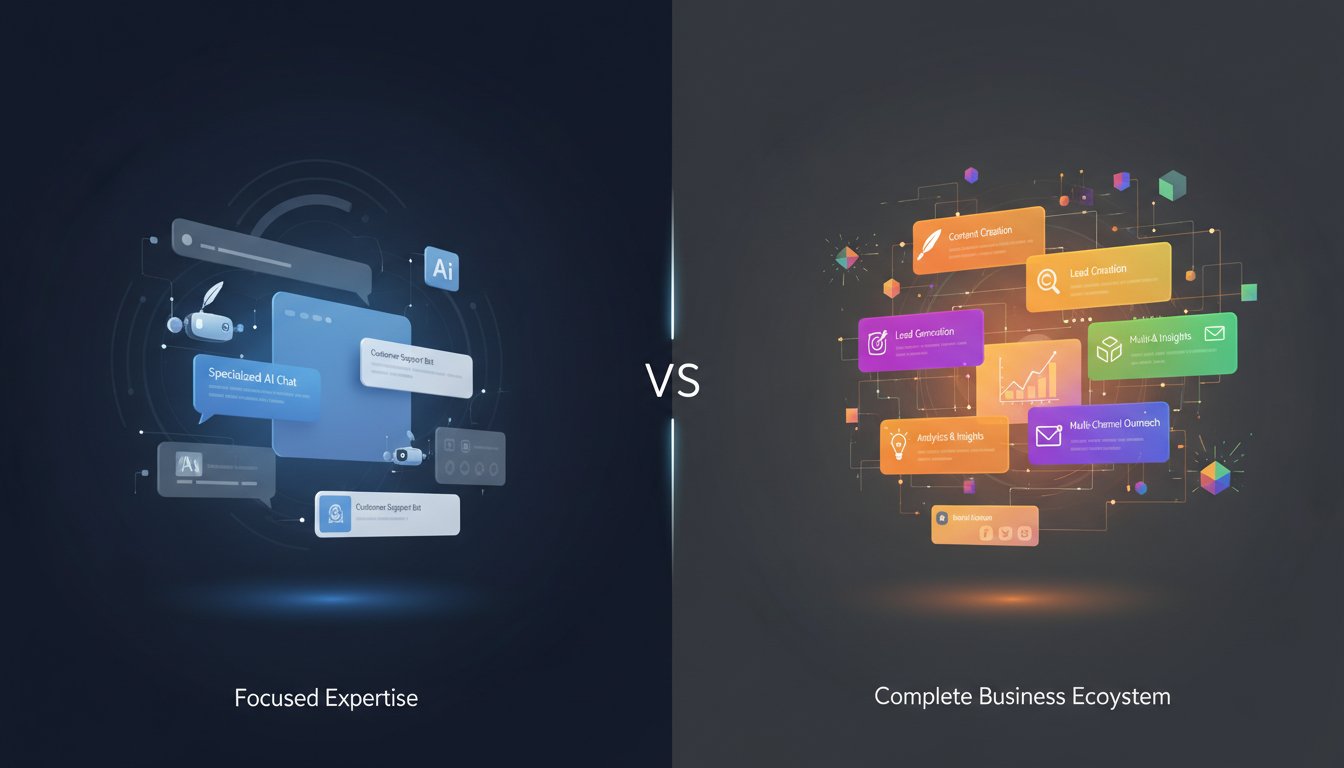
The conversation AI market has matured dramatically in 2025, but most solopreneurs and micro-agencies face a critical strategic question that extends far beyond chatbot functionality: Should you invest in a specialized conversational AI platform, or adopt a comprehensive automation ecosystem that consolidates multiple business functions into a single white-label solution?
This isn’t a trivial technical choice—it’s a business model decision that will determine your service offerings, profit margins, and competitive positioning for the next 24-36 months. While platforms like Voiceflow have established themselves as leaders in the conversational AI space, the actual needs of growing solo consultants and small agencies often extend well beyond chat interfaces into content automation, lead generation, multi-channel outreach, and strategic business intelligence.
The uncomfortable truth: most platform comparison content focuses on feature checklists rather than the strategic implications for resource-constrained businesses trying to punch above their weight class. This analysis cuts through the marketing noise to examine which platform actually delivers sustainable competitive advantage for solopreneurs building scalable, high-margin service businesses in an increasingly AI-saturated market.
The Strategic Context: What Solopreneurs Actually Need From White-Label AI
Before diving into feature comparisons, it’s essential to understand the unique position of solopreneurs and micro-agencies in the AI automation landscape. Unlike enterprise buyers evaluating platforms for internal use, solo consultants and small agencies face a fundamentally different set of constraints and opportunities.
The Resource Reality
Solopreneurs operate with severe time and capital constraints. You’re not just implementing technology—you’re simultaneously serving existing clients, prospecting new business, managing operations, and staying current with rapidly evolving AI capabilities. Every hour spent configuring, integrating, or troubleshooting a platform is an hour not spent on revenue-generating activities.
This creates a unique requirement: platforms must deliver immediate value with minimal configuration while maintaining the flexibility to scale as your business grows. The conventional wisdom of “start simple, add complexity later” breaks down when “later” means migrating clients across platforms or rebuilding workflows from scratch.
The White-Label Imperative
For agencies and consultants, white-label capability isn’t just a nice-to-have feature—it’s the foundation of your entire service positioning. Your clients aren’t buying “Voiceflow implementation services” or “Parallel AI consulting”—they’re buying your expertise and your branded solution to their business problems.
The quality of white-label implementation directly impacts client perception, retention rates, and your ability to command premium pricing. Shallow rebranding that exposes the underlying platform diminishes your perceived value and commoditizes your services.
The Scope Question: Chatbots vs. Complete Automation
This is where strategic divergence becomes critical. If your entire service offering revolves around conversational interfaces—chatbots, voice assistants, and customer support automation—then a specialized conversational AI platform makes sense. Your deep expertise in that narrow domain justifies the specialization.
However, most solopreneurs and micro-agencies serve clients who need comprehensive business automation: content creation, social media management, email marketing, lead qualification, proposal generation, research synthesis, and strategic analysis alongside customer-facing chat interfaces. In this scenario, managing multiple specialized platforms creates operational overhead, integration complexity, and vendor dependency that erodes profitability.
Voiceflow: The Conversational AI Specialist
Voiceflow has established itself as a leading no-code platform for designing, building, and deploying conversational AI agents. Understanding its strengths and limitations is essential for making an informed platform decision.
Core Strengths
Exceptional Conversation Design Interface
Voiceflow’s primary competitive advantage lies in its visual conversation design environment. The platform provides an intuitive, flow-based interface that allows non-technical users to map out complex conversation logic, manage dialog states, and create sophisticated branching scenarios without writing code.
For agencies specializing in customer support automation or voice interface design, this visual approach significantly accelerates development and makes it easier to collaborate with clients on conversation flows. The ability to prototype, test, and iterate on conversational experiences in a visual environment is genuinely valuable.
Multi-Platform Deployment
Voiceflow supports deployment across various channels including websites, mobile apps, voice assistants (Alexa, Google Assistant), and messaging platforms. This omni-channel capability allows you to design once and deploy across multiple touchpoints, maintaining consistency in the conversational experience.
Team Collaboration Features
The platform includes robust collaboration tools that enable multiple team members to work on the same project simultaneously. For micro-agencies with 2-10 employees, this facilitates efficient workflow division and quality control.
White-Label Capabilities
Voiceflow offers white-label options that allow agencies to rebrand the platform for their clients. This includes customization of the user interface, security features, and deployment under your brand identity. For agencies focused exclusively on conversational AI services, this provides adequate branding flexibility.
Strategic Limitations
Narrow Functional Scope
Voiceflow’s specialization in conversational AI is simultaneously its strength and its constraint. The platform excels at what it does, but what it does is fundamentally limited to chat and voice interfaces. If your client needs content generation, social media automation, comprehensive lead nurturing, or strategic business intelligence, you’ll need to integrate or supplement Voiceflow with additional platforms.
This creates the “platform sprawl” problem: you’re managing Voiceflow for conversations, perhaps Jasper or Copy.ai for content, HubSpot or ActiveCampaign for email automation, Buffer or Hootsuite for social media, and various other tools for different functions. Each additional platform adds subscription costs, integration complexity, training requirements, and operational overhead.
Limited Multi-Model Flexibility
While Voiceflow integrates with major AI models including OpenAI’s GPT and Dialogflow, the platform doesn’t provide the same level of multi-model flexibility as comprehensive automation platforms. You’re largely constrained to the models Voiceflow supports and the way they’ve implemented those integrations.
For solopreneurs trying to optimize for quality, cost, and performance across different tasks, the inability to strategically route work to the most appropriate model (OpenAI for reasoning, Anthropic for analysis, Gemini for multimodal tasks, DeepSeek for cost-sensitive operations) creates inefficiency and limits your competitive positioning.
Pricing Structure for Agency Use
Voiceflow’s enterprise plans start around $299/month, with costs scaling based on features, usage, and integrations. For a solopreneur just starting to offer AI services, this represents a significant fixed cost before you’ve landed your first client. The pricing model is designed around internal enterprise deployment rather than agency resale, which affects margin structure.
Content Creation Gap
Conversational interfaces represent just one component of modern business automation. The majority of solopreneur clients need comprehensive content automation: blog posts, social media content, email sequences, proposals, reports, and marketing materials. Voiceflow doesn’t address this need, forcing you to either limit your service offerings or integrate additional content platforms.
Lead Generation and Outreach Constraints
While Voiceflow can qualify leads through conversational interfaces, it lacks the comprehensive lead generation, prospecting, and multi-channel outreach capabilities that agencies need to offer complete growth solutions. You can’t build sophisticated email sequences, social media campaigns, or multi-touch nurture programs within Voiceflow.
Parallel AI: The Complete Business Automation Ecosystem
Parallel AI takes a fundamentally different approach: rather than specializing in one aspect of AI automation (conversations), it consolidates the full spectrum of business automation needs into a single, white-label platform.
Comprehensive Automation Architecture
Multi-Model Foundation
Parallel AI’s most distinctive feature is uncapped access to six premium AI models: OpenAI GPT-4 and GPT-4 Turbo, Anthropic Claude 3 Opus and Sonnet, Google Gemini Pro, Grok (X.AI), and DeepSeek. This isn’t just feature bloat—it’s strategic flexibility that allows you to route different tasks to the optimal model based on performance, cost, and capability requirements.
For example, you might use Claude 3 Opus for complex analytical tasks requiring deep reasoning, GPT-4 Turbo for conversational interfaces and general-purpose tasks, Gemini Pro for multimodal content involving images and text, and DeepSeek for high-volume, cost-sensitive operations. The ability to switch models per task without managing multiple platform subscriptions or integrations is a genuine competitive advantage.
The platform supports context windows up to one million tokens, enabling sophisticated applications that maintain extensive conversation history, process large documents, or synthesize information from comprehensive knowledge bases.
Enterprise Knowledge Base Integration
Parallel AI integrates seamlessly with Google Drive, Confluence, Notion, and other knowledge management platforms. This persistent memory capability means AI agents can access your client’s brand guidelines, previous campaign performance, product specifications, and institutional knowledge to generate contextually appropriate outputs.
For solopreneurs serving multiple clients, this knowledge base isolation is critical. Each client’s AI agents operate within their specific context, accessing only their information while maintaining the same underlying infrastructure. You’re not rebuilding workflows for each client—you’re configuring knowledge bases.
Content Automation Engine
Unlike Voiceflow’s conversation-focused design, Parallel AI includes a comprehensive content automation engine designed for rapid generation of blogs, social posts, email campaigns, marketing copy, reports, proposals, and strategic documents. This addresses the full spectrum of content needs that agencies typically handle.
The platform’s knowledge base integration ensures content maintains brand consistency, voice, and factual accuracy by referencing client-specific information rather than generating generic outputs. For solopreneurs offering “Managed Content Services,” this capability enables you to deliver weekly blogs, daily social posts, and email sequences at scale—charging clients $500-800/month while your platform costs remain $40-60/month.
Omni-Channel Conversational Agents
Parallel AI doesn’t neglect conversational automation—it simply positions it as one component of comprehensive business automation rather than the exclusive focus. The platform deploys AI-powered agents across websites, SMS, social media DMs, chat interfaces, and voice channels, creating unified, context-aware conversations across touchpoints.
Unlike basic chatbots that operate in isolation, Parallel AI’s conversational agents integrate with the knowledge base, access conversation history across channels, and coordinate with other automation workflows. When a lead engages via website chat, then follows up through SMS, then responds to an email sequence, the AI maintains context across all interactions.
For agencies, this enables you to charge $300-500/month per conversational agent while delivering genuinely sophisticated customer experiences that outperform rules-based chatbots.
Lead Generation and Multi-Channel Outreach
Parallel AI includes Smart Lists and Sequences for targeted lead generation and multi-channel outreach over email, social media, SMS, chat, and voice. This addresses the critical gap in conversation-only platforms: the ability to proactively reach prospects, nurture leads through sophisticated sequences, and coordinate touchpoints across channels.
For solopreneurs offering growth services, this consolidation is transformative. Instead of managing separate tools for lead identification, email automation, social outreach, and conversational follow-up, you’re orchestrating integrated campaigns from a single platform.
Hyper-Personalized Email Sequences
The platform’s ability to analyze lead source, behavior, and demographics to generate customized email sequences (6-8 emails) that adapt based on engagement represents a significant advancement over template-based email automation. When a new lead enters your pipeline, Parallel AI generates a personalized nurture sequence tailored to that specific prospect’s context and behavior patterns.
This capability allows agencies to increase client conversion rates by 20-35% and justify $400-600/month retainer increases for “AI-Enhanced Lead Nurturing.”
White-Label Implementation
Parallel AI’s white-label approach is designed specifically for agency resale rather than adapted from internal enterprise tooling. You can customize with your logo, colors, and domain, ensuring clients never see “Parallel AI”—only your brand. Custom client dashboards maintain your brand identity throughout the client experience.
This comprehensive white-labeling extends beyond surface-level rebranding to include client-specific knowledge bases, custom workflows, and branded reporting—creating the experience of a proprietary platform rather than a rebranded third-party tool.
Strategic Automation Workflows
Automated Client Onboarding
When a new client signs a contract, Parallel AI can automatically generate welcome packets, analyze brand questionnaires, create 90-day content calendars, and deliver custom automation recommendations to the client portal. This compresses onboarding from 8 hours to 45 minutes, enabling you to serve 3x more clients with the same time investment—saving 40+ hours monthly.
Strategic Reporting and Analysis
Rather than delivering raw data dumps, Parallel AI analyzes campaign performance, website traffic, and CRM activity to generate executive summaries with strategic recommendations. This transforms you from a tactical service provider to a strategic advisor, enabling you to charge $800-1,200/month for strategic consulting while automating the analytical heavy lifting.
Clients receiving strategic insights rather than just metrics experience 15-25% lower churn rates and are more receptive to service upsells.
Platform-Specific Content Optimization
The content engine generates 30-60 posts optimized for Facebook, Instagram, LinkedIn, and Twitter with platform-specific formatting, hashtags, and CTAs customized for each channel. This addresses the labor-intensive reality of multi-platform social media management, enabling you to offer “Premium Social Management” at $600-900/month while your platform costs remain $50-75/month.
Pricing and Economic Model
Parallel AI’s pricing structure is designed around agency resale economics rather than enterprise internal deployment. Plans range from free introductory tiers to enterprise packages, with the emphasis on enabling high-margin service offerings.
The economic model is fundamentally different from Voiceflow: instead of paying $299+/month for specialized conversational AI capability, you’re accessing a comprehensive automation platform that consolidates functions previously requiring 5-7 separate subscriptions (conversation platform, content tool, email automation, social scheduler, lead generation, knowledge base, analytics).
For a solopreneur offering multiple services—content creation, lead generation, social media management, conversational agents, and strategic consulting—the consolidation economics are compelling. Your platform costs might be $100-150/month while you’re charging clients $2,500-5,000/month across multiple service packages.
Feature Comparison: Side-by-Side Analysis
Conversational AI Capabilities
Voiceflow: Exceptional visual conversation design interface with sophisticated branching logic, state management, and multi-platform deployment. Best-in-class for complex conversation flows requiring extensive customization.
Parallel AI: Robust conversational agents with knowledge base integration, omni-channel deployment, and context awareness across interactions. Not as visually sophisticated for conversation design but more integrated with broader business workflows.
Winner: Voiceflow for conversation specialists; Parallel AI for agencies needing conversations as one component of comprehensive automation.
Content Automation
Voiceflow: Minimal content generation capability; focused on conversational copy rather than marketing content, blogs, or strategic documents.
Parallel AI: Comprehensive content engine supporting blogs, social posts, email campaigns, marketing copy, reports, proposals, and strategic documents with brand voice consistency.
Winner: Parallel AI by a significant margin.
Lead Generation and Outreach
Voiceflow: Can qualify leads through conversational interfaces but lacks proactive outreach, email sequences, or multi-channel campaign orchestration.
Parallel AI: Complete lead generation ecosystem including Smart Lists, multi-channel sequences (email, social, SMS, chat, voice), and behavioral personalization.
Winner: Parallel AI decisively.
Multi-Model Flexibility
Voiceflow: Integrates with select AI models (primarily OpenAI GPT and Dialogflow) through platform-mediated access.
Parallel AI: Direct, uncapped access to six premium models (OpenAI, Anthropic, Gemini, Grok, DeepSeek) with ability to route tasks to optimal models.
Winner: Parallel AI for strategic flexibility and cost optimization.
Knowledge Base Integration
Voiceflow: Can access external data through integrations but not designed around persistent knowledge base architecture.
Parallel AI: Native integration with Google Drive, Confluence, Notion, and other platforms with up to 1M token context windows and client-specific knowledge isolation.
Winner: Parallel AI for depth and client management.
White-Label Capabilities
Voiceflow: White-label options available with customization of interface, security features, and brand deployment.
Parallel AI: Comprehensive white-labeling including logo, colors, domain, client dashboards, custom workflows, and branded reporting—designed specifically for agency resale.
Winner: Parallel AI for agency-focused implementation depth.
Team Collaboration
Voiceflow: Strong collaboration features for multi-user conversation design projects.
Parallel AI: Collaboration features focused on client management and workflow coordination rather than design collaboration.
Winner: Voiceflow for team-based conversation design; Parallel AI for client service delivery.
Pricing and Economic Model
Voiceflow: Enterprise plans starting around $299/month, scaled by features and usage, designed for internal deployment.
Parallel AI: Plans from free to enterprise, designed around agency resale economics with emphasis on high-margin service offerings.
Winner: Parallel AI for solopreneur economics and service business models.
Enterprise Security and Compliance
Voiceflow: Security features designed for white-label deployment with enterprise considerations.
Parallel AI: SOC 2 Type II certification, AES-256 encryption, TLS protocols, on-premise deployment options, API access, and SSO—enterprise-grade security with commitment not to use client data for model training.
Winner: Parallel AI for verifiable security compliance.
The Strategic Decision Framework
Choosing between Voiceflow and Parallel AI isn’t about which platform has “better” features in absolute terms—it’s about which platform aligns with your specific business model, service offerings, and growth trajectory.
Choose Voiceflow If:
You’re a Conversation Design Specialist
If your entire business revolves around creating sophisticated conversational experiences—complex voice assistants, multi-turn customer support dialogs, or intricate chatbot logic—Voiceflow’s specialized conversation design interface provides genuine value. Your deep expertise in conversation architecture justifies the focused toolset.
You Have Existing Automation Infrastructure
If you’ve already invested in and optimized a comprehensive stack for content creation, email automation, lead generation, and social media management, adding Voiceflow as a specialized conversation layer might make sense. You’re not starting from zero—you’re complementing existing capabilities.
Your Clients Have Narrow, Conversation-Specific Needs
If your client base specifically seeks conversational AI implementation without broader automation requirements, Voiceflow’s specialization matches their needs. You’re not being asked to provide content services, lead generation, or strategic automation beyond conversational interfaces.
You Prefer Best-of-Breed Over Integrated
Some agencies prefer managing multiple specialized platforms rather than adopting integrated ecosystems, believing that specialization produces superior results in each domain. If this is your operational philosophy and you have the resources to manage platform integration, Voiceflow can be part of that stack.
Choose Parallel AI If:
You’re Building a Comprehensive Automation Service
If you’re positioning yourself as a complete business automation partner—offering content creation, lead generation, social media management, conversational agents, and strategic intelligence—Parallel AI’s consolidated platform eliminates the overhead of managing 5-7 separate tools while maintaining competitive capability in each domain.
You’re a Solopreneur Maximizing Leverage
For solo consultants seeking maximum output with minimal operational complexity, Parallel AI’s consolidation allows you to serve multiple clients across multiple service lines without drowning in platform management, integration troubleshooting, or subscription overhead.
You Need Multi-Model Strategic Flexibility
If you want to optimize task routing across different AI models based on performance, cost, and capability requirements—using Claude for analysis, GPT-4 for conversation, Gemini for multimodal tasks, DeepSeek for cost-sensitive operations—Parallel AI’s direct multi-model access provides competitive advantage that specialized platforms can’t match.
You’re Prioritizing Client Service Economics
For agencies focused on high-margin service delivery—charging $2,500-5,000/month across multiple service packages while maintaining platform costs under $150/month—Parallel AI’s economic model is specifically designed for this use case.
You’re Starting or Scaling an AI Agency
Solopreneurs and micro-agencies in the early growth phase benefit from Parallel AI’s comprehensive capability without requiring multiple platform subscriptions upfront. You can launch with content services, add conversational agents as you grow, expand into lead generation, and offer strategic consulting—all within the same platform infrastructure.
You Value Rapid Deployment and Client Onboarding
If your competitive advantage depends on speed-to-value—onboarding clients in 30 days, deploying new services quickly, scaling without operational friction—Parallel AI’s integrated architecture eliminates the integration complexity that slows multi-platform implementations.
Real-World Implementation Scenarios
Scenario 1: Marketing Consultant Serving Small B2B Clients
Client Needs: Weekly blog posts, daily social media content, monthly email campaigns, website chatbot for lead qualification, quarterly strategic reports.
Voiceflow Approach: Deploy Voiceflow for chatbot ($299/month), add Jasper for content ($99/month), use Mailchimp for email ($50/month), manage social with Buffer ($15/month), create reports manually. Total platform cost: $463/month. Integration complexity: High. Time spent on platform management: 8-10 hours/month.
Parallel AI Approach: Deploy comprehensive automation within Parallel AI ($100-150/month). All functions integrated within single platform. Time spent on platform management: 2-3 hours/month. Additional capacity available for additional clients or service expansion.
Outcome: Parallel AI provides $300+/month cost savings and 5-7 hours/month time savings while eliminating integration friction.
Scenario 2: Sales Consultant Focused on Lead Generation
Client Needs: Prospecting list building, multi-channel outreach sequences (email, LinkedIn, SMS), conversational qualification chatbot, CRM integration, performance reporting.
Voiceflow Approach: Voiceflow for chatbot, separate lead generation platform ($200/month), email/SMS platform ($100/month), LinkedIn automation tool ($80/month), manual reporting. Total cost: $679/month. Complex integration requirements. Limited cross-channel context.
Parallel AI Approach: Integrated Smart Lists, Sequences, conversational agents, and reporting within Parallel AI ($100-150/month). Unified lead context across all touchpoints. Automated strategic reporting.
Outcome: Parallel AI saves $500+/month, provides superior cross-channel context, and enables conversion rate improvements of 20-35% through personalized sequences.
Scenario 3: Conversation Design Specialist
Client Needs: Complex multi-turn voice assistant, sophisticated branching logic, extensive conversation state management, minimal content or lead generation requirements.
Voiceflow Approach: Leverage Voiceflow’s visual conversation design interface for rapid prototyping and deployment. ($299/month). Minimal additional platforms needed.
Parallel AI Approach: Build conversational agents in Parallel AI, but without the specialized visual design interface that accelerates complex conversation development.
Outcome: Voiceflow provides better tooling for this specific use case, justifying the specialized platform investment.
The Hidden Costs of Platform Proliferation
Beyond direct subscription costs, managing multiple specialized platforms creates hidden expenses that erode profitability and constrain growth:
Integration Maintenance: APIs change, platforms update, integrations break. Each additional platform multiplies the probability of integration failures requiring troubleshooting.
Learning Curve Multiplication: Every platform has unique interfaces, terminology, best practices, and limitations. Training yourself and any team members across multiple platforms consumes time and reduces efficiency.
Client Communication Complexity: Explaining to clients why they’re paying for multiple platforms (even if hidden behind white-labeling) is more complex than presenting a unified solution.
Vendor Relationship Overhead: Managing subscriptions, billing, support tickets, and account relationships across 5-7 platforms is administrative overhead that doesn’t scale.
Data Fragmentation: When conversation data lives in Voiceflow, content in Jasper, email performance in Mailchimp, and social metrics in Buffer, synthesizing strategic insights requires manual integration and analysis.
Security and Compliance Multiplication: Each additional platform is a potential security vulnerability and compliance consideration, particularly when handling client data across multiple vendors.
For solopreneurs and micro-agencies, these hidden costs often exceed the direct subscription savings of specialized platforms.
Migration Considerations and Risk Mitigation
If you’re currently using Voiceflow and considering Parallel AI, or vice versa, migration planning is critical:
Conversation Migration: Complex conversation flows built in Voiceflow’s visual interface don’t automatically port to other platforms. Plan for rebuild time if migrating sophisticated conversational logic.
Knowledge Base Transfer: Parallel AI’s native knowledge base integration may require restructuring how you’ve organized client information in Voiceflow’s architecture.
Client Communication: Existing clients may question platform changes. Position migration as capability expansion rather than vendor switching: “We’re consolidating onto a more comprehensive platform that enables us to serve you better.”
Phased Transition: Rather than migrating all clients simultaneously, transition new clients to your chosen platform while maintaining existing clients on legacy infrastructure until natural renewal points.
Service Offering Evolution: Platform migration is an opportunity to evolve your service packages. If moving from Voiceflow to Parallel AI, introduce content services, lead generation, and strategic consulting alongside existing conversational offerings.
The 2025 Competitive Landscape
The AI automation market is consolidating rapidly. Clients increasingly prefer comprehensive solutions from fewer vendors rather than managing multiple specialized tools. This trend favors platforms like Parallel AI that consolidate functions over specialized players like Voiceflow.
Key market dynamics:
Platform Consolidation: 90% of major corporations list hyperautomation as a strategic priority, driving demand for unified platforms rather than point solutions.
Multi-Agent Systems: The industry is shifting from single-tool automation to multi-agent systems where AI agents collaborate across departments. This requires platforms designed for orchestration rather than specialization.
Democratization: The rise of low-code/no-code platforms is enabling non-technical solopreneurs to offer sophisticated AI services. Platforms with lower technical barriers and faster deployment capture this expanding market.
Economic Pressure: In uncertain economic environments, clients scrutinize vendor counts and seek consolidation. Solopreneurs offering comprehensive solutions through unified platforms have competitive advantage over those requiring multiple specialized tools.
Making Your Decision
The choice between Voiceflow and Parallel AI fundamentally comes down to your business model and growth trajectory:
If your competitive advantage is deep specialization in conversational AI design, and your clients specifically seek that expertise without broader automation needs, Voiceflow’s specialized tooling justifies the investment.
If you’re building a scalable service business offering comprehensive automation—content, conversations, lead generation, strategic intelligence—across multiple clients with minimal operational overhead, Parallel AI’s consolidated platform delivers superior economics and competitive positioning.
For most solopreneurs and micro-agencies, the comprehensive automation approach creates more sustainable competitive advantage. The market is moving toward consolidation, clients prefer fewer vendor relationships, and the economic advantages of unified platforms compound as you scale.
The conversation AI market will continue evolving rapidly. Your platform choice should position you to adapt to emerging trends—multi-agent systems, self-hosted AI options, real-time edge processing, and AI governance requirements—rather than locking you into a narrow capability set that may become commoditized.
The Path Forward
Whichever platform you choose, success depends less on the tool and more on how you position and deliver value to clients. The best platform is the one that enables you to:
- Deliver demonstrable ROI to clients consistently
- Scale your service delivery without linear time investment
- Maintain healthy profit margins on service offerings
- Adapt to evolving market demands without platform migration
- Focus your time on strategic client relationships rather than operational overhead
For specialized conversation design agencies with existing infrastructure, Voiceflow can be the right choice. For solopreneurs and micro-agencies building comprehensive automation services with limited resources and maximum growth ambition, Parallel AI’s consolidated approach provides the foundation for sustainable competitive advantage.
The AI automation revolution isn’t about replacing human expertise with technology—it’s about amplifying your unique insights and capabilities so you can serve more clients at a higher level while maintaining the work-life balance that drove you to solo entrepreneurship in the first place. Choose the platform that best supports that vision for your specific business context.
Ready to explore how white-label AI automation can transform your agency’s service offerings and profitability? Parallel AI’s platform consolidates content creation, conversational agents, lead generation, and strategic intelligence into a single, brandable ecosystem designed specifically for solopreneurs and micro-agencies. Schedule a personalized demo to see how agencies like yours are delivering Fortune 500-level capabilities while maintaining the agility and personal touch that makes your business unique.