
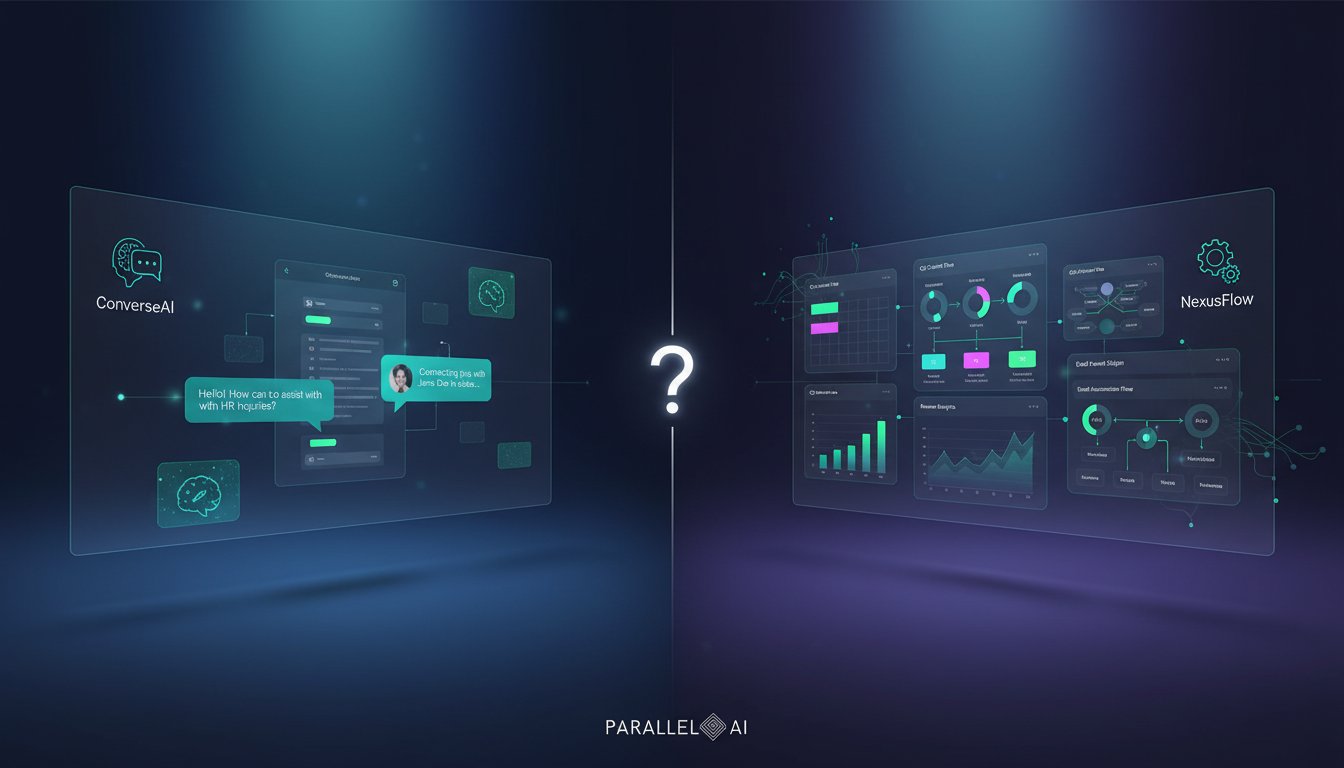
The white-label AI market has reached a critical inflection point. While agencies scramble to add “AI-powered” to their service descriptions, most discover a harsh reality: platforms that excel at one thing—conversational AI, chatbots, voice agents—leave massive gaps in the business automation their clients actually need.
This isn’t a theoretical problem. When you sign a client expecting comprehensive AI transformation, they don’t just need a chatbot on their website. They need content calendars filled, lead nurturing sequences personalized, sales pipelines managed, and strategic reports generated. Delivering on those expectations with a conversational-AI-only platform means cobbling together 4-6 additional tools, destroying your margins and creating integration nightmares that consume billable hours.
Voiceflow and Parallel AI represent two fundamentally different philosophies in the white-label space. Voiceflow has built its reputation as the go-to platform for agencies creating branded conversational experiences—chatbots and voice agents that handle customer interactions with impressive sophistication. Parallel AI positioned itself as a comprehensive business automation ecosystem that happens to include conversational AI alongside content generation, sales automation, knowledge management, and strategic intelligence.
The question isn’t which platform has better features in a vacuum. The question is: which platform architecture actually supports profitable agency growth without forcing you to become a systems integration consultant? Let’s examine what happens when the sales pitch meets operational reality.
The Conversational AI Specialist vs. The Business Automation Ecosystem
Voiceflow’s Core Architecture: Conversational Excellence with Integration Dependencies
Voiceflow built its platform specifically for agencies creating client-facing conversational AI. Their drag-and-drop interface allows non-technical users to design sophisticated conversation flows, implement conditional logic, and deploy chatbots across multiple channels. Over 200 AI agencies worldwide use Voiceflow to deliver white-label conversational agents for support, e-commerce, and lead generation.
The platform shines in its native domain. Custom branding extends throughout the dashboard—your logo, color schemes, custom domains create a seamless client experience. The conversation builder offers granular control over dialogue flows, with 30-day version history on professional plans and unlimited version tracking on enterprise tiers. Integration capabilities include Zapier, Zendesk, and various CRM systems.
But here’s where architectural philosophy creates operational friction: Voiceflow excels at the conversational layer while depending on external integrations for everything else. Need content generation? Integrate with a content platform. Sales automation? Connect your CRM and marketing automation tool. Strategic reporting? Build custom workflows pulling data from multiple sources. Each integration creates additional subscription costs, authentication complexity, and potential failure points.
Parallel AI’s Ecosystem Approach: Unified Platform Architecture
Parallel AI architected its platform around a different premise: agencies need unified business automation, not best-of-breed point solutions that require integration expertise. The platform consolidates 6+ premium AI models (GPT-4 Turbo, Claude 3 Opus, Gemini Pro, Grok, DeepSeek) alongside content engines, sales automation, knowledge management, and omnichannel communication in a single ecosystem.
This architectural difference manifests in practical scenarios. A HighLevel agency using Parallel AI can trigger automated content generation when their client’s calendar hits a publishing deadline, analyze lead behavior to generate personalized email sequences, create executive-level strategic reports from campaign data, and handle customer conversations—all within one platform using one knowledge base and one authentication system.
The white-label implementation extends beyond visual branding. Agencies can configure the entire platform functionality, create custom automation workflows, and deliver a genuinely branded experience where clients never see Parallel AI’s name. Most importantly, the platform handles billing through your Stripe account, positioning you as the technology provider, not a reseller.
Pricing Architecture: Where Margins Get Made or Destroyed
Voiceflow’s Tiered Model and the Hidden Integration Tax
Voiceflow’s pricing appears straightforward on the surface:
– Free tier: Basic features for small-scale projects
– Pro plan: $60/month for up to 20 agents, all LLM models, 30-day version history
– Business/Enterprise: Starting at $150/month with unlimited agents, priority support
For agencies focused exclusively on conversational AI, these numbers work. Deploy a chatbot for a client, charge them $200-300/month, keep a reasonable margin. But this calculation ignores the integration tax.
Consider a realistic agency scenario: Your client needs a conversational AI agent (Voiceflow $60-150/month), content generation (separate AI platform $40-80/month), email marketing automation (another platform $50-100/month), and knowledge base management (additional $30-60/month). Your total tool stack cost: $180-390/month per client before you’ve delivered a single hour of service.
To maintain 50% margins, you’d need to charge clients $360-780/month just to cover platform costs. Add your actual service delivery, and sustainable pricing pushes toward $800-1,200/month. That pricing works for enterprise clients but creates acquisition friction for the small-to-medium businesses most micro-agencies target.
Parallel AI’s Consolidated Economics
Parallel AI’s pricing structure reflects its ecosystem architecture. While exact white-label pricing varies based on seat volume and customization requirements, the base economics tell a different story.
Agencies typically purchase bulk seats with base costs around $387/month for comprehensive access, then markup to $697-997/month for clients. This single subscription replaces the 4-6 tool stack required to deliver comparable functionality with Voiceflow plus integrations.
The margin math transforms significantly:
– Single platform cost: $387/month
– Client pricing (recommended): $697/month
– Gross margin per client: $310/month (44.5%)
– Additional revenue: Setup fees ($1,500-5,000), consulting retainers, custom automation development
But the more significant economic advantage emerges in operational efficiency. Managing one platform instead of maintaining integrations across multiple tools reduces your technical overhead by an estimated 15-25 hours monthly per client. For a solo consultant billing $150/hour, that’s $2,250-3,750 in recovered billable time monthly.
The Real-World Deployment Test: Client Onboarding Scenario
Theory matters less than operational reality. Let’s examine how each platform performs when you’re onboarding a new marketing agency client who needs:
1. Branded chatbot for website lead capture
2. Weekly blog content optimized for their industry
3. Email nurture sequences personalized by lead source
4. Monthly strategic reports with actionable insights
Voiceflow Implementation Path
Day 1-2: Configure Voiceflow conversational agent
– Design conversation flows for lead qualification
– Customize branding (logo, colors, domain)
– Configure integrations with client’s CRM
– Test conversation scenarios
Day 3-4: Set up content generation tool
– Subscribe to separate content AI platform
– Train on client brand voice and guidelines
– Create content calendar triggers
– Build Zapier workflows connecting to publishing system
Day 5-6: Configure email marketing automation
– Set up marketing automation platform
– Build segmentation logic based on lead source
– Create email templates
– Connect data flows from Voiceflow through CRM to email platform
Day 7-8: Build reporting infrastructure
– Create data aggregation workflows
– Pull metrics from Voiceflow, content platform, email system
– Design report templates
– Set up automated delivery
Total implementation time: 8 days
Platforms managed: 4-5 separate systems
Integration points: 8-12 connections requiring ongoing maintenance
Monthly platform costs: $180-390
Parallel AI Implementation Path
Day 1: Configure comprehensive client environment
– Set up white-labeled platform access
– Upload client knowledge base (brand guidelines, voice, product data)
– Configure AI models for different tasks
– Create content automation workflows
Day 2: Build conversational and content systems
– Design AI agent for website lead capture
– Configure content engine with publishing calendar
– Set up email sequence automation with personalization logic
– Create strategic reporting templates
Day 3: Test, refine, and launch
– Run test scenarios across all automation workflows
– Refine based on client feedback
– Train client team on platform access
– Go live with all systems
Total implementation time: 3 days
Platforms managed: 1 unified system
Integration points: Native connections within ecosystem
Monthly platform costs: $387 (covers all functionality)
The deployment comparison reveals more than time savings. With Voiceflow’s multi-platform approach, you’re managing authentication across multiple systems, monitoring several billing relationships, troubleshooting integration failures, and explaining to clients why they need to log into different platforms for different functions. With Parallel AI, you deliver a genuinely unified solution where clients experience your brand, not a collection of integrated tools.
The Knowledge Base Advantage: Context That Actually Persists
Conversational AI lives or dies on context. A chatbot that can’t remember customer history, access product documentation, or understand brand voice creates frustrating experiences that damage client relationships. Both platforms approach knowledge management differently, with significant implications for agency operations.
Voiceflow’s Knowledge Integration Challenge
Voiceflow allows you to build knowledge into conversation flows through uploaded content, API connections, and integration with external knowledge bases. For straightforward conversational scenarios—answering FAQs, qualifying leads based on predefined criteria, routing support tickets—this approach works effectively.
The limitation emerges when you need that same knowledge base to inform content generation, personalize email sequences, and generate strategic insights. Since Voiceflow specializes in conversational AI, leveraging client knowledge across other business functions requires exporting data, maintaining synchronized versions across multiple platforms, and building custom integration logic.
Consider a scenario where a client updates their product pricing. With separate platforms for conversational AI, content generation, and sales automation, you need to update that information in 3-4 different systems, verify synchronization, and test to ensure consistency. Each update creates opportunities for discrepancies that undermine client trust.
Parallel AI’s Unified Knowledge Architecture
Parallel AI built knowledge management as a platform-level capability, not a feature of individual tools. The enterprise knowledge base integrates with Google Drive, Confluence, Notion, and other documentation systems, creating a single source of truth that informs all platform functions.
This architectural decision creates powerful operational advantages. Upload a client’s brand guidelines, product documentation, and customer data once. That knowledge base then informs:
– Conversational AI responses with accurate, on-brand information
– Content generation that reflects current products, pricing, and positioning
– Email personalization based on customer history and preferences
– Strategic reporting that contextualizes performance within business objectives
The platform supports up to 1 million token context windows, meaning AI agents can process extensive documentation, conversation history, and customer data when generating responses or creating content. For agencies managing multiple clients, this eliminates the knowledge synchronization overhead that consumes hours weekly with multi-platform approaches.
Model Flexibility: Choosing the Right AI for Each Task
Not all AI tasks require the same computational sophistication. Generating a simple email confirmation doesn’t need Claude 3 Opus’s reasoning capabilities. Analyzing complex customer behavior patterns to identify upsell opportunities demands more than basic language models can deliver. The ability to match AI models to specific tasks affects both output quality and operational costs.
Voiceflow’s Model Access
Voiceflow’s professional and enterprise plans provide access to “all LLM models,” giving agencies flexibility in choosing AI capabilities for conversational scenarios. This model-agnostic approach makes sense for conversational AI, where response quality, latency, and cost vary significantly across different models.
However, this flexibility exists only within Voiceflow’s conversational context. When you add separate platforms for content, sales automation, and reporting, you’re locked into whatever models those platforms provide, often without granular control over model selection for specific tasks.
Parallel AI’s Multi-Model Strategy
Parallel AI integrated 6+ premium AI models as platform-level capabilities available across all functions:
– OpenAI GPT-4 and GPT-4 Turbo
– Anthropic Claude 3 Opus and Sonnet
– Google Gemini Pro
– Grok (X.AI)
– DeepSeek
Agencies can select models per task based on optimal performance, cost, and capability requirements. Generate high-volume social media content with faster, more economical models. Apply Claude 3 Opus to complex strategic analysis requiring nuanced reasoning. Use GPT-4 Turbo for content that needs extensive context awareness.
This model flexibility extends across all platform functions—conversational AI, content generation, sales automation, reporting—creating consistency in how you optimize AI performance versus cost across your entire client delivery operation.
White-Label Implementation: Beyond Logo Swaps
Every white-label platform claims comprehensive branding capabilities. The difference between superficial customization and genuine white-label implementation emerges when clients start using the platform daily.
Voiceflow’s Client-Facing Branding
Voiceflow delivers solid white-label capabilities for the conversational experiences you create. Custom domains, branded dashboards with your logo and color schemes, and client-facing interfaces that present your agency as the technology provider work effectively.
The branding limitation appears in the broader context. When clients need to access separate platforms for content, email automation, and reporting, the branded experience fragments. Even with consistent visual branding across platforms, clients still experience multiple login credentials, different user interfaces, and varying permission structures.
This fragmentation subtly undermines your positioning. Instead of appearing as a unified technology provider, you’re perceived as a systems integrator—someone who assembles other people’s tools. That perception affects pricing power and client retention.
Parallel AI’s Comprehensive White-Label Architecture
Parallel AI’s white-label implementation extends throughout the entire platform ecosystem. Clients log into a single branded portal accessing all functionality—conversational AI, content generation, sales automation, knowledge management, reporting—under your brand.
The billing architecture reinforces this positioning. Parallel AI processes payments through your Stripe account, meaning clients pay you directly for the platform, not through Parallel AI with you receiving a commission. This seemingly small difference significantly affects client perception and your business model flexibility.
You set your own pricing without restrictions, structure custom packages combining platform access with services, and own the client relationship entirely. If you eventually decide to build proprietary technology, you can migrate clients from Parallel AI to your own system without disrupting the branded experience they’ve grown accustomed to.
The Integration Complexity Tax: What They Don’t Tell You in Sales Demos
Sales demonstrations showcase perfect scenarios where integrations work flawlessly and data flows seamlessly between platforms. Operational reality introduces authentication failures, API version conflicts, rate limiting issues, and the ongoing maintenance burden that destroys agency profitability.
Voiceflow’s Integration Dependencies
Voiceflow provides integration capabilities with Zapier, Zendesk, various CRMs, and other platforms agencies commonly use. For straightforward data flows—capturing lead information from a chatbot conversation and creating a CRM contact—these integrations work reliably.
Complexity compounds when you’re orchestrating workflows across multiple platforms. Consider an automation where a Voiceflow chatbot conversation triggers personalized content generation based on lead interests, which then populates an email sequence in your marketing automation platform, with performance data feeding strategic reports.
That workflow requires:
– Voiceflow → Zapier → Content Platform integration
– Content Platform → Marketing Automation integration
– Marketing Automation → Reporting Platform integration
– Authentication management across all systems
– Error handling when any integration point fails
– Version compatibility monitoring as platforms update APIs
Each integration point creates maintenance overhead. When Zapier changes its API, you troubleshoot. When your content platform updates authentication requirements, you reconfigure. When a client reports that leads aren’t receiving personalized sequences, you debug data flows across four platforms.
For a solo consultant or micro-agency managing 10-15 clients, this integration maintenance conservatively consumes 8-15 hours monthly—time that generates zero revenue while preventing you from acquiring new clients.
Parallel AI’s Native Integration Advantage
Parallel AI’s ecosystem architecture eliminates most integration complexity. Since conversational AI, content generation, sales automation, and reporting exist within a single platform, data flows naturally without external integration middleware.
The platform does offer integrations with external tools—Google Drive, Confluence, Notion for knowledge management, plus custom n8n integrations for specialized workflows. But these integrations extend the platform rather than creating dependencies for core functionality.
The operational impact shows up in support ticket volume. Agencies using multi-platform stacks report that integration issues generate 35-50% of client support requests. Parallel AI agencies report integration issues representing less than 10% of support volume, with most questions focusing on optimization rather than troubleshooting broken connections.
Sales and Lead Generation: Beyond Conversation Capture
Capturing leads through conversational AI represents the beginning of the sales process, not the end. The real revenue impact comes from nurturing those leads with personalized content, identifying high-intent prospects, orchestrating multi-channel outreach, and providing sales teams with contextual intelligence.
Voiceflow’s Lead Capture Capabilities
Voiceflow excels at the initial lead interaction. Sophisticated conversation flows can qualify leads based on budget, timeline, pain points, and other criteria, creating rich qualification data that supports sales prioritization. Integration with CRMs ensures captured lead information flows into existing sales processes.
But converting that captured lead into a customer requires capabilities beyond Voiceflow’s conversational focus. You need personalized nurture sequences, multi-channel outreach coordination, content tailored to prospect interests, and ongoing engagement—all of which require additional platforms and integration complexity.
Parallel AI’s Complete Sales Automation
Parallel AI approaches sales as an end-to-end process encompassing lead capture, intelligent nurturing, multi-channel outreach, and ongoing engagement. The platform includes:
- Smart Lists: AI-powered lead segmentation based on behavior, demographics, engagement patterns, and predictive intent signals
- Sequences: Multi-channel outreach automation across email, social media, SMS, chat, and voice
- Content Personalization: Dynamic content generation based on prospect characteristics, interaction history, and behavioral signals
- Conversation Intelligence: AI analysis of sales conversations identifying objections, buying signals, and recommended next steps
For agencies selling sales automation services to clients, this comprehensive approach enables significantly higher-value engagements. Instead of selling a chatbot for $300-500/month, you’re selling complete sales transformation for $1,200-2,500/month with demonstrable pipeline impact.
A marketing agency client using Parallel AI’s sales automation reported increasing qualified meetings from 47 to 312 monthly without hiring additional sales staff. That level of impact justifies premium pricing and creates sticky client relationships resistant to competitive pressure.
Content Operations: Where Most Agencies Leave Money on the Table
Content generation represents one of the highest-margin services agencies can offer—when delivery systems scale efficiently. The difference between profitable content services and time-consuming customization work comes down to platform architecture.
Voiceflow’s Content Limitations
Voiceflow focuses on conversational content—the responses, flows, and interactions that constitute chatbot experiences. For agencies exclusively offering conversational AI services, this specialization makes sense.
But clients need blogs, social posts, email campaigns, video scripts, ad copy, and case studies. Delivering that content with Voiceflow requires integrating separate content generation platforms, managing additional subscriptions, synchronizing knowledge bases, and coordinating publishing workflows across systems.
The operational result: content services become labor-intensive rather than scalable. Without unified platform support, agencies find themselves manually coordinating between conversation data captured in Voiceflow, content briefs created in project management tools, content generation in AI writing platforms, and publishing across various channels.
Parallel AI’s Content Engine Architecture
Parallel AI built content automation as a platform-core capability designed for agency scalability. The Content Automation Engine generates diverse formats—articles, blogs, marketing copy, reports, social posts, email campaigns, video scripts—using the same knowledge base that informs conversational AI and sales automation.
This architectural integration creates powerful operational leverage. When a Voiceflow chatbot conversation reveals a prospect’s interest in specific topics, that insight remains in the conversational context. When a Parallel AI conversation reveals prospect interests, that data automatically informs content personalization, email sequences, and strategic recommendations.
HighLevel agencies using Parallel AI report delivering “Managed Content Services” to clients for $500-800/month with platform costs around $40-60/month per client. The content engine generates weekly blogs, daily social posts, and email campaigns based on client knowledge bases, with minimal manual intervention required.
The time economics transform content from a constraint to a profit center. Where traditional content services might consume 6-8 hours weekly per client (generating $900-1,200 in agency costs at $150/hour), automated content services consume 45-90 minutes weekly (generating $112-225 in agency costs) while charging the same $500-800/month client fee.
Reporting and Strategic Intelligence: Justifying Monthly Retainers
Clients don’t buy AI platforms—they buy business outcomes. The ability to demonstrate value through clear reporting and strategic insights determines client retention rates and justifies premium pricing.
Voiceflow’s Conversational Analytics
Voiceflow provides analytics and observability features for monitoring AI agent performance. Agencies can track conversation volumes, completion rates, common user paths, drop-off points, and other conversational metrics that inform optimization.
These metrics matter for conversational AI optimization but don’t tell the complete business impact story. Clients want to understand how AI investments affect revenue, customer acquisition costs, lifetime value, and operational efficiency—metrics that require data from across the business, not just conversational interactions.
Generating comprehensive strategic reports with Voiceflow requires exporting conversational data, combining it with metrics from content platforms, email systems, and CRM tools, and building custom reporting workflows. For agencies managing multiple clients, this reporting overhead becomes a significant operational burden.
Parallel AI’s Strategic Reporting Capabilities
Parallel AI approaches reporting as strategic intelligence rather than metrics dashboards. The platform analyzes performance across conversational AI, content, sales automation, and customer engagement, generating executive-level insights that connect tactical activities to business outcomes.
Agencies can automate monthly strategic reports that:
– Analyze campaign performance across channels
– Identify high-performing content topics and formats
– Highlight sales pipeline trends and conversion bottlenecks
– Recommend strategic adjustments based on performance patterns
– Compare results to industry benchmarks and historical performance
The business impact shows up in retention economics. Agencies delivering data dumps from multiple platforms report annual churn rates of 25-35%. Agencies delivering strategic intelligence reports positioning themselves as trusted advisors report churn rates of 10-15%, with significant upsell opportunities for additional services.
One micro-agency using Parallel AI’s automated strategic reporting reduced time spent on monthly reports from 8 hours to 45 minutes per client while increasing the perceived value of their retainer. This enabled them to raise prices from $3,000 to $4,200 monthly without client resistance.
The Enterprise Readiness Question: Scaling Beyond Micro-Agency Status
Most agencies start small, but successful ones grow. The platform decisions you make at 5 clients significantly affect your trajectory when you reach 25 clients and contemplate 100+ client scale.
Voiceflow’s Scaling Considerations
Voiceflow’s enterprise tier offers unlimited agents, priority support, and advanced features designed for larger-scale operations. For agencies scaling conversational AI services specifically, Voiceflow provides a clear growth path.
The scaling challenge emerges in operational complexity. As you add clients, you’re managing not just Voiceflow implementations but the entire integrated tool stack for each client. Twenty-five clients mean maintaining integrations across 4-5 platforms per client—100-125 different platform instances requiring authentication, billing, support, and version management.
This complexity creates scaling friction. Hiring team members requires training them across multiple platforms and complex integration architectures. Onboarding new clients takes longer as team size increases because knowledge fragmentation makes standardization difficult. Eventually, you need dedicated integration specialists just to maintain the operational infrastructure.
Parallel AI’s Enterprise Architecture
Parallel AI designed its platform for scale from the foundation. Enterprise features include:
– On-premise deployment for clients with strict data residency requirements
– API access for custom integrations and proprietary workflow development
– Single sign-on (SSO) for enterprise client organizations
– AES-256 encryption and TLS protocols meeting enterprise security standards
– Guaranteed data privacy with commitment not to use client data for model training
For agencies, the scaling advantage comes from operational simplification. Twenty-five clients on Parallel AI mean managing one platform 25 times, not 4-5 different platforms 25 times. Onboarding new team members requires training on one comprehensive system rather than multiple specialized tools.
This architectural advantage compounds at scale. Agencies at 50+ clients using multi-platform stacks report that 40-50% of team capacity goes to operational overhead—managing integrations, troubleshooting technical issues, coordinating between systems. Agencies at similar scale using unified platforms report operational overhead consuming 15-25% of capacity, freeing significantly more team time for revenue-generating client work.
The Honest Assessment: Which Platform for Which Agency?
No platform serves all agencies equally. The right choice depends on your specific service positioning, technical capabilities, growth ambitions, and client profile.
When Voiceflow Makes Strategic Sense
Voiceflow represents the optimal choice for agencies that:
-
Specialize exclusively in conversational AI: If your entire service model focuses on building sophisticated chatbots and voice agents without broader business automation, Voiceflow’s specialized capabilities and competitive pricing make sense.
-
Already have established tool stacks: Agencies with existing investments in content platforms, marketing automation, and reporting tools may find Voiceflow integrates well with their current infrastructure.
-
Serve clients with simple, focused needs: If clients specifically want conversational AI without comprehensive automation requirements, Voiceflow delivers targeted capabilities at reasonable cost.
-
Have technical resources for integration management: Agencies with developers or technical specialists comfortable managing complex integration architectures can leverage Voiceflow’s conversational excellence while building custom connections to other business systems.
-
Prioritize conversational AI differentiation: If your competitive positioning emphasizes best-in-class conversational experiences and clients evaluate you primarily on chatbot sophistication, Voiceflow’s specialized focus supports that positioning.
When Parallel AI Delivers Superior Business Outcomes
Parallel AI represents the stronger choice for agencies that:
-
Sell comprehensive business transformation: If you position yourself as delivering complete AI-powered business operations—content, sales, customer engagement, strategic intelligence—the unified ecosystem eliminates integration complexity that destroys margins.
-
Prioritize operational efficiency over specialization: Solopreneurs and micro-agencies without technical specialists benefit enormously from consolidated platform management versus coordinating multiple integrated systems.
-
Value time savings as primary metric: If recovering 15-25 hours monthly per client through operational simplification translates to new client acquisition capacity or improved work-life balance, the ecosystem architecture delivers measurable ROI.
-
Target clients needing end-to-end automation: Clients seeking sales automation, content operations, customer engagement, and strategic reporting alongside conversational AI receive demonstrably more value from unified platforms than assembled tool stacks.
-
Aim for premium positioning and pricing: The ability to deliver Fortune 500-level AI capabilities through a genuinely white-labeled platform supports premium pricing ($1,200-2,500/month retainers) that multi-platform integration complexity makes difficult to justify.
-
Plan to scale beyond 15-20 clients: The operational simplification advantages compound dramatically at scale, making unified platforms increasingly advantageous as client count grows.
The Decision Framework: Beyond Feature Comparisons
Choosing between Voiceflow and Parallel AI requires looking past feature checklists to fundamental questions about your agency’s strategic direction:
What business are you actually in?
If you’re building a specialized conversational AI agency competing on chatbot sophistication, Voiceflow’s focused capabilities make sense. If you’re building a comprehensive AI transformation consultancy helping clients automate business operations, Parallel AI’s ecosystem architecture aligns better with your service model.
What’s your relationship with technical complexity?
Agencies with technical resources can leverage best-of-breed specialized tools integrated through custom development. Solo consultants and micro-agencies without technical specialists find unified platforms eliminate complexity that consumes unbillable time.
How do you measure platform ROI?
If ROI means feature sophistication per dollar spent, Voiceflow’s specialized conversational capabilities at $60-150/month appear attractive. If ROI means hours saved through operational simplification, Parallel AI’s elimination of integration overhead delivers measurable time recovery worth thousands monthly.
What determines your pricing power?
Specialized point solutions support pricing based on that specific capability. Unified ecosystems support premium pricing based on comprehensive business impact. Your positioning strategy should drive your platform architecture decision.
Where are you in five years?
Platform migration becomes exponentially harder as client count grows. The decision you make today affects operational efficiency, profit margins, and team scaling for years. Choose the platform architecture that supports your five-year vision, not just immediate needs.
Making the Choice: A 30-Day Decision Framework
Rather than choosing based on sales pitches and feature comparisons, test both platforms against your actual operational reality:
Week 1: Define Your Success Metrics
– Calculate current time spent on client delivery per month
– Document existing tool stack costs and integration maintenance time
– Identify 3-5 most common client service packages
– Determine target profit margins for each service tier
Week 2: Model Voiceflow Implementation
– Map how you’d deliver your common service packages using Voiceflow plus necessary integrations
– Calculate total platform costs including all required tools
– Estimate implementation time for typical client onboarding
– Project monthly operational overhead for integration maintenance
Week 3: Model Parallel AI Implementation
– Map how you’d deliver the same service packages using Parallel AI’s unified ecosystem
– Calculate platform costs and markup pricing
– Estimate implementation time for typical client onboarding
– Project monthly operational overhead for platform management
Week 4: Compare Real Economics
– Compare total delivery costs (platforms + your time) for each approach
– Calculate gross margins at realistic client pricing for each model
– Estimate maximum client capacity given operational overhead differences
– Project annual revenue potential based on capacity and margins
This framework moves beyond feature enthusiasm to operational reality. The platform that delivers superior margins, requires less operational overhead, and supports higher client capacity at your current team size represents the strategically sound choice—regardless of which has more impressive demo presentations.
The white-label AI platform decision isn’t about which tool has the most features. It’s about which business model architecture supports profitable agency growth. For agencies specializing exclusively in conversational AI with technical resources to manage integration complexity, Voiceflow’s focused capabilities make strategic sense. For solopreneurs and micro-agencies selling comprehensive business automation to clients who value unified solutions over specialized point tools, Parallel AI’s ecosystem architecture eliminates the integration complexity that destroys agency profitability at scale.
Your choice should reflect your service positioning, technical capabilities, and growth ambitions—not which platform has the flashier demo. Test both against your actual client delivery workflows, calculate real economics including your time costs, and choose the architecture that supports the agency business model you’re actually building.
Ready to explore which platform architecture aligns with your agency’s strategic direction? Schedule a demo with Parallel AI to see how unified business automation eliminates the integration complexity that’s currently consuming your billable hours and limiting your client capacity.