
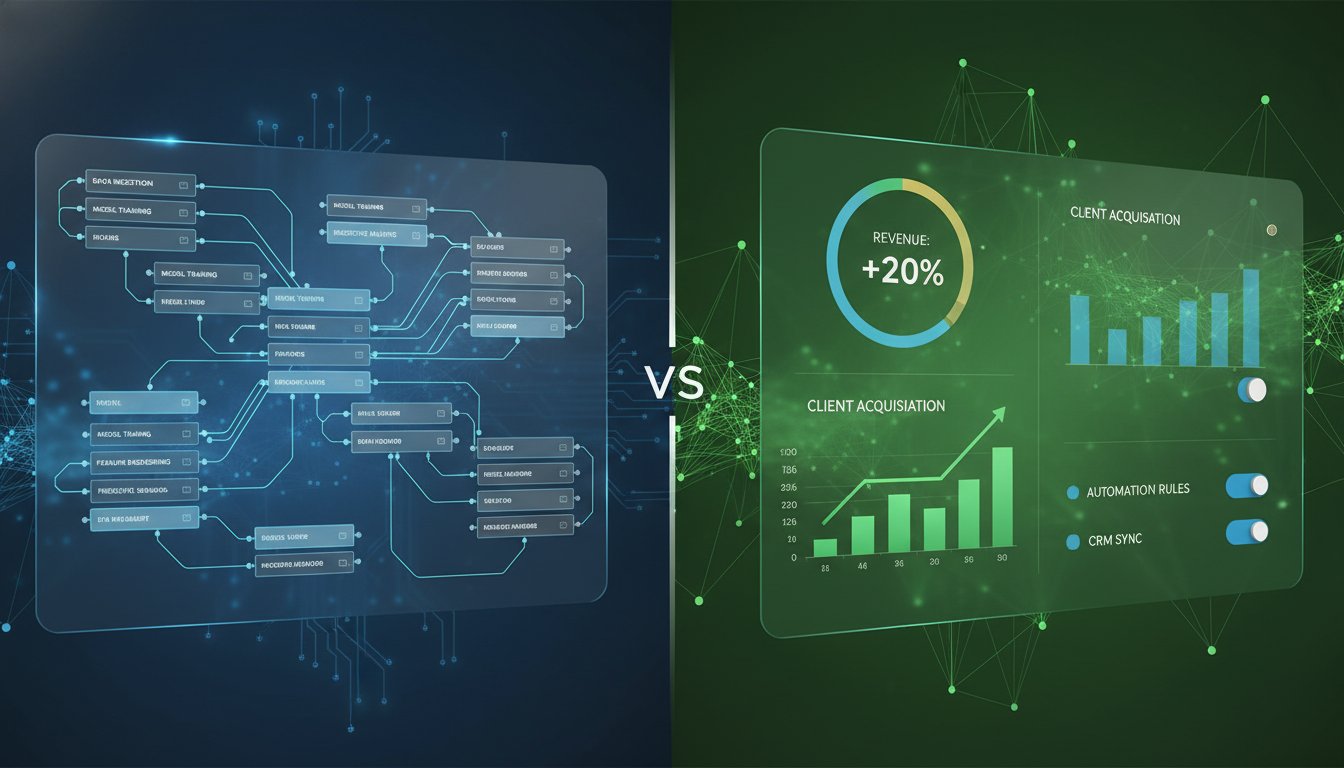
The white-label AI market has exploded in 2025, creating an intriguing dilemma for agencies and solopreneurs: should you invest in a no-code workflow builder that emphasizes visual pipelines, or choose a comprehensive business automation platform designed specifically for profitable agency growth? This isn’t just a technical comparison—it’s a strategic business decision that will determine whether your AI offering becomes a profit center or just another operational headache.
VectorShift and Parallel AI both promise to help agencies deliver AI solutions under their own brand, but they approach this mission from fundamentally different angles. One platform focuses on building custom workflows through node-based interfaces, appealing to agencies with technical resources who want granular control. The other consolidates an entire business ecosystem—content creation, lead generation, customer engagement, and white-label infrastructure—into a revenue-generating machine designed for consultants who want to sell AI services, not just build them.
For the 47% of marketing agencies currently evaluating white-label AI platforms, understanding these differences isn’t academic—it directly impacts your ability to compete, your profit margins, and how quickly you can bring revenue-generating AI services to market. According to industry data, agencies adopting comprehensive automation platforms report 3.2x faster time-to-revenue compared to those building custom solutions on workflow-focused platforms.
This analysis cuts through the marketing claims to examine what each platform actually delivers for agencies trying to build profitable, scalable AI service businesses. We’ll explore the hidden costs, the real implementation timelines, the profit margin implications, and the strategic trade-offs that only become apparent after you’ve committed months and thousands of dollars to a platform. If you’re deciding between workflow-centric customization and business-ready automation, this comparison will help you make the choice that aligns with your agency’s revenue goals, not just your technical preferences.
The Strategic Positioning Gap: Workflow Builder vs Business Platform
VectorShift’s Technical-First Approach
VectorShift positions itself as a no-code AI automation platform with a strong emphasis on visual workflow building. The platform’s core value proposition centers on enabling users to create custom AI applications through a node-based interface—think Zapier meets AI model orchestration. For agencies with technical team members who want to build bespoke solutions for each client, this granular control can feel empowering.
The platform offers deployment across web, Slack, and SMS channels, with pricing starting at a free tier, $25/month for standard plans, and $125/month for pro-level access that includes 100 workflows, 50,000 non-AI actions, and 10GB storage. Enterprise pricing follows the industry-standard “contact us” model, with custom quotes based on specific organizational needs.
Here’s the strategic challenge: VectorShift excels at building AI workflows, but it’s not purpose-built for agencies trying to sell AI services profitably. Customer reviews on Trustpilot reveal a 2.5 out of 5 star rating, with recurring complaints about limited customization for advanced use cases, high costs for small agencies, and poor customer support responsiveness. Multiple users report communication difficulties and integration challenges that slow down client implementations.
The workflow-centric model means agencies spend significant time on each client project—building custom pipelines, testing integrations, and troubleshooting node configurations. For agencies billing by the project, this can work. For those seeking recurring revenue with minimal ongoing service delivery, it creates a scalability bottleneck.
Parallel AI’s Revenue-First Architecture
Parallel AI takes a fundamentally different approach: rather than providing tools to build AI solutions, it delivers a complete, ready-to-sell business platform that agencies can brand as their own and offer to clients immediately. The strategic focus isn’t on workflow customization—it’s on profit margin optimization and time-to-revenue acceleration.
The platform consolidates eight or more separate tools (ChatGPT, Claude, content creation platforms, CRM systems, lead generation tools, customer support solutions) into a unified ecosystem. This consolidation isn’t just about convenience—it’s about economics. When agencies can replace $400-600/month in fragmented subscriptions with a single platform they can white-label and resell at 1.5-2x markup, the profit margin math transforms dramatically.
White-label pricing starts at $271/month with a 30% base margin, but agencies set their own client pricing. The documented fastest implementation? 2.5 hours from signup to first paying client. Most agencies charge $497-$1,997/month per client depending on feature packages, creating profit margins of 30-70% on platform subscriptions alone—before adding setup fees ($1,500-$5,000), training sessions ($200-500), or ongoing consulting services.
The platform includes AI knowledge base integration with Google Drive, Notion, and Confluence; multi-model access to OpenAI, Anthropic, Gemini, Grok, and DeepSeek; omnichannel customer engagement across voice, SMS, chat, and email; and a content automation engine that generates 1-3 months of content in minutes. These aren’t add-ons requiring custom configuration—they’re ready-to-deploy features agencies can activate for clients on day one.
The Profitability Implications
The positioning difference creates starkly different business models:
VectorShift agencies typically charge project fees for building custom workflows, then monthly maintenance retainers. Revenue is tied to ongoing service delivery. Scaling requires hiring more technical talent to build and maintain client workflows.
Parallel AI agencies charge setup fees for initial onboarding, then recurring platform subscriptions that clients pay directly through the white-labeled portal. Revenue scales independently of service delivery hours. One agency can support 50+ clients without proportionally increasing staff.
For a hypothetical agency with 20 clients, the math diverges significantly. Using VectorShift’s project-based model at $125/month platform cost plus 5-10 hours monthly service delivery per client at $150/hour, total monthly revenue might reach $18,000-$30,000 with 100-200 hours of work required. Using Parallel AI’s subscription model at $387/month cost per seat, charged to clients at $897/month, the same 20 clients generate $10,200/month in platform profit alone—with virtually zero ongoing service hours required, freeing the agency to add consulting services, content packages, or additional clients.
Feature Architecture: Customization vs Consolidation
VectorShift’s Workflow-Centric Capabilities
VectorShift’s core strength lies in its visual pipeline builder. Agencies can create custom chatbots, search engines, forms, and automation sequences using a drag-and-drop interface that connects various AI models, data sources, and output channels. The node-based system provides transparency into how information flows through the application, which appeals to technically-minded users who want to understand exactly what’s happening at each step.
The platform supports multi-channel deployment—agencies can build a workflow once and deploy it to web interfaces, Slack workspaces, or SMS systems. This flexibility matters for clients with specific channel preferences or complex communication requirements.
Integration capabilities include connections to standard business tools, though user feedback suggests these integrations can be challenging to configure and maintain. The platform provides analytics dashboards for tracking pipeline performance, with metrics on usage, response quality, and automation efficiency.
White-labeling exists but appears limited in scope based on available documentation. Agencies can customize branding for customer-facing chatbots and applications, but the extent of control over the entire platform experience—billing portals, admin dashboards, notification emails—remains unclear in public materials.
Parallel AI’s Business-Ready Ecosystem
Parallel AI’s feature architecture reflects a different design philosophy: rather than providing maximum customization flexibility, it delivers business-complete functionality that agencies can deploy immediately. The platform includes:
AI Knowledge Base Integration: Seamless connections to Google Drive, Confluence, and Notion mean client data automatically informs AI responses. Agencies don’t build custom knowledge pipelines—they connect existing business systems and the platform handles context management across up to one million token windows.
Content Automation Engine: Four specialized AI agents (Strategy, Copywriting, Customer Profile, and Visual) collaborate to produce 1-3 months of platform-optimized content in minutes. Agencies can white-label this as their own content service, charging $2,000-$5,000/month for what the platform generates automatically.
Omnichannel Customer Engagement: Voice AI for inbound/outbound calls, multi-channel chat across website/SMS/social platforms, and unified conversation context ensure customers receive consistent experiences regardless of contact method. This isn’t a workflow agencies build—it’s a feature they activate.
Sales Prospecting Tools: Smart Lists and Sequences enable targeted lead generation across email, social media, SMS, chat, and voice channels. Agencies can offer this as lead generation services without purchasing separate prospecting platforms.
Complete White-Label Infrastructure: Custom domain configuration (ai.youragency.com), logo and color customization, branded email notifications, custom terms of service, and client billing through the agency’s own Stripe account. Clients never see Parallel AI’s branding—only the agency’s.
The consolidation strategy means agencies replace 8+ separate tool subscriptions with a single platform. For example, an agency previously paying for ChatGPT Teams ($30/user), Jasper AI ($49/month), Intercom ($74/month), Instantly.ai ($37/month), and various other tools can eliminate $400-600 in monthly costs while gaining more capability through Parallel AI’s integrated approach.
The Customization Trade-Off
VectorShift offers greater workflow customization—agencies can build highly specific automation sequences tailored to unique client requirements. This flexibility comes with a development cost: time spent configuring, testing, and maintaining custom pipelines.
Parallel AI offers less workflow-level customization but more business-level completeness. Agencies can’t rebuild the content engine’s internal logic, but they also don’t need to—it already handles the 90% use case for content creation, lead generation, and customer engagement that most clients require.
The strategic question: Do your clients pay premium prices for bespoke workflow architecture, or for reliable business results delivered quickly? For most agencies serving SMB clients, the answer favors business-complete solutions over infinitely customizable workflows.
Implementation Reality: What Actually Happens After You Sign Up
VectorShift’s Learning Curve and Setup Process
VectorShift’s no-code interface promises accessibility, but user feedback reveals a meaningful learning curve. Understanding how to structure nodes, connect data sources, configure AI model parameters, and troubleshoot pipeline failures requires time investment. For non-technical agency owners, this can mean weeks of experimentation before feeling confident enough to deploy client solutions.
The platform provides documentation and tutorials, but customer reviews consistently mention poor support responsiveness. When agencies encounter integration challenges or unexpected behavior, resolution timelines can extend implementations significantly.
Client onboarding follows a project-based pattern: discover requirements, design custom workflow, build and test pipeline, deploy to production, train client users, monitor and optimize. This cycle typically spans 2-4 weeks per client for moderately complex implementations.
Parallel AI’s Speed-to-Revenue Timeline
Parallel AI’s implementation timeline reflects its business-first design philosophy. The documented setup process:
Day 1, Hours 1-2: Account creation, Stripe connection, base subscription selection, logo upload, brand color configuration, custom domain setup, email notification customization—complete white-label infrastructure operational.
Day 1, Hours 3-4: Package configuration including pricing tiers, feature toggles, markup calculations, and client-facing descriptions. Testing with mock client account to verify branding and billing flows.
Day 1-2: First real client onboarding—send branded credentials, knowledge base integration, initial training call.
The fastest documented timeline is 2.5 hours from agency signup to first paying client generating revenue. More typically, agencies spend 4-8 hours on initial setup and first client onboarding, then 30-90 minutes per additional client as the process becomes routine.
This speed matters economically. An agency evaluating VectorShift might spend 3-4 weeks learning the platform, building sample workflows, and preparing for client deployments before generating first revenue. That same agency using Parallel AI can have paying clients within 48 hours, generating $500-1,000+ in monthly recurring revenue while still learning advanced features.
The Hidden Cost of Complex Platforms
Workflow-centric platforms like VectorShift create ongoing maintenance requirements. As AI models update, as integration APIs change, as client needs evolve, agencies must continuously adjust custom pipelines. This isn’t necessarily bad—it creates consulting opportunities—but it does limit scalability.
Business-complete platforms like Parallel AI handle infrastructure maintenance centrally. When OpenAI releases GPT-5, when Anthropic updates Claude, when integration partners change APIs, Parallel AI’s team manages the updates. Agencies wake up to improved capabilities without touching client configurations.
For solo consultants or micro-agencies (1-10 employees), this maintenance burden difference determines whether AI services become a scalable profit center or a time-intensive project treadmill.
The Economics of White-Label AI: Real Profit Margin Analysis
VectorShift’s Project-Based Economics
VectorShift’s pricing model—$25-$125/month for most agency use cases, with custom enterprise pricing for larger deployments—creates a foundation cost, but agencies primarily monetize through service delivery rather than platform markup.
A typical economic model:
– Platform cost: $125/month (Pro plan)
– Custom workflow development: 20-40 hours at $100-150/hour = $2,000-6,000 per client
– Monthly maintenance/optimization: 5-10 hours at $100-150/hour = $500-1,500/month
– Total first-month revenue per client: $2,500-7,500
– Ongoing monthly revenue: $500-1,500
This creates healthy project margins but ties revenue directly to service hours. Scaling to 20 clients means delivering 100-200 hours monthly of technical work—requiring team expansion to maintain service quality.
Parallel AI’s Subscription-Leverage Economics
Parallel AI’s white-label model separates platform revenue from service revenue, enabling agencies to choose their business model:
Platform-Only Model:
– Base cost: $387/month per client seat
– Agency pricing: $897/month (2.3x markup, common in market)
– Monthly profit per client: $510
– 20 clients: $10,200/month platform profit with minimal ongoing work
Hybrid Model (Most Common):
– Platform subscription: $897/month to client
– Setup fee: $2,500 one-time (100% agency profit)
– Monthly consulting: 3-5 hours at $200/hour = $600-1,000
– Total first-month revenue: $3,997-4,397
– Ongoing monthly revenue: $1,497-1,897
The platform’s business impact appears in the scaling math. Agency A using VectorShift with 20 clients at $1,000/month service revenue generates $20,000/month but requires 100-200 hours of technical delivery. Agency B using Parallel AI with 20 clients at $897/month platform + $700/month average consulting generates $31,940/month with 60-100 total hours (mostly high-value consulting rather than technical maintenance).
Documented case studies show agencies reaching $105,240 annual profit from platform subscriptions alone before adding any service revenue. The math: 30 clients × $387 base cost = $11,610/month expense; 30 clients × $897 client pricing = $26,910/month revenue; profit = $15,300/month or $183,600 annually from platform margins alone.
The Service Fee Multiplier
Both platforms enable agencies to charge service fees, but the nature of those fees differs:
VectorShift agencies charge for technical implementation—building workflows, configuring integrations, troubleshooting pipelines. This positions the agency as a technical service provider.
Parallel AI agencies charge for strategic value—training sessions ($200-500), professional onboarding ($1,500-5,000), custom AI employee setup ($500-2,000), knowledge base integration ($750-2,500), and monthly optimization retainers ($500-2,000). This positions the agency as a business transformation partner.
The positioning difference impacts client lifetime value. Technical service providers face commoditization pressure as platforms improve and become easier to use. Strategic transformation partners build deeper client relationships and higher switching costs.
Enterprise Capabilities and Scalability Considerations
VectorShift’s Enterprise Offering
VectorShift provides enterprise solutions through custom pricing arrangements. Based on available information, enterprise features likely include enhanced security, higher query limits, increased storage, dedicated support, and custom integrations—standard enterprise SaaS offerings.
The platform’s node-based architecture can theoretically scale to complex enterprise workflows, though customer feedback about integration challenges and support responsiveness raises questions about production reliability at scale.
White-label capabilities appear available but documentation is limited regarding the extent of branding control, multi-tenant management, and client billing infrastructure—critical features for agencies managing dozens of client accounts.
Parallel AI’s Agency-Scale Infrastructure
Parallel AI’s enterprise tier explicitly addresses agency scaling requirements:
- Multi-organization management: Agencies can create multiple client organizations from a single admin account, each with independent branding, users, and configurations
- Seat distribution: Business tier includes 9 collaborator seats distributed across 3 organizations, enabling agencies to staff client accounts appropriately
- API access: Programmatic integration with agency systems for automated provisioning, usage monitoring, and billing synchronization
- SSO and domain verification: Enterprise security features for clients requiring advanced authentication
- On-premise deployment options: For regulated industries or clients with strict data residency requirements
- Dedicated API resources: Guaranteed performance for high-volume agency deployments
The platform’s security architecture includes AES-256 encryption, TLS protocols, and a commitment not to use client data for model training—critical for agencies serving healthcare, finance, or legal clients with compliance requirements.
Scalability appears in the pricing structure itself: agencies can start with single-client deployments at $271/month base cost, then scale to dozens of clients without platform architecture changes or migration requirements.
The Multi-Tenant Management Question
For agencies managing 10+ clients, operational efficiency depends heavily on multi-tenant architecture. Can you manage all client accounts from a single dashboard? Can you duplicate successful configurations across clients? Can you monitor aggregate usage and costs?
VectorShift’s documentation doesn’t clearly address multi-tenant agency workflows, suggesting this may require manual processes or custom solutions.
Parallel AI’s white-label infrastructure explicitly supports this use case, with agency dashboards for managing multiple client organizations, template sharing, and consolidated billing views.
The Strategic Decision Framework: Choosing Your Platform
When VectorShift Makes Strategic Sense
VectorShift represents the better choice for specific agency profiles:
Technical agencies with development resources: If your team includes developers or technical architects who enjoy building custom solutions, VectorShift’s workflow flexibility can be an asset rather than overhead.
Highly specialized vertical solutions: Agencies serving niche industries with unique workflow requirements may benefit from the granular customization VectorShift enables.
Project-based business models: If your revenue model centers on billable hours for custom development rather than recurring subscriptions, VectorShift’s architecture aligns with this approach.
Clients who value bespoke solutions: Some enterprise clients specifically pay premium prices for custom-built systems rather than productized platforms.
The platform’s lower entry price ($25-125/month) also creates an accessible testing ground for agencies exploring AI service offerings without immediate client commitments.
When Parallel AI Delivers Superior ROI
Parallel AI emerges as the stronger choice for the majority of agencies and solopreneurs based on several strategic factors:
Revenue-first business models: Agencies seeking high-margin recurring revenue with minimal ongoing service delivery find Parallel AI’s white-label subscription model transformative.
Speed-to-market requirements: Consultants who need to launch AI services quickly—weeks or days rather than months—benefit from Parallel AI’s business-ready infrastructure.
Non-technical founders: Solo consultants and agency owners without technical teams can deploy sophisticated AI capabilities without learning workflow programming.
Tool consolidation economics: Agencies currently paying for multiple AI and automation platforms save $400-600/month by consolidating to Parallel AI while gaining white-label resale opportunities.
Scalability without headcount: Micro-agencies (1-10 employees) seeking to serve 20-50+ clients without proportionally scaling staff find Parallel AI’s automated infrastructure essential.
Client success focus over technical delivery: Agencies that want to spend time on strategic consulting and client outcomes rather than technical troubleshooting align with Parallel AI’s productized approach.
The documented implementation timeline—2.5 hours to first paying client—particularly matters for consultants testing market demand or transitioning existing clients to AI-enhanced services.
The Unspoken Reality: What You Discover Three Months In
Platform comparison articles rarely discuss what happens after the honeymoon period ends. Here’s what agencies actually experience:
The VectorShift Three-Month Reality
Month 1: Excitement about customization possibilities, time spent learning node configurations
Month 2: First client implementations, troubleshooting integration issues, support ticket frustrations
Month 3: Realization that each new client requires significant custom development, questioning scalability
The 2.5-star Trustpilot rating reflects this pattern—initial promise followed by operational friction. Agencies discover that workflow customization flexibility becomes workflow maintenance burden.
The Parallel AI Three-Month Reality
Month 1: Rapid client onboarding, surprise at implementation speed, learning advanced features
Month 2: Template development for common client scenarios, margin optimization through service package refinement
Month 3: Focus shifts from platform operation to business growth—adding clients, expanding service offerings, increasing consulting rates
The CEO testimonial from Mercenary Marketing captures this: “In just 30 days of using their platform, we’ve been able to deliver 5x faster content creation and 60% cost savings to our clients while maintaining the personalized, trust-based relationships that are core to our business.”
Making the Choice That Aligns with Your Agency’s Future
The VectorShift vs Parallel AI decision ultimately reflects a deeper strategic question: What business are you actually building?
If you’re building a technical services agency that monetizes custom development expertise, VectorShift’s workflow-centric approach may align with your value proposition. You’ll spend more time on technical implementation, but clients specifically pay for that bespoke development.
If you’re building a scalable consulting business that monetizes business transformation expertise, Parallel AI’s business-ready platform enables you to focus on client outcomes rather than technical plumbing. You’ll spend less time on platform mechanics and more time on strategic client work that commands premium pricing.
The market data suggests most agencies fall into the latter category. According to industry research, 73% of agencies cite “time spent on technical implementation” as a barrier to AI service scaling. These agencies don’t need more workflow customization—they need faster time-to-revenue and higher profit margins.
For the solopreneur consultant evaluating white-label AI platforms, consider this: In the time it takes to master VectorShift’s node-based workflow builder and deploy your first client project, you could have 5-10 clients already generating revenue on Parallel AI’s white-label platform, creating $2,500-$5,000 in monthly recurring profit while you focus on delivering the strategic consulting services that actually differentiate your business.
The platform you choose doesn’t just affect your technology stack—it determines your business model, your profit margins, your scalability ceiling, and ultimately, whether your AI service offering becomes a transformative revenue driver or just another time-intensive project category. Choose accordingly.
Ready to see if Parallel AI’s white-label platform can transform your agency’s economics? The fastest recorded setup was 2.5 hours from signup to first paying client. Your timeline starts whenever you decide to stop researching and start generating revenue. Book a personalized demo to see exactly how the platform would work for your specific agency model, or explore the detailed white-label pricing and profit calculators to model your potential margins before committing.