
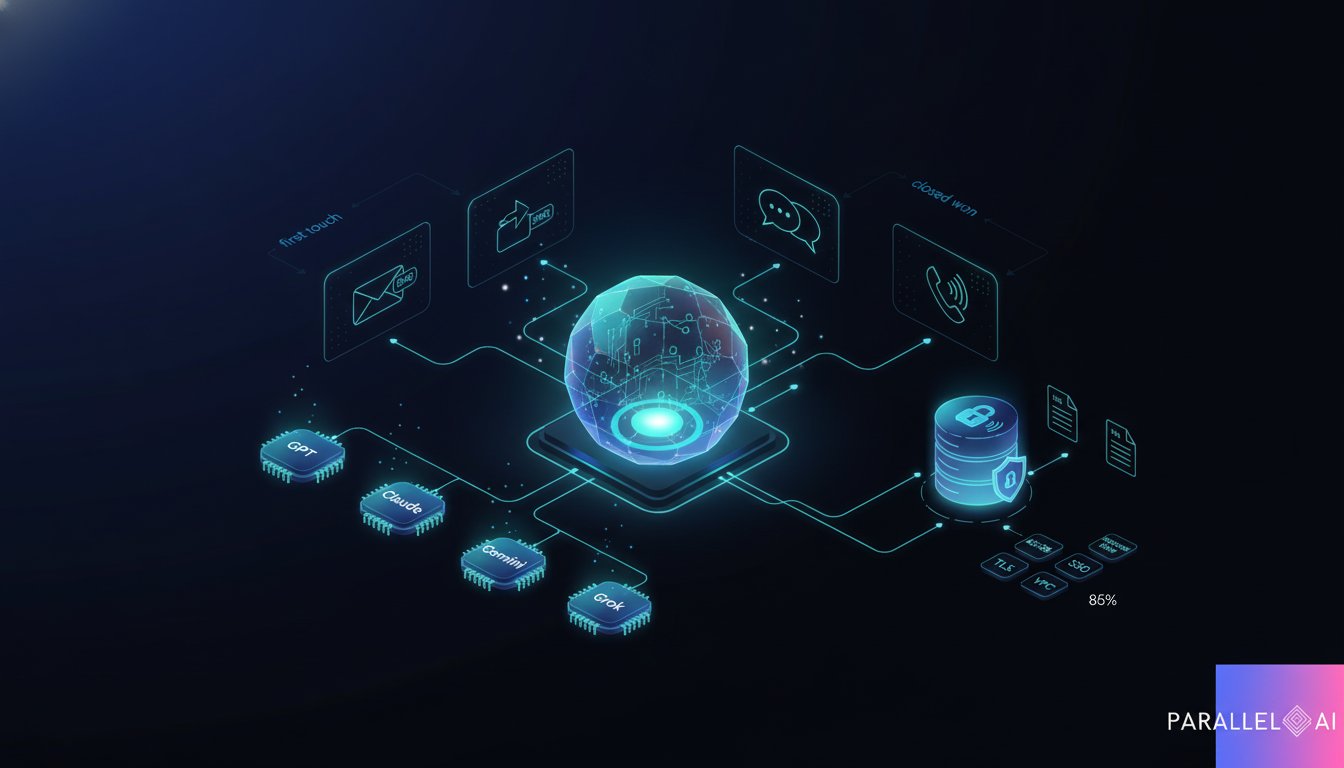
If you’re a solopreneur or micro‑agency, the fastest path to scale isn’t hiring—it’s running your business in parallel. Omni‑channel AI agents let you engage prospects and serve clients across email, SMS, chat, and voice as one coherent system that remembers context from first touch to closed won. This playbook gives you a complete blueprint to design, deploy, and productize a white‑label omni‑channel agent using a practical, secure, and ROI‑positive approach.
Who this is for
– Digital marketing, sales, tech, strategy, and content consultants running 1–10 person practices
– Teams that need enterprise‑grade AI without building from scratch
– Professionals who want to white‑label a platform to sell omni‑channel outreach and service packages
What you’ll build
– A unified agent that operates across email, SMS, chat, and voice
– A buyer‑journey‑aware workflow that selects the right channel at the right time
– A model routing policy that balances accuracy, speed, and cost (OpenAI, Anthropic, Gemini, Grok, DeepSeek)
– Persistent, compliant memory using long‑context models and connected knowledge bases (Google Drive, Confluence, Notion)
– Smart Lists and Sequences for targeted, multi‑step campaigns
– Security and compliance guardrails (SSO, AES‑256/TLS, on‑prem/VPC options, data isolation, no training on client data)
1) The omni‑channel architecture (at a glance)
– Channel adapters: Email (SMTP/IMAP, APIs), SMS (A2P/10DLC), Web chat, Voice (SIP/telephony). Each adapter normalizes events: delivered, opened, clicked, replied, spoken intent.
– Orchestration layer: A router that classifies intent, chooses the next action, picks a model, and schedules multi‑channel steps.
– Memory and long context: Conversation summaries, preferences, and account facts stored in a secure store; long‑context models use this memory at runtime.
– Knowledge sources: Connect Google Drive, Confluence, Notion, and your CRM. Retrieval‑augmented generation (RAG) delivers grounded, citeable answers.
– Model router: Policy‑based selection across OpenAI, Anthropic, Gemini, Grok, and DeepSeek for specific tasks.
– Guardrails: PII redaction, allow/deny lists, tone controls, structured outputs.
– Observability: Analytics for reply rate, meetings booked, LLM cost, time‑to‑first‑value.
– Security: SSO (Google/Microsoft/Okta), AES‑256 at rest, TLS in transit, audit logs, data isolation, on‑prem/VPC deployment options, and clear non‑training policies.
2) Map your buyer journey to channels and intents
Create a journey map that drives channel choice and agent behavior. Keep it simple and measurable.
– Stages: Awareness → Consideration → Evaluation → Decision → Onboarding → Expansion
– For each stage capture: ICP persona, top questions, trust gaps, qualified intent signals, CTA, and SLA.
– Example intent signals:
– Awareness: Ad click, ebook download → Email nurture with value content
– Consideration: Pricing page views, chat questions → Chat summarizes fit, offers case study, proposes call via SMS
– Evaluation: Reply with timeline, budget → Voice agent confirms requirements and books meeting
– Decision: Verbal “yes,” legal review → Email sends proposal; SMS confirms signature reminders
– Onboarding: Form submitted → Chat guides kickoff; email sends credentials; voice verifies access if needed
3) Channel selection playbook (when to use what)
– Email: Best for rich content, async proposals, recaps. Great for A/B testing and deliverability control (SPF/DKIM/DMARC).
– SMS: Best for time‑sensitive nudges, confirmations, rescheduling. Requires explicit opt‑in and compliant templates.
– Chat: Best for instant answers, lead capture, interactive troubleshooting, and routing to human or voice calls.
– Voice: Best for qualification, discovery, and complex or high‑trust moments; excellent for summarizing to CRM.
Simple rule: Start where the prospect is most responsive, then graduate to richer channels as intent increases. Keep context consistent everywhere.
4) Orchestrating multiple models for accuracy, speed, and cost
Adopt a policy that assigns the right model to the right job.
– Triage and classification: Use a fast, cost‑efficient model to detect intent, urgency, and compliance flags.
– Long‑form reasoning and safety: Use models known for reasoning and constitutional guardrails (e.g., Anthropic) for sensitive decisions and summaries.
– Drafting and personalization: Use creative, controllable models (e.g., OpenAI) with structured prompts and style guides.
– Knowledge‑grounded Q&A: Use retrieval + a model that handles long context (e.g., Gemini, Anthropic) and require citations.
– Real‑time trend or web context: Use models with current‑events strengths (e.g., Grok) when appropriate.
– Analytical/cost‑sensitive bulk ops: Consider DeepSeek or other efficient models for classification, enrichment, and bulk transformations.
Routing strategy
– Inputs: Task type, latency budget, cost target, sensitivity level, context window needed.
– Outputs: Model selection, temperature, max tokens, tool access, and fallback.
– Guardrails: Enforce structured outputs (JSON), safety filters, and deterministic checks (regex/validators) before sending.
5) Memory that persists across channels (without creepiness)
Design a compliant memory schema that’s explicit and opt‑in.
– Memory types:
– Identity: Name, roles, verified contact points (encrypted)
– Preferences: Channel, meeting times, tone
– Facts: Company, products in scope, contract state
– History: Summaries of each interaction, linked to source transcripts
– Tasks: Next steps with owner and due date
– Best practices:
– TTL and retention by data class (e.g., delete PII after X days if inactive)
– Encrypt PII at rest (AES‑256) and in transit (TLS)
– Show “why we know this” with links back to chat/email/call
– Let users update or delete their data
6) Connect your knowledge bases (Drive, Confluence, Notion)
– Scope access via SSO and least privilege; mirror permissions at the document level.
– Chunk documents (300–800 tokens), embed at ingestion, and store metadata (owner, date, version).
– Retrieval rules:
– Ground every answer with citations
– Prefer the newest version
– Refuse if confidence is low; escalate to human
– Sync cadence: Daily for static assets; webhooks or rapid sync for FAQs and pricing.
7) Smart Lists and Sequences for targeted campaigns
– Smart Lists: Dynamic segments that auto‑update (e.g., “Leads who visited pricing in 7 days and haven’t booked”).
– Sequences: Multi‑step, multi‑channel flows with waits, branches, and goals.
Example sequence: Revive cold leads (14 days)
– Day 1 Email: Contextual “we built X since we last spoke” with two‑click CTA
– Day 3 SMS: Quick value hook + scheduling link (opt‑in only)
– Day 5 Chat: If they visit site, proactive chat offers a 5‑minute fit check
– Day 7 Email: Case study matching their industry; ask one qualifying question
– Day 10 Voice: Friendly voicemail and live transfer option
– Exit on meeting booked; send recap email summarizing needs and next steps
8) Channel‑specific workflow patterns and templates
Email
– Use structured prompts: persona, voice/tone, value prop, objection handling, and a single CTA.
– Always include a two‑sentence executive summary at the top for skim readers.
– Samples:
– Cold open: “Noticed you’re [trigger]. Clients like [ICP] used [offer] to [outcome]. Worth a 12‑minute chat?”
– Post‑demo recap: Bullet outcomes, risks, timeline, and a calendar link.
SMS
– Keep it <160 characters; include brand, value, and opt‑out.
– Samples:
– “Hi [Name]—it’s [Brand]. That [resource] you requested is here: [short link]. Want a 10‑min walkthrough? Reply YES to see times.”
– “Quick check‑in: still evaluating [topic]? Happy to send a 2‑page comparison. Reply C for comparison. Reply STOP to opt out.”
Chat
– First message summarizes what you know and asks a disarming question.
– Offer two quick actions: “Book time” and “See how we compare.”
– Save chat -> CRM with a one‑paragraph summary and next step.
Voice
– Use a short discovery script: problem, impact, timeline, authority, and next step.
– Auto‑generate call notes, action items, and follow‑up email within 2 minutes.
9) Compliance and deliverability essentials
– Identity and access: SSO (Google, Microsoft, Okta), role‑based access, audit logs.
– Data security: AES‑256 at rest, TLS in transit, secrets vault, environment isolation (workspace per client), and on‑prem/VPC options.
– Data usage: Do not train foundation models on client data; clarify processors/sub‑processors; support data residency where required.
– Email: Authenticate with SPF/DKIM/DMARC, warm up domains, include physical address and unsubscribe.
– SMS: Honor TCPA/CTIA; maintain opt‑in/opt‑out logs; register 10DLC campaigns as applicable.
– Voice: Consent for call recording; disclose AI use where required; respect local regulations.
10) Instrumentation and KPIs to prove ROI
– Top‑of‑funnel: Open rate, click‑through, chat engagement, qualified conversations
– Mid‑funnel: Positive reply rate, meetings booked, show rate, proposal acceptance
– Bottom‑funnel: Cycle time, win rate, ACV, onboarding time
– Efficiency: LLM cost per meeting booked, agent‑assisted hours saved, first‑response time
– Quality and safety: Hallucination rate (flagged), grounded‑answer ratio, compliance incidents
11) Packaging this as a white‑label service (Parallel AI style)
Offer tiered packages your clients can buy today.
– Starter (for pilots): 1 omni‑channel agent, 1 Smart List, 1 Sequence, email + chat, weekly report
– Growth: 3 agents, email/SMS/chat/voice, 5 Sequences, CRM integration, knowledge base sync, SLA
– Scale: Unlimited Smart Lists, custom model routing, VPC or on‑prem, advanced compliance, quarterly business reviews
– Add‑ons: Domain warm‑up, deliverability tuning, sales playbook design, integration sprints
Pricing guidance
– Charge setup + monthly platform + performance bonus (meetings or revenue milestones). Anchor value to outcomes, not tokens.
12) A 14‑day implementation sprint
– Day 1–2: ICP, offers, compliance checklist, domain and number setup
– Day 3–4: Connect CRM, Drive/Confluence/Notion; create Smart Lists
– Day 5–6: Draft Sequences for outreach, nurture, and post‑demo follow‑ups
– Day 7–8: Configure model routing and guardrails; run dry‑runs
– Day 9–10: Launch with a 10% segment; monitor deliverability and replies
– Day 11–12: Add chat and voice; ship recap emails and call notes to CRM
– Day 13–14: Review metrics; iterate copy, gating, and routing policies; expand to full list
13) Proof points you can share with clients
– Industry surveys across 2024–2025 report broad experimentation with generative AI and many teams citing positive time savings and revenue impact within months of deployment.
– Coherent, multi‑channel experiences typically increase engagement versus single‑channel blasts, especially when memory and personalization are consistent.
– Early adopters commonly report faster response times, more meetings per rep, and reduced manual admin due to automatic summaries and follow‑ups.
Note: Always measure your own baselines and attribute results to isolate the impact of AI.
14) Common pitfalls (and how to avoid them)
– Over‑automation: Set clear human‑in‑the‑loop rules and escalation paths.
– Hallucinations: Require citations, use retrieval, and refuse when not confident.
– List abuse: Use Smart Lists with strict filters; cap daily sends; rotate domains.
– Compliance drift: Automate opt‑out handling, DNC checks, and retention policies.
– Cost spikes: Enforce token budgets, batch low‑stakes tasks on efficient models, cache summaries.
15) Quick start with a white‑label platform
– Brand the workspace as your own; invite clients via SSO.
– Import contacts, define Smart Lists, connect CRM and knowledge bases.
– Enable Sequences across email/SMS/chat/voice, then switch on the orchestration layer with your routing policy.
– Ship your first 14‑day program and review the KPI dashboard together.
Copy‑ready prompts
– Outreach email prompt: “Write a 120‑word email to [ICP] at [Company] about [Offer]. Use [Tone]. Cite 2 outcomes from [Case Study doc IDs]. CTA: 12‑minute fit call this week. Output JSON with subject, body, preview.”
– SMS prompt: “Create a compliant SMS (<160 chars) for [Opt‑in lead] who visited [Pricing]. Include brand, value hook, short link [URL], STOP to opt out.”
– Chat guardrail: “If answer is not grounded in [KB citations], say ‘I’m not sure; let me check’ and escalate.”
– Voice discovery: “Ask 5 questions: problem, impact, timeline, authority, next step. Summarize to CRM in bullets with action items.”
Your next step
Choose one campaign and one Smart List, connect one knowledge base, and run a 14‑day pilot. With an omni‑channel agent, you’ll deliver Fortune‑500‑level responsiveness while keeping your boutique edge—and you can sell it tomorrow under your own brand.