
The white-label AI platform market has reached a critical inflection point. Agencies and consultants can no longer ignore the question: should you invest in an enterprise-focused AI builder designed for large corporations, or choose a comprehensive automation platform specifically engineered for service businesses? This decision carries profound implications for your agency’s profitability, client retention, and competitive positioning over the next 3-5 years.
According to recent market analysis, the business process automation market reached $16.46 billion in 2025, growing at 10.7% CAGR, with 90% of major corporations listing hyperautomation as a strategic priority. Yet most comparison articles examining white-label AI platforms miss the fundamental question: which platform actually generates revenue for small agencies, not just Fortune 500 enterprises?
This comprehensive analysis cuts through the marketing noise to examine what Stack AI and Parallel AI actually deliver for solopreneurs, micro-agencies, and independent consultants building scalable service businesses. We’ll explore real-world economics, implementation timelines, client delivery capabilities, and the brutal truths that only emerge after you’ve committed months and thousands of dollars to the wrong platform.
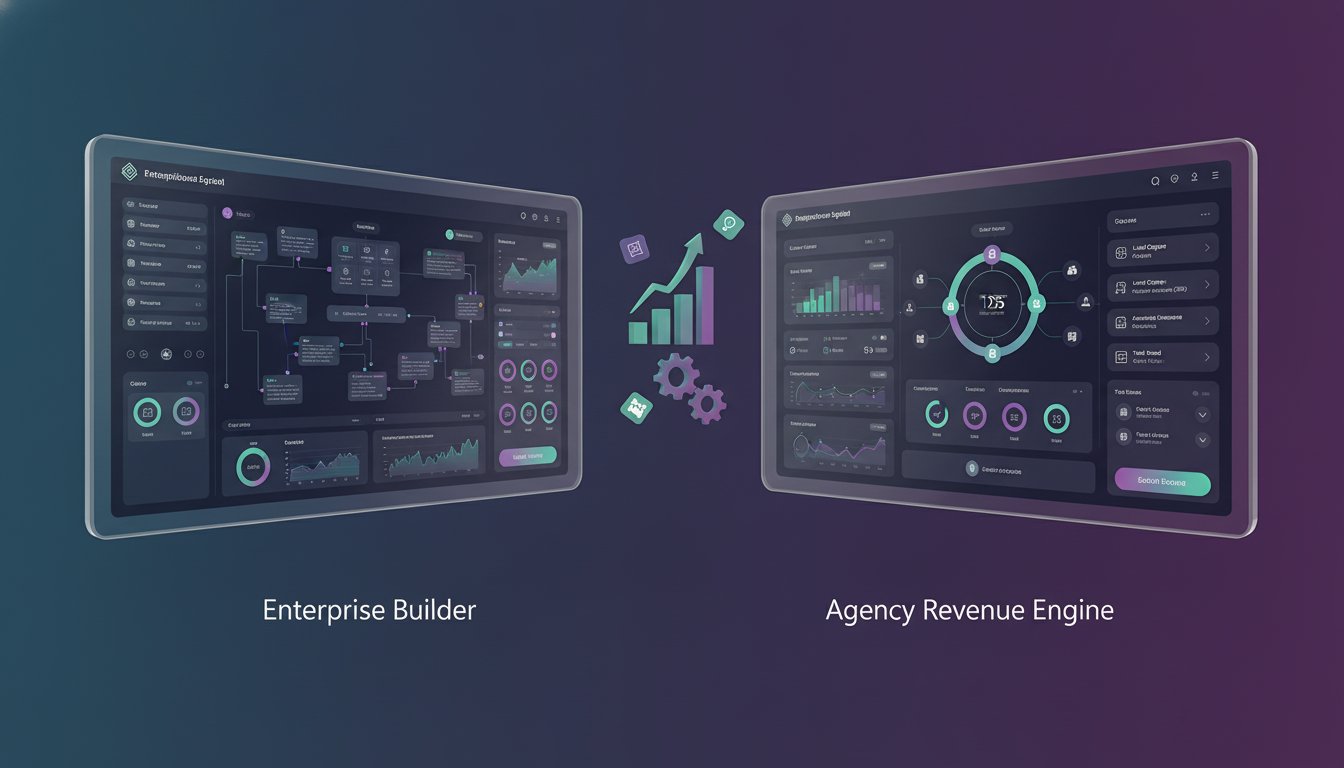
The Enterprise Builder vs. The Agency Revenue Engine: Understanding the Fundamental Difference
Stack AI and Parallel AI represent two philosophically distinct approaches to white-label AI automation, each optimized for dramatically different business models and customer segments.
Stack AI positions itself as an enterprise-grade AI application builder designed for large organizations deploying AI agents at scale. The platform targets companies with dedicated development teams, extensive integration requirements, and complex enterprise workflows spanning systems like SharePoint, Workday, and Salesforce. Their no-code/low-code interface enables technical teams to build custom AI applications without writing extensive code—but the emphasis remains on building, not deploying ready-to-use business solutions.
Parallel AI operates as a complete business automation ecosystem specifically engineered for agencies, consultants, and service providers who need to generate client revenue immediately. Rather than providing building blocks for custom applications, Parallel AI delivers pre-configured automation capabilities across content creation, lead generation, customer engagement, and workflow orchestration—all brandable under your agency’s identity within days.
This distinction matters far more than most agencies realize during the evaluation phase. One platform asks, “What custom AI application do you want to build?” The other asks, “What client revenue do you want to generate this month?”
Target Audience Reality Check: Who Actually Succeeds with Each Platform?
Stack AI’s Ideal Customer Profile:
– Large enterprises (1,000+ employees) with dedicated AI/development teams
– Organizations requiring custom AI applications for highly specific workflows
– Companies with existing technical infrastructure across SharePoint, Workday, Salesforce
– Businesses willing to invest months in application development before client deployment
– Teams comfortable managing complex integrations across 100+ platform connections
Parallel AI’s Ideal Customer Profile:
– Solopreneurs and micro-agencies (1-10 employees) seeking immediate revenue opportunities
– Marketing agencies, sales consultants, content creators needing client-ready solutions
– Service businesses lacking in-house development teams or technical expertise
– Consultants wanting to scale service delivery without hiring additional staff
– Agencies seeking 30-70% profit margins on white-labeled AI subscriptions
The pricing structures reveal this fundamental difference in target markets. Stack AI’s enterprise focus becomes immediately apparent in their tier structure, while Parallel AI’s pricing directly addresses agency profit models.
Platform Capabilities Comparison: Building Blocks vs. Business Solutions
What Stack AI Actually Delivers
AI Application Development Framework:
Stack AI provides a sophisticated drag-and-drop interface for building custom AI applications. Enterprises can create chatbots, forms, workflow automations, and Slack integrations tailored to their specific use cases. The platform supports integration with 100+ enterprise systems, enabling complex data flows across organizational infrastructure.
Enterprise Integration Depth:
For organizations already invested in enterprise software ecosystems, Stack AI offers deep integration capabilities with SharePoint, Workday, Salesforce, and internal APIs. This enables AI agents to access data across siloed systems and automate workflows spanning multiple platforms.
Customization Control:
Technical teams gain granular control over AI application behavior, UI/UX design, and integration logic. This flexibility empowers enterprises to create precisely tailored solutions matching their unique requirements.
White-Label Capabilities:
Stack AI supports white-labeling with custom branding, interface customization, and access permission configuration. Enterprises or large agencies can deploy branded AI tools internally or to clients.
Critical Limitations for Small Agencies:
– Requires technical expertise to build and deploy effective applications
– Implementation timelines span weeks to months before client-ready deployment
– No pre-built content automation, lead generation, or sales prospecting capabilities
– Free plan limited to 100 runs/month and 1 project—insufficient for agency client work
– Starter plan at $199/month supports only basic automation for individuals
– Team plan at $899/month required for serious agency deployment
What Parallel AI Actually Delivers
Complete AI Automation Ecosystem:
Parallel AI provides pre-configured automation capabilities across five critical business functions: AI knowledge base integration, content automation engine, sales prospecting and outreach, omni-channel customer interaction, and workflow orchestration. Agencies can deploy these capabilities to clients within hours, not months.
AI Knowledge Base Integration:
Seamless connection to Google Drive, Notion, Confluence, and databases enables AI agents to access company-specific information. Every AI interaction draws from the client’s actual business knowledge, creating contextually relevant responses rather than generic AI outputs.
Content Automation Engine:
Automated content creation across articles, blogs, marketing copy, social media, and reports. The system generates 1-2 months of authentic content in minutes, directly addressing the $400-500/month agencies typically spend on fragmented content tools (ChatGPT Plus, Jasper, Copy.ai).
Sales Prospecting and Lead Generation:
Smart Lists and Sequences enable targeted lead identification and multi-channel outreach across email, social media, SMS, chat, and voice. This consolidates functionality typically requiring separate subscriptions to Clay, Instantly.ai, and similar point solutions.
Omni-Channel Customer Engagement:
AI-powered agents handle customer conversations across phone, SMS, website chat, and messaging platforms while maintaining context from the knowledge base. Agents remember every interaction, sync with CRM systems, and escalate to humans only when needed.
White-Label Revenue Model:
Parallel AI specifically engineers its white-label offering around agency profitability. Agencies can launch branded AI platforms in 2-5 days, charge clients $497-$1,997/month, and maintain 30-70% profit margins while Parallel AI handles all technical infrastructure.
Critical Advantages for Small Agencies:
– Zero technical expertise required—non-technical agency owners deploy client solutions independently
– Implementation timeline: 2.5 hours to first paying client (fastest recorded)
– Pre-built automation capabilities eliminate months of custom development
– Consolidates 8+ tools (ChatGPT, Claude, Jasper, Clay, Instantly.ai, Zapier, Intercom) into one platform
– Pricing starts at $99/month for entrepreneurs, scales to $297/month for teams managing multiple client organizations
– Direct client billing through agency’s Stripe account with automated revenue share
The Economics of White-Label AI: Real Revenue Models Compared
Stack AI Pricing and Profit Potential
Stack AI Pricing Tiers:
– Free Plan: 100 runs/month, 1 project—exploratory only, not viable for client work
– Starter Plan: $199/month—suitable for individual automation experiments
– Team Plan: $899/month—required for agency deployment with multiple clients
– Enterprise Plan: Custom pricing for large organizations with specific requirements
Agency Revenue Model Reality:
Stack AI doesn’t publish specific white-label pricing or revenue-sharing structures. Their enterprise focus suggests agencies would purchase Team plan ($899/month) or Enterprise pricing, then charge clients for custom-built applications. However, the platform provides no pre-configured pricing tiers, billing infrastructure, or margin guidance for agencies.
Hidden Costs for Agencies:
– Technical talent required to build client applications (developer/contractor costs)
– Extended implementation timelines delay revenue generation (opportunity cost)
– No bundled AI model access—agencies may need separate subscriptions to OpenAI, Anthropic, Google for comprehensive capabilities
– Integration complexity may require additional consulting or development resources
Realistic Agency Scenario:
Small agency purchases Stack AI Team plan at $899/month, hires contractor at $75/hour for 40 hours ($3,000) to build initial client applications, then charges clients $500-1,000/month for access to custom-built tools. First-month investment: $3,899. Break-even requires 4-8 clients before generating profit. Timeline to first paying client: 4-8 weeks.
Parallel AI Pricing and Profit Potential
Parallel AI Pricing Tiers:
– Free Plan: Exploratory access to platform capabilities
– Entrepreneur Plan: $99/month—includes 2,000 questions/month, content engine, sequences, smart lists, white-labeling
– Business Plan: $297/month—includes 9,000 questions/month, 3 organizations with 9 collaborator seats, API access
– Enterprise Plan: Custom pricing with unlimited access, SSO, on-premise deployment, dedicated API resources
White-Label Revenue Model:
Parallel AI operates on transparent revenue-sharing: base cost starts at $271/month with agencies keeping 30% of subscription value as base margin. Agencies set their own client pricing—most charge $497-$1,997/month depending on features and seats.
Detailed Profit Calculations:
Platform-Only Model (Pure Subscription Revenue):
– Agency base cost: $387/month per client seat
– Agency client pricing: $697/month (recommended 1.8x markup)
– Monthly profit per client: $310 (44% margin)
– 10 clients = $3,100/month profit ($37,200/year)
– 30 clients = $9,300/month profit ($111,600/year)
Hybrid Model (Platform + Services):
– 15 clients × $897/month platform subscription = $13,455/month revenue
– Setup fees: 3 new clients × $2,500 = $7,500 one-time (per quarter)
– Monthly consulting: 10 hours × $200/hour = $2,000/month
– Platform costs: 15 clients × $387 = $5,805/month
– Net platform profit: $7,650/month
– Total monthly revenue: $15,455 + consulting projects
– Annual recurring revenue: $185,460 + variable services
Additional Revenue Opportunities:
– Professional onboarding: $1,500-$5,000 per client (100% agency revenue)
– Training sessions: $200-$500 per session (100% agency revenue)
– Custom AI employee setup: $500-$2,000 per implementation (100% agency revenue)
– Knowledge base integration: $750-$2,500 per project (100% agency revenue)
– Workflow automation consulting: $150-300/hour (100% agency revenue)
– Monthly optimization retainer: $500-$2,000/month (100% agency revenue)
Timeline to First Revenue:
Parallel AI enables same-day revenue generation. The fastest recorded setup: 2.5 hours from signup to first client onboarded and paying. Average agency timeline: 3-5 days from account creation to branded platform launch with first paying clients.
Implementation Reality: Months vs. Hours
Stack AI Implementation Timeline
Week 1-2: Platform Setup and Learning
– Create account and explore interface
– Connect integration platforms (SharePoint, Salesforce, internal systems)
– Learn drag-and-drop application builder
– Review documentation and tutorials
– Identify first use case for client application
Week 3-6: Application Development
– Design custom AI application architecture
– Build chatbot, form, or workflow interfaces
– Configure data connections and AI model behavior
– Test application functionality
– Iterate based on testing results
– Debug integration issues
Week 7-8: White-Label Configuration and Client Onboarding
– Apply custom branding to application interfaces
– Set up client access permissions
– Create documentation for client users
– Conduct client training sessions
– Monitor initial usage and troubleshoot issues
Total Timeline: 6-8 weeks minimum from account creation to first client generating revenue. This assumes agencies have technical resources available and don’t encounter significant integration challenges.
Parallel AI Implementation Timeline
Day 1, Hour 1: Account Setup (15 minutes)
– Create white-label account
– Connect Stripe account for automated client billing
– Select base subscription tier
Day 1, Hour 1-2: Brand Customization (30 minutes)
– Upload agency logo and set brand colors
– Configure custom domain (ai.youragency.com)
– Customize email notifications and sender details
– Add terms of service and privacy policy
Day 1, Hour 2-3: Package Configuration (45 minutes)
– Create pricing tiers (Starter, Pro, Enterprise packages)
– Toggle features on/off for each package level
– Set markup and profit margins
– Write package descriptions and client-facing benefits
Day 1, Hour 3-4: Testing and Quality Check (30 minutes)
– Create test client company account
– Verify branding appears correctly throughout platform
– Test client login experience
– Preview all features from client perspective
– Confirm billing flow works properly
Day 1, Hour 4-6: First Client Onboarding (1-2 hours)
– Onboard first real client to branded platform
– Send branded login credentials
– Begin generating revenue immediately
– Schedule onboarding/training call
Total Timeline: 2.5-6 hours from account creation to first paying client. Many agencies complete setup in the morning and onboard their first client by end of business day.
Business Model Implications: Who Wins with Each Platform?
When Stack AI Makes Strategic Sense
Stack AI delivers genuine value for specific organizational profiles and use cases that don’t match typical small agency requirements:
Large Enterprises with Development Resources:
Organizations employing dedicated AI teams, developers, and technical product managers benefit from Stack AI’s customization depth. When you need AI applications tailored to highly specific enterprise workflows not addressed by off-the-shelf solutions, Stack AI’s building-block approach enables precise customization.
Complex Integration Requirements:
Companies already invested in enterprise software ecosystems (SharePoint, Workday, Salesforce, custom internal systems) need AI agents accessing data across these siloed platforms. Stack AI’s 100+ integration capabilities support complex data flows impossible with simpler platforms.
Custom Application Development Services:
Agencies specializing in custom AI application development for enterprise clients—rather than deploying pre-built automation capabilities—may find Stack AI’s flexibility valuable. However, this represents a fundamentally different business model than most small agencies pursue.
When Stack AI Doesn’t Work:
– Solopreneurs or micro-agencies without technical development resources
– Service businesses needing immediate client revenue, not multi-month development projects
– Agencies seeking to consolidate fragmented AI tool spend into one platform
– Consultants wanting pre-built content creation, lead generation, or customer engagement capabilities
– Businesses requiring clear profit margins and revenue-sharing structures for white-label offerings
When Parallel AI Makes Strategic Sense
Parallel AI specifically engineers its platform around the business model, resource constraints, and revenue requirements of solopreneurs and micro-agencies:
Agencies Seeking Immediate Revenue Opportunities:
Service businesses can launch branded AI platforms and onboard paying clients within days, not months. The 2.5-hour record from signup to first paying client reflects genuine platform design around agency revenue generation.
Consolidation Economics:
Agencies currently spending $400-500/month across fragmented tools (ChatGPT Plus $20, Claude Pro $20, Jasper $40+, Clay $150+, Instantly.ai $37+, Zapier $25+, Intercom $74+) save significantly while gaining comprehensive capabilities under their own brand. The consolidation creates immediate positive cash flow.
Non-Technical Service Providers:
Marketing agencies, sales consultants, content creators, and business strategists without in-house development teams can deploy enterprise-grade AI capabilities to clients independently. Zero coding or technical expertise required.
Scalable Service Delivery:
Consultants facing the growth paradox—need to scale revenue without scaling headcount—gain AI-powered capabilities enabling 10x output increases. One consultant can serve 10-30 clients with AI automation handling content creation, lead nurturing, and customer engagement.
Transparent Profit Models:
Agencies gain clear visibility into costs, margins, and revenue potential. The transparent revenue-sharing structure (30% base margin plus unlimited markup potential) enables straightforward business planning and pricing strategy.
When Parallel AI Doesn’t Work:
– Large enterprises requiring custom AI applications for highly specific workflows
– Organizations needing deep integration with proprietary internal systems not supported by standard connectors
– Companies wanting to build custom AI tools from scratch rather than deploy pre-configured capabilities
The White-Label Revenue Model: Platform Subscriptions vs. Development Projects
The fundamental economics of white-label AI differ dramatically between development platforms and deployment platforms:
Stack AI Revenue Model: Project-Based Custom Development
Revenue Structure:
Agencies charge clients for custom AI application development as project-based work, then potentially add ongoing subscription fees for application access and maintenance.
Revenue Timeline:
– Month 1-2: Development work (agency incurs costs, client not yet paying)
– Month 3: Application launch, client begins subscription
– Ongoing: Monthly subscription fees + potential enhancement projects
Margin Profile:
– Development project margins: 30-50% (after contractor/developer costs)
– Ongoing subscription margins: Variable (depends on agency pricing vs. platform costs)
– Requires continuous new project acquisition to maintain revenue growth
Scaling Challenges:
– Each new client requires custom development work (doesn’t scale linearly)
– Technical resource constraints limit client capacity
– Revenue tied to agency’s ability to deliver custom projects
Parallel AI Revenue Model: Recurring Subscription with Service Add-Ons
Revenue Structure:
Agencies generate recurring subscription revenue from white-labeled platform access, plus optional service fees for onboarding, training, and optimization.
Revenue Timeline:
– Day 1: Agency completes platform setup
– Day 1-5: First clients onboarded and paying monthly subscriptions
– Ongoing: Predictable recurring revenue + service add-ons
Margin Profile:
– Platform subscription margins: 30-70% (depending on agency markup)
– Onboarding/training margins: 100% (pure agency revenue)
– Setup and consulting margins: 100% (pure agency revenue)
– Revenue scales linearly with client additions (minimal marginal cost per client)
Scaling Advantages:
– Each new client adds predictable monthly recurring revenue
– No custom development required (scales without technical resource constraints)
– Service add-ons provide additional revenue opportunities without reducing subscription margins
Real-World Agency Scenarios: Total Cost of Ownership Analysis
Scenario 1: Solo Marketing Consultant Launching AI Services
Profile: Independent marketing consultant serving 8 small business clients, seeking to add AI-powered content creation and social media management to service offerings.
Stack AI Approach:
– Month 1 investment: Stack AI Team plan ($899) + contractor development ($3,000-5,000) = $3,899-5,899
– Months 2-3: Application development and testing (ongoing contractor costs)
– Month 4: First client launch at $500/month
– Break-even timeline: 8-12 months
– Technical risk: High (depends on contractor availability and expertise)
– Revenue ceiling: Limited by consultant’s ability to manage custom development projects
Parallel AI Approach:
– Day 1 investment: Parallel AI Entrepreneur plan ($99) or Business plan ($297)
– Day 1-2: Platform setup and first client onboarding
– Week 1: 3-5 clients onboarded at $697/month each = $2,091-3,485/month revenue
– Month 1 profit: $1,500-2,800 (after platform costs)
– Break-even timeline: Immediate (first clients cover platform costs)
– Technical risk: None (no development required)
– Revenue ceiling: 30+ clients manageable by solo consultant with AI automation
Winner for Solo Consultants: Parallel AI delivers immediate profitability, zero technical risk, and scalable client capacity without hiring.
Scenario 2: 5-Person Digital Agency Adding AI to Service Portfolio
Profile: Established digital marketing agency with 25 retainer clients, seeking to enhance service delivery with AI capabilities and create new revenue stream.
Stack AI Approach:
– Initial investment: Stack AI Enterprise plan (est. $2,000-5,000/month) + internal development resources
– Timeline: 3-6 months to develop client-ready applications across content, social, analytics
– Revenue model: Charge clients $300-500/month add-on for AI-enhanced services
– Year 1 revenue (25 clients × $400/month × 6 months active): $60,000
– Year 1 costs (platform + development): $50,000-80,000
– Net Year 1 outcome: Break-even to modest profit
Parallel AI Approach:
– Initial investment: Parallel AI Business plan ($297/month) or Enterprise plan (custom)
– Timeline: 1 week to launch white-label platform and begin client onboarding
– Revenue model: Offer existing clients AI platform at $497/month, plus $2,000 onboarding
– Year 1 revenue (25 clients × $497/month × 11 months + $2,000 onboarding): $186,175
– Year 1 costs (platform at $387/client × 25 × 11 months): $106,425
– Net Year 1 profit: $79,750
– Additional: Service revenue from training, optimization, consulting
Winner for Established Agencies: Parallel AI delivers 3-5x higher profit margin, 90% faster time-to-revenue, and zero development risk.
Scenario 3: Agency Specializing in Enterprise Client Custom Solutions
Profile: Boutique consulting firm serving Fortune 500 clients, building custom AI solutions for specific enterprise workflows.
Stack AI Approach:
– Platform capabilities align with custom development service model
– Enterprise clients value tailored solutions over off-the-shelf platforms
– Agency charges $50,000-200,000+ per custom AI application project
– Stack AI provides development framework reducing build time vs. coding from scratch
– Revenue model: High-value projects with ongoing enhancement retainers
Parallel AI Approach:
– Platform optimized for deployment, not custom development
– Pre-built capabilities may not address highly specific enterprise workflow requirements
– Better suited for standardized automation across multiple mid-market clients vs. bespoke enterprise solutions
Winner for Enterprise Custom Development: Stack AI better aligns with custom application development service model for Fortune 500 clients.
The Brutal Truth: What Platform Vendors Won’t Tell You
Stack AI’s Unspoken Limitations for Small Agencies
Technical Expertise Gap:
Stack AI’s marketing emphasizes “no-code/low-code” capabilities, but the reality requires substantial technical understanding. Agencies without developers on staff struggle to build effective applications, often requiring contractor support that undermines profit margins.
Integration Complexity:
While Stack AI touts 100+ platform integrations, actually configuring these connections for client use cases requires understanding API authentication, data mapping, and workflow logic. Small agencies frequently underestimate implementation complexity.
Revenue Model Ambiguity:
Stack AI doesn’t publish transparent white-label pricing or revenue-sharing structures. Agencies must negotiate custom arrangements, creating uncertainty in business planning and pricing strategy.
Time-to-Revenue Reality:
Marketing suggests rapid deployment, but real-world agency implementations span 6-12 weeks from signup to first paying client. This extended timeline creates cash flow challenges for small agencies investing in platform adoption.
Parallel AI’s Unspoken Limitations
Customization Boundaries:
While Parallel AI offers extensive white-labeling and configuration options, agencies needing highly specialized AI applications for unique enterprise workflows may find pre-built capabilities insufficient. The platform optimizes for breadth across common use cases rather than unlimited depth in specialized applications.
Enterprise Integration Depth:
Parallel AI supports major platforms (Google Drive, Notion, Confluence, standard CRMs) but doesn’t offer the 100+ enterprise system integrations Stack AI provides. Agencies serving Fortune 500 clients with complex legacy systems may encounter integration gaps.
Development Platform Alternative:
Agencies wanting to build proprietary AI tools from scratch—rather than deploy pre-configured capabilities under their brand—need development platforms, not deployment platforms. Parallel AI doesn’t position itself as a custom AI application builder.
Making the Strategic Decision: Framework for Platform Selection
Choose Stack AI If You:
✓ Employ or contract with dedicated AI developers and technical teams
✓ Serve enterprise clients requiring custom AI applications for unique workflows
✓ Generate revenue from high-value custom development projects ($50,000+)
✓ Need deep integration with specialized enterprise systems (SharePoint, Workday, proprietary platforms)
✓ Have 3-6 month timelines for client project delivery
✓ Operate as a custom AI development agency rather than service delivery business
✓ Possess technical expertise to navigate complex integration and configuration requirements
Choose Parallel AI If You:
✓ Run a solopreneur or micro-agency (1-10 employees) without in-house developers
✓ Need immediate revenue generation within days, not months
✓ Serve small to mid-market clients requiring proven automation capabilities, not custom development
✓ Want to consolidate fragmented AI tool spend ($400-500/month) into one white-labeled platform
✓ Seek transparent profit margins (30-70%) and revenue-sharing structure
✓ Require pre-built content creation, lead generation, and customer engagement capabilities
✓ Prefer recurring subscription revenue model over project-based custom development
✓ Value same-day implementation over multi-month custom application builds
The Bottom Line: Revenue Generation vs. Application Development
The Stack AI vs. Parallel AI decision fundamentally reduces to one question: Does your agency generate revenue by building custom AI applications for enterprise clients, or by deploying proven automation capabilities to small and mid-market businesses?
If you’re a custom AI development firm serving Fortune 500 clients with dedicated technical teams and multi-month project timelines, Stack AI provides the building blocks for tailored enterprise solutions. Your clients pay for bespoke applications addressing their unique requirements, and you possess the technical resources to deliver them.
If you’re a service-focused agency or consultant seeking to scale client delivery, generate recurring revenue, and compete with larger competitors using AI automation, Parallel AI delivers pre-configured capabilities under your brand within days. Your clients pay for proven results—content creation, lead generation, customer engagement—not custom development projects.
The market data supports this distinction. With 75% of enterprises shifting from AI pilots to operationalization in 2025, demand exists for both custom development and deployment-ready solutions. The critical variable is which market your agency serves and which business model generates sustainable profitability.
For the overwhelming majority of solopreneurs and micro-agencies reading this comparison, Parallel AI’s revenue-first approach, transparent profit margins, and same-day implementation timeline deliver measurably superior outcomes. The fastest recorded implementation—2.5 hours from signup to first paying client—reflects genuine platform design around agency revenue generation, not enterprise custom development.
Stack AI serves an important market segment. But for small agencies seeking to transform AI from expense into profit center, consolidate fragmented tool spend, and scale service delivery without hiring developers, Parallel AI’s comprehensive automation ecosystem purpose-built for agency profitability represents the strategic choice.
The question isn’t which platform offers more features. The question is which platform generates revenue for your specific agency business model. For service-focused consultants and micro-agencies, that answer increasingly points to Parallel AI’s white-label automation ecosystem designed around your profitability, not enterprise development complexity.
Ready to see how quickly you can launch your branded AI platform and onboard your first paying client? Schedule a demo to explore whether Parallel AI’s white-label model aligns with your agency’s revenue goals and client service strategy.