
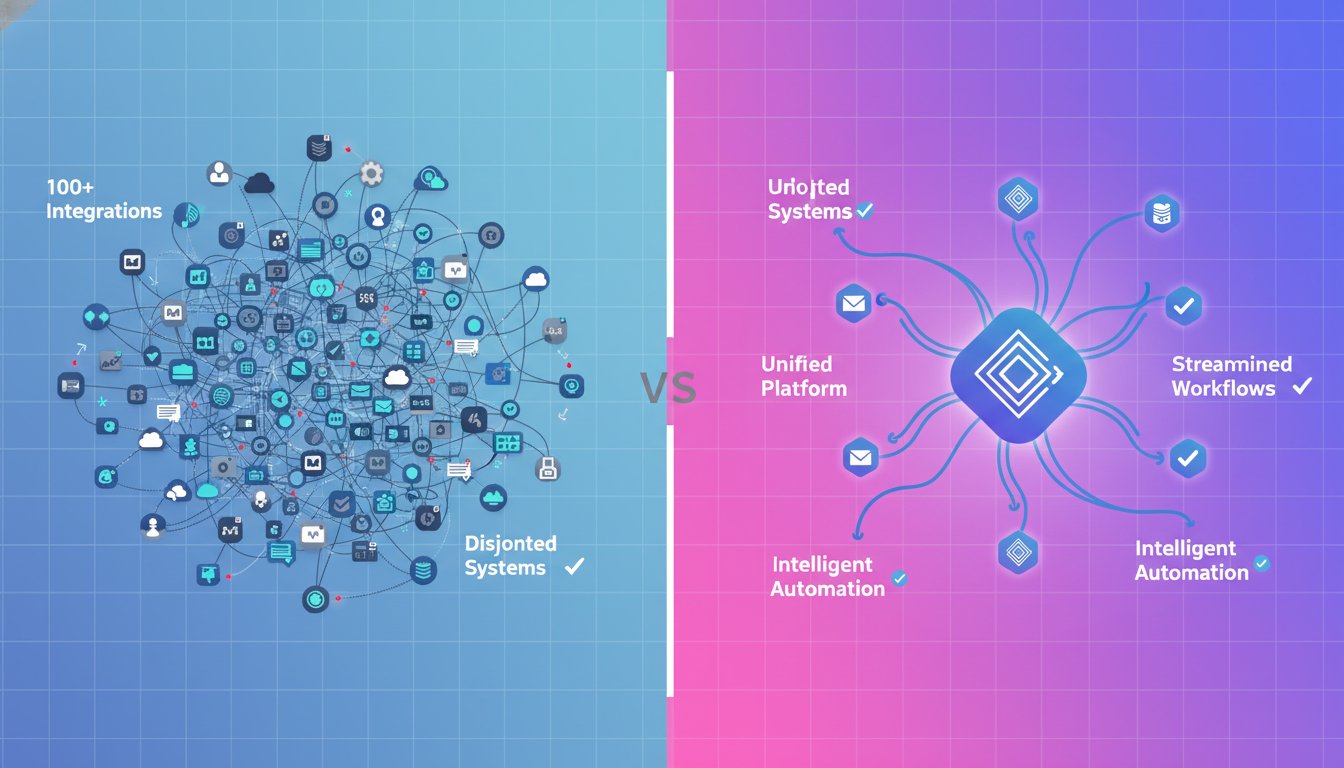
The white-label AI platform market presents service agencies with a deceptive choice: platforms that promise enterprise-grade capabilities through extensive integrations, versus ecosystems that consolidate complete business operations into one unified system. This distinction matters more than most comparison articles acknowledge, particularly for solopreneurs and micro-agencies operating with limited resources and technical expertise.
Stack AI and Parallel AI both offer white-label capabilities, but they approach business automation from fundamentally different philosophies. One platform emphasizes connecting to your existing enterprise systems through 100+ integrations. The other replaces those fragmented systems entirely with an all-in-one ecosystem designed specifically for service businesses. For agencies evaluating their AI infrastructure investment, understanding this philosophical difference will determine whether you’re adding another integration layer to manage—or actually simplifying your entire technology stack.
This analysis cuts through the marketing messaging to examine what these platforms actually deliver for service agencies, consultants, and micro-businesses building scalable operations. We’ll explore the hidden costs of integration-heavy approaches, the real-world implications of technical complexity, and why the “complete business automation” promise matters more than feature count for agencies trying to compete without enterprise budgets.
Platform Philosophy: Integration Layer vs Complete Ecosystem
Stack AI’s Enterprise Integration Approach
Stack AI positions itself as an enterprise AI solution distinguished by over 100 integrations with existing business systems. The platform’s core value proposition centers on connecting AI agents to your current technology stack—allowing them to read, write, and execute tasks within tools you already use.
This integration-first philosophy appeals to established enterprises with significant technology investments. If your organization runs on Salesforce, uses ServiceNow for operations, manages content in enterprise CMS platforms, and coordinates through Microsoft Teams, Stack AI promises to layer intelligent automation across these existing systems without replacing them.
The platform provides no-code agent builders and pre-built templates designed to work within this integrated environment. You create AI workflows that connect multiple systems, automate data transfers between platforms, and execute tasks across your technology ecosystem.
Parallel AI’s Consolidation Strategy
Parallel AI takes the opposite approach: replace your fragmented tool stack entirely with one unified platform that handles content creation, lead generation, customer conversations, and business workflows natively.
Rather than connecting to ChatGPT Plus, Claude Pro, Jasper, Copy.ai, Clay, Instantly.ai, and separate customer service tools, Parallel AI consolidates these capabilities into a single dashboard. You access multiple AI models (OpenAI, Anthropic, Gemini, Grok, DeepSeek, Perplexity) without managing separate subscriptions, create content campaigns that execute automatically, build sales sequences that qualify leads, and deploy omnichannel agents that handle customer interactions—all within one ecosystem.
This consolidation philosophy specifically targets solopreneurs and micro-agencies drowning in subscription costs and context-switching between platforms. The platform connects to your knowledge base (Google Drive, Notion, Confluence) so AI interactions understand your business context, then provides complete automation capabilities without requiring external integrations.
The Hidden Cost of Integration Complexity
What Stack AI Doesn’t Tell You About Enterprise Integrations
The “100+ integrations” marketing message sounds impressive until you encounter the operational reality. Each integration point represents a potential failure mode, authentication challenge, and maintenance burden. When Stack AI connects your AI agents to Salesforce, Slack, Google Workspace, and custom databases, you’re not simplifying your technology stack—you’re adding an orchestration layer on top of existing complexity.
User reviews reveal the practical implications. Performance issues during peak hours suggest infrastructure challenges with managing multiple simultaneous integrations. Storage constraints and run limits in lower tiers indicate that the integration approach creates scaling bottlenecks. The platform earns praise for its no-code interface, but this accessibility doesn’t eliminate the underlying complexity of coordinating AI workflows across fragmented systems.
For solopreneurs and micro-agencies, this integration complexity creates several hidden costs:
Subscription Stack Multiplication: Stack AI doesn’t replace your existing tools—it connects to them. You still pay for Salesforce, your CRM, marketing automation platform, content tools, and customer service software. Stack AI becomes another subscription on top of this existing spend.
Authentication Management Overhead: Each integration requires authentication setup, permission configuration, and ongoing credential management. When APIs change, authentication expires, or access permissions shift, your AI workflows break until you troubleshoot the integration chain.
Troubleshooting Complexity: When something fails in an integrated workflow, diagnosing the problem requires understanding which system caused the failure. Is it Stack AI’s agent logic, the API connection, the external platform’s availability, or a permission issue? This debugging complexity consumes time that small agencies can’t afford.
Technical Expertise Requirements: Despite the no-code interface, effectively deploying integrated AI workflows requires understanding API concepts, data formatting, authentication protocols, and system architecture. The learning curve extends beyond Stack AI itself to encompass all connected systems.
The True Cost Comparison for Service Agencies
Consider a typical micro-agency technology stack that Stack AI integrates with:
- ChatGPT Plus: $20/month
- Claude Pro: $20/month
- Jasper for content: $49/month
- Copy.ai: $49/month
- Clay for lead data: $149/month
- Instantly.ai for outreach: $97/month
- Intercom for customer service: $74/month
- Project management tools: $30/month
- CRM platform: $45/month
Total monthly spend before Stack AI: $533/month
Stack AI doesn’t replace these tools—it connects to them. The platform’s pricing (specific tiers not detailed in public documentation, but positioned for enterprise budgets) adds to this existing spend. Even with efficiency gains from automation, you’re maintaining the entire subscription stack plus the orchestration layer.
Parallel AI’s consolidation approach eliminates this multiplication:
- Entrepreneur Plan: $99/month (includes all AI models, content engine, sequences, smart lists, workflows)
- Business Plan: $297/month (adds higher usage limits, multiple organizations, API access)
- Enterprise Plan: Custom pricing for unlimited access
By replacing ChatGPT, Claude, Jasper, Copy.ai, Clay, Instantly.ai, and customer service tools with one platform, agencies save $400-500/month in eliminated subscriptions while gaining unified automation capabilities. The cost savings compound as you scale—adding clients doesn’t require upgrading multiple platforms independently.
White-Label Capabilities: Branding vs Complete Business Platform
Stack AI’s White-Label Implementation
Stack AI offers white-label capabilities focused on interface customization:
- Custom branding of the platform interface
- Corporate color schemes and logo placement
- Access permission configurations for different roles
- Interface customization to match your brand identity
These capabilities enable service providers to present Stack AI’s functionality under their own brand when delivering solutions to clients. An agency could create a branded portal where clients access AI agents that execute within their enterprise systems.
The white-label approach assumes you’re primarily delivering AI agent deployment services—helping clients build custom automation workflows within their existing technology infrastructure. The value proposition centers on your expertise in configuring and deploying these integrated agents.
Parallel AI’s Complete White-Label Ecosystem
Parallel AI provides white-label capabilities that extend far beyond interface branding to encompass complete business platform deployment:
Full Platform Rebranding: Logo, color schemes, domain customization, and complete brand identity integration across all platform features—not just agent interfaces but content engines, sales sequences, customer service tools, and analytics dashboards.
Flexible Client Packaging: Configure different pricing tiers, feature access levels, and usage limits for different client segments. Create custom packages that align with your service offerings and positioning strategy.
Revenue Model Freedom: Structure pricing as you choose—monthly subscriptions, usage-based billing, one-time setup fees, or hybrid models. The platform supports your business model rather than dictating it.
Complete Service Offering: White-label the entire AI automation ecosystem including content creation, lead generation, customer conversations, and workflow automation. Deliver a complete business solution rather than just AI agent deployment.
Straightforward Onboarding: The setup process requires no development—sign up for white-label access, complete branding configuration, define pricing packages, create test clients to preview the experience, then launch. Many partners start with smaller packages and scale as they add clients.
This complete ecosystem approach enables fundamentally different business models. Rather than positioning as an AI implementation consultant who configures agents within client systems, you become a SaaS provider delivering a complete AI automation platform. Your clients access a fully-branded solution that handles their content, leads, and customer service—not just connects to their existing tools.
Content Automation: Templates vs Complete Production Engine
Stack AI’s Content Capabilities
Stack AI approaches content automation through pre-built templates and integration with existing content management systems. The platform enables creating AI workflows that generate content, then push it to your CMS, document management system, or collaboration tools.
The template library provides starting points for common content tasks—social media posts, blog outlines, marketing copy variations. You customize these templates using the drag-and-drop builder, connect them to your content systems via integrations, and deploy them as recurring workflows.
This integration approach maintains your existing content production process while adding AI acceleration at specific points. Your content still flows through established approval workflows, publishing systems, and distribution channels—Stack AI automates generation within this existing infrastructure.
Parallel AI’s Content Engine Revolution
Parallel AI’s Content Engine represents a fundamentally different approach to content automation—replacing the entire production process rather than accelerating pieces of it:
AI Agent Collaboration: Four specialized agents work together on every content piece:
– Strategy Agent develops customized content plans aligned with business goals, leveraging platform algorithms and industry best practices
– Copywriting Agent produces high-converting copy using proven techniques while maintaining consistent brand voice
– Customer Profile Agent creates detailed ideal customer profiles to ensure content resonates with target audiences
– Visual Agent generates on-brand visuals in minutes, eliminating expensive photoshoots
Campaign Automation: Create content campaigns that automatically generate 1-3 months of content in minutes. The system maintains authentic brand voice through extensive context windows that process your brand guidelines, company data, and training materials.
Multi-Platform Optimization: Generate content specifically optimized for LinkedIn, Instagram, Facebook, YouTube, X (Twitter), TikTok, and blogs simultaneously. Each piece adapts to platform-specific formats, character limits, and engagement patterns.
Integrated Publishing: Schedule and publish directly to WordPress, LinkedIn, Instagram, Facebook, YouTube, RSS feeds, and other platforms without exporting to external tools. The entire workflow—strategy, creation, optimization, scheduling, and publishing—happens within one dashboard.
Fine-Tuning Capabilities: Train AI models on your unique brand voice, industry terminology, and communication patterns. The platform learns your style and replicates it consistently across all content.
Agencies using the Content Engine report saving 20+ hours weekly on content production while scaling output 10x without adding headcount. The system doesn’t just speed up content creation—it replaces the entire fragmented workflow of strategy tools, writing platforms, design software, scheduling systems, and publishing platforms.
Sales Automation: Integration Workflows vs Complete Prospecting System
Stack AI’s Sales Process Approach
Stack AI enables building AI agents that integrate with your existing sales stack—CRM platforms, email systems, data enrichment tools, and communication channels. You create workflows that automate specific tasks within your established sales process:
- Data entry and CRM updates
- Lead qualification scoring based on defined criteria
- Email response suggestions and drafting
- Meeting scheduling and calendar management
- Report generation and pipeline analytics
The platform excels at eliminating manual data work and providing AI assistance within your current sales methodology. Your team continues using familiar CRM interfaces, email clients, and communication tools—Stack AI adds intelligent automation behind the scenes.
This approach assumes you’ve already invested in sales technology infrastructure and want to enhance it with AI capabilities. The value comes from efficiency gains within existing workflows rather than replacing the entire sales stack.
Parallel AI’s Complete Prospecting Ecosystem
Parallel AI consolidates the entire sales automation stack into unified capabilities:
Smart Lists: Build targeted prospect lists using AI-powered research and enrichment. The system identifies ideal customers based on your criteria, enriches contact data, and organizes prospects for outreach—replacing tools like Clay, Apollo, and ZoomInfo.
Sequences: Create multi-channel outreach campaigns across email, social media, SMS, chat, and voice. Design sophisticated follow-up workflows that adapt based on prospect engagement, automate personalization at scale, and track results across all channels—replacing Instantly.ai, Outreach, and SalesLoft.
AI-Powered Qualification: Deploy AI agents that engage prospects through conversations, qualify leads based on your criteria, schedule meetings with qualified prospects, and route opportunities to appropriate team members—replacing chatbots and SDR headcount.
Unified Analytics: Track prospect engagement, conversion rates, and revenue attribution across all channels in one dashboard. No more reconciling data between email platforms, CRM systems, and communication tools.
The complete ecosystem approach means agencies can offer clients a full outbound sales solution without managing multiple platform subscriptions, integration maintenance, or data synchronization between systems. Your white-label clients access comprehensive sales capabilities through one branded platform rather than juggling fragmented tools.
Customer Service Automation: Connected Agents vs Omnichannel Intelligence
Stack AI’s Customer Service Integration
Stack AI enables deploying AI agents that integrate with existing customer service platforms—help desk software, chat systems, email management tools, and knowledge bases. These agents assist support teams by:
- Suggesting responses based on historical ticket data
- Routing inquiries to appropriate departments
- Pulling relevant information from integrated knowledge bases
- Automating simple query responses
- Escalating complex issues to human agents
The integration approach maintains your established support infrastructure while adding AI assistance. Your team continues using familiar help desk interfaces, and customers interact through existing support channels—Stack AI works behind the scenes to improve efficiency.
This capability particularly benefits organizations with significant investments in enterprise support platforms like Zendesk, Intercom, or ServiceNow. You enhance existing workflows rather than replacing the support stack.
Parallel AI’s Omnichannel Agent Deployment
Parallel AI provides complete omnichannel customer service capabilities that replace fragmented support tools:
Voice AI: Deploy inbound and outbound call agents with natural conversation capabilities. Handle customer inquiries, appointment scheduling, order support, and routine questions through voice interactions that sound authentically human.
Multi-Channel Chat: Implement AI agents across website chat, SMS, WhatsApp, Facebook Messenger, and other messaging platforms—all managed from one dashboard with unified conversation context.
Knowledge Base Integration: Connect agents to your Google Drive, Notion, Confluence, and custom documentation so every interaction draws from current business knowledge. Agents provide accurate, contextual responses based on your actual content rather than generic information.
Context Preservation: Agents maintain conversation context across channels—a customer who starts on chat can continue via SMS or voice without repeating information. The platform tracks the entire customer journey across touchpoints.
Intelligent Escalation: Configure escalation rules that transfer complex issues to human team members with complete conversation history and context. Humans receive the full interaction record and customer background.
Performance Analytics: Track resolution rates, customer satisfaction, conversation metrics, and agent performance across all channels in unified dashboards.
For service agencies, this omnichannel approach enables delivering complete customer service solutions to clients without managing separate chat platforms, voice systems, SMS tools, and integration layers. White-label clients receive comprehensive support capabilities through one branded ecosystem.
Technical Requirements and Learning Curve
Stack AI’s No-Code Complexity
Stack AI earns consistent praise for its intuitive drag-and-drop interface and no-code builder. The platform genuinely enables creating AI workflows without writing code—a significant advantage for teams without development resources.
However, “no-code” doesn’t mean “no complexity.” Effectively deploying Stack AI requires understanding:
Integration Architecture: How APIs work, what data formats mean, how authentication flows function, and why integrations fail. You’re not coding, but you’re still configuring technical integrations.
System Relationships: How your connected platforms relate to each other, what data should flow between systems, and how to structure workflows across multiple tools.
Troubleshooting Methodology: When integrated workflows break, diagnosing problems requires technical troubleshooting skills even if you’re not writing code.
Performance Optimization: Understanding why workflows run slowly during peak hours and how to structure processes for better performance requires technical insight.
User reviews mention a learning curve despite the no-code interface. The complexity stems not from Stack AI’s interface but from the inherent challenge of orchestrating AI across fragmented systems. Small agencies often underestimate this operational burden until they’re managing complex integration chains.
Parallel AI’s Unified Learning Path
Parallel AI provides a more straightforward learning curve by eliminating integration complexity:
Single Platform Mastery: Learn one unified interface rather than understanding how multiple systems integrate. All capabilities—content creation, sales sequences, customer service, workflows—operate within consistent design patterns.
Business Context Focus: Configuration centers on business requirements (“what content should we create?” “how should we qualify leads?” “which customer questions should escalate?”) rather than technical integration concerns.
Knowledge Base Connection: The primary technical setup involves connecting to Google Drive, Notion, or Confluence—straightforward authentication that requires no API knowledge or integration architecture understanding.
Progressive Complexity: Start with basic capabilities like AI chat and content generation, then progressively adopt sales sequences, customer service agents, and advanced workflows as you become comfortable. The platform supports growth without requiring complete technical mastery upfront.
Onboarding Support: White-label partners receive dedicated onboarding that covers platform capabilities, business model configuration, client packaging, and success strategies—focusing on business outcomes rather than technical implementation.
Agencies consistently report faster time-to-value with Parallel AI because they’re learning to use business automation tools rather than mastering integration architecture.
Performance, Scalability, and Reliability Considerations
Stack AI’s Performance Challenges
User reviews reveal concerning performance patterns with Stack AI:
Peak Hour Slowdowns: Multiple users report performance degradation during high-traffic periods. When you’re running integrated workflows across multiple platforms, this slowness compounds—delays in Stack AI create cascading delays across all connected systems.
Tier Limitations: Free and lower-tier plans face storage constraints, limited runs, and feature restrictions that create scaling bottlenecks. As your AI usage grows, you quickly hit these ceilings and must upgrade to access the performance you need.
Integration Reliability: While not explicitly detailed in reviews, integration-heavy architectures inherently face reliability challenges. Each connected system represents a potential failure point—when Salesforce has API issues, Google Workspace changes authentication, or Slack updates its interface, your Stack AI workflows can break.
For agencies building client solutions on Stack AI’s white-label platform, these performance and reliability concerns create reputation risk. When client workflows slow down or break due to platform limitations, your brand bears the consequences.
Parallel AI’s Unified Infrastructure
Parallel AI’s consolidated architecture provides performance advantages:
Consistent Performance: All capabilities run on unified infrastructure rather than depending on external integrations. Content generation, sales sequences, and customer service operate at consistent speeds without external API dependencies.
Uncapped Model Access: Unlike platforms that limit AI interactions, Parallel AI provides uncapped access to top models with large context windows reaching one million tokens. You can scale usage without hitting arbitrary ceilings.
Enterprise-Grade Security: The platform implements AES-256 encryption, TLS protocols, and commits to privacy (data not used for model training). On-premise deployment options for enterprise clients ensure complete data control.
Predictable Scaling: As you add clients to your white-label solution, performance remains consistent because you’re not multiplying integration points. Each new client accesses the same unified infrastructure rather than creating additional integration complexity.
API Availability: Business and Enterprise plans include API access, enabling custom integrations when you actually need them—but only for specific use cases rather than as the foundation of all functionality.
The reliability difference matters significantly for service agencies. Your client deliverables depend on platform availability and performance. Unified infrastructure provides more predictable operation than integration chains spanning multiple vendors.
Real-World Implementation: What Agencies Actually Experience
Stack AI Implementation Reality
Deploying Stack AI for agency clients typically follows this pattern:
Discovery Phase (2-3 weeks): Audit client’s existing technology stack, document all platforms requiring integration, identify data flows between systems, and map current workflows to understand what AI can enhance.
Integration Configuration (3-4 weeks): Set up authentication for each platform integration, configure data mapping between systems, build AI agent workflows using the no-code builder, and test integration reliability across the technology stack.
Customization and Testing (2-3 weeks): Refine AI agent responses, optimize workflow performance, troubleshoot integration failures, and conduct user acceptance testing with client team members.
Deployment and Training (1-2 weeks): Roll out integrated AI workflows, train client teams on new processes, document troubleshooting procedures, and establish monitoring protocols.
Total implementation timeline: 8-12 weeks per client, with ongoing maintenance required for integration management, performance optimization, and troubleshooting as external platforms change.
This extended timeline stems from integration complexity—each client’s unique technology stack requires custom configuration. Agencies struggle to templatize implementations because every client uses different combinations of platforms.
Parallel AI Implementation Reality
Deploying Parallel AI’s white-label solution follows a dramatically different pattern:
White-Label Setup (1-2 days): Sign up for white-label account, complete branding configuration (logo, colors, domain), define pricing packages and feature access, and create test client to preview the experience.
Knowledge Base Connection (1-2 days): Connect to Google Drive, Notion, or Confluence to provide business context. Upload brand guidelines, company data, and training materials for AI fine-tuning.
Content Campaign Configuration (2-3 days): Set up content strategy, define target platforms and posting schedules, configure the Content Engine for client’s brand voice, and generate initial content calendar.
Sales Sequence Setup (2-3 days): Configure Smart Lists for prospect targeting, create email and multi-channel outreach sequences, set up qualification criteria and routing rules, and test prospect engagement workflows.
Customer Service Deployment (2-3 days): Deploy omnichannel agents across preferred channels, configure escalation rules and response patterns, connect knowledge base for contextual responses, and test conversation flows.
Total implementation timeline: 1-2 weeks per client, with minimal ongoing maintenance because there are no external integrations to manage. The unified platform enables templating core workflows that customize quickly for each client.
Agencies report this implementation speed as a competitive advantage—clients see value within weeks rather than months, accelerating time-to-revenue and improving cash flow.
Pricing Models and Business Viability
Stack AI’s Enterprise Positioning
Stack AI positions itself for enterprise budgets, though specific pricing tiers aren’t detailed in public documentation. The platform emphasizes affordability relative to enterprise solutions while packing essential features for teams of various sizes.
The pricing structure appears designed for organizations with existing technology investments seeking to add AI capabilities. You’re paying for the orchestration layer on top of subscriptions you already maintain.
For micro-agencies and solopreneurs, this pricing approach creates challenges:
Budget Multiplication: The platform cost adds to existing tool subscriptions rather than replacing them. Even if Stack AI pricing seems reasonable in isolation, the total technology spend increases.
Client Cost Transfer Difficulty: When client solutions require Stack AI plus all the platforms it integrates with, pricing proposals become complex. Clients question why they need so many subscriptions.
Margin Compression: If you’re absorbing technology costs to deliver fixed-price services, the multiplication of subscriptions directly reduces profit margins.
Parallel AI’s Consolidation Economics
Parallel AI’s pricing structure reflects its consolidation philosophy:
Free Plan: Access to basic features with usage limits—ideal for testing platform capabilities before committing.
Entrepreneur Plan ($99/month): 2,000 questions monthly, full access to Content Engine, Sequences, Smart Lists, Inboxes, and Workflows, plus custom branded white-labeling. Designed for individual consultants building service offerings.
Business Plan ($297/month): 9,000 questions monthly, create up to 3 organizations with 9 total collaborator seats, API access, and all Entrepreneur features. Built for agencies serving multiple clients.
Enterprise Plan (Custom): Unlimited high-speed access to top models, Single Sign-On and domain verification, on-premise deployment options, and dedicated API resources. Scaled for large organizations and established agencies.
This pricing enables completely different business economics:
Tool Consolidation Savings: By replacing $400-500/month in fragmented subscriptions, the platform pays for itself immediately while providing superior capabilities.
Predictable Client Pricing: With one platform delivering complete automation, you can offer clients simple, predictable pricing. No explaining why they need eight different subscriptions.
Margin Protection: Lower technology costs directly improve service margins. The difference between $99/month and $533/month in tool costs determines profitability on every client engagement.
Scalable Economics: The Business Plan’s multi-organization structure lets you serve multiple clients under one subscription, dramatically improving per-client economics as you scale.
Agencies report margin improvements of 30-40% when consolidating their technology stack into Parallel AI, money that flows directly to profitability or enables more competitive client pricing.
The Decision Framework for Service Agencies
When Stack AI Makes Sense
Stack AI represents the right choice for specific organizational profiles:
Enterprise Clients with Established Stacks: If your clients are large organizations with significant investments in Salesforce, ServiceNow, enterprise CMS platforms, and complex technology ecosystems, Stack AI’s integration capabilities match their needs. These organizations aren’t replacing their technology stack—they’re enhancing it.
Implementation-Focused Consulting: If your business model centers on consulting fees for AI implementation rather than recurring SaaS revenue, Stack AI’s project-based approach aligns well. You’re selling expertise in configuring integrated workflows, not providing ongoing platform access.
Technical Team Availability: If you have developers or technical architects who can manage integration complexity, troubleshoot API issues, and optimize integrated workflows, Stack AI’s capabilities become more accessible.
Specific Integration Requirements: If your use cases specifically require connecting to niche enterprise platforms that Parallel AI doesn’t support natively, Stack AI’s 100+ integrations might provide necessary coverage.
When Parallel AI Delivers Superior Value
Parallel AI becomes the clear choice for agencies and solopreneurs focused on scalable service delivery:
Solopreneurs and Micro-Agencies: If you’re running a 1-10 person service business, the tool consolidation alone saves enough money to fund the platform while dramatically simplifying operations. The unified learning curve and straightforward implementation enable faster client delivery.
White-Label SaaS Models: If your business strategy involves building recurring revenue through white-label platform access rather than project-based consulting, Parallel AI’s complete ecosystem enables this model. Your clients receive comprehensive AI capabilities through your branded solution.
Rapid Implementation Requirements: If clients expect to see value within weeks rather than months, Parallel AI’s unified platform enables the fast deployment that wins deals and improves cash flow.
Complete Solution Positioning: If you want to position as a complete AI automation provider rather than an integration specialist, Parallel AI enables delivering content, sales, and customer service capabilities through one branded offering.
Budget-Conscious Operations: If technology costs directly impact your profitability and competitive positioning, the $400-500/month savings from tool consolidation significantly improves business economics.
Limited Technical Resources: If you don’t have developers or technical architects on staff, Parallel AI’s unified platform eliminates the integration expertise requirements that make Stack AI challenging to deploy effectively.
The Platform That Matches Your Business Model
The Stack AI versus Parallel AI decision ultimately reflects competing visions of how service agencies should deliver AI capabilities. Stack AI assumes you’ll continue operating within fragmented technology ecosystems, adding intelligent automation as an integration layer. Parallel AI assumes you’ll consolidate these ecosystems entirely, replacing multiple subscriptions with one unified platform.
For solopreneurs and micro-agencies building scalable service businesses, the consolidation approach delivers transformative advantages. The $400-500/month in eliminated subscriptions, 8-12 week reduction in implementation timelines, elimination of integration maintenance overhead, and ability to offer complete white-label solutions create competitive positioning that’s difficult to achieve with integration-based platforms.
Stack AI serves a valuable role for enterprise consulting focused on enhancing established technology investments. But for agencies trying to compete without enterprise budgets, the platform’s integration complexity and cost multiplication create barriers rather than opportunities. You’re not simplifying client operations—you’re adding orchestration complexity on top of existing tool sprawl.
Parallel AI’s unified ecosystem enables agencies to deliver Fortune 500-level AI capabilities while maintaining the cost structure, implementation speed, and operational simplicity that small businesses require. Your clients don’t need to understand API integrations, manage multiple subscriptions, or troubleshoot integration chains—they access comprehensive automation through one branded platform that just works.
The choice isn’t about which platform has more integrations or better enterprise credentials. It’s about which approach actually transforms your agency’s economics, enables scaling without headcount growth, and positions you to compete effectively in an AI-driven market.
For most service agencies reading this comparison, that transformative platform is Parallel AI. The consolidation savings alone justify the investment, and the white-label capabilities enable business models that integration platforms simply can’t support. If you’re ready to replace your fragmented tool stack with unified automation that actually delivers on the AI transformation promise, schedule a demo to see how Parallel AI’s complete ecosystem can transform your agency operations and unlock the scalable growth you’ve been pursuing.