
You’re staring at your calendar. Three client deadlines. Two proposals. One technical question you can’t answer without spending two hours researching.
You know AI could change this. But here’s the question keeping you up at night: Do you white-label an AI platform, or do you build something custom?
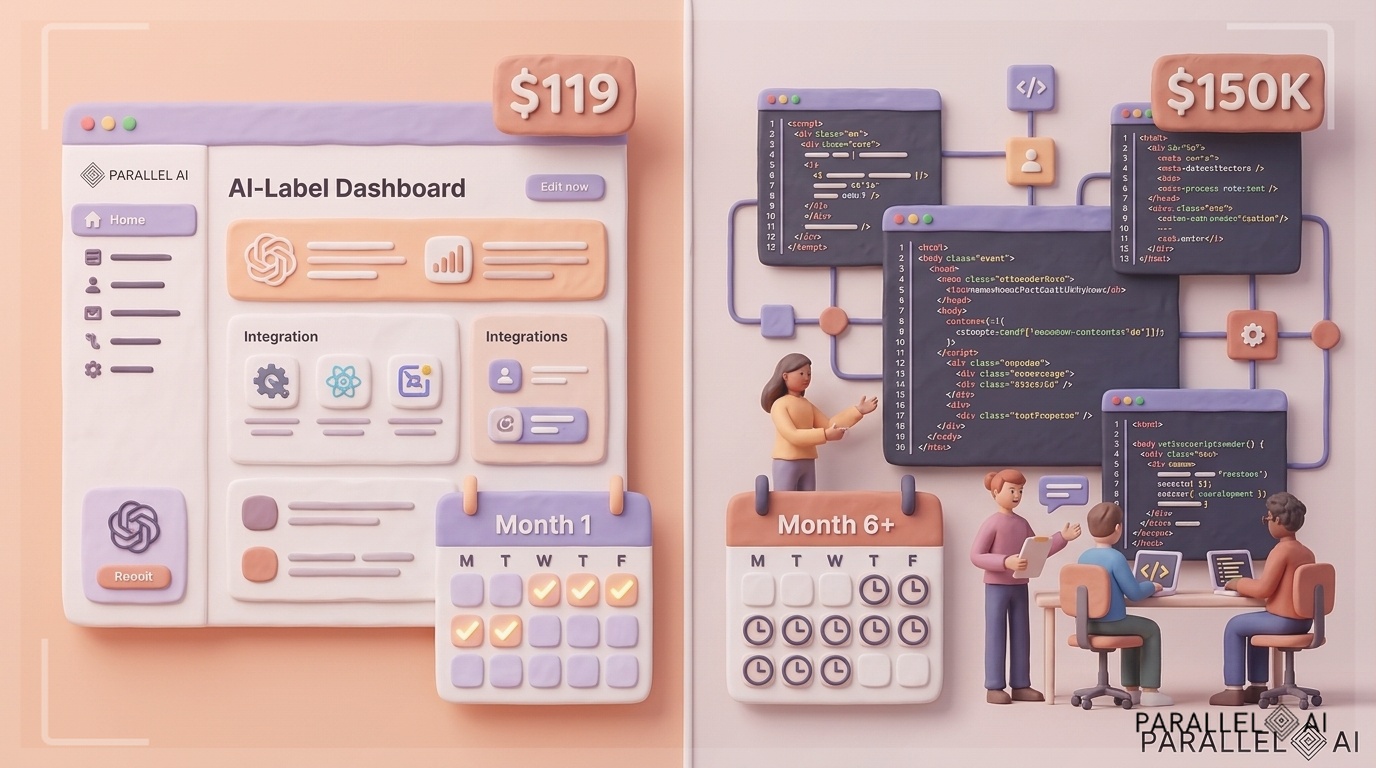
This isn’t just a technical decision. It’s the difference between launching next month or next year. Between spending $119 monthly or $150,000 upfront. Between serving five clients or fifty.
According to Gartner’s February 2026 Small Business AI Adoption Report, 67% of solopreneurs and micro-agencies now use at least one AI tool daily, up from 23% in 2024. But most aren’t building. They’re buying.
Here’s why that matters for your business.
The Real Cost of “Custom”
When most consultants and agency owners say they want “custom AI,” they picture something perfectly tailored to their exact workflow. What they don’t picture: the six-month development timeline, the $150,000-$500,000 price tag, and the ongoing maintenance costs that eat 20-30% of that budget every year.
Custom AI development typically requires:
– A dedicated development team (3-5 engineers minimum)
– Data scientists to train and fine-tune models
– DevOps specialists for deployment and scaling
– Ongoing security and compliance management
– Continuous model retraining as your business evolves
Satya Nadella, CEO of Microsoft, noted at the January 2026 Build Conference: “AI is no longer a luxury for enterprises alone. Small businesses and solopreneurs are now the fastest-growing segment of AI adopters, with adoption rates increasing 340% year-over-year.”
The reason? They’re not building. They’re implementing.
The typical custom build timeline breaks down like this:
– Months 1-2: Requirements gathering and architecture design
– Months 3-6: Development and initial testing
– Months 7-9: Integration with existing systems
– Months 10-12: Refinement based on real-world usage
That’s a full year before you can even start using it with clients. And according to Forrester’s February 2026 Technology Implementation Timeline Study, 68% of custom AI projects run over budget and past deadline.
Meanwhile, white-label platforms have an average implementation time of 14 days.
White-Label: The Overlooked Advantage
The white-label AI market tells a different story. Grand View Research projects it will reach $47.3 billion by 2028, growing at 42.8% annually. That growth isn’t happening because businesses want generic solutions. It’s happening because modern white-label platforms offer something custom builds can’t: immediate deployment with continuous improvement.
What true white-labeling actually means in 2026:
– Custom domain hosting (clients.yourbusiness.com)
– Complete UI customization matching your brand
– Your logo, colors, and messaging throughout
– Client portal management under your brand
– API access for deeper integration
– Zero mention of the underlying platform
Dr. Fei-Fei Li, Co-Director of Stanford HAI, explained in the March 2026 Stanford HAI Annual Report: “White-label AI solutions are bridging the technical expertise gap for small businesses. The barrier to entry has dropped from requiring a team of AI engineers to simply understanding your business processes.”
Consider this data point from McKinsey’s March 2026 Small Business Technology Survey: small businesses using AI automation report an average revenue increase of 34% within the first six months of implementation.
That revenue increase doesn’t wait twelve months for custom development to finish.
5 Questions That Reveal Your Best Path
Question 1: What Problem Are You Actually Solving?
Most consultants think they need custom AI because they want to stand out. But your differentiation doesn’t come from the AI itself. It comes from how you apply it to client problems.
Ask yourself:
– Do I need proprietary algorithms, or do I need AI that works?
– Am I solving a problem no one else has, or am I solving a common problem in my unique way?
– Will clients pay more for “custom” AI, or for better results?
According to Deloitte’s March 2026 Client Preference Survey, 72% of small business clients prefer working with AI-augmented consultants over traditional consultants. But here’s the key: they don’t care whether the AI is custom-built. They care about outcomes.
Real-world example: A marketing consultant in Denver implemented a white-label content automation platform. She didn’t build the AI. She built the strategy framework her clients needed. Revenue grew from $8,000 to $27,000 monthly in three months. Her clients don’t ask if the AI is custom. They ask for more services.
Question 2: How Much Control Do You Actually Need?
The word “control” triggers a fear response in entrepreneurs. We worry that using someone else’s platform means we’re at their mercy.
But consider what control actually matters:
Control that matters:
– Brand presentation to clients
– Pricing and packaging of services
– Which features clients can access
– Integration with your existing tools
– Client data ownership and privacy
Control that doesn’t matter as much as you think:
– The underlying AI model architecture
– Server infrastructure and scaling
– Security protocol implementation
– Model training and fine-tuning
– Technical support and maintenance
Modern white-label platforms give you the first list. Custom development requires you to manage both.
Dharmesh Shah, CTO of HubSpot, stated at the January 2026 INBOUND Conference: “Micro-agencies using AI automation are reporting 60-70% time savings on routine tasks, allowing them to serve 3-4x more clients without increasing headcount. This is the biggest productivity shift we’ve seen since cloud computing.”
That shift happens because these agencies focus on client work, not platform maintenance.
Question 3: What’s Your Real Timeline to Revenue?
Here’s the math most consultants miss:
Custom AI development:
– Development: 6-12 months
– Testing and refinement: 2-3 months
– Client pilot program: 1-2 months
– Time to first revenue: 9-17 months
White-label implementation:
– Platform setup: 3-5 days
– Service design and packaging: 1-2 weeks
– First client onboarding: 1 week
– Time to first revenue: 3-4 weeks
The white-label AI market didn’t grow 340% year-over-year because consultants wanted generic solutions. It grew because consultants needed revenue now.
According to IDC’s February 2026 AI Investment Returns Analysis, the average ROI for white-label AI implementation is 340% in the first year. That ROI starts accumulating in month one, not month twelve.
Real-world scenario: A two-person digital marketing agency in Austin evaluated both approaches. The custom build would cost $180,000 and take ten months. The white-label platform cost $119 monthly. They chose white-label, launched in two weeks, and signed three clients in their first month. Six months later, they’re generating $15,000 in monthly recurring revenue. The custom build still wouldn’t be finished.
Question 4: How Will Your Needs Change in 12 Months?
The AI field shifted more in the past 18 months than in the previous decade. OpenAI launched GPT-5 with 2 million token context windows in February 2026. Anthropic announced Claude for Business Suite with white-label capabilities in January 2026. Google introduced their Gemini Agency Partner Program in March 2026.
If you started building custom AI twelve months ago, your architecture is already outdated.
Andrew Ng, Founder of DeepLearning.AI, noted at the February 2026 AI for Everyone Summit: “The most successful AI implementations in small businesses aren’t about replacing humans. They’re about augmentation. Solopreneurs who treat AI as a co-pilot are outperforming traditional agencies with 10x their staff.”
What changes faster than you can build:
– Available AI models and capabilities
– Best practices for prompting and fine-tuning
– Integration requirements with other tools
– Client expectations and use cases
– Competitive pricing and positioning
White-label platforms absorb these changes automatically. Your custom build requires you to manage every update.
According to TechCrunch’s February 2026 report “The Great AI Consolidation,” businesses cut their AI tool stack by 60%, from an average of 8.3 separate tools in 2024 to 3.1 integrated platforms in 2026. That consolidation happened because maintaining multiple custom solutions became unsustainable.
Question 5: What’s Your Competitive Advantage?
This is the question that cuts through all the others.
Your competitive advantage isn’t the AI. It’s your expertise, your client relationships, your understanding of their problems, and your ability to deliver results.
Sam Altman, CEO of OpenAI, stated at the February 2026 Developer Day: “The democratization of AI means that a single person with the right tools can now accomplish what previously required a team of 10-15 people. We’re seeing this transformation happening in real-time with consultants and micro-agencies.”
Companies thriving with white-label AI:
– Marketing consultants positioning AI as a strategic advantage
– Sales consultants offering AI-powered prospecting systems
– Business strategists providing AI-driven analytics
– Content creators delivering faster, higher-quality work
– Technology consultants implementing AI for clients
What they all share: they’re experts in their field using AI as a force multiplier, not AI developers trying to enter consulting.
According to HubSpot’s January 2026 Agency Pricing Benchmark Report, AI-powered agencies charge a 40-60% premium over traditional agencies for equivalent services. That premium isn’t for custom AI. It’s for better results delivered faster.
The Hybrid Approach Nobody Talks About
Here’s the path most successful AI-augmented consultants actually take:
Phase 1 (Months 1-6): Implement a white-label platform, learn what works, generate revenue, and understand client needs.
Phase 2 (Months 7-12): Build proprietary processes, frameworks, and methodologies on top of the platform. Create unique service packages.
Phase 3 (Year 2+): Evaluate whether custom development makes sense for specific high-value features. Build only what creates genuine competitive advantage.
This approach generates revenue immediately while building toward custom solutions if they actually make business sense.
According to Agency Analytics’ March 2026 Small Agency Revenue Study, micro-agencies report an $8,200 average monthly revenue increase after implementing AI automation. That revenue funds future development if needed.
Making the Decision
Here’s the framework that actually works:
Choose white-label if:
– You want to launch services within 30 days
– Your budget is under $50,000 for year one
– You need to generate revenue while learning
– Your competitive advantage is industry expertise, not technology
– You want to test AI services before making a major investment
– You’re serving fewer than 50 clients currently
Consider custom if:
– You’re solving a problem no existing platform addresses
– You have $200,000+ and 12-18 months to invest
– Your business model requires proprietary algorithms
– You’re serving 100+ clients with identical, specific needs
– You have technical expertise in-house already
– Platform licensing creates impossible limitations
Most solopreneurs and micro-agencies fall into the first category. And according to Upwork’s February 2026 Freelancer and Agency Growth Study, 89% of consultants and agency owners cite “scaling without hiring” as their top business challenge.
White-label AI platforms solve that challenge. Custom builds just hand you a different challenge to manage.
The Next 30 Days
You know the statistics. You understand the economics. You’ve seen the timeline comparison.
The question isn’t whether to use AI in your business. That decision was made for you by your competitors who adopted it six months ago.
The question is whether you’ll spend the next year building, or the next month implementing.
White-label AI platforms like Parallel AI offer multi-model access, true customization, and transparent pricing starting at $119 monthly. Setup takes two weeks, not two years. The platform includes access to GPT-4, Claude, Gemini, and other leading models, with no single-model lock-in.
More than that, it lets you focus on what you’re actually good at: serving clients, solving problems, and growing your business.
The AI shift isn’t waiting for you to build the perfect custom solution. It’s happening now, with the tools available today. The consultants and agencies winning aren’t the ones with the most sophisticated custom AI. They’re the ones who moved fast, learned quickly, and stayed focused on delivering value.
Explore how white-label AI can transform your consulting or agency business in weeks instead of years. Your competitors are already three months ahead. The gap widens every day you spend planning instead of implementing.