
As a solo consultant or micro-agency owner, you’ve probably noticed AI everywhere. Your LinkedIn feed is full of it. Your competitors are talking about it. Your clients are asking about it. But here’s the question that actually matters: Should you implement AI tools or AI agents in your business?
The distinction isn’t just technical jargon. It fundamentally changes how you deliver services, what you charge, and how you scale. Get this decision wrong, and you’ll waste months and thousands of dollars on technology that doesn’t fit your business model. Get it right, and you’ll have the capacity to serve more clients without hiring.
Here’s the direct answer first, then we’ll get into why it matters.
The short answer: Most solopreneurs and micro-agencies should start with AI tools for specific, well-defined tasks, then gradually bring in AI agents as their business matures and they understand exactly which processes need autonomous decision-making.
But that’s oversimplified. Your specific situation, including your service offerings, technical comfort level, client base, and growth stage, all influence which approach makes sense. Here’s exactly what you need to know.
What AI Tools and AI Agents Actually Are (Without the Hype)
The terms “AI tools” and “AI agents” get thrown around interchangeably, but they represent fundamentally different approaches to automation.
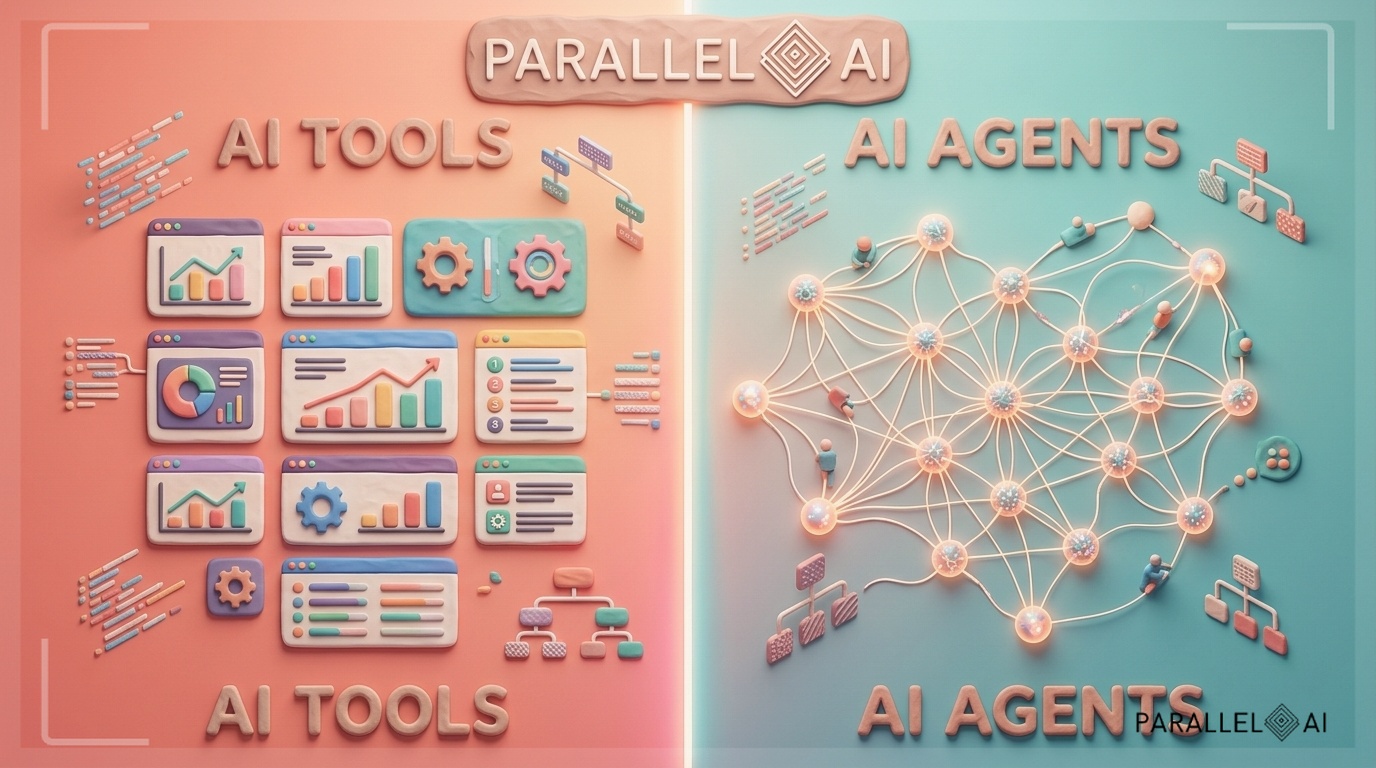
AI tools are pre-defined applications that perform specific tasks. Think of them as specialized assistants that excel at one thing. They integrate with your existing software, your CRM, your email platform, your project management system, and enhance specific functions. Examples include:
- Content generation tools that help you write blog posts or social media updates
- Data analysis software that spots trends in your business metrics
- Customer service chatbots that handle routine inquiries
- Email automation platforms with AI-powered personalization
These tools have defined inputs and outputs. You tell them what to do, they do it, and they deliver a result. The scope is intentionally limited.
AI agents, on the other hand, work with autonomy and adaptability. They don’t just execute predefined tasks. They learn from interactions, make decisions based on context, and adjust their behavior over time. According to recent analysis from Forbes and industry experts, AI agents can:
- Handle multi-step processes that require decision-making at each stage
- Adapt their approach based on previous interactions and outcomes
- Operate across multiple platforms without constant human guidance
- Learn and improve their performance continuously
The key difference? AI tools enhance your existing processes. AI agents can actually run processes on your behalf.
Why This Distinction Matters for Your Bottom Line
Here’s what nobody tells you about this choice: it’s not about which technology is “better.” It’s about which technology fits your current business reality and growth trajectory.
The Case for Starting with AI Tools
When you’re running a solo consultancy or small agency, your primary constraints are time and attention. You need solutions that deliver immediate value without requiring massive upfront investment in setup and learning.
AI tools excel here because:
Quick Implementation: Most AI tools can be deployed in hours or days, not weeks or months. You sign up, connect your accounts, and start seeing results. According to recent implementation data, businesses typically see ROI from AI tools within 3-12 months when deployed in high-volume situations, a timeline that works for solopreneurs who can’t afford long experiments.
Lower Complexity: AI tools integrate with platforms you already use. If you’re using HubSpot for CRM, AI-powered sales forecasting tools plug right in. If you’re using Google Workspace, AI writing assistants work within your existing documents. There’s minimal disruption to your workflow.
Predictable Costs: AI tools typically operate on subscription models with clear pricing. You know exactly what you’re spending each month. For solopreneurs operating on tight margins, this predictability is crucial for financial planning.
Immediate Efficiency Gains: Research from multiple sources in 2026 confirms that properly implemented AI automation reduces time spent on repetitive tasks by 20-40%. For a solo consultant billing $150-250 per hour, recovering even 5 hours per week translates to $3,000-5,000 in additional monthly revenue capacity.
Here’s a concrete example. A marketing consultant I spoke with recently implemented AI-powered content generation tools to help with blog outlines, social media posts, and client reports. Her implementation timeline:
- Week 1: Testing three different tools, selecting the best fit
- Week 2: Creating templates and workflows
- Week 3: First client deliverables using the new approach
- Week 4: Refinement and fine-tuning
By the end of month one, she’d reduced her content production time by 35%, allowing her to take on two additional clients without working longer hours. That’s the power of well-chosen AI tools.
When AI Agents Make Sense
AI agents offer compelling advantages, but they’re not the right starting point for most solopreneurs. Here’s why, and when they do make sense.
The Reality of Implementation Complexity: AI agents require more sophisticated setup. You’re not just connecting an app to your existing workflow. You’re building decision-making frameworks, training the agent on your specific processes, and testing extensively to ensure it handles edge cases appropriately.
According to implementation data from white-label AI platforms, deploying AI agents typically takes 1-3 weeks for complex integrations, compared to 2-5 business days for basic AI tool setups. That’s a significant time investment when you’re still handling client work, business development, and operations.
Higher Initial Costs: AI agents generally require larger upfront investments. You’re paying for the autonomous decision-making capability, the learning algorithms, and often for custom configuration to match your specific business processes.
But here’s where AI agents shine:
Dynamic Process Improvement: Once properly configured, AI agents can improve workflows in real-time based on performance metrics. They adapt to changing conditions without requiring your constant intervention.
A business strategy consultant I work with implemented an AI agent system for client onboarding after she’d scaled to three team members. The agent handles:
- Initial client intake and needs assessment
- Resource allocation based on project requirements
- Progress monitoring and milestone tracking
- Client communication scheduling
- Deliverable quality checks
This wasn’t her first AI implementation. She’d already been using AI tools for two years. She understood her processes intimately and knew exactly which decisions the agent could safely make on its own. Her team’s capacity increased by 40% without adding headcount.
Advanced Customer Interactions: AI agents excel at handling complex, multi-turn conversations with clients. Unlike chatbots that follow decision trees, AI agents understand context, remember previous interactions, and adjust their responses based on the full conversation history.
For consultants offering technical support, strategic advisory, or complex problem-solving services, this capability can be transformative. But it only makes sense once you’ve reached a scale where you’re having dozens of similar client interactions weekly.
The Technical Expertise Question Everyone Asks
One of the most common concerns I hear: “How technical do I need to be to implement either option?”
Honestly, it depends more on the specific platform than whether it’s a “tool” or “agent.”
For AI Tools:
Most modern AI tools are designed for non-technical users. You need to be comfortable with:
- Navigating web applications
- Understanding basic workflow logic (if this happens, do that)
- Connecting apps through authorization processes
- Following written instructions for setup
If you can use Gmail, Google Docs, and a CRM system, you have sufficient technical skills for most AI tools. The learning curve is typically measured in hours, not weeks.
For AI Agents:
The technical requirements vary significantly based on whether you’re using a white-label platform or building custom solutions.
White-label AI agent platforms (like those offered by Parallel AI, Konverso, or CustomGPT.ai) have dramatically reduced the technical barrier. You still need to:
- Map out your business processes clearly
- Define decision rules and criteria
- Test thoroughly before deploying to clients
- Monitor and adjust performance
But you don’t need to write code or understand machine learning algorithms. The platforms handle the technical complexity, and you focus on the business logic.
Here’s the key insight: The bigger challenge isn’t technical skill. It’s process clarity. Before implementing any AI solution, you need to understand your own workflows well enough to explain them clearly. If you can’t articulate your process to another human, you can’t effectively implement AI to support it.
Real Implementation: What the First 90 Days Look Like
Here’s what realistic AI implementation looks like for a solo consultant or micro-agency, starting with AI tools and potentially moving toward agents.
Months 1-2: AI Tools for High-Impact Tasks
Week 1-2: Audit and Selection
Start by auditing how you actually spend your time. Track for one full week:
– Which tasks consume the most hours?
– Which tasks are repetitive with clear patterns?
– Which tasks don’t require your unique expertise?
For most consultants, the highest-impact areas are:
1. Content creation (blog posts, social media, client reports)
2. Email management and client communication
3. Research and data analysis
4. Administrative tasks (scheduling, invoicing, document management)
Select one AI tool for your highest-impact area. Resist the temptation to implement everything at once. According to implementation research, businesses that focus on one problem at a time see 3-10x ROI within 3-12 months, while those trying to implement across multiple areas simultaneously often abandon the effort entirely.
Week 3-4: Implementation and Testing
Implement your chosen tool in a controlled environment first. Don’t immediately use it for client-facing work. Instead:
- Create internal documents or test content
- Compare AI-generated output to your previous work
- Refine prompts and settings to match your style
- Document what works and what doesn’t
Week 5-8: Gradual Integration
Once you’re confident in the tool’s output, gradually integrate it into client work:
- Start with low-stakes deliverables
- Always review and edit AI-generated content
- Track time saved compared to your previous approach
- Adjust your process based on results
By the end of eight weeks, you should have one AI tool fully integrated into your workflow, with clear data on time saved and quality maintained.
Month 3: Expand or Fine-Tune
At this point, you have two options:
Option A: Add Another AI Tool
If your first implementation was successful, consider adding a tool for your second-highest impact area. Follow the same implementation process.
Option B: Fine-Tune Your Current Tool
If you’re seeing good results but not great results, invest time in refinement before adding more tools. Often, the difference between 20% efficiency gains and 40% efficiency gains is in the fine-tuning, not in adding more technology.
Months 4-6: Consider AI Agents (If Appropriate)
After 3-6 months of successfully using AI tools, you’re in a position to evaluate whether AI agents make sense for your business.
Consider AI agents if:
- You’re consistently handling 20+ similar client interactions weekly
- You have clear, documented processes that require multi-step decision-making
- You’ve already maximized efficiency with AI tools and need the next level of automation
- You have the time and resources to invest in proper setup and testing
- Your business has reached a scale where autonomous operation genuinely makes sense
If these conditions aren’t met, keep improving your AI tool stack. There’s no shame in staying with tools. Many successful consultants and agencies never need agents.
The Cost Reality Nobody Talks About
Let’s address the financial question directly, because pricing confusion is one of the biggest barriers to AI adoption.
AI Tools: Typical Cost Structure
Most AI tools operate on tiered subscription pricing:
Starter Tier: $20-50/month
– Basic features
– Limited usage (word count, API calls, etc.)
– Suitable for testing and light use
Professional Tier: $50-200/month
– Full feature access
– Higher usage limits
– Priority support
– Suitable for active solo consultants
Business/Agency Tier: $200-500/month
– Unlimited or very high usage
– Team collaboration features
– White-label options
– API access
– Suitable for growing agencies
For a typical solo consultant, expect to invest $100-300/month total across 2-4 well-chosen AI tools. If you’re recovering 5-10 hours per week, that’s an ROI of 10-20x at typical consulting rates.
AI Agents: Typical Cost Structure
AI agent platforms typically cost more due to their sophistication:
Platform Fee: $200-1,000/month
– Access to the agent platform
– Configuration and customization capabilities
– Integration support
– Ongoing updates
Usage-Based Costs: Variable
– Based on the number of interactions, decisions made, or conversations handled
– Can range from $0.01-0.50 per interaction depending on complexity
Implementation Time Cost:
Don’t forget the opportunity cost. If implementation takes 20-40 hours of your time at $150-250/hour, that’s $3,000-10,000 in opportunity cost even before subscription fees.
This is why starting with AI tools makes financial sense. The ROI timeline is much shorter.
How to Choose: Your Decision Framework
Here’s a practical framework for deciding between AI tools and AI agents based on your current situation.
Start with AI Tools if:
✓ You’re a true solopreneur (no team members)
✓ Your revenue is under $200K annually
✓ You need quick wins to justify AI investment
✓ You have clearly identifiable repetitive tasks
✓ Your processes are relatively straightforward
✓ You’re new to AI implementation
✓ You need to see ROI within 3-6 months
Consider AI Agents if:
✓ You have 2+ team members
✓ Your revenue exceeds $200K annually
✓ You’ve successfully implemented multiple AI tools
✓ You have complex, multi-step processes
✓ You’re handling 20+ similar client interactions weekly
✓ You have documented, repeatable processes
✓ You can invest 3-6 months in implementation
✓ You’re ready to fundamentally rethink how you deliver services
A Hybrid Approach (Best for Most):
The most successful consultants and micro-agencies I’ve observed use a hybrid approach:
- AI tools for content creation, research, and administrative tasks
- AI tools for client communication and project management
- AI agents only for the 1-2 processes that are truly repetitive at scale
This gives you the efficiency gains of tools with the autonomous operation of agents where it actually matters.
Common Mistakes to Avoid
Based on implementation data and real experiences, here are the most common mistakes solopreneurs make:
Mistake 1: Implementing Too Many Tools at Once
The “shiny object syndrome” is real in AI. You see a demo of a new tool, get excited, sign up, and never fully integrate it. Meanwhile, you’ve accumulated subscriptions for six different tools, none of which you’re using effectively.
Focus on one tool at a time. Master it completely before adding another.
Mistake 2: Choosing Agents Before Mastering Tools
AI agents are seductive. They promise autonomous operation and hands-off scaling. But without the foundation of understanding how AI tools work in your business, you’ll struggle to configure agents effectively.
Build your AI literacy with tools first.
Mistake 3: Not Tracking Time Savings
If you don’t measure, you can’t improve. Track exactly how much time you’re spending on tasks before and after AI implementation. Without data, you won’t know if your AI investments are actually paying off.
Mistake 4: Keeping AI Implementation Secret from Clients
Some consultants worry about telling clients they’re using AI, fearing it will devalue their expertise. The opposite is usually true. Clients want results, and being transparent about using modern tools to deliver better outcomes faster typically strengthens client relationships.
Position it properly: “I use AI tools to enhance my research and speed up content creation, allowing me to deliver higher quality work in less time.”
Mistake 5: Treating AI as Set-It-and-Forget-It
Both AI tools and agents require ongoing attention. The prompts that worked last month might not work as well this month. Client needs evolve. Your business changes. Plan to spend 2-4 hours monthly refining your AI implementation.
What Success Actually Looks Like
Let’s set realistic expectations based on current implementation data.
After 3 Months with AI Tools:
– 20-30% reduction in time spent on repetitive tasks
– Capacity to serve 1-2 additional clients without working longer hours
– Improved consistency in deliverable quality
– Clear documentation of which tools work best for which tasks
After 6 Months with AI Tools:
– 30-40% reduction in time spent on repetitive tasks
– 20-30% increase in revenue capacity
– Refined workflow incorporating AI at multiple touchpoints
– Confidence in AI capabilities and limitations
After 12 Months with AI Agents (if implemented):
– Autonomous handling of routine client interactions
– Significant reduction in administrative overhead
– Capacity to grow your client base by 40-50% without a proportional workload increase
– Established feedback loops for continuous improvement
These timelines assume consistent implementation effort and proper process documentation. Your results will vary based on your specific situation, but these benchmarks are achievable for most consultants and micro-agencies.
Your Next Steps
If you’re ready to move forward with AI implementation, here’s your action plan:
This Week:
1. Audit your time for 5 full working days
2. Identify your top 3 most time-consuming repetitive tasks
3. Research AI tools specifically designed for your #1 time-consuming task
4. Select one tool to test (most offer free trials)
This Month:
1. Implement your chosen AI tool in a test environment
2. Compare outputs to your previous work
3. Document your workflow and notes
4. Gradually integrate into real client work
This Quarter:
1. Fully integrate your first AI tool
2. Track and measure time savings
3. Calculate actual ROI
4. Decide whether to add a second tool or fine-tune further
The key is to start small, measure honestly, and scale what works. Don’t get paralyzed trying to choose between tools and agents. Start with tools, master them, and let your business needs guide you toward agents if and when they make sense.
The real question isn’t “AI tools or AI agents?” It’s “What’s the smallest AI implementation that will create the biggest impact in my business right now?” Answer that, and you’ll know exactly where to start.
Your clients aren’t waiting for you to become an AI expert. They’re waiting for you to deliver better results faster. AI tools are your fastest path to making that happen. Start there, and let your success guide your next steps.
The solopreneurs and micro-agencies that will thrive in the next five years aren’t those with the most sophisticated AI setups. They’re the ones who implement pragmatically, measure honestly, and improve consistently. That can be you, starting today.