
Your SEO content sounds like a robot because it was written for a keyword instead of a reader. Once the search phrase becomes the whole brief, ranking beats everything else. The opinions go, the client stories go, and so does your way of describing a problem. What's left could sit on any agency's blog with the logo swapped. For a small agency owner, that's a quiet but expensive problem.
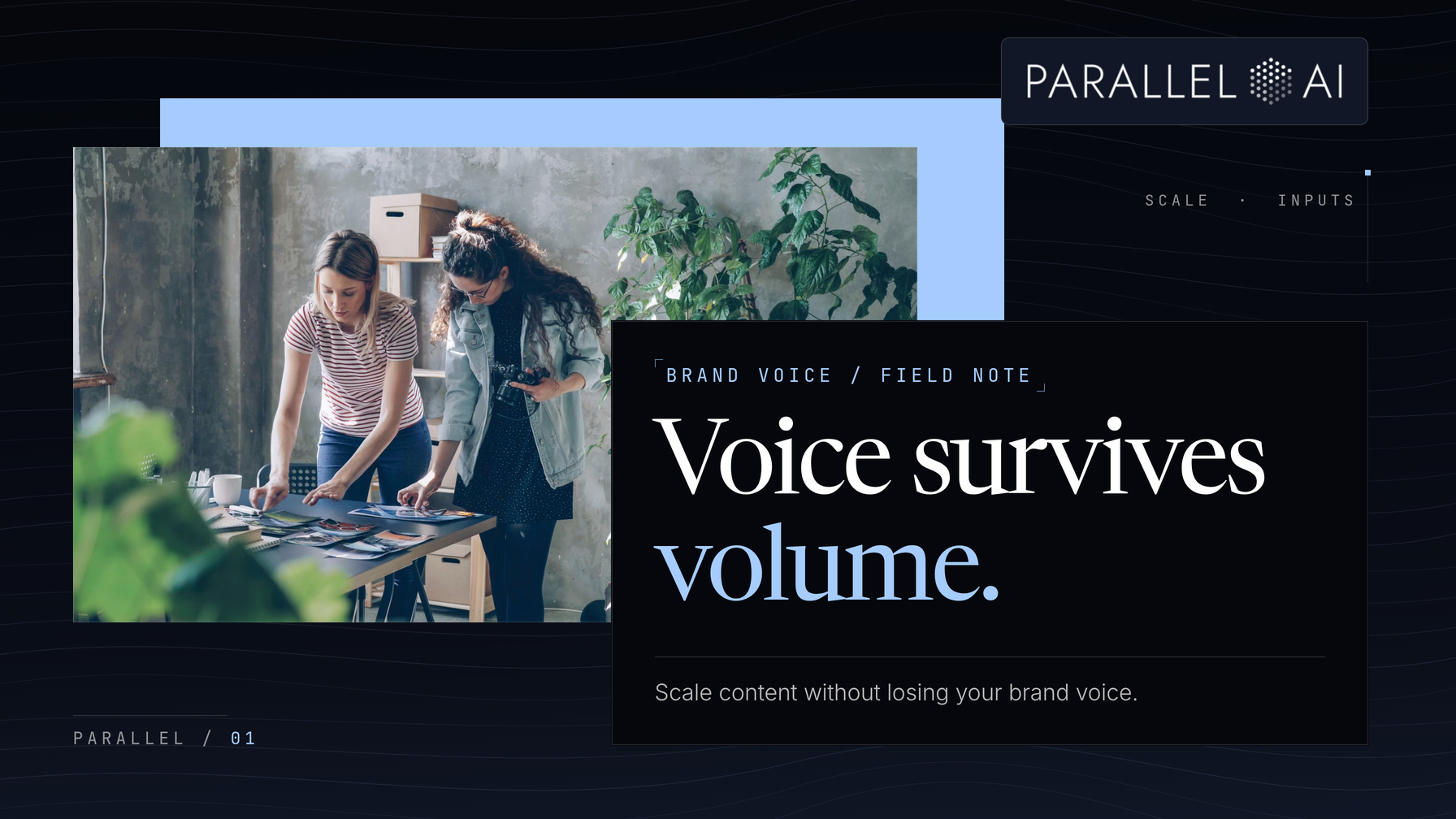
This post is about the fix: how to scale content without losing your brand voice. Voice survives volume when it lives in your inputs, not in a late-stage edit. We also cover what buyers pick up on and why generic content costs more than it earns. The December angle gets its own section.
Why does your blog get read as a work sample?
A buyer evaluating a small agency has almost nothing else to judge you on. Proposals are written to impress. Sales calls are rehearsed, and testimonials are hand-picked. The blog is different. It's the one place your agency puts work out in public, on a schedule, with no particular buyer in mind. That's why readers treat it as evidence of how you think and write.
For an agency selling SEO, websites, or consulting, that evidence cuts both ways. Say a post shows real reasoning, like a specific take, a number from a project, or a lesson only your team could have learned. The reader reasonably assumes client work looks similar. When the post is a keyword outline wearing sentences, they assume that too. Nobody emails to complain. They close the tab, and the next agency on their list gets the meeting.
That's the real cost of robotic content. The failure makes no sound. It happens at the exact moment a qualified buyer is checking whether you're as good as your pitch.
What robotic content looks like to a buyer
Readers rarely name what's wrong. They notice what's missing, and the tells are consistent:
- The opening could live anywhere. If the first line fits every site in your category, it fits none of them.
- Headings answer the crawler first. When a title serves the search engine before the reader, the order of priority is visible.
- Specifics are missing. There's no client situation, no number from your own work, and no opinion a peer could push back on. Template content is specific about nothing.
- The shape never changes. You get an intro, seven tips of equal length, and a conclusion that restates the intro. Predictability reads as mass production.
- The agency never appears in its own writing. With no "we" anywhere, there's nobody behind the words to trust.
Run one test before January planning starts. Open your last five posts and ask whether a competitor could publish each one unchanged. Every post that passes, meaning every post that's interchangeable, is a page where you spent credibility to earn a click.
Why December is the wrong month to go quiet
Between year-end planning and time off, buyers don't stop researching. They just do it quietly. Budgets reset in January, and the people who sign in the first quarter spend December reading. Whatever is on your blog when they arrive is what they find.
That makes the next few weeks unusually valuable. An article published now keeps answering searches through the holidays, working nights, weekends, and the slow days between Christmas and New Year's. For a small team, this month's posts may be the only marketing you have live in that window.
A realistic December plan is smaller than a normal month's, and that's fine. Two posts you can stand behind beat six you can't. Choose topics your January buyers are already researching, and schedule them now. That way the publishing happens without anyone having to be at a desk.
The catch is capacity. December is also when client deadlines, year-end wrap-up, and holiday coverage eat every spare hour. Long-form writing is the first thing that slips. So the question becomes how to keep publishing on a schedule that survives your busiest weeks.
How to scale content without losing your brand voice
Three places carry voice as you scale: the source material, the brief, and the publishing gate.
Write from your own knowledge base
Robotic content is generic content, and generic content comes from generic sources. The strongest material an agency owns is already in its files. Think process docs, client debriefs, the answers written on sales calls, and the positions taken in proposals. When a draft starts there, specifics arrive on the page by default, because that's all the source contains. The same post written from a keyword and a blank page has to invent its substance. Invention drifts toward the average.
Give every piece one claim only you can make
Before anything gets drafted, name the sentence a competitor couldn't publish. It might be what you check first on a new client's site. It might be the mistake you see most often in your niche, or a stand you take that others don't. If the honest answer is "nothing here is ours," the piece isn't ready to be written. One real point of view earns more trust than ten balanced paragraphs that say nothing.
Keep a human approval on publishing
Volume without a gate is how blogs drift into template territory. The pressure to ship makes "good enough" the standard. Agencies that scale well keep a person reading every piece before it goes live, even when software drafted it. That approval step is where the standard gets enforced.
Where our Content Engine fits
This is the workflow our Content Engine was built for. It starts from the questions buyers ask on search engines and, more and more, on AI assistants. From there it writes and publishes blog articles, social posts, newsletters, and branded graphics in your brand voice.
The voice part is worth being precise about. The Content Engine draws on the same knowledge base as the rest of Parallel AI. That means your files, written documents, website pages, and connected sources like Google Drive, Notion and Confluence. The system writing your December posts reads the same material your team works from. Your voice comes from what your agency knows and has written down, not from a style setting picked during setup.
Publishing runs on scheduled tasks: one-time, recurring, or heartbeat runs. Each comes with run history, quality scoring, and human approvals for publishing. Around the writing, our SEO and AEO tools cover keyword research, site audits, rankings, and AI visibility. That includes tracking when ChatGPT, Claude, Gemini, Perplexity, or Google AI Overviews mention your brand. A Brand Kit keeps voice and visuals consistent across everything that ships.
We built the platform in the USA with a small, senior team of engineers from Salesforce Marketing Cloud and TikTok. It serves more than 5,000 customers, who have generated over 4 million leads on it.
Getting started is deliberately light. Starter is $29 a month ($24 billed yearly) with a 7-day free trial. Free onboarding includes a content strategy, social and blog posts, and 50 leads with email outreach. You also get an AI agent ready to go on your website. No coding is required. Agencies that want to run all of this for their own clients can move up to Entrepreneur. That plan is $119 a month ($99 billed yearly) and includes a white-label instance under your own brand.
Let December's posts carry your voice into January
The blog is where buyers see your work with no pitch attached. Generic pages undercut the expertise you're selling without ever announcing it. The fix comes down to one habit: draft from what only your agency knows, and let nothing ship unread. Hold that through December, and the blog next quarter's buyers find still sounds like you. A researcher opening one of those posts between Christmas and New Year's hears your agency at full voice. Your team can be offline when it happens. Try Parallel AI free for 7 days.