
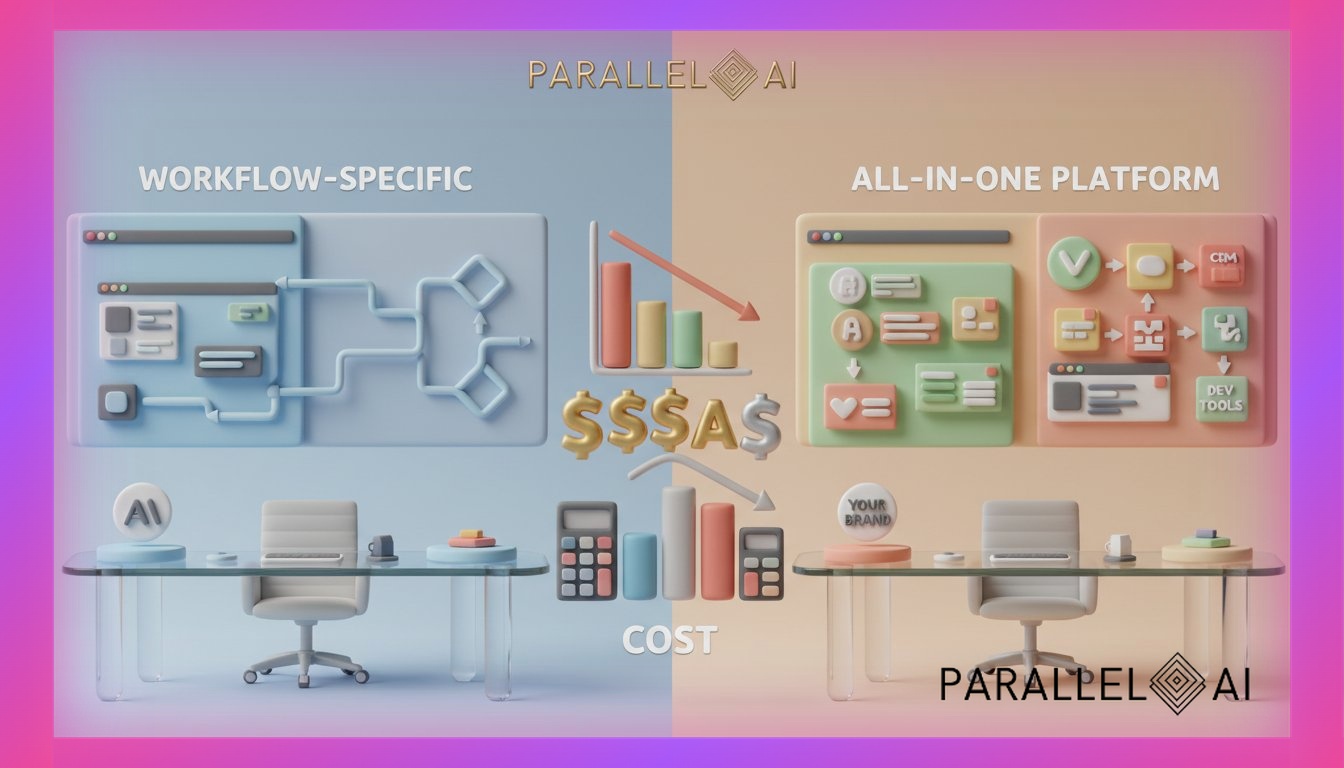
You’ve just landed a $3,500/month retainer with a client who needs AI-powered sales automation, content creation, and customer support. Your agency-building platform can handle the workflow automation and AI agents beautifully—but now your client also needs branded content, multi-channel outreach, and knowledge base integration. Suddenly, you’re cobbling together ChatGPT Plus, Jasper, Clay, and three other tools, paying $400+/month while your margins evaporate and your client questions why they’re juggling five different logins.
This is the hidden cost of agent-builder-only platforms: they excel at one thing but force solopreneurs into expensive tool fragmentation that kills profitability and complicates client delivery.
After analyzing Relevance AI’s $24 million Series B funding, enterprise-focused positioning, and workflow-specific approach against Parallel AI’s comprehensive white-label platform, the cost difference for solopreneurs becomes impossible to ignore. Here’s what the data reveals about choosing between specialized agent builders and all-in-one AI platforms for your agency.
What is Relevance AI?
Relevance AI positions itself as an “AI Agent Operating System” designed for building sophisticated workflow automation through custom AI agents. Following their $24 million Series B funding round led by Bessemer Venture Partners in May 2025, they’ve established themselves as a serious enterprise player in the AI automation space.
Key Features
Agent Builder Capabilities
Relevance AI’s core strength lies in its no-code agent builder that allows businesses to create AI agents for specific workflows—sales outreach, customer success sequences, lead qualification, and CRM automation. The platform excels at building complex, multi-step automation chains that handle repetitive business processes.
Integration Ecosystem
The platform offers extensive third-party integrations with CRMs, marketing tools, and data enrichment services, allowing agents to pull data from multiple sources and execute actions across different systems.
Team Collaboration
Relevance AI includes team-based features for larger organizations, with role-based access controls and shared agent libraries that allow teams to collaborate on automation development.
Pricing Structure
Relevance AI employs a tiered pricing model:
- Free: Limited for small-scale testing
- Team: 200 actions/month + 1,000 Vendor Credits/month
- Enterprise: Custom pricing based on action volume and credit requirements
The action-based pricing means costs scale directly with usage—a critical consideration for agencies planning to resell services where client usage is unpredictable.
Target Market
Relevance AI primarily targets medium to large enterprises with dedicated operations teams. Their Series B funding and enterprise-focused roadmap signal a strategic focus on businesses with:
- 50+ employees
- Established GTM (go-to-market) teams
- Complex, multi-department workflows
- Budget for custom implementation
Their recent partnership with major corporations and enterprise-grade security features reinforce this positioning.
White-Label Capabilities
While Relevance AI offers customizable AI agents that can be branded, the platform itself isn’t designed as a white-label solution for resellers. Agencies can build agents for clients, but clients would typically need their own Relevance AI accounts—making it challenging to create a fully branded, resellable platform experience.
What is Parallel AI?
Parallel AI takes a fundamentally different approach: rather than specializing in agent building alone, it delivers a comprehensive white-label AI platform that consolidates content creation, AI model access, knowledge base integration, sales automation, and customer engagement into one unified system designed specifically for solopreneurs and micro-agencies to resell.
Key Features
Multi-Model AI Access
Unlimited access to OpenAI, Anthropic, Gemini, Grok, DeepSeek, and Perplexity—eliminating the need for separate ChatGPT Plus ($20/month), Claude Pro ($20/month), and Gemini Advanced ($20/month) subscriptions. This alone saves $60+/month before even considering specialized tools.
AI Knowledge Base Integration
Connect Google Drive, Notion, Confluence, and databases so every AI interaction is informed by your specific business context. Process up to 1 million tokens of context—ensuring AI responses reflect your company’s actual knowledge, not generic outputs.
Content Engine
Automated content creation, scheduling, and publishing across WordPress, LinkedIn, Instagram, Facebook, YouTube, X, and more. Users report creating 80+ pieces of content monthly versus 10-15 before, saving 20+ hours per week on content production alone.
White-Label Platform
Full branding customization allowing agencies to launch their own AI platform in 3-5 days with 30-70% profit margins. Agencies set their own pricing, typically marking up 1.5-2x base cost (example: $387/month cost → $697/month client charge = $310/month profit per client).
Sales Automation & Outreach
Integrated Smart Lists and Sequences for multi-channel prospecting across email, social media, SMS, chat, and voice—replacing tools like Clay ($349/month) and Instantly.ai ($97/month).
Pricing Structure
Parallel AI uses straightforward subscription pricing:
- $99-499/month: All AI models + automation included
- Unlimited usage: No per-action or per-credit metering
- White-label margin: 30% base margin + unlimited markup potential
The unlimited model means predictable costs regardless of client usage volume—critical for agencies that need to offer flat-rate retainers without worrying about variable platform costs.
Target Market
Parallel AI specifically targets solopreneurs and micro-agencies (1-10 employees) in:
- Digital marketing
- Sales consulting
- Content creation services
- AI implementation services
- Business strategy consulting
The platform is designed for non-technical founders who need enterprise-grade AI capabilities without requiring developer resources or complex implementation.
White-Label Capabilities
Parallel AI is purpose-built for white-labeling, offering:
- Full platform branding (logo, colors, domain)
- Client portal with your branding
- Billing through your Stripe account
- 3-5 day implementation timeline
- No technical expertise required
Head-to-Head Comparison
Feature Comparison
| Capability | Relevance AI | Parallel AI |
|---|---|---|
| AI Agent Building | ✅ Advanced workflow builder | ✅ Pre-built + custom agents |
| Multi-Model AI Access | ❌ Single model or API integration required | ✅ OpenAI, Anthropic, Gemini, Grok, DeepSeek, Perplexity |
| Content Creation Engine | ❌ Not included (requires separate tool) | ✅ 80+ pieces/month automation |
| Knowledge Base Integration | ⚠️ Via custom integrations | ✅ Native Drive, Notion, Confluence |
| Sales Prospecting Tools | ⚠️ Agent-based, requires configuration | ✅ Smart Lists + Sequences built-in |
| White-Label Reselling | ❌ Not designed for resellers | ✅ Full white-label platform |
| Pricing Model | Per-action + vendor credits | Unlimited flat-rate |
| Target Market | Enterprise (50+ employees) | Solopreneurs (1-10 employees) |
| Implementation Complexity | Medium-High (workflow configuration) | Low (3-5 days to launch) |
| Content Scheduling | ❌ Not included | ✅ Multi-platform automation |
| Customer Support Automation | ✅ Via custom agents | ✅ Built-in AI agents |
Pricing Comparison: 12-Month Total Cost Analysis
Scenario: Solopreneur Agency with 3 Client Accounts
Relevance AI Stack:
– Relevance AI Team Plan: ~$150/month (estimated for 3 client workflows)
– ChatGPT Plus: $20/month
– Claude Pro: $20/month
– Jasper (content): $39/month
– Clay (prospecting): $349/month
– Instantly.ai (outreach): $97/month
– Monthly Total: $675
– Annual Total: $8,100
Parallel AI:
– Parallel AI Platform: $387/month (includes all features)
– Additional tools needed: $0
– Monthly Total: $387
– Annual Total: $4,644
12-Month Savings: $3,456
But the real cost difference emerges when calculating white-label revenue opportunity:
White-Label Revenue Scenario:
Relevance AI:
– Can’t white-label platform itself
– Must resell individual services
– Typical agency markup on services: 30-40%
– Revenue from 3 clients at $1,200/month each: $3,600/month
– Tool costs: $675/month
– Net margin: $2,925/month ($35,100 annually)
Parallel AI:
– Full white-label platform
– Charge clients $697/month per seat
– Revenue from 3 clients: $2,091/month
– Platform cost: $387/month
– Net margin: $1,704/month ($20,448 annually)
Wait—Relevance AI shows higher margins in this scenario. But here’s what this calculation misses:
The Hidden Cost Analysis
The numbers above assume you’re charging $1,200/month for services using Relevance AI. But to deliver those services, you’re:
- Managing 6+ separate tool subscriptions (15+ hours/month admin overhead)
- Training clients on multiple platforms (reduces perceived value)
- Troubleshooting integration issues between disparate tools
- Paying per-action fees that spike with client success
- Unable to offer branded platform access (limits premium positioning)
With Parallel AI’s white-label model, you can offer:
- Branded platform access ($697/month/client for full platform)
- Bundled service packages ($1,500-3,000/month including platform + services)
- Platform-only subscriptions (passive recurring revenue)
- Tiered pricing based on feature access
Revised calculation with bundled services:
Parallel AI Bundled Model:
– 3 clients at $1,800/month (platform + light services)
– Revenue: $5,400/month
– Platform cost: $387/month
– Service delivery time saved: 20 hours/month (due to automation)
– Net margin: $5,013/month ($60,156 annually)
– Additional revenue opportunity vs. Relevance AI stack: $25,056/year
Use Case Scenarios
Scenario 1: Marketing Agency Offering AI-Powered Content
With Relevance AI:
– Build custom agent for content workflow
– Subscribe to Jasper separately ($39-$99/month)
– Manual scheduling across platforms
– Client sees multiple tool logins
– Estimated setup: 2-3 weeks
With Parallel AI:
– Content Engine generates 80+ pieces/month automatically
– One-click scheduling to WordPress, LinkedIn, Instagram, Facebook, YouTube, X
– Single branded login for client
– Estimated setup: 3-5 days
Scenario 2: Sales Consultant Automating Outreach
With Relevance AI:
– Build BDR agent for lead qualification
– Integrate Clay ($349/month) for prospect data
– Integrate Instantly.ai ($97/month) for email sequences
– Configure cross-platform data flow
– Estimated setup: 3-4 weeks
With Parallel AI:
– Smart Lists identify prospects automatically
– Sequences handle email, social, SMS, chat, voice from one platform
– No additional tools required
– Estimated setup: 1 week
Scenario 3: Consultant Building Custom AI for Client’s Industry
With Relevance AI:
– Build highly customized workflow agent
– Advanced automation with complex decision trees
– Deep CRM integration
– Estimated setup: 4-6 weeks
– Best choice for this scenario
With Parallel AI:
– Pre-built agents with business context from knowledge base
– Faster deployment but less workflow customization
– Estimated setup: 1-2 weeks
– Trade-off: Speed vs. deep customization
Implementation Complexity
Relevance AI:
– Requires understanding of workflow logic and automation architecture
– Medium to high learning curve for building effective agents
– Best suited for users with operations or technical background
– Powerful but requires time investment to master
– Client implementation: 2-6 weeks depending on complexity
Parallel AI:
– Designed for non-technical solopreneurs
– Pre-configured agents and templates
– 3-5 day white-label platform launch
– Drag-and-drop content automation
– Client onboarding: 3-5 days
The complexity difference matters significantly for solopreneurs wearing multiple hats who can’t afford weeks of platform configuration.
The Real Cost Analysis
Total Cost of Ownership Over 12 Months
Beyond subscription costs, let’s calculate true TCO including time investment:
Relevance AI Total Cost:
– Platform & tools: $8,100/year
– Implementation time: 80 hours @ $100/hour = $8,000
– Monthly tool management: 15 hours/year × $100/hour = $18,000
– Integration troubleshooting: 20 hours/year × $100/hour = $2,000
– Total 12-Month TCO: $36,100
Parallel AI Total Cost:
– Platform: $4,644/year
– Implementation time: 24 hours @ $100/hour = $2,400
– Monthly platform management: 3 hours/year × $100/hour = $3,600
– Integration troubleshooting: 4 hours/year × $100/hour = $400
– Total 12-Month TCO: $11,044
True Cost Difference: $25,056 over 12 months
This doesn’t even account for:
- Opportunity cost: 88 additional hours with Relevance AI stack that could be spent on revenue-generating client work ($8,800 in billable time)
- Client satisfaction: Unified platform experience vs. juggling multiple tools
- White-label revenue: Platform reselling opportunities unavailable with Relevance AI
Hidden Fees Breakdown
Relevance AI Hidden Costs:
- Action-Based Pricing Uncertainty: Client success increases usage, increasing your costs unpredictably
- Vendor Credit Consumption: High-volume workflows burn through credits quickly
- Tool Fragmentation Tax: Each additional tool requires separate subscription, training, and management
- Integration Maintenance: Custom integrations break when third-party tools update
- Enterprise Feature Lockout: Advanced features require Enterprise pricing (undisclosed, likely $1,000+/month)
Parallel AI Pricing Transparency:
- Unlimited Usage: Flat monthly rate regardless of volume
- All Features Included: No tiered feature lockouts
- White-Label Margin Built-In: 30-70% margins without additional fees
- No Per-Seat Charges: Use across unlimited clients on agency plans
- Predictable Scaling: Know exact costs as you add clients
Margin Calculations for Agencies
Relevance AI Service-Based Margins:
– Monthly service revenue: $3,600 (3 clients × $1,200)
– Monthly tool costs: $675
– Monthly service delivery: 60 hours @ $100/hour fully loaded cost = $6,000
– Net margin: -$3,075/month (unprofitable without efficiency gains)
With efficiency gains from automation:
– Reduced delivery time: 35 hours @ $100/hour = $3,500
– Net margin: $125/month (3.5% margin)
Parallel AI Platform + Service Margins:
– Monthly bundled revenue: $5,400 (3 clients × $1,800)
– Monthly platform cost: $387
– Monthly service delivery: 20 hours @ $100/hour = $2,000 (automated content + outreach saves 40 hours)
– Net margin: $3,013/month (55.8% margin)
The margin difference is stark: 3.5% vs. 55.8%—and Parallel AI’s model scales better as automation handles more client work.
Pros and Cons
Relevance AI Strengths
✅ Advanced Workflow Customization: Best-in-class agent builder for complex, multi-step automations
✅ Enterprise-Grade Infrastructure: $24M Series B funding signals stability and ongoing development
✅ Deep Integration Capabilities: Extensive third-party connections for data-rich workflows
✅ Team Collaboration Features: Built for larger organizations with multiple users
✅ Custom Agent Libraries: Share and reuse automation templates across teams
Relevance AI Weaknesses
❌ Not White-Label Friendly: Can’t resell platform itself, only services built on it
❌ Action-Based Pricing Risk: Costs scale unpredictably with client success
❌ Tool Fragmentation Required: Need separate subscriptions for content, AI models, outreach
❌ Enterprise-Focused: Features and pricing optimized for larger organizations
❌ Steeper Learning Curve: Requires workflow logic understanding and configuration time
❌ No Built-In Content Creation: Must integrate or subscribe to separate tools
❌ Implementation Complexity: 2-6 week setup for comprehensive client solutions
Parallel AI Strengths
✅ Purpose-Built White-Label: Full platform branding and reselling in 3-5 days
✅ Unlimited Flat-Rate Pricing: Predictable costs regardless of usage volume
✅ All-In-One Consolidation: Replaces $400+/month in separate tool subscriptions
✅ Multi-Model AI Access: OpenAI, Anthropic, Gemini, Grok, DeepSeek, Perplexity included
✅ Content Engine: 80+ pieces/month automation saves 20+ hours weekly
✅ Solopreneur-Optimized: Designed for non-technical founders with 1-10 person teams
✅ Fast Implementation: Client onboarding in 3-5 days vs. weeks
✅ High Profit Margins: 30-70% margins with clear markup guidance
✅ Knowledge Base Integration: Native Google Drive, Notion, Confluence connectivity
Parallel AI Weaknesses
❌ Less Workflow Customization: Pre-built agents vs. fully custom workflow logic
❌ Newer Platform: Less enterprise track record than established players
❌ Limited Advanced Integrations: Fewer third-party connectors than specialized platforms
Which Platform is Right for You?
Choose Relevance AI if you:
- Lead a 10+ person operations team that needs collaborative agent development
- Require highly complex workflow automation with intricate decision trees and multi-system integrations
- Have technical resources to configure and maintain custom agent architectures
- Serve enterprise clients willing to pay for sophisticated, customized automation solutions
- Don’t need white-label platform reselling—you’re selling services, not software
- Can invest 2-6 weeks in implementation and configuration per client
- Have predictable, lower-volume usage that won’t trigger high action-based fees
Best for: Mid-sized agencies (10-50 employees) with technical operations teams building custom automation for enterprise clients.
Choose Parallel AI if you:
- Run a solopreneur or micro-agency (1-10 people) looking to scale without adding headcount
- Want to white-label and resell an AI platform under your own brand
- Need all-in-one consolidation to replace ChatGPT Plus, Claude Pro, Jasper, Clay, Instantly.ai, and other fragmented tools
- Require fast client onboarding (3-5 days vs. weeks) to start generating revenue quickly
- Want predictable, unlimited pricing without per-action fees that scale with client success
- Lack deep technical resources and need a platform designed for non-technical founders
- Seek 30-70% profit margins with clear white-label revenue models
- Value content automation that saves 20+ hours weekly on content production
- Want multi-model AI access without managing separate subscriptions
Best for: Solopreneurs and micro-agencies (1-10 employees) in digital marketing, sales consulting, content creation, and AI services seeking high-margin, scalable platform reselling.
The Decision Matrix
| Your Priority | Better Choice |
|---|---|
| Complex workflow customization | Relevance AI |
| White-label platform reselling | Parallel AI |
| Lowest total cost of ownership | Parallel AI |
| Enterprise client requirements | Relevance AI |
| Fast implementation (< 1 week) | Parallel AI |
| Content creation automation | Parallel AI |
| Advanced agent collaboration | Relevance AI |
| Highest profit margins (50%+) | Parallel AI |
| Deep CRM integrations | Relevance AI |
| Multi-model AI consolidation | Parallel AI |
| Team-based development | Relevance AI |
| Solopreneur-friendly | Parallel AI |
Conclusion
Relevance AI and Parallel AI serve fundamentally different markets with different business models. Relevance AI excels as an enterprise-focused agent builder for teams that need sophisticated workflow customization and have the technical resources to configure complex automations. Their $24 million Series B funding and enterprise partnerships validate this positioning.
But for solopreneurs and micro-agencies, the math tells a different story. Parallel AI’s all-in-one white-label platform delivers $25,056 in annual savings through tool consolidation while enabling 55.8% profit margins versus 3.5% with service-only models. The ability to launch a branded AI platform in 3-5 days, charge clients $697-1,800/month, and eliminate tool fragmentation makes it the superior choice for solo founders looking to scale without hiring.
The choice isn’t about which platform is “better”—it’s about which business model aligns with your agency’s reality. If you’re a solopreneur juggling multiple hats, racing to deliver client results while managing your own business development, Parallel AI’s turnkey white-label approach eliminates the complexity tax that agent-builder platforms impose.
Relevance AI asks: “How sophisticated can your workflow automation become?”
Parallel AI asks: “How quickly can you launch a profitable AI business?”
For the overwhelmed solopreneur choosing between configuring complex agents or launching a revenue-generating platform this week, the answer is clear. The question isn’t whether to adopt AI—it’s whether you’ll spend weeks building it or days selling it.
Ready to launch your white-label AI platform and start generating 30-70% margins this month? Parallel AI’s all-in-one solution replaces your entire AI stack, eliminates tool fragmentation, and puts you in business in 3-5 days. Try Parallel AI free or schedule an agency demo to see how solopreneurs are building $60K+ annual margin businesses without enterprise complexity.