
The low-code AI revolution has created an intriguing opportunity for solopreneurs and micro-agencies: platforms that promise to automate complex business processes without requiring a development team. But here’s the question nobody’s asking: when you’re choosing between building AI workflows and running a complete AI-powered business, which platform actually delivers the scalability independent consultants need?
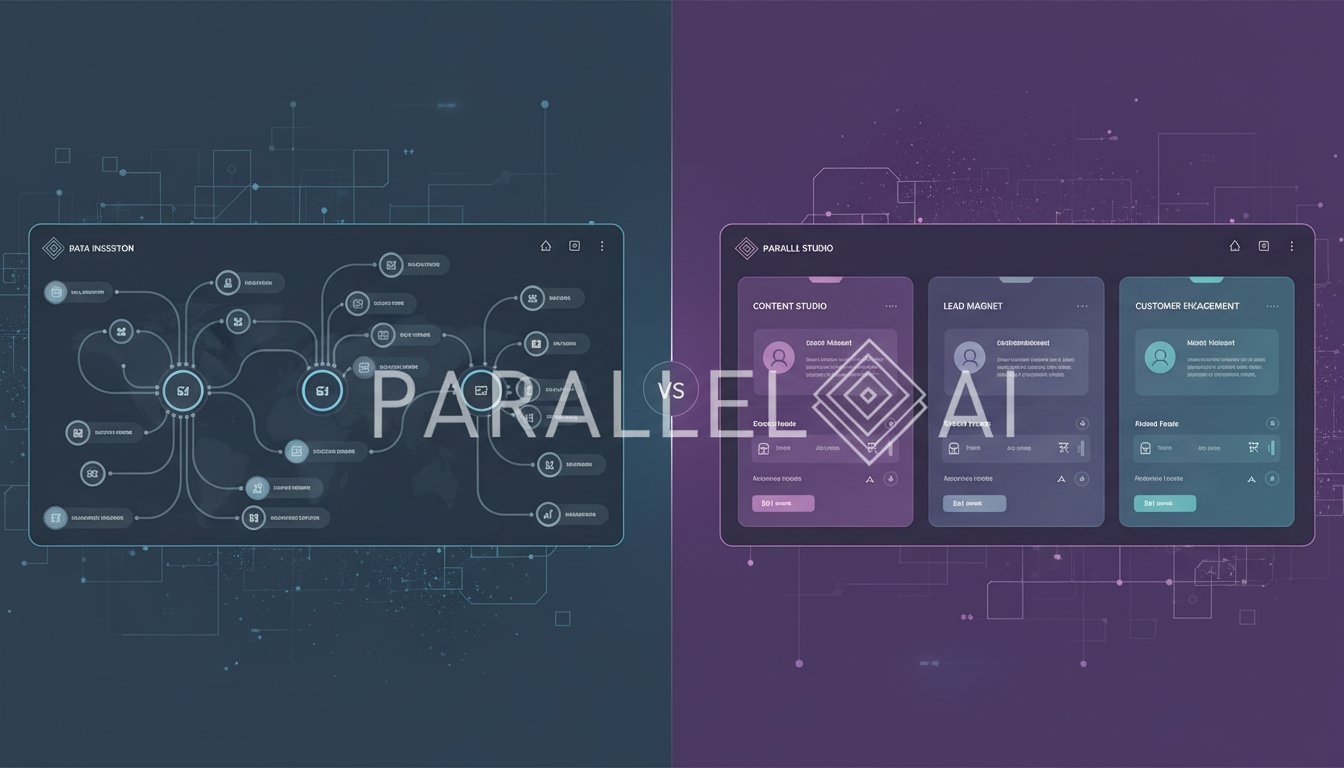
Relevance AI and Parallel AI both position themselves as comprehensive automation solutions, but they take fundamentally different approaches to solving the same problem. One focuses on creating autonomous AI workforces through workflow building, while the other provides a complete business operating system with pre-built automation across content, leads, and customer engagement.
For agencies and consultants evaluating these platforms, the decision extends far beyond feature lists. It’s about understanding which architecture supports sustainable growth, delivers faster time-to-value, and enables you to build a truly differentiated service offering that clients can’t find elsewhere.
This comparison cuts through the marketing claims to reveal the operational realities, hidden costs, and strategic implications of each platform—insights that only emerge after you’ve committed months and substantial investment to the wrong solution.
Platform Philosophy: Workflow Builder vs. Business Operating System
Relevance AI’s Approach
Relevance AI positions itself as a low-code platform for building autonomous AI workforces. The core philosophy centers on empowering users to create custom AI agents that perform specific tasks by connecting various tools and services through workflow automation.
The platform emphasizes flexibility through its integration with over 2,000 tools including Slack, Salesforce, Google Workspace, Asana, Notion, Gmail, and HubSpot. Users design workflows by connecting these integrations, creating custom “skills” for their AI agents, and automating business processes according to their specific requirements.
This approach appeals to businesses that need highly customized automation solutions and have the time and expertise to design, build, and maintain these workflows. The low-code interface reduces technical barriers compared to traditional development, but users still need to understand workflow logic, integration mapping, and process design.
Parallel AI’s Approach
Parallel AI takes a fundamentally different approach: providing a complete, pre-integrated business operating system that consolidates multiple business functions into a unified platform. Rather than requiring users to build workflows from scratch, Parallel AI delivers ready-to-use automation across content creation, lead generation, customer engagement, and business processes.
The platform replaces fragmented tool stacks (ChatGPT, Claude, Clay, Instantly.ai, Jasper, Baseloop, and others) with a single ecosystem that includes:
- Multi-model AI access (OpenAI, Anthropic Claude, Google Gemini, Grok, DeepSeek) with uncapped usage
- AI Content Engine that produces 1-3 months of platform-optimized content in minutes
- Smart Lists and Sequences for lead enrichment and multi-channel outreach
- Omni-channel AI agents for voice, chat, SMS, and messaging platforms
- Knowledge Base integration connecting Google Drive, Notion, and Confluence
- White-label capabilities starting at the Entrepreneur tier ($99/month)
This architecture prioritizes speed-to-value and operational efficiency. Users can deploy sophisticated AI capabilities immediately without workflow design expertise, making it particularly attractive for solopreneurs and micro-agencies that need to deliver client results quickly rather than spend weeks building infrastructure.
White-Label Capabilities: The Agency Revenue Model Test
For agencies and consultants, white-label capabilities determine whether AI becomes a profit center or remains an operational expense. The differences between these platforms reveal fundamentally different approaches to partner economics.
Relevance AI’s White-Label Offering
Relevance AI offers white-label solutions, allowing agencies to rebrand the platform for their clients. However, specific details about the scope, limitations, and pricing structure of these white-label capabilities remain notably absent from public documentation.
This lack of transparency creates uncertainty for agencies evaluating the platform:
- Unclear pricing structure for white-label access
- Unknown customization limits on branding and interface
- Undisclosed margin opportunities for resellers
- Ambiguous client billing capabilities
For agencies building their business model around AI services, these unknowns represent significant risk. Without clear understanding of white-label economics, it’s impossible to accurately forecast revenue, price services, or commit to long-term client relationships.
Parallel AI’s White-Label Offering
Parallel AI makes white-label capabilities a core differentiator, with transparent pricing and clear revenue models starting at the Entrepreneur tier ($99/month). The platform provides:
Three Revenue Model Options:
-
Direct Platform Subscriptions: Clients subscribe through your branded portal, paying you directly via your Stripe account. Recommended markup: 1.5-2x base cost. Example: Base cost $297/month → Charge $597/month → $300/month profit per client.
-
Bundled Service Packages: Purchase bulk seats, include platform access in monthly retainers. Charge setup fees ($1,500-$5,000) plus monthly service fees. Example: $3,000/month retainer includes AI platform access plus your consulting.
-
Hybrid Model (Most Popular): Combine platform subscriptions at your markup with professional services for onboarding, training, and custom automation setup.
White-Label Features Include:
– Fully customizable AI agents with your branding
– Branded dashboards and client portals
– API access for custom integrations
– 30-70% margin potential on subscriptions
– Launch timeline: 3-5 days
This transparency enables agencies to build concrete business plans, price services accurately, and commit confidently to client deliverables. The platform becomes a predictable foundation for scalable service offerings rather than an uncertain variable.
AI Model Access: Flexibility vs. Simplicity
Relevance AI’s Model Strategy
Relevance AI utilizes Large Language Models (LLMs) to power its AI agents, but specific details about which models are available, how they’re accessed, or whether users can choose between different models remain unclear in public documentation.
This ambiguity creates several challenges:
- Unknown model selection options
- Unclear performance characteristics for different use cases
- Uncertain cost implications of model usage
- Limited transparency on model updates and capabilities
For agencies delivering client work, this uncertainty makes it difficult to guarantee specific quality levels, estimate project costs accurately, or explain AI capabilities to clients with confidence.
Parallel AI’s Multi-Model Approach
Parallel AI provides transparent, uncapped access to multiple leading AI models starting at the Entrepreneur tier ($99/month):
- OpenAI (GPT-4.1, GPT-5, reasoning models, vision)
- Anthropic Claude (Haiku 4.5, Sonnet 4.5, Sonnet 3.7)
- Google Gemini (2.5 Flash, 2.5 Pro, text and vision)
- Grok 4
- DeepSeek R1 (advanced reasoning)
- Context windows up to 1 million tokens
This multi-model approach delivers three critical advantages:
- Task Optimization: Choose the best model for each use case (Claude for analysis, GPT for creative content, Gemini for visual tasks)
- Cost Predictability: Fixed monthly pricing eliminates usage surprises
- Vendor Independence: No lock-in to single provider’s limitations or price increases
Users also gain access to AI-powered image generation (OpenAI DALL-E, Google Imagen, LeonardoAI), audio generation (OpenAI, ElevenLabs), and video generation (Google Veo3, OpenAI Sora2)—capabilities that would require separate subscriptions and integrations on other platforms.
Integration Ecosystem: Breadth vs. Depth
Relevance AI’s Integration Advantage
Relevance AI’s standout feature is its integration with over 2,000 tools and services. This extensive connectivity enables users to build workflows that touch virtually every business system:
- CRM platforms (Salesforce, HubSpot)
- Communication tools (Slack, Gmail)
- Project management (Asana, Notion)
- Google Workspace suite
- Hundreds of niche business applications
For businesses with complex, highly customized tech stacks requiring specific tool connections, this breadth provides significant value. The ability to automate processes across disparate systems without custom development reduces integration costs and enables sophisticated automation scenarios.
However, this breadth comes with trade-offs:
- Configuration complexity: Each integration requires mapping, authentication, and workflow design
- Maintenance overhead: Updates to connected tools can break workflows
- Learning curve: Understanding hundreds of integration options takes time
- Time-to-value: Building comprehensive workflows delays ROI
Parallel AI’s Strategic Integration Approach
Parallel AI takes a different approach: deep integration with the most critical business systems plus extensibility for custom needs:
Native Integrations:
– Knowledge bases: Google Drive, Notion, Confluence (with context preservation)
– Communication platforms: Slack, Discord, website chat, SMS, voice
– Publishing platforms: WordPress, LinkedIn, Instagram, Facebook, YouTube, TikTok, X
– CRM and outreach: Email, social media, browser automation
– Development: API access, n8n custom integration nodes, MCP Server support
Rather than requiring users to build workflows, Parallel AI provides pre-built automation that works immediately:
- Connect your Google Drive and AI agents instantly access company knowledge
- Link WordPress and content publishes automatically on schedule
- Integrate Slack and team members chat with AI employees directly
For custom integration needs, the platform offers:
– Workflow Builder with 1,000+ integration nodes (Business plan)
– Custom n8n nodes for advanced automation
– API access for proprietary system connections
– MCP Server for using knowledge base in MCP-supported tools
This approach delivers faster time-to-value for the 80% of use cases while maintaining extensibility for the 20% requiring custom workflows.
Content Creation: The Solopreneur Scalability Test
Content creation represents one of the most time-consuming activities for solopreneurs and micro-agencies. The platform that solves this problem most effectively creates immediate, measurable ROI.
Relevance AI’s Content Capabilities
Relevance AI can automate content creation through custom workflows connecting various AI models and content management systems. Users build automation by:
- Creating AI agents with content generation skills
- Connecting to content management platforms
- Designing workflows for content production and distribution
- Configuring brand voice and style guidelines
This approach provides customization flexibility but requires significant upfront investment in workflow design, testing, and optimization before delivering results.
Parallel AI’s Content Engine
Parallel AI includes a dedicated Content Engine designed specifically for scaling content production without headcount:
Four Specialized AI Agents:
- Strategy Agent: Develops customized content strategies aligned with business goals, leverages platform algorithms and industry best practices
- Copywriting Agent: Produces high-converting copy using proven techniques while maintaining consistent brand voice
- Customer Profile Agent: Creates detailed ideal customer profiles to ensure content resonates with target audiences
- Visual Agent: Generates on-brand visuals in minutes, eliminating expensive photoshoots
The Content Engine enables users to:
- Create 1-3 months of content in minutes across multiple platforms
- Schedule automated content generation matching publishing goals
- Maintain authentic brand voice through advanced AI fine-tuning
- Optimize for each platform (LinkedIn, Instagram, Facebook, YouTube, TikTok, X, WordPress)
- Export and import entire calendars for team or client review
Quantifiable Impact:
– Save 20+ hours per week on content creation
– Scale production 10x without additional headcount
– Increase visibility in AI-powered searches (ChatGPT, Claude, Perplexity, Gemini)
For solopreneurs competing against larger agencies, this represents the difference between publishing sporadically and maintaining the consistent presence that builds authority and drives leads.
Lead Generation and Sales Automation: Critical Revenue Functions
For service-based businesses, lead generation directly impacts revenue. The platform that automates this function most effectively creates sustainable growth.
Relevance AI’s Lead Capabilities
Relevance AI can automate lead generation and sales processes through custom workflows connecting CRM systems, enrichment tools, and outreach platforms. Users design automation by building agents that:
- Identify and qualify prospects
- Enrich contact data
- Trigger outreach sequences
- Update CRM records
This requires connecting multiple systems, configuring data flows, and maintaining complex workflows across various platforms.
Parallel AI’s Integrated Sales Automation
Parallel AI consolidates lead generation and sales automation into native platform features that replace multiple specialized tools:
Smart Lists (Replaces Clay, Apollo, ZoomInfo):
– AI-powered prospecting and lead identification
– Automated enrichment with company and contact data
– Lead qualification and scoring
– Research and segmentation
– Browser automation for data collection
Sequences (Replaces Instantly.ai, SmartLead, Outreach):
– Multi-channel outreach: email, SMS, LinkedIn, browser automation
– Personalized messaging at scale
– Automated follow-up based on engagement
– Response tracking and optimization
Omni-Channel AI Agents:
– Voice AI for inbound/outbound calls with natural conversation
– Multi-channel chat (website, SMS, messaging platforms)
– Context preservation across all interactions
– CRM synchronization
– Automatic escalation to humans when needed
This consolidation delivers three critical advantages:
- Cost savings: $2,071+/month traditional stack → $297/month Parallel AI Business plan
- Unified data: No disconnected systems or manual data transfer
- Faster deployment: Pre-built automation vs. custom workflow design
For micro-agencies handling lead generation for multiple clients, this represents the difference between managing fragmented tool stacks for each client and delivering sophisticated automation through a single platform.
Pricing Transparency: The Hidden Cost Analysis
Pricing transparency determines whether agencies can accurately forecast costs, price services, and maintain profitability as they scale.
Relevance AI’s Pricing Structure
Relevance AI mentions “transparent and competitive pricing” but specific pricing tiers, costs, and feature allocations are notably absent from public documentation. This creates several challenges:
- Impossible to calculate total cost of ownership before sales conversations
- Unknown scaling costs as usage increases
- Unclear seat pricing for team expansion
- Hidden costs for premium features or integrations
- Difficult client pricing without understanding your own costs
For agencies building financial models or justifying platform investments to stakeholders, this opacity represents significant risk.
Parallel AI’s Transparent Pricing
Parallel AI publishes complete pricing details with clear feature allocations:
Free Tier:
– 50 credits/month
– Limited access to top AI models
– 200k context window
– 30-day chat history
– Web scraper, GPT-4.1-mini access
Entrepreneur ($99/month):
– 2,000 credits/month
– All AI models (OpenAI, Claude, Gemini, Grok, DeepSeek)
– 1M context window
– Content Engine, Sequences, Smart Lists, Inboxes, Workflows
– Custom branded white-labeling
– Knowledge Base integration
– Unlimited chat history
Business ($297/month – Most Popular):
– 9,000 credits/month
– Everything in Entrepreneur
– Up to 3 organizations with 9 total collaborator seats
– API access
– Workflow Builder integration
– Share AI employees across team
– N8N custom integration nodes
Enterprise (Custom Pricing):
– Unlimited credits with high-speed access
– On-premise deployment
– Single Sign-On (SSO) and domain verification
– Dedicated API resources
– Priority support
Add-ons (Business Plan):
– Additional 3,000 credits: $80/month
– Additional seat: $48/month
– Additional company: $80/month
This transparency enables agencies to:
– Calculate exact monthly costs before committing
– Price client services with known margins
– Forecast scaling costs as business grows
– Compare accurately against alternative solutions
Cost Comparison Example:
Traditional tool stack for 3 users:
– ChatGPT Pro: $60/month
– Claude Pro: $60/month
– Clay: $349/month
– SmartLead: $282/month
– Baseloop: $315/month
– Content creation tools: $1,000+/month
– Total: $2,071+/month
Parallel AI Business plan: $297/month (includes all above capabilities plus additional features)
Savings: $1,774/month ($21,288/year)
Implementation Timeline: Speed to Value
For solopreneurs and micro-agencies, time is the scarcest resource. The platform that delivers results fastest creates competitive advantage.
Relevance AI’s Implementation Process
Relevance AI’s low-code approach reduces development time compared to custom coding, but users still face substantial implementation requirements:
- Learn the platform: Understand workflow builder, integration options, and agent configuration
- Design workflows: Map business processes to automation logic
- Configure integrations: Connect and authenticate each tool in your stack
- Build and test agents: Create AI agents with appropriate skills and behaviors
- Optimize and refine: Iterate based on results and edge cases
Estimated timeline for basic automation: 2-4 weeks
Estimated timeline for comprehensive business automation: 4-8 weeks
This timeline delays ROI and requires ongoing maintenance as business processes evolve.
Parallel AI’s Implementation Process
Parallel AI’s pre-built automation enables immediate deployment:
- Sign up and configure: Create account, set brand preferences (30 minutes)
- Connect knowledge base: Link Google Drive, Notion, or Confluence (15 minutes)
- Deploy AI agents: Activate pre-built employees for specific tasks (30 minutes)
- Launch content automation: Configure Content Engine and schedule first campaign (1 hour)
- Set up lead generation: Configure Smart Lists and Sequences (1 hour)
Estimated timeline for basic automation: 3-4 hours
Estimated timeline for comprehensive business automation: 1-2 days
White-Label Launch: 3-5 days from signup to client-facing branded platform
This compressed timeline enables agencies to:
– Deliver client results within days of platform adoption
– Generate revenue before significant investment
– Test and validate use cases quickly
– Scale successful implementations immediately
Security and Compliance: Enterprise Requirements
For agencies serving enterprise clients or handling sensitive data, security and compliance capabilities are non-negotiable.
Relevance AI’s Security Approach
Specific security certifications, compliance standards, and data protection measures are not detailed in publicly available Relevance AI documentation, creating uncertainty for agencies with security-conscious clients.
Parallel AI’s Enterprise Security
Parallel AI provides transparent, enterprise-grade security features:
Encryption:
– Data encryption at rest (AES-256)
– Data in transit (TLS 1.2+)
– Option for private hosted models
Access Control:
– Single Sign-On (SSO) via SAML 2.0
– Domain verification
– Group permission mirroring
– Audit logging
Privacy Commitment:
– Data never used for model training
– On-premise deployment options
– SOC-II Type 2 certification (enterprise tier)
These certifications enable agencies to serve regulated industries (legal, financial services, healthcare) and enterprise clients with strict security requirements.
The Strategic Decision Framework
Choosing between Relevance AI and Parallel AI ultimately depends on your business model, technical capabilities, and growth strategy.
Choose Relevance AI If You:
- Need highly customized workflows connecting niche business tools
- Have technical resources to design, build, and maintain automation
- Require specific integrations among the 2,000+ available connectors
- Value workflow building flexibility over speed-to-value
- Can invest 4-8 weeks in implementation before seeing ROI
- Don’t need transparent pricing for financial planning
Choose Parallel AI If You:
- Need to deliver client results within days, not weeks
- Want to replace $2,000+/month tool stacks with a single platform
- Require white-label capabilities with transparent revenue models
- Need uncapped access to multiple leading AI models
- Want pre-built automation for content, leads, and customer engagement
- Require cost predictability for accurate client pricing
- Need enterprise security for regulated industries
- Value consolidation over fragmented best-of-breed tools
The Operational Reality
Beyond feature comparisons, the fundamental difference between these platforms lies in their operational philosophy:
Relevance AI positions you as a workflow architect—someone who designs, builds, and maintains custom automation infrastructure. This approach offers maximum flexibility but requires ongoing technical investment.
Parallel AI positions you as a service provider—someone who leverages pre-built automation to deliver client results immediately. This approach prioritizes speed-to-value and operational efficiency over customization flexibility.
For solopreneurs and micro-agencies, this distinction matters enormously. Your constraint isn’t imagination or ambition—it’s time. The platform that lets you deliver sophisticated AI capabilities without becoming a workflow engineer is the platform that enables sustainable scaling.
The brutal truth: workflow building might feel like creating competitive moats, but for most service businesses, it’s actually creating operational overhead that prevents you from focusing on client success, business development, and strategic growth.
Making the Decision
If you’re evaluating these platforms, consider this framework:
Calculate your opportunity cost: How much revenue could you generate in the 4-8 weeks you’d spend building workflows on Relevance AI? For most consultants billing $150-300/hour, that’s $24,000-$96,000 in opportunity cost.
Assess your core competency: Are you building a workflow consulting business, or are you delivering specific outcomes (content, leads, customer engagement) that clients pay for?
Evaluate your scaling strategy: Does your growth plan depend on building increasingly sophisticated custom automation, or on delivering consistent results to more clients?
Consider your white-label economics: Can you build a profitable business model without transparent pricing and clear margin opportunities?
For most solopreneurs and micro-agencies in digital marketing, sales consulting, business strategy, and content creation, the answers point decisively toward platforms that prioritize speed-to-value, operational efficiency, and transparent economics over workflow building flexibility.
The AI automation revolution isn’t about who can build the most complex workflows—it’s about who can deliver the most value to the most clients while maintaining profitability and work-life balance. Choose the platform that supports that mission, not the one that turns you into an infrastructure engineer.
Ready to see how Parallel AI can transform your service business in days instead of weeks? The platform’s free tier lets you test core capabilities without commitment, and the Entrepreneur plan ($99/month) includes full white-label capabilities—letting you start building your branded AI offering immediately. Schedule a demo to see exactly how agencies are using Parallel AI to scale their operations 10x without adding headcount, or sign up today to start delivering AI-powered results to your clients this week.