
You’ve finally accepted that AI isn’t optional anymore. Your clients expect faster response times, your competitors are automating everything, and every conversation about scaling inevitably circles back to the same question: “Can AI handle this?”
So you start researching platforms. Quickchat AI appears in your search results with its promise of easy-to-build customer service chatbots and multilingual support. The pricing seems reasonable at $316 per month, and the no-code interface looks approachable for your small team.
But three weeks into implementation, you realize something critical: you’ve solved one problem (customer support automation) while creating three new ones. Your content creation still requires a separate tool. Lead generation lives in another platform. Your knowledge base integrations feel fragmented. You’re now managing four subscription services, each with its own login, billing cycle, and learning curve.
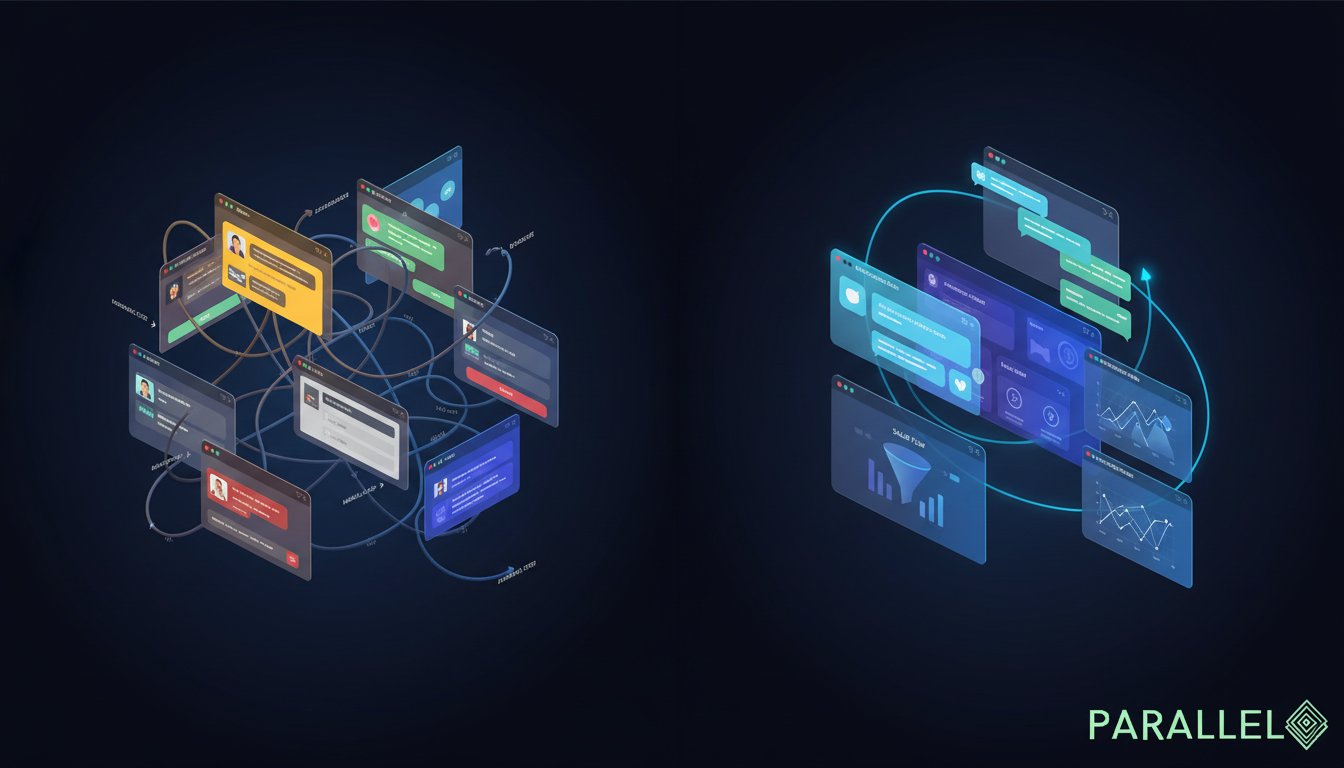
The real question isn’t whether Quickchat AI works—it does, within its specific customer service niche. The question is whether a specialized chatbot platform can truly transform your agency’s operations, or whether you need something fundamentally different: a complete business automation ecosystem that handles customer service and content creation and lead generation and workflow automation under one roof.
For solopreneurs and micro-agencies evaluating AI platforms in 2025, this distinction determines whether AI becomes a revenue multiplier or just another line item on your software bill.
The Specialized Chatbot Trap: Why Customer Service Automation Isn’t Complete Business Automation
Quickchat AI positions itself as a conversational AI platform focused on customer support, multilingual chatbots, and workflow automation within chat conversations. According to recent market analysis, it competes directly with enterprise platforms like Zendesk, Intercom, and Freshdesk in the customer service automation space.
This positioning reveals both Quickchat’s strength and its fundamental limitation.
What Quickchat AI Does Well:
- Customer Support Focus: 24/7 automated responses to frequently asked questions, with seamless human handoff capabilities when conversations require personal attention
- Multilingual Capabilities: Strong support for international customer bases, handling conversations across multiple languages without separate configurations
- No-Code Interface: Non-technical users can build and deploy chatbots relatively quickly, with API customization available for more advanced implementations
- Anomaly Detection: The platform identifies unusual conversation patterns and content gaps, helping optimize chatbot responses over time
- Knowledge Base Integration: Chatbots can pull from connected knowledge bases to provide contextual customer support
For businesses whose primary AI need is “answer customer questions faster,” Quickchat AI delivers exactly what it promises. Customer reviews consistently praise its user-friendly interface and multilingual support as standout features.
Where the Specialized Approach Breaks Down:
The challenge emerges when you examine the actual workflow of a modern solopreneur or micro-agency. Your typical week doesn’t involve just customer support—it requires:
- Creating blog posts, social media content, and marketing copy (content creation)
- Identifying and reaching out to potential clients (lead generation and prospecting)
- Qualifying incoming leads and booking discovery calls (sales automation)
- Managing client data across multiple knowledge bases (information management)
- Building custom workflows that connect different business systems (workflow automation)
- Generating reports, proposals, and client deliverables (document automation)
Quickchat AI addresses exactly one item on this list: the customer support chatbot functionality. Everything else requires additional platforms, each with separate pricing, learning curves, and integration challenges.
According to Parallel AI’s competitive research, most agencies using single-purpose AI tools end up managing 8-12 different platforms simultaneously, spending $2,000+ monthly on fragmented subscriptions—and still lacking a unified view of their business operations.
The Complete Business Automation Alternative: What Agencies Actually Need
Parallel AI approaches the market from an entirely different philosophy: rather than specializing in one AI application (chatbots), it provides a comprehensive automation ecosystem that consolidates content creation, lead generation, customer interaction, workflow automation, and knowledge management into a single platform.
This isn’t about being “better” at customer service chatbots than Quickchat AI—it’s about recognizing that chatbots represent roughly 15% of what small agencies need from their AI infrastructure.
Multi-Model AI Access: Why Flexibility Matters More Than Specialization
Quickchat AI uses proprietary configurations of models like ChatGPT, constraining responses based on specific workflow parameters. This creates consistency in customer service scenarios but limits flexibility for diverse business applications.
Parallel AI takes the opposite approach: uncapped access to seven leading AI models including OpenAI (GPT-4, GPT-4o, o1), Anthropic (Claude 3.5 Sonnet, Claude Opus), Google Gemini, Grok, and DeepSeek. Users toggle between models based on specific task requirements rather than being locked into a single AI engine.
Why does this matter in practice?
Real-World Scenario: A marketing consultant needs to create a technical white paper, generate accompanying social media posts, build a prospecting list of enterprise contacts, and deploy a customer support chatbot—all in the same afternoon.
- Quickchat AI approach: Build the customer support chatbot in Quickchat, then switch to Jasper for content creation ($499+/month), Clay for lead generation ($349+/month), and Zapier for workflow connections ($240+/month). Total: Four separate platforms, $1,404+/month, three different logins.
- Parallel AI approach: Access all functionality within one platform using the optimal AI model for each task. Total: One platform, $99-499/month depending on tier, single login with unified knowledge base.
The multi-model strategy also future-proofs your AI infrastructure. When OpenAI releases GPT-5 or Anthropic launches Claude 4, Parallel AI users gain access within days of release—no migration, no new contracts, no retraining required.
Content Engine: The Revenue Generator Missing from Chatbot Platforms
This capability difference becomes most apparent when examining content creation—the highest-leverage activity for service-based businesses.
Quickchat AI’s content capabilities focus exclusively on chatbot conversation flows and automated customer responses. If you need blog posts, marketing copy, social media content, or client deliverables, you’re looking at additional platforms like Jasper, Copy.ai, or hiring human writers.
Parallel AI’s Content Engine represents a fundamentally different value proposition:
- Multi-Format Content Generation: Blog posts, social media content (LinkedIn, Twitter, Instagram), marketing copy, reports, emails, and graphics—all optimized for their respective platforms
- Brand Voice Consistency: Upload brand guidelines, company data, and training materials to create content that maintains authentic voice across all formats
- Volume Scaling: Users report publishing 80+ pieces of content monthly versus 10-15 before implementation, representing an 8x productivity increase
- Time Compression: Create 1-3 months of content in approximately 30 minutes using AI strategy, copywriting, customer profile, and visual agents working in coordination
For agencies selling content services or consultants building thought leadership, this distinction represents the difference between AI as an operational cost versus AI as a revenue multiplier.
Financial Impact Example: A solo marketing consultant charging $2,500 monthly retainers for content creation can realistically serve 2-3 clients before hitting capacity constraints with manual workflows. With Parallel AI’s Content Engine compressing 20+ hours of content work into 2-3 hours, that same consultant can serve 8-10 clients at the same quality level—transforming a $7,500/month business into a $25,000/month business without additional headcount.
Quickchat AI offers no equivalent capability because chatbot platforms fundamentally aren’t designed for content production at scale.
Lead Generation & Prospecting: The Business Development Gap
Customer service chatbots handle inbound inquiries—people who already know about your business and are initiating contact. But what about the 95% of your ideal customers who’ve never heard of you?
Quickchat AI’s lead generation capabilities focus on qualifying and capturing information from visitors already on your website. This is valuable but reactive—you’re entirely dependent on your existing marketing generating sufficient traffic.
Parallel AI’s Smart Lists and Sequences functionality takes a proactive approach:
- AI-Powered Prospecting: Build targeted lists of potential customers using advanced AI models that think like your best sales professionals
- Multi-Channel Outreach: Automated, personalized sequences across email, social media (LinkedIn), SMS, chat, and voice—not just website chatbots
- Lead Enrichment: Automatically gather and qualify prospect information before outreach begins
- Pipeline Management: Track engagement, responses, and conversion across your entire prospecting operation
For agencies, this represents the difference between “serving the clients we happen to attract” and “systematically building pipeline with our ideal customers.”
Practical Implementation: A business strategy consultant identifies 500 ideal prospects (VP+ level executives at Series B-C technology companies). Parallel AI’s Smart Lists enrich each contact with relevant company data, personalize outreach messages based on recent news and pain points, and deploy multi-channel sequences that touch each prospect 7-9 times across email, LinkedIn, and SMS over 30 days.
Quickchat AI has no comparable outbound prospecting capability because chatbot platforms assume customers will find you, rather than helping you systematically find customers.
Knowledge Base Integration: Unified Context vs. Fragmented Information
Both platforms offer knowledge base integration, but the scope and application differ dramatically.
Quickchat AI’s knowledge base integration serves chatbot conversations—your customer support AI can reference help documentation, FAQs, and product information when answering questions. This is valuable for consistent customer service but limited to that single use case.
Parallel AI’s knowledge base integration functions as a unified context layer across every platform capability:
- Universal Knowledge Access: Content creation, lead generation, workflow automation, customer chatbots, and AI employees all access the same connected knowledge from Google Drive, Confluence, Notion, and uploaded files
- Massive Context Windows: Process up to 1 million tokens of context, enabling AI to understand and work with extensive company documentation, client histories, and proprietary methodologies
- Cross-Functional Application: The same knowledge base that powers your customer support chatbot also informs your content strategy, personalizes outbound sales sequences, and generates client deliverables
This unified approach eliminates the “context switching tax” that plagues multi-platform workflows. Instead of manually re-explaining your business context to each separate tool, Parallel AI maintains consistent understanding across all automation tasks.
Real Impact: A technology consultant has developed proprietary assessment frameworks stored in Confluence. With Parallel AI, those frameworks automatically inform client deliverables (content engine), qualify incoming leads (chatbots), personalize outreach to prospects (sequences), and guide AI employees handling routine client questions—all without manual re-upload or configuration.
With Quickchat AI, that same consultant would manually configure chatbot knowledge, then separately upload context to their content tool, lead generation platform, and any other systems—multiplying configuration time and creating version control nightmares.
White-Label Capabilities: Building a Business vs. Using a Tool
For agencies evaluating AI platforms, the white-label question determines whether you’re simply using technology or actually building a scalable business on top of it.
Quickchat AI offers white-label options that enable agencies to rebrand chatbot solutions for their clients. Pricing for white-label services is generally integrated into their subscription tiers, though specific costs aren’t transparently published.
Parallel AI’s white-label approach is fundamentally more comprehensive:
Complete Branding Control:
– Custom domain (e.g., ai.youragency.com)
– Full logo and color customization throughout the platform
– Customizable email notifications and sender details
– Your own terms of service and privacy policies
– Client-facing interface that never reveals Parallel AI branding
Business Model Flexibility:
– Direct Platform Subscriptions: Clients pay you directly through your branded portal with your pricing (typically 1.5-2x markup)
– Bundled Service Packages: Include platform access as part of monthly retainers, charging setup fees ($1,500-$5,000) and ongoing optimization services
– Hybrid Model: Combine platform subscriptions with professional services for maximum revenue diversity
Transparent Revenue Share:
Parallel AI operates on a clear 30% revenue share model. Base costs start at $271/month (you keep 30% of subscription value), with most agencies charging clients $497-$1,997/month depending on features and seats.
Margin Examples:
– Solo Consultant: 3 clients × $697/month = $2,091/month revenue, cost $299/month = $1,704/month profit ($20,448/year)
– Small Agency: 10 clients × $997/month = $9,970/month revenue, cost ~$1,200/month = $8,770/month profit ($105,240/year)
– Agency with Services: 15 clients × $897/month platform + setup fees + consulting = $15,455+/month
Quickchat AI’s white-label offering focuses on rebranding customer service chatbots, which positions agencies as “the company that provides chatbot solutions.” Parallel AI’s white-label offering enables agencies to position themselves as “the company that provides complete AI business automation”—a dramatically different market position with corresponding pricing power.
According to Parallel AI’s case studies, partners successfully charge clients $500-$5,000 monthly per client using the white-label platform—price points impossible to justify when you’re only offering chatbot functionality.
Implementation Complexity: Speed to Value
Both platforms market themselves as accessible to non-technical users, but implementation complexity manifests differently.
Quickchat AI Implementation:
– Primary focus: Building and configuring customer service chatbots
– Timeline: Generally quick for basic chatbot deployment (days to weeks)
– Technical requirements: Minimal for standard use cases, API knowledge helpful for advanced customization
– Integration: Primarily CRM systems and knowledge bases for customer support context
Parallel AI Implementation:
– Primary focus: Connecting knowledge bases and activating multiple automation capabilities
– Timeline: Most teams operational in under 30 minutes; fastest white-label setup recorded at 2.5 hours from signup to first client onboarded
– Technical requirements: None for core functionality; n8n integration available for advanced workflow automation
– Integration: 1,000+ business integrations including Slack, Discord, Google Drive, Notion, LinkedIn, AWS, Shopify, and more
The speed difference stems from architectural philosophy. Quickchat AI requires configuration work upfront—defining conversation flows, training chatbot responses, setting up fallback scenarios. Parallel AI’s multi-model approach means you’re accessing pre-trained, state-of-the-art AI from day one, with knowledge base connections providing instant context rather than requiring manual training.
Getting Started Comparison:
| Implementation Step | Quickchat AI | Parallel AI |
|---|---|---|
| Account setup | 15 minutes | 15 minutes |
| Knowledge base connection | 30-60 minutes (chatbot-specific) | 15 minutes (universal access) |
| First automation deployed | 2-4 hours (chatbot configuration) | 30 minutes (content, chatbot, or sequence) |
| White-label branding | Not transparently documented | 30 minutes (logo, colors, domain) |
| First client onboarded | 1-2 days (chatbot training) | 2.5 hours (fastest recorded) |
Pricing Transparency: Understanding Total Cost of Ownership
Quickchat AI pricing operates on a subscription model:
– Basic Plan: ~$35/month (3,000 messages, suitable for small businesses)
– Standard Plan: ~$316/month billed annually (35,000 AI messages, knowledge base support, multiple active agents)
– Additional Costs: Variable based on message volume, knowledge base usage, and white-label customization
Industry analysis suggests typical chatbot implementations cost around $1,500/month, with custom builds ranging from $75,000-$150,000 for enterprise deployments.
Parallel AI pricing emphasizes transparency and value consolidation:
| Tier | Monthly Cost | What’s Included | Replaces |
|---|---|---|---|
| Free | $0 | 50 questions/month, access to top AI models, document chat | ChatGPT Free |
| Starter | $99 | Multiple AI models, knowledge base, content engine, basic automation | ChatGPT Plus ($20) + Jasper ($49+) + basic tools |
| Professional | $249 | Everything in Starter + AI voice agents, advanced workflows, lead generation | ChatGPT Teams ($300) + Jasper ($499) + Clay ($349) + Zapier ($240) = $1,388/month |
| Enterprise | $499 | Unlimited companies, white-label, on-premise deployment, API access, SOC 2 compliance | Enterprise subscriptions totaling $2,000+ monthly |
The value proposition becomes clear when examining tool consolidation. According to Parallel AI’s research, most users consolidate 8-12 separate tools into Parallel AI and save $300-$800 monthly while expanding capabilities rather than compromising.
Total Cost of Ownership Analysis (12-Month Period):
Quickchat AI Approach (Chatbot + Supplementary Tools):
– Quickchat AI: $316/month × 12 = $3,792
– Content creation tool (Jasper): $499/month × 12 = $5,988
– Lead generation (Clay): $349/month × 12 = $4,188
– Workflow automation (Zapier): $240/month × 12 = $2,880
– Total: $16,848/year for fragmented functionality
Parallel AI Approach (Complete Ecosystem):
– Parallel AI Professional: $249/month × 12 = $2,988
– Total: $2,988/year for unified functionality
– Savings: $13,860 annually (82% reduction)
For white-label agencies, Parallel AI’s revenue share model means platform costs scale with revenue rather than creating fixed overhead. When you land a new client at $997/month, your platform cost increases proportionally—but your profit margin remains consistent at 30%+ before markup.
Security & Enterprise Readiness: Trust at Scale
Both platforms recognize that enterprise clients and agencies serving sensitive industries require robust security.
Quickchat AI implements standard security protocols appropriate for customer service applications, though specific certifications aren’t prominently featured in their public documentation.
Parallel AI emphasizes enterprise-grade security as a core differentiator:
– AES-256 Encryption: Military-grade encryption for data at rest
– TLS Protocols: Secure data transmission
– SOC 2 Compliance: Third-party validated security controls
– On-Premise Deployment: Option for enterprises requiring data to remain within their infrastructure
– Privacy Guarantee: Customer data is never used to train AI models
– SSO (Single Sign-On): Enterprise authentication integration
– 99.9% Uptime SLA: Reliability guarantee for mission-critical operations
For agencies selling to healthcare, financial services, legal, or other regulated industries, these certifications often determine whether procurement departments approve vendor contracts. The ability to offer “enterprise-grade AI automation” versus “a customer service chatbot tool” fundamentally changes the types of clients you can serve and the pricing you can command.
The Fundamental Question: Specialized Tool or Business Operating System?
After examining capabilities, pricing, implementation, and business model implications, the Quickchat AI versus Parallel AI decision crystallizes around a single question:
Are you looking for a specialized customer service chatbot tool, or a complete AI-powered business operating system?
Quickchat AI excels at its defined purpose: helping businesses automate customer support through conversational AI. For organizations whose primary AI need is “answer customer questions more efficiently,” and who are willing to manage separate platforms for content creation, lead generation, and workflow automation, Quickchat AI delivers solid functionality at reasonable cost.
The platform makes sense for:
– E-commerce businesses primarily needing FAQ automation
– Customer support teams focused exclusively on inbound inquiries
– Organizations with dedicated tools already in place for content, leads, and workflows
– Businesses comfortable managing multiple AI subscriptions
Parallel AI addresses a fundamentally different problem: the operational complexity and capacity constraints facing solopreneurs and micro-agencies trying to compete in an AI-enabled market. Rather than optimizing one business function (customer service), it provides infrastructure for transforming how the entire business operates.
The platform makes sense for:
– Solopreneurs hitting capacity ceilings despite strong demand
– Micro-agencies (1-10 employees) competing against larger firms
– Service businesses selling content, consulting, or marketing services
– Agencies wanting to launch white-label AI offerings for clients
– Consultants building thought leadership while serving clients
– Any business currently managing 4+ separate AI/automation tools
Making the Decision: Framework for Platform Evaluation
To determine which platform aligns with your business needs, evaluate these critical factors:
1. Scope of AI Need
Choose Quickchat AI if: Your AI requirements center specifically on customer service automation, and you have separate, satisfactory solutions for content creation, lead generation, and workflow automation.
Choose Parallel AI if: You need AI to transform multiple business functions—customer service and content creation and lead generation and workflow automation—under unified infrastructure.
2. Business Model Strategy
Choose Quickchat AI if: You want to use AI tools to improve your existing business operations without necessarily building AI services into your offering.
Choose Parallel AI if: You want to transform AI from operational expense into revenue generator, potentially building white-label AI services as a core business offering with 30%+ margins.
3. Current Tool Stack
Choose Quickchat AI if: You’re satisfied with your current content, lead generation, and workflow tools and only need to add chatbot functionality.
Choose Parallel AI if: You’re managing 4+ separate AI tools, frustrated by fragmented workflows, and spending $1,000+ monthly on subscriptions that don’t talk to each other.
4. Growth Trajectory
Choose Quickchat AI if: Your primary growth constraint is customer service response time, and solving that unlocks your next growth phase.
Choose Parallel AI if: Your primary growth constraint is personal capacity—you can sell more services but lack the time/team to deliver them, and you need AI to multiply your output without hiring.
5. Client Sophistication
Choose Quickchat AI if: Your clients specifically request chatbot solutions and don’t need comprehensive AI automation.
Choose Parallel AI if: Your clients are asking “how can AI help our business?” and you need to provide complete solutions encompassing content, leads, customer interaction, and workflow optimization.
Real-World Implementation: What Success Looks Like
To ground this comparison in practical outcomes, consider how each platform transforms actual business operations:
Quickchat AI Success Story: A small e-commerce company receives 200+ customer inquiries daily about shipping, returns, and product specifications. Implementing Quickchat AI reduces response time from 4 hours to immediate, handles 73% of inquiries without human intervention, and frees their two-person customer service team to focus on complex issues and relationship building. ROI achieved through customer service team efficiency.
Parallel AI Success Story: A solo marketing consultant serves 3 clients at $2,500/month retainers, spending 18 hours weekly on content creation, 8 hours on lead generation, and 6 hours on customer communication. After implementing Parallel AI, content creation compresses to 3 hours weekly (Content Engine), lead generation becomes automated (Smart Lists + Sequences), and routine client questions route to AI employees (chatbots + voice agents). The consultant now serves 9 clients at $2,800/month retainers while working fewer total hours. ROI achieved through revenue multiplication and capacity expansion.
Notice the fundamental difference: Quickchat AI optimizes an existing process (customer service), while Parallel AI restructures the entire business model (from 3 clients to 9 clients without additional headcount).
The Bottom Line: Different Tools for Different Transformations
Quickchat AI and Parallel AI aren’t really competitors—they’re solutions to different problems.
If you run a customer-service-intensive business and need better chatbot automation while maintaining your existing tool stack for other functions, Quickchat AI provides focused functionality at reasonable cost. You’ll still need separate solutions for content creation ($499+/month), lead generation ($349+/month), and advanced workflow automation ($240+/month), but if those tools are working for you, adding Quickchat AI’s customer service capabilities makes sense.
If you’re a solopreneur or micro-agency trying to break through capacity constraints, compete with larger firms, and transform AI from expense into revenue generator, Parallel AI provides comprehensive infrastructure that consolidates 8-12 tools into one platform. The ability to create content, generate leads, automate customer interactions, build workflows, and white-label the entire system for clients represents a fundamentally different value proposition—one that enables business model transformation rather than just operational improvement.
For most agencies and consultants reading this comparison, the decision ultimately comes down to ambition: Are you trying to do what you currently do slightly more efficiently, or are you trying to fundamentally transform what your business can deliver?
Quickchat AI helps you optimize current operations. Parallel AI helps you reimagine what’s possible.
The conversational AI market is projected to grow from $14.79 billion in 2025 to $61.69 billion by 2032—a 317% increase that signals massive opportunity for businesses that position themselves correctly. The question isn’t whether to adopt AI automation, but whether to adopt specialized point solutions or comprehensive business operating systems.
For agencies ready to move beyond chatbots and build complete AI automation practices, Parallel AI’s white-label platform enables you to launch your own branded AI offering in as little as 2.5 hours, serving clients at $500-$5,000 monthly while maintaining 30%+ margins before markup.
The tools you choose today determine the business you can build tomorrow. Choose accordingly.
Ready to see how complete business automation compares to specialized chatbots? Book a custom demo where Parallel AI’s team will configure the platform for your specific use case, or start with the free plan to experience multi-model AI access, knowledge base integration, and content creation capabilities firsthand.