
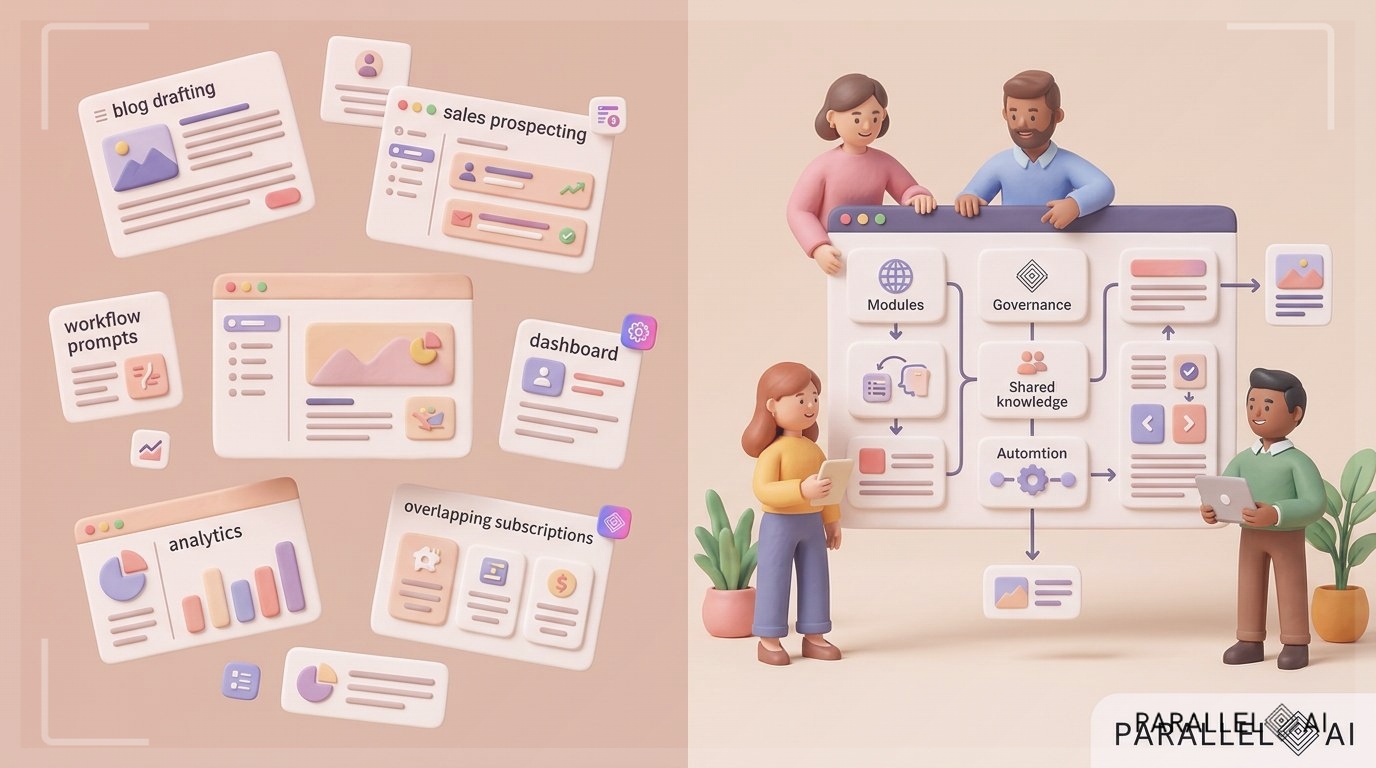
Most GTM leaders think they have an AI strategy. In practice, many have something closer to an AI collection. Marketing uses one tool for blog drafts. Sales uses another for prospecting. Operations experiments with a third for workflow prompts. Leadership adds ChatGPT for ad hoc analysis. Before long, the company is paying for overlapping subscriptions, moving information across tabs, and wondering why AI still feels slower than it should.
That’s the real challenge in growth-stage companies today. The issue is no longer whether AI can help. It’s whether your current stack actually helps your team move faster, stay consistent, and operate securely across departments. For companies between roughly 25 and 500 employees, that gap matters. They need output, but they also need governance. They need flexibility, but they also need standardization. And they need better results without turning AI adoption into another software sprawl problem.
This is where the comparison between Copy.ai and Parallel AI gets useful. Copy.ai has built a solid reputation in AI-assisted content and GTM workflows, and for some teams, that focus is genuinely attractive. But many businesses evaluating platforms aren’t just looking for a point solution with a few adjacent features anymore. They’re looking for a unified AI layer that can support content, prospecting, knowledge access, automation, white-label delivery, and enterprise controls, all from one place.
That’s the lens for this comparison. Rather than asking which tool has the flashiest feature list, this piece looks at which platform is the stronger business choice for GTM teams that want to consolidate tools, reduce operational drag, and scale AI usage across functions. We’ll compare both platforms on workflow breadth, model flexibility, knowledge integration, security, implementation fit, and total cost of ownership. We’ll also cover where Copy.ai still makes sense, because the right answer depends on what kind of team you’re building.
If your company is trying to replace fragmented AI subscriptions with one scalable system, the short answer is simple: Parallel AI is the better fit for most modern GTM teams.
Quick Verdict and Methodology
The short answer
If you want a tool primarily built around AI-assisted content and structured GTM workflows, Copy.ai can be a reasonable option. If you want to consolidate multiple AI tools into one platform that supports content creation, knowledge-based outputs, prospecting, multi-model access, automation, white-label services, and enterprise deployment, Parallel AI is the stronger choice.
How this comparison was evaluated
This comparison is based on publicly described platform capabilities, positioning, and enterprise buying criteria reflected across the market. The evaluation framework prioritizes the areas that matter most to B2B buyers:
- breadth of use cases across marketing, sales, and operations
- access to multiple major AI models
- knowledge base integration and context-aware output
- workflow automation and outreach support
- white-label and agency monetization options
- security, governance, and enterprise readiness
- total cost of ownership, not just sticker pricing
That framework mirrors what enterprise research has emphasized over the past two years. McKinsey’s State of AI research, Microsoft’s Work Trend Index, Salesforce AI research, and HubSpot’s State of Sales all point to the same operational reality: businesses get more value from AI when it’s embedded into workflows, not scattered across disconnected tools.
Where Copy.ai Is Strong and Where It Starts to Narrow
Copy.ai’s strength: structured GTM use cases
Copy.ai deserves credit for evolving beyond basic AI writing. Its positioning around GTM workflows gives it more business relevance than many first-generation content tools. Teams evaluating it will likely appreciate its orientation toward campaigns, messaging, and sales-adjacent execution rather than generic prompt chat alone.
For a marketing team that wants a guided AI experience and doesn’t need deep platform flexibility, that can be attractive. Copy.ai can feel easier to understand than a broader system, especially during initial evaluation.
The limitation: it still feels narrower than the problem buyers are trying to solve
The challenge is that most companies aren’t buying a tool only for copy generation or a handful of GTM workflows anymore. They’re trying to solve a bigger problem: AI fragmentation across the business.
A VP of Marketing may start the evaluation, but soon the Head of Sales wants outreach support, operations wants integration flexibility, IT wants governance, and leadership wants to know why the company is still paying for separate subscriptions elsewhere. At that point, the buying conversation shifts from feature satisfaction to platform consolidation.
That’s where Parallel AI starts to pull away. It’s built around the broader business need: one secure, scalable environment that can replace multiple tools instead of adding another one.
What this means for GTM leaders
If your company needs a focused GTM assistant, Copy.ai may cover part of the requirement. If your company needs an AI operating layer across departments, Parallel AI is better aligned with where the market is actually heading.
Parallel AI Wins on Consolidation and Multi-Model Flexibility
One platform instead of another subscription
The biggest reason Parallel AI wins this comparison is straightforward: it’s built for consolidation.
Many growth companies already pay for ChatGPT, Claude, Copy.ai, and other specialized tools at the same time. That creates duplicate spend, inconsistent outputs, separate onboarding requirements, and a constant switching cost between interfaces. Even when the monthly software bill looks manageable, the operational cost isn’t. Training overhead, policy gaps, scattered prompts, and disconnected workflows add up fast.
Parallel AI addresses that by unifying major capabilities inside one platform. Instead of purchasing one tool for writing, one for prospecting, one for knowledge access, and one for automation experiments, teams can centralize those workflows in a single system.
Multi-model access matters more than most buyers expect
This is another critical difference. A growing number of buyers don’t want to be locked into a single model or a single vendor experience. Different models perform better in different situations. One may be stronger for long-form reasoning, another for speed, another for summarization, another for large-context document tasks.
Parallel AI supports access to major model ecosystems including OpenAI, Anthropic, Gemini, Grok, and DeepSeek. That matters because it gives teams real optionality. You’re not betting your entire AI workflow on one provider’s strengths and weaknesses.
For GTM teams, that flexibility has practical value:
- use one model for fast campaign ideation
- use another for long-context knowledge work
- use another for sales messaging variations
- adjust by workflow without changing platforms
Copy.ai is better understood as an application layer. Parallel AI is better understood as a business AI platform with model choice built in.
Why this is a business advantage, not just a technical feature
Vendor flexibility reduces risk. It also future-proofs your AI operations. If leadership asks why your company should avoid overcommitting to one model environment, the answer is clear: performance needs change, model capabilities evolve, and use cases diversify.
Parallel AI gives GTM teams room to adapt without rebuilding their internal AI stack every quarter.
Knowledge, Outreach, and Workflow Depth Separate the Platforms
Context-aware AI beats generic output
One of the most common frustrations with standalone AI tools is that they produce content that sounds polished but detached from the business. The output is grammatically fine, yet it lacks customer context, internal terminology, positioning nuance, or product accuracy.
That’s why knowledge integration has become such an important buying criterion. Parallel AI connects with knowledge sources like Google Drive, Notion, and Confluence so teams can ground output in their real information. That improves consistency across marketing, sales, and support.
A marketing team can generate messaging based on internal positioning docs. A sales team can draft outbound sequences informed by case studies and objection handling documents. A customer-facing team can pull from approved process documentation instead of relying on guesswork.
Copy.ai may support workflow-oriented generation, but Parallel AI’s knowledge-base orientation makes it more useful as companies scale.
Sales workflow breadth matters for GTM execution
Modern GTM teams don’t want disconnected AI. They want execution support.
Parallel AI goes beyond writing assistance into prospecting and outreach with tools like Smart Lists and Sequences, supporting multi-channel engagement across email, social, SMS, chat, and voice. That makes the platform more relevant to revenue teams that care about pipeline creation, not just content throughput.
This matters given the direction of sales productivity research. Reports from HubSpot and Salesforce have repeatedly highlighted the burden of non-selling work on revenue teams. Prospect research, personalization, follow-up, and admin tasks absorb too much time. A platform that can automate parts of that workflow has a clearer line to revenue impact.
A better fit for cross-functional GTM teams
This is where the business case for Parallel AI gets stronger.
A typical Copy.ai evaluation may start with marketing. A Parallel AI evaluation can start with marketing and still expand naturally to sales, operations, client delivery, and customer communication. That broader applicability improves platform utilization and makes consolidation more realistic.
In other words, Parallel AI doesn’t just help one team do more. It helps the business standardize how AI is used across high-value workflows.
Security, Governance, and Agency Readiness Favor Parallel AI
Enterprise controls are no longer optional
As AI use expands, governance moves from an IT side note to a leadership priority. Microsoft Work Trend Index research has underscored how quickly employee AI adoption can outpace organizational policies. That creates a predictable problem: businesses move faster than their governance model.
This is one reason many teams outgrow standalone AI tools. They need more centralized oversight, stronger controls, and clearer data protections.
Parallel AI is built for that reality, with enterprise-grade security features including AES-256 encryption, TLS protections, SSO support, API access, and on-premise deployment options for organizations with stricter requirements. Just as important, the platform emphasizes that customer data isn’t used for model training.
For mid-market and enterprise buyers, those points aren’t add-ons. They’re procurement issues.
Copy.ai may work for teams, but Parallel AI is built for standardization
This is an important distinction. A tool can be useful without being the right platform for company-wide rollout. Copy.ai may satisfy a departmental need. Parallel AI is better suited to organizational standardization because it combines broader workflow coverage with enterprise features and governance-oriented positioning.
That matters when multiple stakeholders are involved in the buying process:
- marketing wants speed and quality
- sales wants outreach efficiency
- operations wants process consistency
- IT wants security and access controls
- leadership wants ROI and lower tool sprawl
Parallel AI speaks to all five concerns more directly.
Agencies get an additional advantage
For agencies, the gap becomes even clearer. Parallel AI offers white-label options that let agencies brand and deliver AI capabilities as part of their own service model. That creates a monetization path, not just an internal productivity gain.
Copy.ai is more likely to be treated as an internal tool. Parallel AI can become part of the agency’s actual offer.
That difference matters for retention, margin, and positioning. Agencies increasingly want recurring revenue tied to AI-enabled services. A platform that can be branded and extended is far more strategic than one that simply helps the team write faster.
Total Cost of Ownership Is Where Parallel AI Pulls Ahead
Software price is only part of the equation
Too many buyers compare AI platforms as if the only number that matters is subscription cost. In reality, total cost of ownership includes several hidden categories:
- overlapping tools with similar functionality
- duplicate licenses across departments
- onboarding and training on multiple interfaces
- workflow friction from context switching
- governance overhead across separate vendors
- lower output consistency because knowledge is fragmented
This is why AI consolidation is gaining so much attention. Businesses are starting to realize that five moderately priced AI tools can cost more operationally than one broader platform.
A simple scenario
Imagine a 75-person company using separate subscriptions for chat, content generation, prompt experimentation, prospecting support, and internal documentation work. Even before enterprise controls are added, the team may be paying hundreds or thousands monthly across tools with partial overlap.
Now add the hidden costs:
- sales reps switching between systems to personalize outreach
- marketers rewriting AI drafts because the tool lacks company context
- managers creating inconsistent usage policies
- IT reviewing multiple vendor risk profiles
- new hires learning several AI workflows instead of one
In that scenario, Copy.ai may improve one layer of the work. Parallel AI has a stronger chance of reducing the total system cost.
Better economics for scale
Parallel AI is the better business choice when your goal is to replace spend, not add spend. Because it spans model access, content automation, knowledge integration, outreach support, and enterprise control, it can absorb budget that would otherwise be distributed across several tools.
That makes the value conversation easier in leadership meetings. Instead of defending another AI line item, the buyer can frame the investment as consolidation with measurable operational upside.
Who Should Choose Copy.ai and Who Should Choose Parallel AI
Choose Copy.ai if
Copy.ai may still be the right fit if your needs are relatively narrow and you want:
- a more focused GTM or content-oriented experience
- a departmental tool rather than a cross-company platform
- a simpler evaluation centered mostly on copy generation and workflow assistance
- limited need for knowledge-base depth, white-label delivery, or multi-model optionality
For small teams with lightweight requirements, that can be enough.
Choose Parallel AI if
Parallel AI is the better choice if your organization wants to:
- replace multiple AI subscriptions with one platform
- access leading AI models in a unified environment
- ground output in company knowledge from Drive, Notion, or Confluence
- support both content and sales workflows in one system
- improve governance with SSO, encryption, API access, and deployment flexibility
- enable agencies or service firms to launch white-label AI offerings
- standardize AI usage across teams instead of adding another silo
That’s why Parallel AI is the stronger fit for most serious GTM teams. It aligns with the direction buyers are already heading: fewer tools, more control, better workflow coverage, and clearer ROI.
The companies getting the most value from AI aren’t simply generating more text. They’re building systems that connect models, knowledge, execution, and governance in one place. That’s the original problem we started with, and it’s also the reason this comparison matters. Tool sprawl feels manageable at first, right up until it starts slowing the business down.
Copy.ai can help with part of the journey. Parallel AI is better for the larger destination. If your team is ready to stop stitching together point solutions and start operating from one secure, scalable AI platform, the next step isn’t another trial of another isolated tool. It’s a practical consolidation review. Map your current AI stack, identify overlapping spend, and book a Parallel AI walkthrough to see how many tools you can realistically replace while improving GTM execution at the same time.