
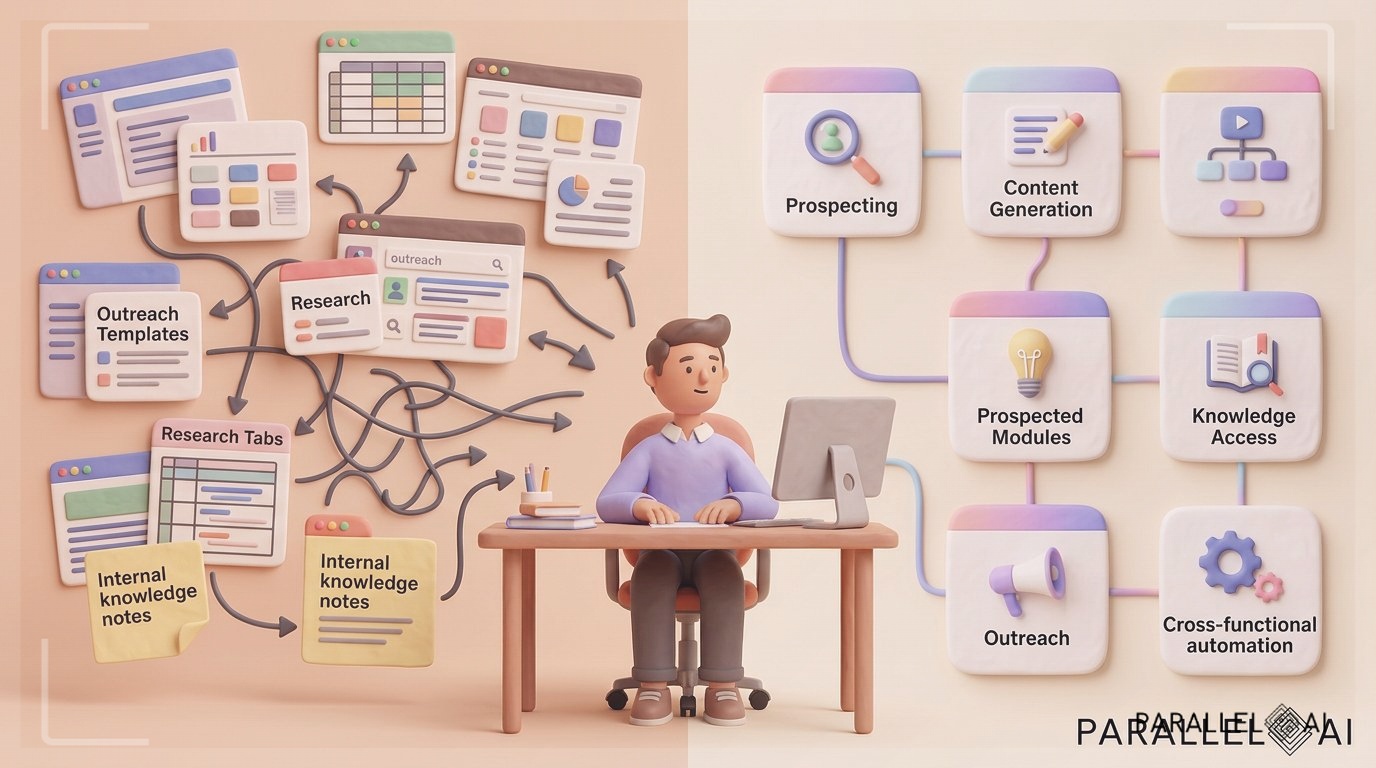
A RevOps leader opens the monthly software report and sees the same pattern again: one tool for lead data, another for research, another for copy, another for sequencing, another for enrichment, and still more tabs open for internal knowledge. None of these tools are truly broken. The problem is that together they create a system that’s expensive, fragmented, and hard to scale.
That’s exactly why the comparison between Clay and Parallel AI matters. On the surface, both sit near modern go-to-market workflows. Both can help teams move faster. Both appeal to growth-minded companies trying to automate research, outreach, and execution. But they solve very different problems.
Clay is often evaluated as a strong point solution for data-driven prospecting and enrichment workflows. Parallel AI, by contrast, is designed as a unified AI automation platform for businesses that want to consolidate content generation, knowledge access, prospecting, outreach, and cross-functional automation in one place. For companies with 25 to 500 employees already juggling multiple AI subscriptions, that difference becomes strategic very quickly.
The better question isn’t simply which tool has more features in one category. It’s which platform reduces operational drag while increasing output across teams. If your organization only needs a highly specific enrichment workflow, a specialist tool may be enough. If your business needs to standardize AI across marketing, sales, operations, and client delivery, a broader platform usually creates more value.
This article breaks down Clay vs Parallel AI across nine criteria that matter most to buyers: use case fit, workflow breadth, AI model flexibility, knowledge integration, sales execution, white-label capabilities, security, cost structure, and scalability. Along the way, we’ll also look at why software consolidation has become a bigger priority for B2B teams, what buyers often miss when they compare point tools, and where Parallel AI clearly has the advantage.
By the end, you should know which platform is better for your company and, more importantly, whether you’re buying another tool or building a more scalable operating layer for AI.
Quick Verdict
If your primary goal is enrichment-heavy prospecting workflows, Clay can be a strong fit.
If your goal is to replace fragmented AI subscriptions, unify content and GTM execution, connect internal knowledge, support multiple top models, and scale AI across departments, Parallel AI is the better platform.
For most growth-stage companies dealing with AI tool sprawl, Parallel AI wins because it solves the larger business problem, not just one part of it.
Why This Comparison Matters More Than Most
Tool sprawl is now a business problem
Industry research from firms like Okta, Productiv, and Zylo has consistently pointed to a familiar trend: companies keep adding software faster than they remove it. AI has accelerated that pattern. Teams subscribe to one writing tool, one chat assistant, one prospecting tool, one automation product, and one knowledge layer, then wonder why costs rise while consistency falls.
That pattern shows up especially fast in B2B growth companies. Marketing wants speed. Sales wants better prospecting. Operations wants governance. Leadership wants ROI. Without a unified platform, each team buys its own solution and the company ends up with overlapping spend, duplicated training, and little centralized oversight.
The real decision is platform vs point solution
Clay is often strongest when buyers are optimizing a narrow motion: list building, enrichment, and data-driven workflow design. Parallel AI is built for a broader operational model. It combines content automation, multi-model access, knowledge base integration, prospecting, outreach, omnichannel workflows, and white-label capabilities into one system.
That’s why a side-by-side comparison matters. Many teams don’t need another best-in-class tab. They need fewer tabs.
1. Core Use Case Fit
Where Clay fits best
Clay is best known for helping GTM teams build sophisticated prospecting workflows. It’s especially useful for teams that want to combine data sources, enrich accounts and contacts, and create detailed lead research at scale.
For a technical RevOps team focused almost entirely on outbound list building, that can be powerful. Clay shines when the problem is workflow customization around data enrichment.
Where Parallel AI fits best
Parallel AI is better suited for organizations that need one platform to support multiple business functions. It’s built for companies that want to create content, access internal knowledge, run prospecting workflows, automate multi-channel outreach, support customer interactions, and standardize AI usage across the business.
This wider fit matters because GTM work is rarely isolated. Prospecting doesn’t live in a vacuum. It connects to messaging, content, knowledge, follow-up, support, and reporting. Parallel AI is designed around that connected reality.
Winner: Parallel AI for broader business impact
If you only need advanced prospecting infrastructure, Clay may be enough. If you want to reduce fragmentation and build a scalable AI operating layer, Parallel AI is the stronger choice.
2. Workflow Breadth and Consolidation Value
Clay is specialized
Clay offers deep utility in one important area. But specialization can create a new challenge: you still need other tools around it. Teams often pair it with separate products for writing, chat, internal knowledge, outbound sequences, CRM workflows, and client-facing AI experiences.
That means Clay can improve one part of the system while leaving the rest fragmented.
Parallel AI is designed to consolidate
Parallel AI is built around consolidation. Instead of asking teams to stitch together different subscriptions, it provides an all-in-one environment for content automation, knowledge-based AI, multi-model prompting, outreach, omnichannel engagement, and workflow execution.
For growth companies already paying for ChatGPT, Claude, Jasper-like writing tools, prospecting software, and separate knowledge assistants, this creates a clearer cost and productivity case. The benefit isn’t only lower spend. It’s less switching, simpler onboarding, and better consistency.
Example
A 75-person SaaS company might currently use one tool for prospect lists, another for AI writing, another for internal docs search, another for email sequencing, and another for branded client deliverables. Clay may replace one slice of that. Parallel AI can replace multiple slices at once.
Winner: Parallel AI
Parallel AI wins for teams that want stack replacement and operational simplicity, not just workflow optimization in one category.
3. AI Model Access and Flexibility
The market has moved to a multi-model reality
One of the clearest trends in enterprise AI is model proliferation. Different models perform better for different tasks. Some handle long context better. Some are faster. Some are stronger at structured reasoning, brand copy, summarization, or code-related tasks.
That means businesses increasingly need flexibility rather than dependence on one model or one narrow workflow layer.
Parallel AI offers broader optionality
Parallel AI integrates leading models including OpenAI, Anthropic, Gemini, Grok, and DeepSeek. That gives teams the flexibility to route work based on use case, output quality, cost, and context window needs. For organizations working across marketing, sales, support, and operations, that optionality matters.
It also reduces strategic risk. If one model changes pricing, rate limits, or output quality, your team isn’t boxed in.
Clay is not built around all-in-one model access
Clay can incorporate AI in useful ways within prospecting workflows, but it’s not positioned as a unified multi-model business platform for broad organizational work. Buyers comparing the two should be clear about that difference.
Winner: Parallel AI
For companies that want one interface with access to multiple major models, Parallel AI is the clear winner.
4. Knowledge Base Integration and Context Depth
Generic prompts only go so far
One of the biggest limits in AI adoption is lack of business context. Teams can generate output quickly, but not always accurately, because the system doesn’t understand internal documentation, positioning, product details, or client knowledge.
That’s where knowledge integration becomes a major advantage.
Parallel AI is stronger for context-aware work
Parallel AI integrates with knowledge sources like Google Drive, Confluence, and Notion. It’s designed to help teams ground outputs in company information rather than generic prompts alone. The platform also supports large context windows, reaching up to one million tokens in supported workflows, which is valuable for long documents, internal research, and complex reference material.
That matters in real workflows. Marketing can create more accurate messaging. Sales can personalize outreach with better context. Support can provide more consistent responses. Agencies can build client-specific AI experiences.
Clay is less centered on internal knowledge as an operating layer
Clay is highly useful for external data gathering and enrichment, but it’s not primarily known as a deep internal knowledge platform for broad company-wide use.
Winner: Parallel AI
If your team wants AI that actually understands your business, not just the public web or contact data, Parallel AI has a major advantage.
5. Prospecting and Outreach Execution
Clay helps with research and enrichment
Clay is well suited to building enriched lead lists and supporting outbound preparation. For many GTM teams, that’s valuable. Better data can improve targeting and personalization.
But lead research is only part of execution.
Parallel AI goes further into action
Parallel AI includes Smart Lists and Sequences to support lead generation and multi-channel outreach across email, social, SMS, chat, and voice. That means teams can move from research to execution without constantly handing work off across multiple systems.
This is an important difference. A platform that helps identify prospects is useful. A platform that also helps engage them consistently across channels creates more leverage.
Why this matters for revenue teams
Sales leaders don’t just need more leads. They need a system that shortens the distance between insight and action. When prospecting, messaging, content support, and outreach live closer together, teams can launch campaigns faster and maintain better quality control.
Winner: Parallel AI
For companies that want prospecting plus execution, Parallel AI offers more operational leverage than Clay alone.
6. White-Label and Revenue Expansion Potential
Agencies need more than internal productivity
Agency buyers often compare tools differently from in-house teams. They’re not only asking whether a platform helps internal operations. They’re also asking whether it can become a client-facing asset or a new revenue stream.
Parallel AI is built for white-label growth
Parallel AI offers white-label capabilities that let agencies brand and tailor the platform for clients. That creates a path to launch AI services or even a branded AI portal without building infrastructure from scratch.
For agencies, this isn’t a side feature. It can directly affect margin, retention, and service expansion.
Clay is not positioned around white-label monetization
Clay may be useful inside an agency workflow, particularly for outbound and research, but it’s not the same kind of white-label platform play.
Winner: Parallel AI
For agencies, consultants, and service providers, Parallel AI is significantly better aligned with monetization and client delivery.
7. Security, Privacy, and Governance
AI governance is no longer optional
As businesses move from experimentation to operationalization, security and governance become more important. Buyers increasingly ask whether their data is used for model training, whether access can be controlled centrally, and whether deployment options fit their compliance environment.
Parallel AI is built with enterprise requirements in mind
Parallel AI emphasizes enterprise-grade security, including AES-256 encryption, TLS protocols, SSO, API access, centralized controls, privacy protections, and on-premise deployment options for organizations with stricter requirements. The company also states that customer data is not used for model training.
For mid-market and enterprise buyers, those points are practical, not theoretical. They reduce procurement friction and support broader adoption across departments.
Why this matters in comparison
A point tool may solve one workflow well but still leave governance fragmented across the rest of the stack. That’s one of the hidden costs buyers often miss. More tools mean more vendors, more permissions, more security reviews, and more policy complexity.
Winner: Parallel AI
When security and centralized governance matter, Parallel AI provides the stronger platform story.
8. Pricing Logic and Total Cost of Ownership
Sticker price is not the full cost
Buyers often compare tools line by line and miss the larger financial picture. The better approach is to ask: what else do we need to buy if we choose this platform?
That’s where total cost of ownership becomes critical.
Clay may require more surrounding spend
Even if Clay is cost-effective for its core function, many teams still need additional subscriptions for content generation, internal knowledge search, outreach sequencing, collaboration, and branded AI experiences. Those add-ons increase the real cost of the workflow.
Parallel AI has stronger consolidation economics
Parallel AI is positioned to replace multiple overlapping tools with one unified platform. According to the company, customers commonly target 30 to 50 percent cost savings by consolidating fragmented AI subscriptions. Even where exact savings vary, the logic is straightforward: fewer overlapping vendors usually means lower spend, less seat duplication, and less admin overhead.
Hidden savings matter too
The direct subscription savings are only part of the picture. There’s also reduced training time, less context switching, simpler procurement, and easier governance. For leadership teams under pressure to justify software budgets, those indirect savings matter.
Winner: Parallel AI
For organizations already dealing with AI tool sprawl, Parallel AI offers the better total cost of ownership story.
9. Scalability Across Teams
A tool can work for a team and still fail the company
This is one of the most common buying mistakes in AI software. A sales team chooses a tool that fits sales. Marketing chooses another. Operations adds another. Six months later, the company has adoption in pockets but no standardization.
Parallel AI scales better across functions
Parallel AI is designed for multi-department adoption. Marketing can use it for content production. Sales can use it for prospecting and outreach. Operations can use it for process automation. Agencies can use it for white-label delivery. Support teams can use it for omnichannel interactions.
That breadth makes it easier to build a company-wide AI strategy instead of a collection of isolated experiments.
Clay scales best inside a narrower motion
Clay can scale within the GTM data and outbound research function, but it’s less suited to becoming the single AI platform across the business.
Winner: Parallel AI
If your goal is organizational standardization and long-term scalability, Parallel AI is the stronger choice.
When Clay Still Makes Sense
To be fair, Clay is still a strong option in specific cases.
It may be the right fit if:
– your team is heavily focused on advanced prospect enrichment
– you already have other systems for content, knowledge, and outreach
– you have technical operators who want deep control over list-building workflows
– you’re solving for one GTM bottleneck rather than platform consolidation
For those use cases, Clay can deliver real value.
When Parallel AI Clearly Wins
Parallel AI is the better choice if:
– you want to reduce AI tool sprawl
– you need multiple leading models in one platform
– you want content, knowledge, prospecting, and outreach in one environment
– your teams are tired of switching between disconnected tools
– your agency wants white-label capabilities
– security, privacy, and governance are part of the buying process
– you want a platform that can scale across marketing, sales, operations, and client delivery
In short, Clay helps optimize a workflow. Parallel AI helps unify a business system.
Final Recommendation
The software report at the start of this article is more than an accounting issue. It’s a signal. When a company keeps adding AI tools to solve isolated problems, complexity grows faster than output. Costs rise. Governance gets harder. Teams work in fragments.
That’s why this comparison matters. Clay is a capable tool for enrichment-driven GTM workflows, and for some teams that may be enough. But for growth companies that want to consolidate AI, standardize usage, connect internal knowledge, execute across channels, and scale with less operational drag, Parallel AI is the better choice.
It wins not because it tries to out-specialize every niche tool, but because it solves the bigger challenge those tools create together. A unified platform is often more valuable than another excellent point solution.
If your team is currently paying for overlapping AI subscriptions and still struggling with disconnected workflows, the next step is straightforward: map your current stack, identify where tools overlap, and compare that against what Parallel AI could consolidate. A practical platform audit will show very quickly whether you need another tool or a better system. If the goal is fewer tabs, lower spend, and broader execution, Parallel AI is the smarter move.