
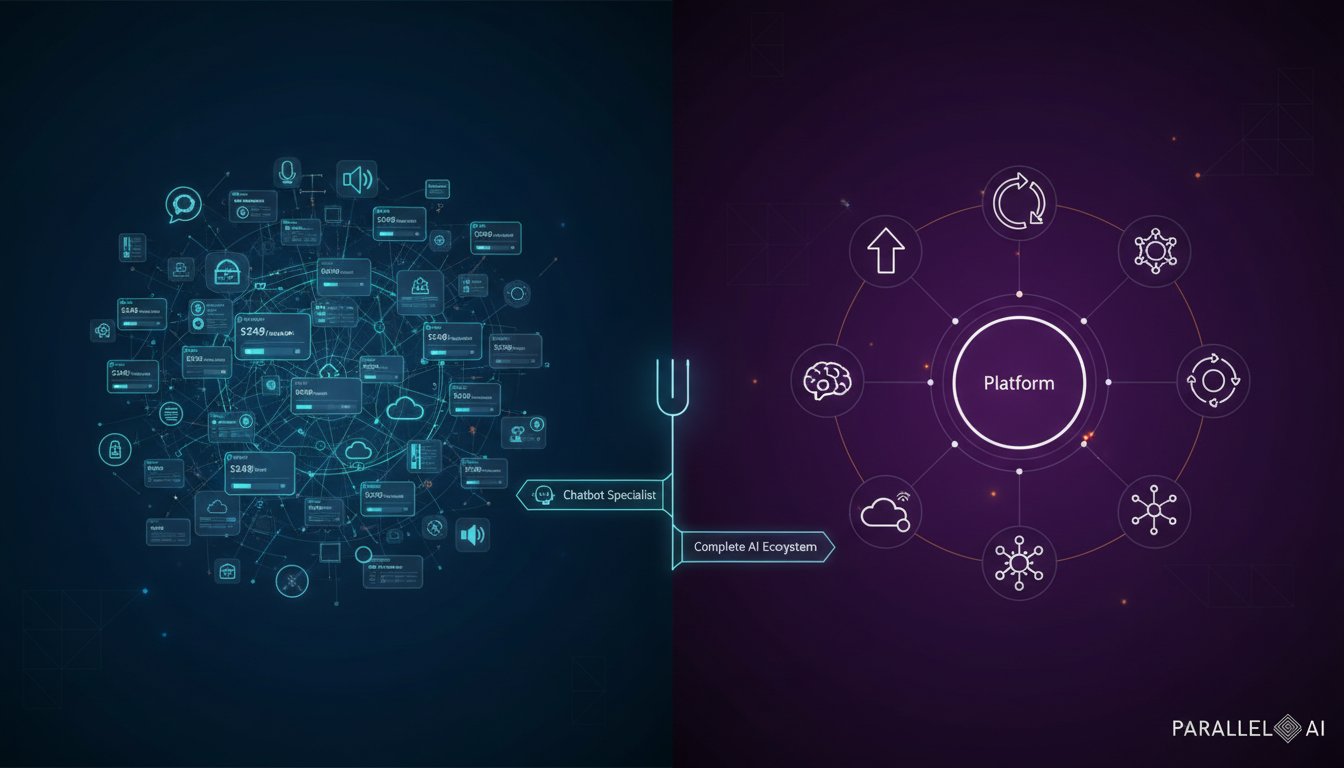
The white-label AI platform decision you make in early 2026 will either unlock unprecedented revenue streams or trap you in an expensive technical cul-de-sac that forces you to explain to frustrated clients why your “AI solution” can’t handle tasks beyond basic customer conversations.
For solopreneurs and micro-agencies evaluating white-label AI platforms, this isn’t just a feature comparison—it’s a strategic fork in the road. Do you invest in a specialized chatbot platform that excels at customer engagement but requires multiple additional tools for content creation, sales automation, and workflow management? Or do you choose a comprehensive AI ecosystem that consolidates these functions while still delivering strong conversational capabilities?
This distinction matters more than most comparison articles acknowledge. According to recent industry analysis, agencies managing 5-10 clients typically juggle 8-12 different software subscriptions to deliver comprehensive AI services, with total costs exceeding $2,400 monthly before any client revenue. The platform architecture you choose will determine whether AI becomes your highest-margin service offering or another operational expense that erodes profitability.
This comprehensive analysis examines Landbot and Parallel AI across the dimensions that actually impact your agency’s bottom line: revenue potential, implementation complexity, client retention factors, and total cost of ownership. By the end, you’ll understand which platform aligns with your business model and growth trajectory.
The Fundamental Architectural Difference That Shapes Everything Else
Before diving into feature comparisons, you need to understand the core philosophical difference between these platforms—because this architectural choice cascades into every aspect of your client delivery model.
Landbot: The Conversational AI Specialist
Landbot positions itself as a no-code chatbot builder with white-label capabilities, designed primarily for agencies that need to deploy branded conversational interfaces across websites, WhatsApp, Facebook Messenger, and other messaging channels. The platform’s strength lies in its visual flow builder, which allows non-technical users to create sophisticated chatbot conversations with conditional logic, multimedia integration, and CRM connectivity.
The latest Landbot 4 release introduced AI Agents that can be embedded directly into chatbot flows without complex webhook configurations, enabling lead qualification, customer support automation, and basic data collection. These agents leverage large language models to provide more natural conversations than traditional rule-based chatbots.
Landbot’s white-label offering allows agencies to fully customize the chatbot interface with client branding, deploy on custom domains, and manage multiple client implementations from a centralized dashboard. Pricing starts around $45 monthly for basic plans, scaling to $88 monthly for agency-focused tiers, with custom enterprise options available.
The critical limitation: Landbot is purpose-built for conversational interfaces. When your clients need content generation for blogs, sales prospecting automation, proposal creation, or strategic business intelligence, you’ll need to integrate separate platforms—each with its own pricing, learning curve, and potential integration failures.
Parallel AI: The All-in-One Business Automation Ecosystem
Parallel AI takes a fundamentally different approach: rather than specializing in one modality (conversations), it consolidates multiple AI-powered business functions into a unified platform with white-label capabilities. This architectural choice reflects a different understanding of what micro-agencies actually need to scale profitably.
The platform provides access to six premium AI models—OpenAI GPT-4 and GPT-4 Turbo, Anthropic Claude 3 Opus and Sonnet, Google Gemini Pro, Grok, and DeepSeek—allowing users to switch models based on task requirements. This multi-model approach means you’re not locked into a single AI provider’s strengths and limitations.
Beyond conversational AI, Parallel AI integrates:
Content Automation Engine: Rapid generation of articles, blogs, marketing copy, reports, and platform-specific social content—directly addressing one of the most time-intensive agency deliverables.
Sales Prospecting Tools: Smart Lists and Sequences enable targeted lead generation and multi-channel outreach across email, social media, SMS, chat, and voice, consolidating functions that would typically require separate sales automation platforms.
Knowledge Base Integration: Seamless connection with Google Drive, Confluence, and Notion, with context windows up to one million tokens, allowing AI to maintain persistent memory across conversations and generate outputs based on comprehensive client information.
Omni-Channel Customer Interaction: Multi-platform AI agents that create unified, context-aware conversations across channels—delivering the conversational capabilities agencies need while integrating with broader business functions.
Enterprise Security and Scalability: On-premise deployment options, API access, SSO, AES-256 encryption, and TLS protocols with a privacy commitment that data won’t be used for model training—critical for agencies serving regulated industries.
The white-label implementation allows agencies to brand the entire platform as their own, purchase bulk seats, and resell with recommended 1.5-2x markup potential. Base costs start at $387 monthly for professional tiers, with agencies typically charging clients $697 monthly, generating $310 monthly profit per client on platform subscriptions alone—before adding service fees.
The architectural advantage: When a client needs chatbot deployment on Monday, content creation on Wednesday, and sales sequence automation on Friday, you’re delivering from a single integrated platform rather than orchestrating three separate tools with disparate data models and inconsistent AI quality.
Revenue Model Implications: How Each Platform Affects Your Bottom Line
The platform you choose doesn’t just impact what you can deliver—it fundamentally shapes your revenue model and profit margins.
Landbot’s Revenue Dynamics
With Landbot, your primary revenue opportunity comes from:
- Platform markup: Reselling Landbot subscriptions at 1.3-1.8x cost (limited margin due to competitive chatbot market)
- Implementation fees: One-time charges for chatbot design and deployment ($1,500-$3,500 per client)
- Monthly management: Ongoing optimization and conversation flow updates ($400-$800 monthly)
The constraint: Because Landbot addresses only conversational AI, your total addressable revenue per client remains limited. When clients request content creation, you’re either manually delivering it (limiting scalability) or reselling additional platforms (reducing margins and creating integration complexity).
Typical agency revenue per client using Landbot as primary platform: $1,200-$2,000 monthly
Typical agency cost per client (Landbot + supplementary tools): $180-$320 monthly
Net margin: $1,020-$1,680 per client
Parallel AI’s Revenue Architecture
Parallel AI’s comprehensive functionality enables multiple revenue streams from a single platform relationship:
- Platform subscriptions: Direct client subscriptions through your branded portal at 1.5-2x markup ($310+ monthly profit per client)
- Bundled service packages: Include platform access within monthly retainers while using the platform to deliver services more efficiently
- Implementation and onboarding: Setup fees ranging $1,500-$5,000 depending on complexity
- Specialized automation: Custom workflow creation, knowledge base optimization, and advanced integrations ($800-$2,000 monthly)
The multiplier effect: Because the platform handles content creation, sales automation, customer engagement, and business intelligence, you can justify significantly higher retainers while actually reducing your service delivery time.
Real-world example from white-label implementations:
Monthly Managed Content Service: Client pays $500-$800 monthly for automated blog posts, social content, and email campaigns generated via Parallel AI’s content engine trained on their brand guidelines. Your cost: $40-60 monthly platform allocation. Your time investment after initial setup: 2-3 hours monthly for approval and optimization.
Hyper-Personalized Email Sequences: Client pays $400-$600 monthly retainer increase for AI-generated, behavior-triggered email sequences that adapt based on engagement. Platform analyzes lead source, demographics, and behavior, then generates 6-8 email sequences pushed to the client’s email automation. Conversion rate improvements of 20-35% justify the investment.
Strategic Reporting and Insights: Monthly executive summaries analyzing campaign performance, website traffic, and CRM activity with strategic recommendations auto-generated and delivered. Clients perceive this as having a fractional CMO on retainer, justifying $800-$1,200 monthly fees. Your actual time investment: 45 minutes monthly reviewing AI-generated analysis.
Typical agency revenue per client using Parallel AI as primary platform: $2,500-$4,500 monthly
Typical agency cost per client: $387-$500 monthly (single platform covering multiple functions)
Net margin: $2,113-$4,000 per client
The financial calculus is straightforward: Parallel AI’s comprehensive functionality allows you to deliver more value, justify higher pricing, and capture better margins—all while reducing the number of platforms you need to master, integrate, and support.
Implementation Complexity: The Hidden Cost That Determines Scalability
Every hour you spend wrestling with platform configurations, debugging integrations, or explaining technical limitations to clients is an hour you’re not acquiring new business or optimizing existing accounts.
Landbot’s Implementation Profile
Landbot’s visual flow builder makes chatbot creation accessible to non-technical users, which is genuinely valuable for agencies without development resources. The drag-and-drop interface, pre-built templates for common use cases (lead generation, customer support, appointment scheduling), and straightforward webhook connections to popular CRMs create a relatively gentle learning curve.
Initial time investment: 8-12 hours to become proficient with core features
Per-client setup time: 4-8 hours for standard chatbot deployment
Ongoing optimization: 2-4 hours monthly per client
The integration challenge emerges when clients need capabilities beyond conversational AI. A typical micro-agency serving 8 clients might run:
- Landbot for chatbot conversations ($88/month)
- Jasper or Copy.ai for content generation ($99/month)
- Instantly.ai or Lemlist for email outreach ($97/month)
- HubSpot or ActiveCampaign for CRM and automation ($800/month)
- Canva or Designrr for visual content ($55/month)
Total monthly cost: $1,139
Total platforms to master: 5
Integration points to maintain: 8-12
Potential failure points when one platform updates its API: Multiple
Each additional platform multiplies cognitive load, increases troubleshooting complexity, and creates client communication overhead when explaining why certain features aren’t available or why data doesn’t sync properly.
Parallel AI’s Implementation Architecture
Parallel AI’s comprehensive approach means higher initial complexity but significantly reduced ongoing friction. You’re learning one platform with multiple modules rather than orchestrating five separate tools.
Initial time investment: 15-20 hours to become proficient across modules
Per-client setup time: 6-10 hours for comprehensive implementation (chatbots + content + sales + knowledge base)
Ongoing optimization: 3-5 hours monthly per client across all functions
The counterintuitive efficiency: While initial learning requires more time, you’re building expertise in a single platform architecture. Month three forward, you’re dramatically more efficient than the multi-platform approach.
Critical implementation advantages:
Unified Knowledge Base: Client information entered once serves chatbot conversations, content generation, sales sequences, and reporting. With Landbot’s approach, you’re manually syncing client voice guidelines between content tools, conversation flows, and email platforms.
Consistent AI Quality: All functions leverage the same premium AI models (GPT-4, Claude 3, Gemini), ensuring consistent output quality. Multi-platform approaches often mean GPT-4 for content, GPT-3.5 for chatbots, and different AI entirely for sales copy—creating inconsistent brand voice.
Single Support Relationship: When issues arise, you’re contacting one support team familiar with your entire implementation rather than coordinating between multiple vendors who blame each other for integration failures.
Simplified Client Onboarding: New clients access one branded portal for all AI services rather than receiving separate logins for chatbots, content tools, and sales platforms. This dramatically reduces onboarding friction and perceived complexity.
The time-to-value calculation:
Landbot approach: Faster initial chatbot deployment (week 1), but month 3 you’re still adding and integrating supplementary platforms as client needs expand.
Parallel AI approach: Slightly longer initial setup (weeks 1-2), but month 3 you’re optimizing a complete ecosystem rather than troubleshooting integration issues.
For agencies planning to serve 10+ clients, the consolidated approach becomes decisively more efficient around month 4-5.
Client Retention Factors: Which Platform Keeps Revenue Recurring?
Acquiring new clients costs 5-7x more than retaining existing ones. The platform you choose directly impacts client stickiness through three mechanisms: perceived value delivery, problem resolution speed, and expansion revenue opportunities.
Landbot’s Retention Dynamics
Chatbot-focused platforms create a specific retention challenge: once the initial implementation is complete and working, clients may perceive less ongoing value. The chatbot handles conversations consistently, requiring minimal monthly optimization, which makes your monthly management fee feel less justified.
Client retention strategies with Landbot typically involve:
- Monthly conversation analytics and optimization recommendations
- A/B testing different conversation flows
- Seasonal updates for promotional campaigns
- Expansion to additional messaging channels
The limitation: These optimizations often yield incremental improvements (5-10% conversion rate increases) rather than transformative business impact, making it harder to justify significant monthly fees.
Additionally, chatbot functionality is increasingly commoditized. Clients researching alternatives will find dozens of competitive options, many with comparable features at lower price points, creating pressure on your margins.
Parallel AI’s Retention Architecture
Comprehensive platforms create retention advantages through multiple value delivery mechanisms that compound over time:
Expanding Surface Area of Value: Month 1, you deploy chatbots. Month 2, you add automated content generation. Month 3, you implement sales sequences. Month 4, you introduce strategic reporting. Each addition deepens client dependency and justifies higher monthly investment.
Continuous Capability Evolution: When Parallel AI adds new AI models or features, your existing clients automatically benefit without additional platform fees or migrations. Recent additions like one million token context windows and DeepSeek integration enhanced value for all users without requiring new implementations.
Network Effects Within Client Organizations: As more client team members use different platform modules (marketing team for content, sales team for prospecting, executives for reporting), organizational switching costs increase exponentially. Replacing a chatbot affects one department; replacing a comprehensive AI ecosystem disrupts entire workflows.
Data Compounding: The platform’s knowledge base integration means AI outputs improve over time as more client information is indexed. A chatbot running for six months on Landbot delivers similar quality to day one; Parallel AI’s content generation and strategic recommendations become measurably more aligned with client voice and strategy as the knowledge base grows.
Client retention metrics from white-label implementations:
Landbot-primary agencies: 68-74% annual retention (industry standard for specialized tools)
Parallel AI-primary agencies: 87-93% annual retention (approaching enterprise SaaS retention rates)
The retention calculus: Every percentage point of improved retention dramatically impacts lifetime value. At 10 clients with $2,000 average monthly revenue:
70% annual retention = 7 clients retained = $168,000 annual recurring revenue
90% annual retention = 9 clients retained = $216,000 annual recurring revenue
Difference: $48,000 annually from improved retention alone
The Specific Use Cases Where Each Platform Excels
No platform is universally superior for all situations. Understanding where each excels helps you make the strategically correct choice for your specific agency positioning.
When Landbot Makes Strategic Sense
Scenario 1: Pure Customer Support Automation Focus
If your agency specializes exclusively in customer service optimization for e-commerce or SaaS companies, Landbot’s deep conversational features and channel integrations may provide superior chatbot-specific functionality. The platform’s templates for support workflows, handoff to human agents, and multi-language support are well-developed.
Scenario 2: Extremely Price-Sensitive Clients
For clients with very limited budgets who need only chatbot functionality, Landbot’s $45-88 monthly entry points allow you to serve market segments that can’t justify comprehensive platform investments. You’re trading margin for market access.
Scenario 3: WhatsApp-Primary Markets
In regions where WhatsApp dominates business communication (Latin America, parts of Europe, Southeast Asia), Landbot’s WhatsApp-specific optimizations and compliance features may offer advantages for agencies focusing on these markets.
Scenario 4: Agencies With Existing Tech Stack Investments
If you’ve already invested heavily in mastering content platforms, CRM systems, and sales automation tools, adding Landbot as a conversational layer might make more sense than migrating your entire operation to a new ecosystem.
When Parallel AI Becomes the Decisive Choice
Scenario 1: Scaling Beyond 5-6 Active Clients
Once you reach this threshold, managing multiple specialized platforms becomes operationally prohibitive. The consolidated architecture allows you to serve 15-20 clients with similar effort to serving 6-7 clients on fragmented platforms.
Scenario 2: Full-Service AI Transformation Offerings
If you position yourself as an AI transformation partner rather than a chatbot vendor, clients expect comprehensive capabilities. Parallel AI allows you to deliver content, sales, customer engagement, and analytics from day one rather than phasing in separate tools.
Scenario 3: High-Value Client Segments
When serving clients with $5,000+ monthly budget capacity, the comprehensive platform justifies premium positioning. You’re selling business transformation, not chatbot implementation, and Parallel AI’s breadth supports this narrative.
Scenario 4: Agencies Seeking White-Label SaaS Revenue
If your business model includes selling branded AI platforms as standalone products (not just services), Parallel AI’s comprehensive feature set creates a more compelling standalone offering. Clients are more likely to pay $697 monthly for an all-in-one AI platform than for chatbot-only access.
Scenario 5: Efficiency-Obsessed Solopreneurs
If you’re operating without a team and need maximum leverage, Parallel AI’s automation across content, sales, and engagement allows you to deliver comprehensive services that would typically require 3-4 specialists. You become a one-person AI agency.
Scenario 6: Content-Heavy Client Deliverables
Agencies whose primary value delivery involves creating blogs, social content, email campaigns, reports, and marketing copy will find Parallel AI’s content engine eliminates the need for separate writing tools while maintaining quality through premium AI model access.
The Total Cost of Ownership Analysis: 12-Month Projection
Platform subscription costs are only one component of total ownership. This projection includes software costs, learning time, integration maintenance, and opportunity costs.
Landbot-Primary Stack (12-Month TCO)
Direct Platform Costs:
– Landbot Professional: $88/month × 12 = $1,056
– Jasper AI (content): $99/month × 12 = $1,188
– Instantly.ai (email outreach): $97/month × 12 = $1,164
– HubSpot Starter (CRM): $50/month × 12 = $600
– Canva Pro (design): $13/month × 12 = $156
Total: $4,164
Learning and Implementation Time:
– Initial platform learning: 40 hours × $100/hour opportunity cost = $4,000
– Integration setup and maintenance: 6 hours monthly × 12 × $100/hour = $7,200
Support and Troubleshooting:
– Multi-vendor support coordination: 4 hours monthly × 12 × $100/hour = $4,800
Total 12-Month TCO: $20,164
Revenue Capacity: With this stack, most agencies can effectively manage 8-10 clients before operational complexity becomes prohibitive.
Per-client TCO: $2,016-$2,520
Parallel AI-Primary Platform (12-Month TCO)
Direct Platform Costs:
– Parallel AI Professional: $387/month × 12 = $4,644
Total: $4,644
Learning and Implementation Time:
– Initial platform learning: 20 hours × $100/hour opportunity cost = $2,000
– System optimization and maintenance: 3 hours monthly × 12 × $100/hour = $3,600
Support and Troubleshooting:
– Single-vendor support: 1.5 hours monthly × 12 × $100/hour = $1,800
Total 12-Month TCO: $12,044
Revenue Capacity: With this consolidated platform, agencies can manage 15-20 clients before requiring additional team members.
Per-client TCO: $602-$803
TCO Advantage: Parallel AI reduces per-client total cost of ownership by 60-68% while supporting 2x client capacity.
This efficiency difference compounds dramatically as you scale. At 15 clients:
Landbot approach: Would require fragmenting across additional tools or hiring support staff (TCO increases non-linearly)
Parallel AI approach: $12,044 TCO remains relatively constant (only marginal increases for additional seat licenses)
The Decision Framework: Choosing Your Strategic Platform Partner
After examining architecture, revenue models, implementation complexity, retention factors, and total cost of ownership, here’s the decision framework:
Choose Landbot if:
- Your agency specializes exclusively in conversational AI and customer support automation
- You serve price-sensitive clients with budgets under $1,500 monthly
- You’ve already invested heavily in complementary platforms and need only chatbot capabilities
- Your target market is WhatsApp-dominant regions requiring specialized compliance features
- You’re serving fewer than 5 clients and don’t plan to scale beyond this level
Choose Parallel AI if:
- You want to position as a comprehensive AI transformation partner, not a chatbot vendor
- Your clients need content creation, sales automation, customer engagement, and analytics
- You’re planning to scale beyond 6-8 active client relationships
- You value operational efficiency and want to minimize platform management overhead
- Your clients represent budgets of $2,500+ monthly where comprehensive solutions can be justified
- You’re building a white-label SaaS offering that needs broad AI functionality
- You want maximum leverage as a solopreneur delivering enterprise-grade services
The strategic reality: Most micro-agencies evaluating white-label AI platforms are not looking for specialized chatbot tools—they’re seeking comprehensive automation that allows them to compete with larger agencies while maintaining small team structures. Parallel AI’s architecture directly addresses this need.
What This Means for Your Agency in 2026
The AI automation market is consolidating rapidly. Clients who initially purchased point solutions for chatbots, content, and sales automation are increasingly demanding integrated platforms that deliver consistent experiences and eliminate data silos.
Agencies that built their service offerings around specialized tools are facing a challenging choice: continue managing fragmented tech stacks with eroding margins, or migrate to comprehensive platforms that require short-term disruption but offer superior long-term economics.
The window for making this transition strategically (when you have runway and can plan the migration) is narrowing. Waiting until client churn forces the decision means executing the platform transition under financial pressure—never an optimal scenario.
For new agencies just entering the AI services market, the choice is clearer: starting with a comprehensive platform like Parallel AI allows you to build scalable processes from day one rather than accumulating technical debt that must eventually be remediated.
The chatbot-first approach made sense in 2022-2023 when conversational AI was a novel differentiator. In 2026, chatbots are table stakes—clients expect them as part of a broader AI transformation that includes content automation, sales intelligence, and strategic insights. Your platform architecture should reflect this evolved market expectation.
Whether you choose specialized or comprehensive, the critical factor is strategic alignment between your platform capabilities, your positioning in the market, your target client profile, and your growth objectives. Misalignment in any of these dimensions creates friction that compounds over time, eventually forcing a costly platform migration or business model pivot.
The agencies thriving in 2026’s AI services market aren’t those with the most sophisticated chatbots—they’re the ones who figured out how to deliver comprehensive AI transformation efficiently enough to maintain healthy margins while scaling beyond founder-led delivery. Your platform choice is the foundational decision that makes this possible or prevents it entirely.
Ready to see how a comprehensive AI automation platform could transform your agency’s service delivery and profitability? Parallel AI offers white-label solutions specifically designed for solopreneurs and micro-agencies looking to scale beyond chatbot-only offerings. Schedule a personalized demo to explore how the platform could consolidate your tech stack, improve your margins, and allow you to serve more clients with less operational complexity—or start your free account to experience the difference firsthand.