
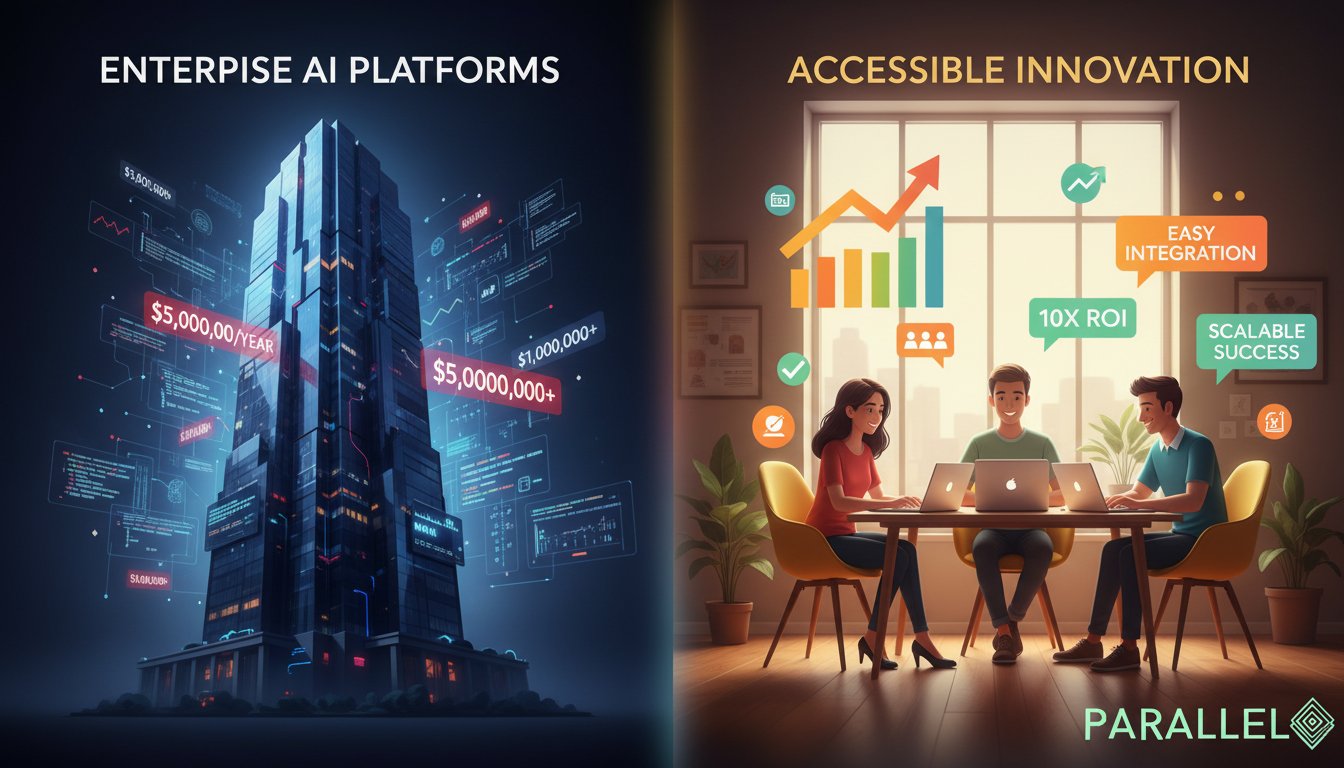
Your agency just landed a promising lead—a mid-sized healthcare company looking to automate patient communication and internal workflows. They’re impressed with your strategic thinking and ask a simple question: “Can you build this for us?”
You know the answer should be yes. You’ve researched conversational AI platforms. You’ve seen what Kore.ai delivers for enterprise clients—sophisticated multi-channel bots, advanced natural language processing, seamless integrations across CRM and ERP systems. The platform is powerful, proven, and exactly what your client needs.
Then you see the price tag: $300,000 annually. Your client’s entire digital transformation budget is $75,000.
This scenario plays out daily in agencies across North America. The enterprise AI market has matured beautifully, delivering sophisticated solutions for organizations with seven-figure technology budgets. But this maturity has created a dangerous gap—capable agencies with qualified clients can’t access the technology needed to deliver AI solutions profitably.
The question isn’t whether platforms like Kore.ai work. They absolutely do, for the right market segment. The question is whether solopreneurs, micro-agencies, and small service providers have a viable alternative that delivers comparable automation capabilities without requiring enterprise budgets, technical teams, or year-long implementations. This comprehensive comparison examines Kore.ai and Parallel AI not to declare a universal winner, but to clarify which platform serves which market segment—and more importantly, where the profitable opportunity actually exists for independent agencies.
Understanding the Enterprise-First Philosophy: What Kore.ai Actually Delivers
Kore.ai represents the maturation of enterprise conversational AI. Founded to help large organizations deploy intelligent virtual assistants at scale, the platform has evolved into a comprehensive automation ecosystem trusted by financial institutions, healthcare systems, telecommunications companies, and retail chains operating across multiple countries.
The platform’s core strength lies in sophisticated orchestration. Kore.ai doesn’t just create chatbots; it coordinates multiple AI agents, human agents, and backend systems to handle complex workflows that span departments, channels, and business functions. A single customer interaction might trigger workflows across customer service, billing, inventory systems, and field operations—all coordinated through Kore.ai’s orchestration layer.
Their natural language understanding (NLU) capabilities are genuinely impressive. The platform handles multi-turn conversations with contextual awareness, remembering previous interactions and maintaining conversation state across channels. Whether a customer starts a conversation on web chat, continues via WhatsApp, and concludes through voice, Kore.ai maintains context and continuity.
The security and compliance infrastructure reflects enterprise requirements. Kore.ai delivers SOC 2 certification, GDPR compliance, HIPAA readiness, and industry-specific security frameworks necessary for regulated industries. For a healthcare system handling protected health information or a financial institution processing sensitive transactions, these certifications aren’t optional—they’re table stakes.
Integration capabilities extend across hundreds of enterprise systems. Pre-built connectors link to Salesforce, Microsoft Dynamics, SAP, Oracle, ServiceNow, and virtually every major enterprise platform. Custom API integrations handle proprietary systems. The platform can orchestrate workflows spanning legacy mainframes and cutting-edge cloud services.
Development options accommodate both business users and technical teams. A visual bot builder enables drag-and-drop conversation design for non-technical users, while advanced developers can access custom code for sophisticated logic and integrations. This dual-track approach theoretically democratizes AI development while preserving flexibility for complex use cases.
The Enterprise Cost Structure: Where Accessibility Breaks Down
Kore.ai’s pricing reflects its enterprise positioning. Industry analysis indicates typical deployments start around $300,000 annually, though exact pricing remains opaque—a deliberate choice that signals the platform’s target market.
This pricing isn’t arbitrary gouging. It reflects comprehensive platform access, enterprise-grade infrastructure, dedicated support teams, implementation assistance, and the overhead of serving highly regulated industries with complex requirements. For a Fortune 500 company deploying conversational AI across 50,000 employees and millions of customers, $300,000 represents reasonable value.
For a three-person marketing agency serving mid-market clients, it represents an impossible barrier.
The cost structure creates cascading accessibility issues. An agency needs not just platform access, but technical expertise to implement and customize solutions. Kore.ai’s sophistication requires dedicated technical resources—either in-house developers or expensive consultants. Implementation timelines stretch months, not weeks, as technical teams configure integrations, customize workflows, and train AI models on specific use cases.
White-label capabilities exist but require custom negotiation and enterprise-level commitments. The platform doesn’t offer simple “turn on white-labeling” options accessible to small agencies. Custom branding and reseller arrangements require direct conversations with enterprise sales teams, minimum commitments, and pricing that assumes substantial client bases.
The Hidden Opportunity Cost: What Agencies Actually Need
Beyond direct pricing, Kore.ai’s enterprise focus creates opportunity costs that small agencies often underestimate. The platform solves enterprise problems—multi-national deployments, complex compliance requirements, legacy system integration—that don’t exist for most small and mid-market businesses.
An agency serving local businesses, regional companies, or specialized niches doesn’t need multi-national language support or mainframe integration. They need rapid deployment, straightforward pricing, and the ability to deliver results within typical small business budgets of $2,000-$10,000 monthly.
The technical expertise requirement creates another barrier. Kore.ai assumes access to developers, AI specialists, and integration engineers. Most micro-agencies are led by marketing strategists, business consultants, or industry specialists without technical backgrounds. Hiring these capabilities for Kore.ai implementation often costs more than the platform itself.
Implementation timelines conflict with small business expectations. Enterprise clients understand that sophisticated AI deployments require 6-12 months. Small businesses expect to see value within 30-60 days. The disconnect between enterprise implementation cycles and small business expectations makes Kore.ai fundamentally misaligned for agency-led deployments to SMB clients.
Parallel AI’s Market Positioning: Business Automation for the 99%
Parallel AI addresses a fundamentally different market question: How do solopreneurs, micro-agencies, and small service providers access enterprise-grade AI capabilities with small business budgets, timelines, and technical resources?
The platform consolidates multiple AI models—OpenAI, Anthropic, Gemini, Grok, DeepSeek—into a single interface with unified knowledge base integration, content automation, lead generation, and workflow orchestration. Rather than specializing in conversational AI for customer service, Parallel AI delivers comprehensive business automation across the full client lifecycle.
Multi-Model Flexibility: Choosing the Right AI for Each Task
Where Kore.ai focuses on sophisticated conversational experiences through proprietary NLU, Parallel AI provides access to the industry’s leading AI models with the flexibility to choose optimal models for specific tasks.
Content creation might leverage Claude for nuanced writing. Data analysis could use GPT-4 for complex reasoning. Quick customer responses might employ faster, more cost-effective models. This multi-model approach delivers two advantages: optimal results for varied tasks and cost efficiency by matching capability to requirement.
The platform includes context windows reaching one million tokens—enabling AI to process and reference massive amounts of information in single sessions. An agency can feed entire client knowledge bases, industry research, and historical campaigns into AI workflows, generating outputs with deep contextual awareness without manual summarization or chunking.
Knowledge Base Integration: Connecting AI to Real Business Context
Parallel AI integrates directly with Google Drive, Confluence, Notion, and other knowledge platforms that businesses actually use. This integration isn’t just file upload—it’s bidirectional synchronization that keeps AI updated as business knowledge evolves.
For agencies, this integration transforms AI from generic tool to client-specific expert. Upload a client’s brand guidelines, product documentation, past campaigns, and industry research. The AI immediately becomes contextualized, generating outputs that reflect specific brand voice, product details, and strategic positioning without manual prompting or correction.
The knowledge base becomes cumulative intelligence. Each project, campaign, and analysis feeds back into the system, creating increasingly sophisticated understanding of client businesses, industries, and successful approaches. Over time, the AI develops institutional memory that would typically require senior-level employees.
Content Automation Engine: From Strategy to Execution at Scale
The content automation engine accelerates production across blogs, social media, email campaigns, reports, and marketing collateral. Where conversational AI platforms optimize customer interactions, Parallel AI optimizes the entire content production workflow that agencies deliver daily.
Content generation isn’t just faster—it’s strategically consistent. The AI maintains brand voice, messaging frameworks, and positioning across hundreds of content pieces. An agency can generate a month of social content, weekly blog posts, and email sequences in hours rather than weeks, with consistent quality and strategic alignment.
The impact on agency economics is profound. Content production typically represents 40-60% of agency delivery costs. Accelerating this production 5-10x while maintaining quality transforms agency profitability and capacity. An agency previously serving five clients can serve fifteen without additional headcount.
White-Label Infrastructure: Built for Agency Resale
Where Kore.ai requires enterprise negotiations for white-label access, Parallel AI builds resale into its core architecture. Agencies can brand the platform completely—custom domains, logos, colors, email notifications—creating the appearance of proprietary technology.
The billing infrastructure handles client subscriptions directly through the agency’s Stripe account. Clients pay the agency, not Parallel AI. The agency controls pricing, packages, and client relationships. From the client perspective, they’re purchasing the agency’s AI platform, not a third-party tool.
Feature toggles enable package differentiation. An agency might offer a Starter package with AI chat and knowledge base at $497/month, a Professional package adding content automation and lead generation at $997/month, and an Enterprise package with full capabilities at $1,997/month. Each tier is simply toggling features within the same underlying platform.
The Revenue Share Economics: Transparent Profitability
Parallel AI operates on a transparent revenue share model. The agency keeps 30% of every subscription dollar, with 70% covering platform costs. Unlike enterprise platforms with opaque pricing and complex licensing, agencies know exactly what they pay and what they keep.
Base platform costs start at $69/month (annual billing) for the Entrepreneur tier—one company, one seat, 2,000 credits. An agency charging clients $497/month generates $428 profit per client. At $697/month, profit reaches $628 per client.
Scale economics improve dramatically with volume. Ten clients at $997/month generate $9,970 monthly revenue against approximately $1,200 in platform costs—$8,770 monthly profit or $105,240 annually. A solo consultant running this model exceeds six-figure revenue with entirely predictable margins.
Additional revenue streams layer onto subscriptions. Setup fees ($1,500-$5,000), training sessions ($200-$500), custom AI employee configuration ($500-$2,000), knowledge base integration ($750-$2,500), and ongoing optimization retainers ($500-$2,000 monthly) create professional services revenue on top of platform subscriptions.
Implementation Timeline: Same-Day Revenue Generation
The fastest recorded agency setup time is 2.5 hours from signup to first client onboarded. Most agencies complete full setup—account creation, branding, package configuration, and testing—in a single morning.
This implementation speed fundamentally changes agency economics. Rather than months of platform investment before generating revenue, agencies can onboard paying clients the same day they commit to Parallel AI. The platform becomes immediately revenue-generating rather than a long-term infrastructure investment.
Client onboarding follows similar timelines. Connecting a client’s knowledge base, configuring AI employees, and training the client team typically completes within 1-2 hours. Clients see value within days, not months, aligning with small business expectations and purchasing cycles.
The Feature-by-Feature Reality: Where Each Platform Actually Excels
Direct feature comparison reveals fundamental philosophical differences. Kore.ai optimizes for enterprise conversational AI depth. Parallel AI optimizes for comprehensive business automation breadth accessible to non-technical agencies.
Conversational AI Sophistication
Kore.ai’s Advantage: Sophisticated multi-turn conversations with advanced NLU, complex dialog management, and enterprise-grade voice capabilities. For customer service operations handling millions of interactions across complex workflows, Kore.ai delivers superior conversational depth.
Parallel AI’s Approach: Leverages best-in-class foundation models (GPT-4, Claude, Gemini) for conversational capabilities without building proprietary NLU. Suitable for most business conversations but lacks Kore.ai’s specialized conversation orchestration for complex enterprise scenarios.
Winner Depends on Use Case: Enterprise customer service with complex multi-department workflows? Kore.ai. Agency-led automation for client businesses? Parallel AI’s foundation model approach delivers 90% of needed capability at 1% of the cost.
Multi-Channel Orchestration
Kore.ai’s Advantage: Sophisticated orchestration across web, mobile, messaging, voice, and custom channels with unified conversation state. Handles complex scenarios where conversations flow seamlessly across channels and departments.
Parallel AI’s Approach: Omni-channel customer interaction supporting email, SMS, chat, and voice with unified context. Suitable for most agency client needs without enterprise-level channel complexity.
Winner Depends on Scale: Multi-national enterprise with dozens of channels? Kore.ai. Agency serving SMB clients with standard channel requirements? Parallel AI delivers necessary capabilities without unnecessary complexity.
Knowledge Base and Contextual Intelligence
Kore.ai’s Advantage: Deep integration with enterprise knowledge management systems and sophisticated knowledge graph capabilities for complex organizational intelligence.
Parallel AI’s Advantage: Direct integration with platforms small businesses actually use (Google Drive, Notion, Confluence) with up to one million token context windows enabling entire business contexts in single AI sessions.
Winner: Parallel AI for agency use cases. The platforms small businesses use and the massive context windows deliver more practical value than enterprise knowledge graphs.
Content Production and Marketing Automation
Kore.ai’s Positioning: Not a primary focus. The platform optimizes for conversational customer service, not content production.
Parallel AI’s Advantage: Purpose-built content automation engine generating blogs, social media, emails, and marketing collateral at scale with brand consistency. This capability directly addresses agency core deliverables.
Clear Winner: Parallel AI. Content production represents 40-60% of agency delivery costs. This capability alone justifies platform selection for marketing and content-focused agencies.
Lead Generation and Sales Automation
Kore.ai’s Positioning: Conversational AI can support lead qualification, but outbound lead generation isn’t a platform focus.
Parallel AI’s Advantage: Smart Lists and Sequences enabling targeted lead generation and multi-channel outreach over email, social media, SMS, chat, and voice. Complete sales prospecting infrastructure included.
Clear Winner: Parallel AI. For agencies selling lead generation services, these capabilities are essential and completely absent from conversational AI platforms.
White-Label and Resale Capabilities
Kore.ai’s Approach: White-label available through enterprise negotiations with custom pricing and minimum commitments. Not accessible to small agencies.
Parallel AI’s Approach: White-label built into platform architecture with transparent pricing. Agencies can launch branded platforms in hours with full billing control and feature toggles.
Clear Winner: Parallel AI. White-label accessibility determines whether small agencies can participate in the AI services market. Kore.ai’s approach excludes this segment entirely.
Security and Compliance
Kore.ai’s Advantage: Comprehensive enterprise security with SOC 2, GDPR, HIPAA readiness, and industry-specific compliance frameworks. Essential for regulated industries.
Parallel AI’s Approach: AES-256 encryption, TLS protocols, SOC 2 compliance, on-premise deployment options, and commitment not to use data for model training. Enterprise-grade security without enterprise-only access.
Winner Depends on Requirements: Highly regulated industries with specific compliance frameworks? Kore.ai delivers specialized certifications. Most agency clients? Parallel AI’s security infrastructure exceeds requirements at accessible pricing.
The Total Cost Analysis: Where Profitability Actually Lives
Pricing comparison reveals why market segment determines platform viability. These numbers aren’t just different—they represent fundamentally different business models and accessible markets.
Kore.ai Total Cost of Ownership (Annual)
- Platform Licensing: $300,000+ (estimated, custom pricing)
- Implementation Services: $50,000-$150,000 (integration, customization, training)
- Technical Resources: $120,000+ (developer/AI specialist salary or consultant fees)
- Ongoing Maintenance: $30,000-$60,000 (updates, optimization, support)
- Total First Year: $500,000-$660,000
- Subsequent Years: $450,000-$510,000
Parallel AI Total Cost of Ownership (Annual)
Solo Consultant Serving 3 Clients:
– Platform Cost: $3,588 (annual billing)
– Client Revenue: $25,092 (3 clients × $697/month)
– Net Profit: $20,448
– Implementation: Self-service, 2-3 hours
– Technical Resources: None required
Small Agency Serving 10 Clients:
– Platform Cost: $14,400
– Client Revenue: $119,640 (10 clients × $997/month)
– Net Profit: $105,240
– Setup Time: Single day
– Technical Requirements: None
The cost difference isn’t incremental—it’s categorical. Kore.ai requires enterprise budgets and generates value for enterprise-scale operations. Parallel AI generates profit from day one for agencies serving small and mid-market clients.
Break-Even Analysis: When Each Platform Makes Financial Sense
Kore.ai Break-Even Scenario:
To justify $500,000 first-year costs, an agency needs contracts generating substantial revenue above platform costs. Assuming 30% margin on AI services, the agency needs approximately $1.7 million in AI-related revenue to break even on Kore.ai investment.
This revenue requirement means serving enterprise clients paying $50,000-$200,000+ for AI implementations. The agency needs either several large enterprise clients or dozens of mid-market clients—and the expertise to win and deliver these contracts.
Parallel AI Break-Even Scenario:
At base cost of $299/month (annual billing), an agency breaks even with a single client paying $497/month—generating $198 monthly profit ($2,376 annually). Three clients at this price point generate $20,448 annual profit on $3,588 platform investment—570% ROI.
This math works for solo consultants, micro-agencies, and service providers without existing enterprise relationships or technical teams.
The Technical Expertise Divide: Who Can Actually Implement Each Platform
Platform selection isn’t just about features and pricing—it’s about whether your agency possesses the expertise to implement and deliver value.
Kore.ai Technical Requirements
Successful Kore.ai implementation requires several specialized roles:
Conversational AI Architect: Designs dialog flows, conversation states, and NLU training strategies. Typical salary: $140,000-$180,000.
Integration Developer: Builds custom connectors between Kore.ai and client systems. Requires expertise in APIs, enterprise middleware, and client technology stacks. Typical salary: $120,000-$160,000.
AI Training Specialist: Trains and optimizes NLU models, manages intent recognition, and improves conversation accuracy. Typical salary: $100,000-$140,000.
Small agencies face a painful choice: hire these expensive roles (destroying profitability), outsource to consultants (eating margins), or pass on opportunities (limiting growth).
Parallel AI Technical Requirements
Parallel AI deliberately eliminates technical barriers:
Setup: Connect knowledge bases through OAuth integrations. Upload documents. Configure brand settings through web interface. No coding required.
Client Onboarding: Connect client knowledge sources. Create AI employees through conversational interface. Configure workflows through visual builder. Training occurs through platform documentation and video tutorials.
Ongoing Management: Feature toggles, billing management, and client administration through web dashboard. No technical expertise required.
Agencies led by marketing strategists, business consultants, and industry specialists can implement Parallel AI without hiring developers or AI specialists. The platform assumes non-technical users and designs accordingly.
The Client Segment Reality: Who Each Platform Actually Serves
Platform viability ultimately depends on who your clients are and what they can afford.
Kore.ai’s Ideal Client Profile
Company Size: 1,000+ employees, multi-national operations
Budget: $100,000-$500,000+ for AI initiatives
Use Cases: Multi-channel customer service, complex workflow automation, enterprise-wide deployment
Timeline Expectations: 6-12 months for implementation, understanding enterprise project cycles
Technical Environment: Complex legacy systems, enterprise software stack, dedicated IT teams
Agency Requirement: Existing relationships with enterprise clients, enterprise sales capabilities, technical delivery teams, and proven enterprise AI experience.
Parallel AI’s Ideal Client Profile
Company Size: 1-500 employees, single or limited geographic markets
Budget: $497-$1,997/month for AI capabilities
Use Cases: Content production, lead generation, customer communication, workflow automation
Timeline Expectations: 30-60 days for value realization
Technical Environment: Cloud-based SaaS tools, Google Workspace or Microsoft 365, standard business applications
Agency Requirement: Understanding of client business challenges, ability to configure and train AI tools, and capacity to deliver strategic guidance. No technical team required.
Most agencies serve clients in Parallel AI’s profile. According to the U.S. Census Bureau, 99.9% of U.S. businesses have fewer than 500 employees. These businesses need AI capabilities but can’t access enterprise platforms.
Real-World Implementation Scenarios: How Each Platform Performs
Theoretical comparison matters less than practical implementation. These scenarios reflect actual agency experiences.
Scenario 1: Regional Healthcare System Customer Service Automation
Client: 1,200-bed hospital system, 8,000 employees, 150,000 annual patient interactions
Requirement: Multi-channel patient communication (web, mobile app, SMS, voice) integrated with Epic EHR, appointment scheduling, billing inquiries, and HIPAA compliance
Kore.ai Implementation:
– Timeline: 8-10 months
– Team: Conversational AI architect, Epic integration specialist, HIPAA compliance consultant
– Cost: $400,000 platform + $200,000 implementation
– Result: Sophisticated multi-channel system handling complex medical workflows with Epic integration
Winner: Kore.ai. This scenario requires enterprise capabilities, healthcare-specific compliance, and complex integration that justifies enterprise investment.
Scenario 2: Marketing Agency Serving 12 E-commerce Clients
Client: Agency delivering content, social media, email marketing, and SEO for e-commerce businesses
Requirement: Scale content production, personalize customer communication, generate product descriptions, create email campaigns, and maintain brand consistency across clients
Kore.ai Evaluation:
– Platform Cost: $300,000+ (prohibitive for agency margins)
– Capability Match: Conversational AI doesn’t address core content production needs
– Technical Requirements: Agency lacks AI specialists for implementation
– Conclusion: Platform doesn’t match agency use case or economics
Parallel AI Implementation:
– Timeline: Setup in 4 hours, clients onboarded over 2 weeks
– Team: Agency’s existing account managers
– Cost: $1,200/month platform cost
– Client Pricing: $897/month per client
– Monthly Profit: $9,564 ($8,770 after platform costs)
– Annual Profit: $105,240
– Result: 5x content production speed, consistent brand voice across clients, new lead generation services
Winner: Parallel AI. Matches agency use case, economics, and technical capabilities perfectly.
Scenario 3: Financial Services Compliance Chatbot
Client: Investment advisory firm, 250 employees, requiring client communication tracking for regulatory compliance
Requirement: Customer service chatbot with conversation logging, compliance archiving, integration with Salesforce CRM, and financial services regulatory compliance
Kore.ai Implementation:
– Timeline: 5-6 months
– Compliance Framework: Financial services-specific security and logging
– Integration: Deep Salesforce integration with custom compliance workflows
– Cost: $150,000 implementation + $100,000 annual platform
Parallel AI Implementation:
– Timeline: 4-6 weeks
– Compliance: SOC 2, data encryption, on-premise deployment option
– Integration: Standard Salesforce connection through API
– Cost: $1,997/month
– Result: AI-powered customer communication with conversation logging and CRM integration
Winner: Depends on specific compliance requirements. If client needs financial services-specific certifications, Kore.ai. If standard enterprise security suffices, Parallel AI delivers 90% of capability at 8% of cost.
Making the Strategic Decision: Which Platform Matches Your Agency Reality
Platform selection shouldn’t start with features or pricing. It should start with honest assessment of your agency’s position, capabilities, and growth trajectory.
Choose Kore.ai If You:
-
Serve Enterprise Clients Exclusively: Your client base consists of organizations with 1,000+ employees and enterprise technology budgets
-
Have Technical Delivery Teams: You employ or contract AI specialists, integration developers, and conversational AI architects
-
Focus on Conversational AI: Your service offerings center on sophisticated customer service automation and multi-channel conversational experiences
-
Win Six-Figure Contracts: Your typical project values exceed $100,000 with 6-12 month delivery timelines
-
Operate in Highly Regulated Industries: Your clients require industry-specific compliance frameworks beyond standard enterprise security
Choose Parallel AI If You:
-
Serve Small to Mid-Market Clients: Your clients are businesses with 1-500 employees and monthly budgets of $500-$5,000 for AI services
-
Lack Technical Teams: Your agency is led by strategists, marketers, and consultants without developers or AI specialists
-
Deliver Comprehensive Services: You provide content production, marketing automation, lead generation, and business process optimization—not just conversational AI
-
Need Immediate Revenue: You can’t invest $500,000 over 12 months before seeing return on platform investment
-
Want White-Label Resale: You seek to build recurring revenue through branded AI platform subscriptions, not just project delivery
For most agencies reading this comparison, the honest self-assessment points clearly to Parallel AI. The platform matches the clients you serve, the budgets they have, the timelines they expect, and the technical capabilities you possess.
The Uncomfortable Truth About Enterprise Platforms and Small Agency Reality
The conversational AI industry has matured beautifully for enterprise buyers. Platforms like Kore.ai deliver sophisticated capabilities that were science fiction a decade ago. But this maturation has created a dangerous perception that all businesses need enterprise solutions.
Small agencies face constant pressure to appear more sophisticated, more technical, and more enterprise-ready than their actual capabilities and client base warrant. This pressure leads to platform selections that impress peers but destroy profitability.
The truth is simpler and less glamorous: most agencies serve clients who need practical business automation, not cutting-edge conversational AI. They need faster content production, more efficient lead generation, and better customer communication. They need results within typical small business budgets and timelines.
Kore.ai solves real problems for the right clients. It’s genuinely impressive technology delivering measurable value to enterprise organizations. But impressive enterprise technology doesn’t translate to small agency profitability when the economics don’t work, the clients can’t afford it, and the expertise to implement it doesn’t exist.
Parallel AI’s value proposition is less technically impressive but economically honest: deliver 90% of needed AI capabilities to 99% of businesses at pricing that creates profitable agency business models. For most agencies, this equation creates more sustainable businesses than chasing enterprise platforms that serve enterprise clients.
The platform decision ultimately reflects strategic clarity about who you serve and how you create value. Enterprise platforms serve enterprise clients profitably. Small business platforms serve small business clients profitably. Trying to force enterprise platforms into small business economics doesn’t create sophistication—it creates unprofitable complexity.
The best platform isn’t the most technically impressive. It’s the one that matches your clients, your capabilities, and your business model while generating sustainable profit. For the vast majority of agencies and solopreneurs building AI service offerings in 2025, that platform is Parallel AI.
Ready to see how quickly you can launch your white-label AI platform and start generating revenue from clients who are asking for AI capabilities right now? Book a custom demo where we’ll configure Parallel AI specifically for your agency’s use cases and show you exactly how the economics work for your client base.