
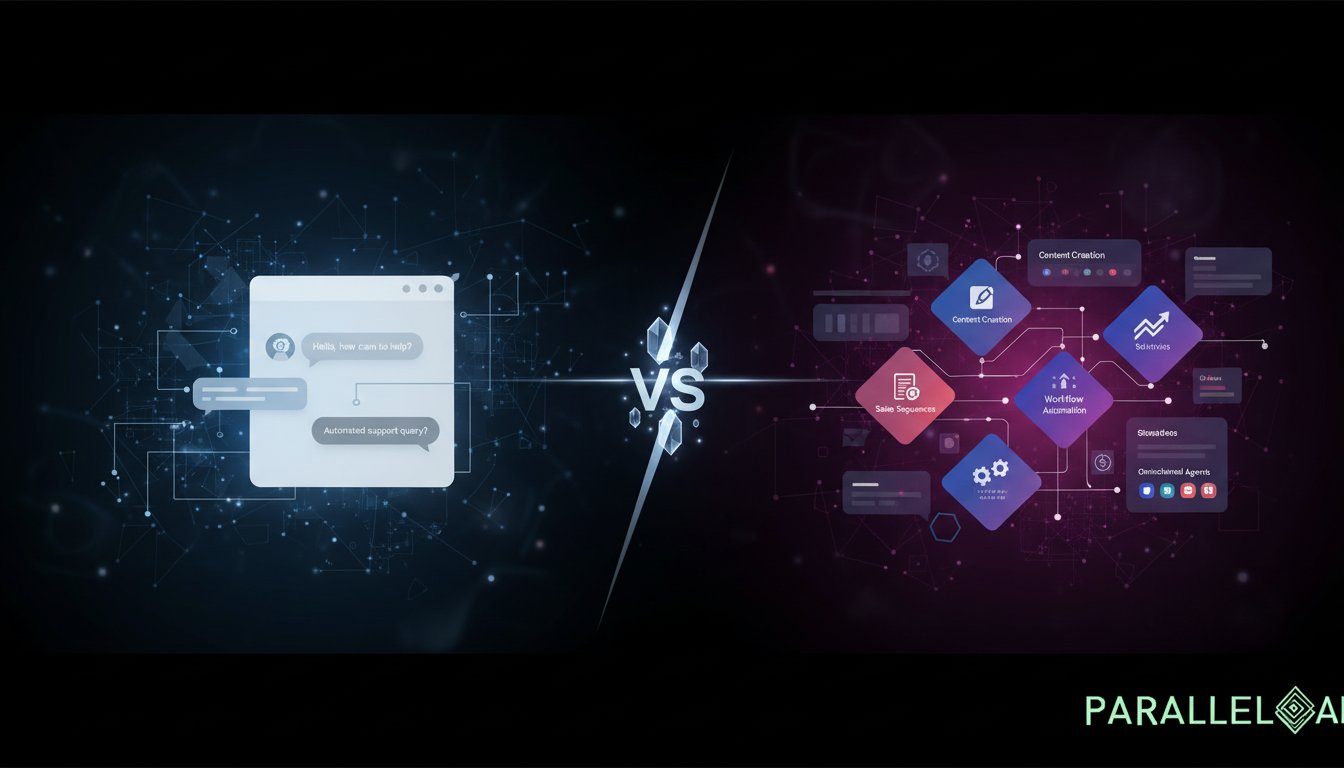
The white-label AI market presents agencies with a critical decision: invest in a specialized chatbot platform that excels at conversational AI, or choose a comprehensive automation ecosystem that handles customer interactions alongside content creation, sales prospecting, and workflow automation. This choice carries implications that extend far beyond initial feature comparisons—it shapes your service offerings, profit margins, and competitive positioning for years to come.
For agencies and consultants evaluating AI platforms in 2025, CustomGPT.ai and Parallel AI represent two fundamentally different approaches to the same challenge: empowering businesses with AI capabilities under their own brand. CustomGPT.ai has built its reputation on secure, customizable chatbot development with enterprise-grade compliance. Parallel AI positions itself as a complete business automation platform that consolidates content engines, omnichannel agents, sales sequences, and workflow automation into a single white-label solution.
The question isn’t simply which platform offers better features—it’s which platform architecture aligns with how agencies actually generate revenue and serve clients in 2025. According to recent industry data, 85% of enterprises are increasing spending in intelligent automation, with a 40% rise in end-to-end automation projects driven by AI advancements. This shift suggests that agencies need platforms capable of addressing multiple business functions, not just isolated conversational AI implementations.
This analysis examines both platforms through the lens of agency profitability, implementation complexity, and long-term scalability. We’ll explore how each platform approaches white-label customization, what capabilities they deliver beyond basic chatbot functionality, and which architecture better positions agencies to capture the expanding automation market projected to reach $80-100 billion by 2030.
Platform Philosophy: Specialized Chatbots vs Unified Business Automation
Understanding the foundational difference between CustomGPT.ai and Parallel AI requires examining what each platform was designed to accomplish.
CustomGPT.ai’s Conversational AI Focus
CustomGPT.ai built its platform around a singular objective: enabling businesses to create highly customized AI chatbots without coding expertise. The platform supports over 1,400 file formats and integrates with more than 100 third-party tools including Google Drive, HubSpot, and Shopify. With support for 92 languages and the ability to store up to 60 million words of training data, CustomGPT.ai delivers impressive depth in conversational AI capabilities.
The platform emphasizes enterprise-grade security with SOC-2 and GDPR compliance, data encryption, and privacy protections—critical factors for agencies serving regulated industries. CustomGPT.ai’s chatbots can handle customer support, internal research, onboarding, training, competitive analysis, site search, and knowledge management use cases.
For agencies whose clients primarily need sophisticated conversational AI deployed across websites and customer touchpoints, CustomGPT.ai offers robust capabilities within this specific domain. The platform excels at what it was designed to do: create accurate, source-verified chatbots that can be deeply customized to match brand voice and industry requirements.
Parallel AI’s Comprehensive Automation Architecture
Parallel AI approaches the market from a different premise: agencies don’t just sell chatbots—they sell business transformation. The platform was architected to replace what it describes as “Clay, Instantly.ai, Blaze, ChatGPT, Claude, Jasper, and 8+ other tools” with a unified ecosystem.
This architecture includes five distinct automation engines working from a shared knowledge base:
Content Engine: Automated content creation across blogs, LinkedIn, Instagram, Facebook, YouTube, TikTok, and X with scheduling and publishing capabilities. Agencies can produce 1-2 months of on-brand content in minutes using specialized strategy, copywriting, customer profile, and visual generation agents.
Sales Automation: Smart Lists for lead generation and Sequences for multi-channel outreach across email, social media, SMS, chat, and voice—enabling agencies to deliver prospecting services alongside AI implementation.
Omnichannel Agents: Voice and chat AI that handles customer conversations across phone, SMS, website chat, and messaging platforms while maintaining context from connected knowledge bases.
Workflow Automation: Custom AI employees that execute business processes, integrated with platforms like Google Drive, Notion, and Confluence.
Knowledge Base Integration: Centralized access to company data across multiple platforms, ensuring every AI interaction—whether content creation, customer support, or sales outreach—draws from the same informed context.
Parallel AI provides uncapped access to multiple leading AI models including OpenAI, Anthropic Claude, Google Gemini, Grok, DeepSeek, and Perplexity. This multi-model approach allows agencies to select the optimal AI for specific tasks rather than being locked into a single provider’s strengths and limitations.
The fundamental difference becomes clear: CustomGPT.ai optimizes for conversational AI excellence within a defined scope, while Parallel AI optimizes for business automation breadth across content, sales, support, and operations.
White-Label Capabilities: Branding and Agency Control
For agencies building AI into their service offerings, white-label customization determines whether the platform enhances or undermines their brand equity.
CustomGPT.ai’s White-Label Approach
CustomGPT.ai offers white-label capabilities designed for resellers and businesses aiming to offer branded AI chatbot solutions. The platform enables customization of branding, voice, and interface appearance without coding. Agencies can deploy chatbots that reflect their visual identity and communication style.
The platform provides flexible deployment options that allow integration across various client environments. For agencies focused exclusively on conversational AI implementation, CustomGPT.ai delivers the branding control necessary to present chatbot solutions as proprietary technology.
However, the white-label capabilities remain bounded by the platform’s conversational AI focus. Agencies cannot brand content creation engines, sales automation tools, or workflow management systems because these capabilities exist outside CustomGPT.ai’s architectural scope.
Parallel AI’s Comprehensive White-Label Ecosystem
Parallel AI positions white-label functionality as central to its value proposition for agencies. The platform allows complete customization of every client-facing element: logo, colors, custom domains (e.g., ai.youragency.com), email notifications, sender details, terms of service, and privacy policies.
Agencies can configure multiple pricing tiers—Starter, Pro, Enterprise, or custom packages—with features toggled on or off for each level. This granular control enables agencies to create differentiated service offerings for different client segments without platform limitations.
The white-label implementation extends across all five automation engines. When an agency’s client accesses content creation tools, sales sequences, omnichannel agents, or workflow automation, every interface element reflects the agency’s brand—not Parallel AI’s.
Parallel AI handles client billing through the agency’s own Stripe account, creating a seamless financial relationship where clients pay the agency directly through the branded portal. This eliminates the awkward dynamic of clients discovering they’re paying for a third-party platform rather than the agency’s proprietary technology.
Setup time represents another practical consideration. According to Parallel AI’s documentation, agencies can complete white-label setup in as little as 2-3 hours, with some agencies onboarding their first paying client the same day. The process includes:
- 15 minutes: Account creation and Stripe connection
- 30 minutes: Brand customization (logo, colors, domain configuration)
- 45 minutes: Package configuration and pricing setup
- 30 minutes: Testing and quality verification
- 1-2 hours: First client onboarding
This rapid implementation timeline matters for agencies that need to respond quickly to client demands or competitive threats.
Revenue Models: How Agencies Actually Make Money
Platform features matter less than revenue generation when agencies evaluate long-term partnerships.
CustomGPT.ai’s Pricing Structure
CustomGPT.ai operates on a tiered subscription model:
- Standard Plan: $99/month for small to medium implementations
- Premium Plan: $499/month with enhanced features and capacity
- Enterprise Plan: Custom pricing for large-scale requirements
The platform uses per-agent and per-query pricing with caps on document storage (5,000 documents per agent) and monthly queries (1,000 queries/month on standard plans).
For agencies, this creates a straightforward reseller model: purchase seats at platform pricing, mark up the subscription, and capture the margin. The limitation lies in margin potential—agencies competing primarily on chatbot implementation face pressure to keep markups modest to remain competitive.
Agencies can supplement subscription margins with implementation services: setup fees, training sessions, and ongoing optimization. However, these revenue opportunities remain tied to conversational AI deployment rather than expanding into adjacent services like content automation or sales prospecting.
Parallel AI’s Multi-Revenue Architecture
Parallel AI structures white-label pricing around a revenue share model starting at $271/month base cost, where agencies retain 30% of subscription value as baseline margin. However, agencies set final client pricing, enabling significantly higher margins depending on positioning and value delivery.
The platform documentation outlines three primary revenue models:
Model 1: Direct Platform Subscriptions
Agencies mark up platform access 1.5-2x and handle billing through their branded portal. Example: $387/month base cost → $697/month client charge = $310/month profit per client (44% margin). This model suits agencies wanting recurring revenue without ongoing service delivery.
Model 2: Bundled Service Packages
Agencies purchase bulk seats and include platform access within monthly retainers. They charge setup/onboarding fees ($1,500-$5,000 one-time) plus the platform within service fees. Example: $3,000/month retainer includes AI platform plus consulting. This model works for agencies selling done-for-you services.
Model 3: Hybrid Model (Most Popular)
Agencies combine platform subscriptions at markup with professional services: onboarding, training, custom automation setup, and ongoing consulting for advanced implementations.
Parallel AI provides specific service fee benchmarks agencies can charge:
– Training sessions: $200-$500/session
– Professional onboarding: $1,500-$5,000
– Custom AI employee setup: $500-$2,000 per employee
– Knowledge base integration: $750-$2,500
– Workflow automation: $150-$300/hour
– Monthly optimization retainer: $500-$2,000
The platform’s revenue projections illustrate scalable economics:
Subscription-Only Agency (20 clients at $697/month platform fee):
– Monthly revenue: $13,940
– Monthly cost: $5,170 (20 × $271 base)
– Monthly profit: $8,770 ($105,240/year)
Agency with Services (15 clients):
– Platform revenue: 15 × $897/month = $13,455/month
– Setup fees: 3 new clients × $2,500 = $7,500 one-time
– Monthly consulting: 10 hours × $200 = $2,000/month
– Total monthly: $15,455 + variable consulting
This multi-revenue architecture creates opportunities beyond chatbot implementation. Agencies can monetize content automation for marketing clients, sales prospecting for business development consultants, and workflow automation for operations-focused engagements—all under their brand, all generating margin.
Capability Comparison: What Can Each Platform Actually Do?
Feature lists obscure a more important question: what client problems can agencies solve with each platform?
Customer Interaction and Support
CustomGPT.ai excels in this domain. The platform’s 92-language support, source verification, citation capabilities, and deep customization enable agencies to deploy sophisticated chatbots for customer support, internal knowledge management, and training applications. Integration with 100+ third-party tools allows chatbots to access data from CRMs, help desks, and business systems.
For clients whose primary need is conversational AI—answering customer questions, providing product information, handling support tickets—CustomGPT.ai delivers enterprise-grade capabilities with the security compliance necessary for regulated industries.
Parallel AI approaches customer interaction through its Omnichannel Agents, which handle conversations across phone, SMS, website chat, and messaging platforms. These agents maintain context from connected knowledge bases (Google Drive, Notion, Confluence), enabling consistent responses informed by company-specific information.
The distinction lies in breadth versus depth. CustomGPT.ai offers deeper customization for conversational AI specifically, while Parallel AI integrates customer interaction with content creation, sales automation, and workflow management.
Content Creation and Marketing Automation
CustomGPT.ai does not position content creation or marketing automation as core capabilities. While chatbots can assist with content research or answer questions about content strategy, the platform lacks dedicated content engines, social media scheduling, or multi-platform publishing tools.
Agencies using CustomGPT.ai would need separate platforms for client content needs—potentially Jasper, Copy.ai, or similar tools—creating additional subscription costs and integration complexity.
Parallel AI built content automation as a primary pillar through its Content Engine. The system employs four specialized AI agents:
- Strategy Agent: Develops customized content strategies aligned with business goals using latest platform algorithms
- Copywriting Agent: Produces platform-optimized copy using proven conversion techniques
- Customer Profile Agent: Creates detailed ideal customer profiles ensuring content resonates with target audiences
- Visual Agent: Generates on-brand visuals eliminating expensive photoshoots
Agencies can produce 1-2 months of content in minutes and schedule publishing across WordPress, LinkedIn, Instagram, Facebook, YouTube, RSS, Google, TikTok, X, and email. For marketing agencies, this represents a complete content operations platform under their brand.
The platform claims to save 20+ hours weekly on content creation and enable 10x production capacity scaling without headcount increases—metrics that translate directly to agency profitability.
Sales Prospecting and Lead Generation
CustomGPT.ai does not offer sales prospecting, lead generation, or outreach automation capabilities. These functions fall outside the conversational AI scope.
Agencies serving clients with lead generation needs would require separate platforms like Clay, Instantly.ai, or Apollo—again increasing tool sprawl and subscription costs.
Parallel AI includes dedicated sales automation through Smart Lists and Sequences. Smart Lists enable targeted lead identification, while Sequences automate multi-channel outreach across email, social media, SMS, chat, and voice.
For agencies offering business development consulting or lead generation services, this creates an additional revenue stream. Rather than simply implementing chatbots, agencies can deliver complete sales automation under their brand, charging for setup, list building, sequence creation, and ongoing optimization.
Workflow Automation and Business Process
CustomGPT.ai focuses on conversational workflows—chatbots that guide users through processes via conversation. While valuable for certain applications, this represents a narrow slice of workflow automation.
The platform’s integrations with tools like HubSpot and Shopify enable chatbots to trigger actions or retrieve data, but comprehensive business process automation requires development work beyond the platform’s no-code capabilities.
Parallel AI positions workflow automation as creating “custom AI employees” that execute business processes. Integration with Google Drive, Notion, Confluence, and API access enables automation across business systems.
The platform provides access to multiple AI models (OpenAI, Claude, Gemini, Grok, DeepSeek) with context windows reaching one million tokens. This multi-model access allows agencies to select the optimal AI for specific workflow requirements—using Claude for complex reasoning tasks, Gemini for multimodal workflows, or GPT-4 for general automation.
Agencies can charge $150-$300/hour for workflow automation development, creating high-margin consulting revenue beyond platform subscriptions.
AI Model Access and Flexibility
CustomGPT.ai leverages OpenAI’s models as its foundation, optimized specifically for conversational AI applications. The platform’s strength lies in how it fine-tunes these models using uploaded data—up to 60 million words—creating highly specialized chatbots.
For agencies whose clients need depth in conversational AI, this specialization delivers superior chatbot performance. The limitation emerges when different AI models excel at different tasks.
Parallel AI provides uncapped access to OpenAI, Anthropic Claude, Google Gemini, Grok, DeepSeek, and Perplexity. This multi-model architecture enables agencies to:
- Use Claude for complex analytical tasks requiring deep reasoning
- Deploy Gemini for multimodal workflows involving images and documents
- Leverage GPT-4 for general content creation and conversation
- Utilize DeepSeek for specialized technical applications
- Access Perplexity for research-intensive workflows
According to Parallel AI’s positioning, this multi-model access saves agencies $400+/month versus paying for ChatGPT Plus, Claude Pro, and Gemini Advanced separately. For agencies serving diverse clients with varying AI needs, this flexibility prevents being constrained by a single model’s limitations.
Implementation Complexity and Technical Requirements
Agencies evaluate platforms not just on features but on how quickly they can deliver value to clients and begin generating revenue.
CustomGPT.ai Implementation
CustomGPT.ai emphasizes its no-code approach, enabling agencies to create chatbots without development expertise. The implementation process involves:
- Uploading training data (documents, websites, database connections)
- Configuring chatbot behavior and response parameters
- Customizing appearance and branding
- Testing conversational flows and accuracy
- Deploying to client websites or applications
- Monitoring performance and refining responses
For agencies with established processes around conversational AI, implementation can be streamlined. The learning curve centers on optimizing training data quality and configuring chatbot parameters for specific use cases.
The technical barrier remains relatively low for chatbot deployment but increases when clients require complex integrations with business systems, custom workflows, or advanced automation beyond conversation.
Parallel AI Implementation
Parallel AI’s broader scope creates more initial complexity but potentially faster time-to-value across multiple services. The white-label setup process takes 2-3 hours:
- Account Setup (15 min): Create white-label account, connect Stripe for client billing
- Brand Customization (30 min): Upload logo, set colors, configure custom domain, customize email notifications
- Package Configuration (45 min): Create pricing tiers, toggle features per package, set margins, write descriptions
- Testing (30 min): Create test client account, verify branding, test login experience
- First Client Launch (1-2 hours): Onboard first client, send credentials, begin revenue generation
The platform’s documentation notes that some agencies onboard their first paying client the same day they sign up, with the fastest recorded setup time being 2.5 hours from signup to client onboarding.
Once white-label setup completes, agencies can configure different automation engines based on client needs:
- Content Engine: Connect knowledge bases, configure content strategies, set publishing schedules
- Sales Automation: Build Smart Lists, create outreach Sequences, configure multi-channel campaigns
- Omnichannel Agents: Deploy voice and chat agents, integrate with communication platforms
- Workflow Automation: Create custom AI employees, integrate with business systems
The complexity trades off against capability breadth. Agencies implementing only chatbots face simpler configuration with CustomGPT.ai. Agencies implementing content automation, sales prospecting, customer support, and workflow management find unified configuration within Parallel AI more efficient than managing separate platforms for each function.
Security, Compliance, and Enterprise Requirements
For agencies serving enterprise clients or regulated industries, security and compliance capabilities directly impact serviceable market size.
CustomGPT.ai’s Security Posture
CustomGPT.ai built its platform with enterprise security as a cornerstone:
- SOC-2 Compliance: Third-party verified security controls
- GDPR Compliance: European data protection regulation adherence
- Data Encryption: Protection for data in transit and at rest
- Privacy Commitments: Data not used for model training outside customer control
For agencies serving clients in healthcare, finance, legal, or other regulated industries, these compliance certifications enable market access that platforms without formal compliance cannot provide.
CustomGPT.ai’s focus on data privacy—particularly the commitment not to use customer data for model training—addresses a critical concern for enterprises wary of AI platforms learning from proprietary information.
Parallel AI’s Enterprise Security
Parallel AI emphasizes “enterprise-grade security” with AES-256 encryption and TLS protocols. The platform commits that customer data is not used for model training, addressing the same proprietary information concerns.
Enterprise-tier features include:
- Single Sign-On (SSO): Integration with corporate identity management
- Domain Verification: Ensures only authorized users access the platform
- On-Premise Deployment: Option for organizations requiring data to remain within their infrastructure
- Dedicated API Resources: Separated infrastructure for enterprise clients
- API Access: Programmatic integration with existing systems
While Parallel AI lists these security capabilities, the documentation reviewed does not explicitly mention SOC-2 or specific compliance certifications beyond general security best practices.
For agencies serving highly regulated industries where formal compliance certification is required, CustomGPT.ai’s documented SOC-2 and GDPR compliance provides clearer risk mitigation. For agencies serving small to mid-market clients where general security best practices suffice, both platforms appear adequate.
Cost Analysis: Total Cost of Ownership for Agencies
Platform subscription costs represent only part of the economic equation. Total cost of ownership includes the tools agencies must purchase separately to deliver complete services.
CustomGPT.ai Cost Structure
An agency using CustomGPT.ai as its primary AI platform would pay:
- CustomGPT.ai: $99-$499/month per implementation (or enterprise custom pricing)
- Content Creation: $49-$199/month (Jasper, Copy.ai, or similar)
- Social Media Scheduling: $29-$199/month (Buffer, Hootsuite, or similar)
- Sales Automation: $99-$499/month (Instantly.ai, Lemlist, or similar)
- Lead Intelligence: $149-$799/month (Clay, Apollo, or similar)
- CRM/Workflow: $99-$299/month (HubSpot, Pipedrive, or similar)
- AI Model Access: $60-$120/month (ChatGPT Plus, Claude Pro, Gemini Advanced)
Total Monthly Cost Range: $584-$2,614+ depending on specific tools selected and number of seats
This assumes an agency needs these capabilities to serve clients comprehensively. Agencies focused exclusively on chatbot implementation would only pay for CustomGPT.ai itself, but would be unable to offer content, sales, or workflow automation services under their brand.
Parallel AI Cost Structure
An agency using Parallel AI would pay:
- Parallel AI White-Label: Starting at $271/month base (30% revenue share model)
- Additional Tools Needed: Potentially none—platform includes content engine, sales automation, omnichannel agents, workflow automation, and uncapped AI model access
Parallel AI’s positioning as replacing “Clay, Instantly.ai, Blaze, ChatGPT, Claude, Jasper, and 8+ other tools” suggests agencies could reduce tool sprawl to a single platform.
The cost comparison becomes:
- CustomGPT.ai + Supplementary Tools: $584-$2,614+/month
- Parallel AI All-Inclusive: $271+/month depending on client volume
Parallel AI claims agencies save “$400+/month” through consolidation. Based on typical tool combinations, the actual savings could range from $300-$2,300/month depending on which tools agencies previously purchased separately.
For the specific agency example Parallel AI provides (20 clients at $697/month), base cost would be $5,420/month ($271 × 20 clients), generating $13,940/month revenue and $8,520/month profit. This assumes direct platform subscriptions without additional service fees.
Market Positioning and Ideal Use Cases
Understanding which platform serves which agency type clarifies the decision framework.
When CustomGPT.ai Makes More Sense
CustomGPT.ai represents the stronger choice for agencies when:
Conversational AI Specialization: The agency’s service offering centers specifically on chatbot implementation, customer support automation, and conversational interfaces. Depth in this domain outweighs breadth across other automation types.
Regulated Industry Focus: Clients require formal SOC-2 and GDPR compliance certifications with documented security controls. The agency serves healthcare, financial services, legal, or government clients where compliance verification is mandatory.
Multilingual Requirements: Clients operate globally and need chatbots supporting 92 languages with the same level of customization and accuracy. CustomGPT.ai’s language breadth exceeds most competitors.
Complex Knowledge Management: Clients have extensive documentation (approaching 60 million words) that needs to be accessible through conversational interfaces. The depth of training data CustomGPT.ai can process enables highly specialized chatbots.
Integration-Heavy Environments: Clients use many of the 100+ tools CustomGPT.ai integrates with, and chatbots need to interact with these systems. The pre-built integrations reduce custom development.
Narrow Service Scope: The agency intentionally focuses on a specific service (chatbots) and uses best-of-breed tools for other functions. They prefer specialized platforms over unified ecosystems.
When Parallel AI Makes More Sense
Parallel AI represents the stronger choice for agencies when:
Multi-Service Offerings: The agency sells combinations of content creation, sales automation, customer support, and workflow optimization. A unified platform enables consistent client experience and simplified billing.
Rapid Market Entry: The agency needs to launch AI services quickly—within days rather than months—without deep technical expertise. The 2-3 hour white-label setup and same-day client onboarding enable speed to market.
Margin Maximization: The agency prioritizes profit margins and wants to capture revenue across platform subscriptions, setup fees, training, and ongoing consulting. The multi-revenue model architecture supports higher overall margins.
Tool Consolidation: The agency currently pays for multiple AI tools and wants to reduce subscription costs while maintaining capability breadth. The “replace 8+ tools” positioning directly addresses this pain point.
Content-Driven Clients: Many clients need content automation for social media, blogs, and marketing channels. The Content Engine’s ability to produce “1-2 months of content in minutes” creates immediate value.
Sales and Marketing Focus: Clients need lead generation, prospecting, and multi-channel outreach alongside AI implementation. The integrated sales automation creates additional revenue opportunities.
Small to Mid-Market: Clients are solopreneurs, micro-agencies, or SMBs that benefit from unified platforms rather than enterprise-complexity tools. The business tier ($297/month) serves this market effectively.
Multi-Model Requirements: Different client projects benefit from different AI models. Access to OpenAI, Claude, Gemini, Grok, and DeepSeek without separate subscriptions provides flexibility without cost multiplication.
Long-Term Strategic Considerations
Platform selection creates path dependencies that shape agency evolution over years.
Technology Evolution and Future-Proofing
The AI landscape evolves rapidly. Agencies need platforms that adapt to new models, capabilities, and market demands without requiring platform migration.
CustomGPT.ai’s focused approach means the platform can optimize deeply for conversational AI improvements. As large language models improve in reasoning, multimodal capabilities, and efficiency, CustomGPT.ai can integrate these advancements into its chatbot architecture.
The risk lies in market evolution beyond conversational AI. If client demands shift toward integrated automation across content, sales, and operations, agencies using CustomGPT.ai must add new platforms—creating integration complexity and potentially fragmenting their service brand.
Parallel AI’s breadth creates different trade-offs. The platform must maintain excellence across multiple automation domains—content, sales, support, workflows—which could dilute focus. However, the multi-model architecture provides inherent flexibility. As new AI models emerge (Anthropic’s next Claude version, Google’s Gemini improvements, new entrants), Parallel AI can add them to its model roster without agencies changing platforms.
The agentic AI market’s projected growth from $12-15 billion in 2025 to $80-100 billion by 2030 (40-50% CAGR) suggests sustained demand for AI automation platforms. Agencies positioned to deliver comprehensive automation across business functions—not just isolated chatbots—likely capture larger portions of client AI budgets.
Competitive Differentiation
How agencies differentiate from competitors influences long-term market position and pricing power.
Agencies using CustomGPT.ai differentiate through:
– Deep expertise in conversational AI design and optimization
– Specialization in specific industries requiring complex chatbots
– Compliance and security credibility for regulated industries
– Superior chatbot performance through training data optimization
This differentiation works well when agencies compete against generalist marketing firms or consultants without conversational AI expertise. It becomes more challenging when competing against other agencies also using sophisticated chatbot platforms.
Agencies using Parallel AI differentiate through:
– Comprehensive automation capabilities under a single brand
– Faster implementation timelines (same-day client onboarding)
– Unified client experience across content, sales, support, and workflows
– Cost advantages from tool consolidation passed to clients
– Access to cutting-edge AI models without client subscription management
This differentiation works well when agencies compete on business transformation rather than point solutions. The ability to say “we handle your content, sales automation, customer support, and workflows through one platform” creates competitive separation from chatbot-only or single-function providers.
Client Retention and Expansion
Platform architecture influences how easily agencies expand relationships with existing clients.
With CustomGPT.ai, expansion opportunities center on:
– Adding chatbots for additional use cases (support → sales → internal knowledge)
– Increasing chatbot sophistication and training data depth
– Expanding to multilingual implementations
– Integrating chatbots with additional business systems
These expansions remain within the conversational AI domain. Agencies wanting to sell content services, sales automation, or workflow management to existing chatbot clients must introduce new platforms—creating implementation friction and potentially opening competitive opportunities for agencies offering unified solutions.
With Parallel AI, expansion opportunities span:
– Starting with one automation type (e.g., content) and expanding to sales, support, workflows
– Increasing sophistication within each automation domain
– Adding new channels (e.g., voice agents after starting with chat)
– Expanding to additional departments within client organizations
– Upselling from Starter to Pro to Enterprise tiers with additional capabilities
The platform’s unified architecture means expansion happens within a client’s existing system rather than requiring new platform adoption. This reduces friction and potentially increases lifetime value per client.
Making the Decision: Framework for Agency Evaluation
Agencies should evaluate both platforms against their specific situation using this framework:
Assess Current Service Portfolio
Question 1: What percentage of revenue comes from conversational AI / chatbot services specifically?
– >70%: CustomGPT.ai’s depth may outweigh Parallel AI’s breadth
– 30-70%: Consider how other services integrate with chatbots
– <30%: Parallel AI’s comprehensive automation likely aligns better
Question 2: How many separate AI tools do you currently pay for?
– 1-2 tools: Consolidation benefits minimal
– 3-5 tools: Moderate consolidation value ($200-500/month savings)
– 6+ tools: Significant consolidation value ($500-2,000+/month savings)
Question 3: What additional services could you sell if platform barriers were removed?
– List services you can’t currently offer due to lacking platform capabilities
– Estimate potential annual revenue from these services
– Compare against platform cost differences
Evaluate Client Requirements
Question 4: What percentage of clients require formal compliance certifications (SOC-2, GDPR)?
– >50%: CustomGPT.ai’s documented compliance provides clear advantage
– 20-50%: Evaluate specific client requirements case-by-case
– <20%: General security best practices likely sufficient
Question 5: How many clients need capabilities beyond conversational AI?
– Count clients who also need content, sales automation, or workflow services
– Estimate implementation complexity of managing multiple platforms per client
– Consider client experience implications of fragmented systems
Question 6: What is your average client’s technical sophistication?
– Enterprises with IT departments: Can manage multiple platforms
– SMBs with limited technical resources: Prefer unified solutions
– Solopreneurs: Strongly prefer single-platform simplicity
Analyze Financial Implications
Question 7: What is your current total monthly spend on AI tools?
– Calculate across all platforms: AI models, content tools, sales automation, chatbots, etc.
– Compare to Parallel AI’s all-inclusive cost
– Factor in time spent managing multiple vendor relationships
Question 8: What margins do you need to maintain profitability?
– Calculate margins on current service delivery
– Model margins using CustomGPT.ai pricing + supplementary tools
– Model margins using Parallel AI’s revenue share structure + service fees
– Identify which structure provides better economics at different client volumes
Question 9: How much can you realistically charge for setup and consulting?
– Research market rates for chatbot implementation in your region
– Research rates for comprehensive automation consulting
– Determine which service commands higher fees and better reflects your positioning
Consider Implementation Reality
Question 10: How quickly do you need to launch or expand AI services?
– Within 1 week: Parallel AI’s rapid setup supports this timeline
– Within 1 month: Both platforms feasible; choose based on other factors
– 3+ months: Implementation speed less critical to decision
Question 11: What internal expertise exists on your team?
– Deep conversational AI expertise: Leverage with CustomGPT.ai specialization
– Broad marketing automation expertise: Align with Parallel AI’s breadth
– Limited AI expertise: Consider which platform’s learning curve matches capabilities
Question 12: How do you prefer to differentiate competitively?
– Best-in-class specialization: CustomGPT.ai depth supports this
– Comprehensive business transformation: Parallel AI breadth supports this
– Hybrid approach: Evaluate which represents stronger core offering
The Unbiased Conclusion: Different Platforms for Different Agencies
The comparison between CustomGPT.ai and Parallel AI reveals two fundamentally sound platforms optimized for different agency models.
CustomGPT.ai delivers exceptional depth in conversational AI with enterprise-grade security compliance, multilingual capabilities, and extensive integration options. Agencies specializing in chatbot implementation for regulated industries, enterprises with complex knowledge management needs, or clients requiring sophisticated conversational interfaces will find CustomGPT.ai’s focused architecture advantageous. The platform’s documented SOC-2 and GDPR compliance, support for 92 languages, and ability to process 60 million words of training data create genuine competitive differentiation in the conversational AI domain.
Parallel AI delivers exceptional breadth across content creation, sales automation, omnichannel customer interaction, and workflow management—all under unified white-label branding. Agencies selling business transformation rather than point solutions, serving small to mid-market clients who value simplicity, or looking to maximize margins through multi-revenue models will find Parallel AI’s comprehensive architecture advantageous. The platform’s tool consolidation (replacing 8+ separate subscriptions), rapid implementation timeline (same-day client onboarding possible), and access to multiple AI models without subscription multiplication create genuine competitive differentiation in the business automation domain.
The critical insight is that these platforms optimize for different outcomes. CustomGPT.ai optimizes for conversational AI excellence within a defined scope. Parallel AI optimizes for business automation breadth across multiple functions. Neither approach is inherently superior—superiority depends entirely on agency business model, client needs, and competitive strategy.
For most agencies reading this comparison, however, the market data points toward a specific conclusion. The intelligent automation market is growing at 40-50% annually toward $80-100 billion by 2030. Enterprises are increasing automation spending by 40% year-over-year. This growth is driven not by isolated chatbot implementations but by end-to-end automation across content, sales, support, and operations.
Agencies positioned to capture this growth need platforms that support comprehensive automation services, rapid implementation, high margins, and scalable delivery models. While CustomGPT.ai excels at its specific mission, Parallel AI’s architecture aligns more directly with the market’s expansion trajectory.
The platform that enables agencies to say “yes” to more client requests, consolidate more tools, launch faster, and capture margin across subscriptions plus services is the platform that positions agencies for the automation market’s next phase. For most agencies evaluating these platforms in 2025, that platform is Parallel AI.
Ready to explore how white-label AI automation could transform your agency’s service offerings and profit margins? Schedule a demo to see Parallel AI’s comprehensive platform in action and discuss your specific agency needs with our team.