
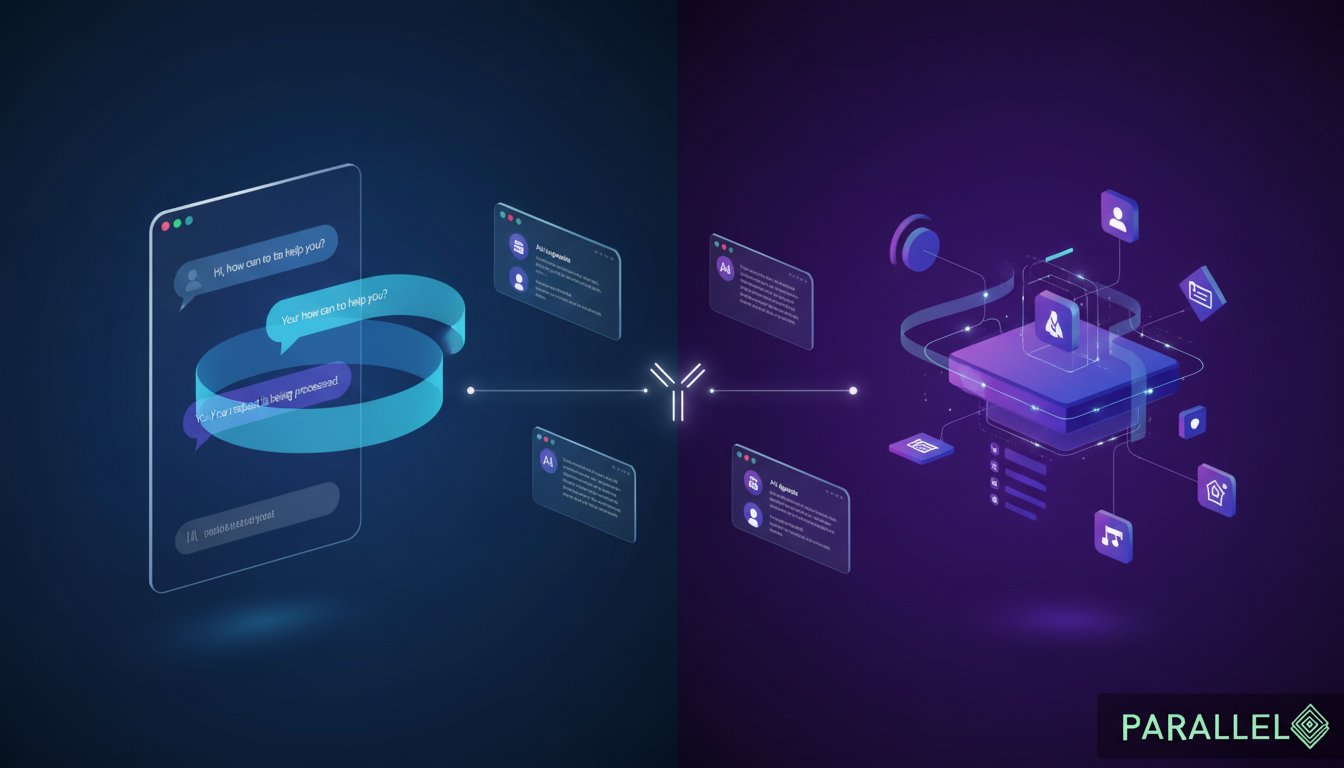
The white-label AI market presents agencies and consultants with a strategic dilemma that extends far beyond feature comparisons. As the conversational AI market surges toward $22 billion in 2025, business owners face a critical question: Should you invest in a specialized chatbot platform that excels at customer support, or choose a comprehensive automation ecosystem that transforms your entire service offering?
This isn’t a theoretical debate. The platform you select today determines whether you’ll build a scalable, profitable AI business or find yourself managing an increasingly fragmented tech stack that drains margins and limits growth. After analyzing both platforms extensively, the distinctions reveal strategic implications that most comparison articles completely overlook.
The Chatbot Specialization vs. Business Automation Divide
ChatNode positions itself as a white-label AI chatbot platform focused on customer support automation. The platform enables agencies to create AI support agents that handle inquiries 24/7, integrate with knowledge bases like Zendesk and Notion, and deploy across websites with no-code simplicity. For agencies whose primary value proposition centers on customer service automation, ChatNode offers a focused, straightforward solution.
Parallel AI takes a fundamentally different approach—it’s an all-in-one business automation platform that includes conversational AI as one component within a comprehensive ecosystem. The platform consolidates content creation, lead generation, sales sequences, workflow automation, omnichannel customer engagement, and multi-model AI access into a single unified system.
The strategic question isn’t which platform has better chatbot features—it’s whether your agency needs just chatbots or complete business transformation capabilities.
What ChatNode Does Exceptionally Well
ChatNode excels in its specialized domain. The platform’s no-code chatbot builder allows non-technical users to deploy customer support agents quickly, with human-like conversational capabilities and dynamic data integration. The visual interface makes it accessible for agencies serving clients who need straightforward support automation without technical complexity.
The platform offers white-labeling starting at the Scale plan, enabling agencies to remove ChatNode branding and add custom domains. For agencies exclusively focused on customer support automation, this represents a viable path to branded offerings. Integration with tools like Zapier and Make extends automation capabilities beyond the core chatbot functionality.
ChatNode’s pricing structure includes a free tier for basic experimentation, with paid plans scaling from Lite to Enterprise based on credits, AI actions, and team members. This tiered approach allows agencies to start small and expand as client needs grow.
The Critical Limitations That Emerge at Scale
The challenges with chatbot-specialized platforms surface when agencies attempt to scale beyond customer support. ChatNode’s architecture centers on conversational AI for support and engagement—it doesn’t include native capabilities for content creation at scale, comprehensive lead generation, multi-channel sales outreach, or workflow automation across business functions.
For agencies serving clients who need more than chatbots, this creates an immediate problem: you’ll need to integrate ChatNode with separate platforms for content creation (Jasper, Copy.ai), sales automation (Instantly.ai, Lemlist), lead generation (Clay, Apollo), and workflow management (Make, Zapier). This fragmented approach introduces several hidden costs:
Subscription Stack Expense: Industry analysis indicates agencies typically manage dozens of AI and software subscriptions, which can cost hundreds to thousands monthly. Each additional tool adds licensing fees, maintenance requirements, and support complexity.
Integration Tax: Connecting multiple specialized platforms requires technical expertise, ongoing maintenance, and introduces failure points. When one integration breaks, entire workflows collapse.
Context Loss: When customer data, content creation, and sales processes live in separate systems, your AI lacks the unified context necessary to deliver truly intelligent automation. Each tool operates in isolation rather than understanding your complete business ecosystem.
Client Confusion: Explaining to clients why they need five different platforms to accomplish what should be a unified AI strategy creates friction and undermines your positioning as a strategic partner.
The All-in-One Alternative: Complete Business Automation
Parallel AI addresses these limitations by consolidating capabilities that would typically require 8+ separate subscriptions into a single platform. This isn’t about cramming features into one interface—it’s about creating an ecosystem where AI capabilities share context, data, and intelligence across your entire business operation.
Multi-Model AI Access: The Foundation for Specialized Tasks
One of Parallel AI’s most significant differentiators is uncapped access to multiple leading AI models—OpenAI (GPT-4, GPT-5), Anthropic (Claude 3.5, Claude 4), Google (Gemini 2.5), Grok, DeepSeek, and Perplexity. This multi-model architecture matters far more than most agencies initially realize.
Different AI models excel at different tasks. GPT models deliver speed and conversational fluency ideal for customer interactions. Claude excels at complex reasoning and longer context windows, making it superior for contract analysis and strategic content. Gemini’s multimodal capabilities handle visual content exceptionally well. Having access to all models means you can optimize for each specific use case rather than forcing every task through a single model.
The cost implications are substantial. Subscribing to ChatGPT Plus ($20/month), Claude Pro ($20/month), and Gemini Advanced ($20/month) separately costs $60 monthly per user—and that’s just for basic access without automation capabilities. Parallel AI’s Entrepreneur plan at $99/month includes all models plus the complete automation platform, representing a $400+ monthly savings when you factor in the content, sales, and workflow tools you’d otherwise need.
Content Engine: Scaling Production Without Scaling Headcount
Parallel AI’s Content Engine represents a capability entirely absent from chatbot-focused platforms. The system employs specialized AI agents—Strategy Agent, Copywriting Agent, Customer Profile Agent, and Visual Agent—working in concert to produce 1-2 months of authentic, on-brand content in minutes.
For agencies, this transforms service delivery economics. Traditional content creation requires writers, editors, strategists, and designers—a team structure that doesn’t scale efficiently. Parallel AI users report publishing 80+ pieces of content monthly versus 10-15 before implementation, a productivity multiplier that fundamentally changes agency capacity.
The platform’s extensive context window (up to 1 million tokens) allows you to upload brand guidelines, company data, and training materials so the AI maintains consistent brand voice across all content. This isn’t generic AI writing—it’s AI that understands your client’s specific business context, audience, and strategic objectives.
Content is automatically optimized for multiple platforms (LinkedIn, Instagram, Facebook, YouTube, WordPress, TikTok, X) and can be scheduled for publication directly from the platform. This end-to-end workflow eliminates the manual coordination typically required across content creation, approval, and distribution.
Smart Lists + Sequences: AI-Powered Prospecting and Outreach
While ChatNode focuses on inbound customer inquiries, Parallel AI includes comprehensive outbound capabilities through Smart Lists and Sequences. This combination enables agencies to build AI-powered prospecting, enrichment, qualification, and 1:1 personalized outreach at scale.
Smart Lists leverage advanced AI models to identify ideal prospects using criteria that go beyond simple demographic filters—the system thinks like your best sales professionals, identifying behavioral patterns and contextual signals that indicate purchase intent. Once prospects are identified, Sequences automate multi-channel outreach across email, SMS, LinkedIn, and browser-based interactions.
This capability is particularly valuable for agencies serving B2B clients who need consistent lead generation. Rather than selling chatbot services as an isolated offering, you’re delivering complete sales automation that directly impacts revenue—a positioning that commands significantly higher fees and creates stickier client relationships.
Omnichannel AI Agents: Beyond Website Chatbots
Where ChatNode deploys chatbots primarily for website support, Parallel AI’s omnichannel agents operate across voice, SMS, website chat, and email—all while maintaining unified context. This architectural difference fundamentally changes what’s possible.
Consider a service-based consultant: a potential client might first encounter your business through a website chat inquiry, then receive a follow-up SMS with additional information, participate in a voice call for qualification, and finally receive personalized email content based on their specific interests. Parallel AI’s agents maintain context across all these touchpoints, creating a coherent experience that feels intelligent rather than robotic.
The platform supports optional voice cloning, allowing agencies to create AI agents that sound like specific team members or client representatives. For professional services firms concerned about maintaining personal relationships, this capability bridges the gap between automation efficiency and human authenticity.
These agents don’t just respond to inquiries—they handle support questions, qualify leads, book appointments, manage routine tasks, and escalate to humans only when necessary. The system syncs with CRM platforms, ensuring that every interaction enriches customer data rather than creating isolated conversational threads.
Workflows and Integration: Connecting Your Entire Tech Stack
Parallel AI includes native n8n integration for building multi-step AI workflows with 1000+ business integrations. Existing connections include Slack, Discord, Confluence, Google Drive, Notion, Zapier, WordPress, LinkedIn, AWS, SendGrid, Office 365, HeyGen, Twilio, Chrome, and Shopify.
This workflow capability transforms how agencies deliver automation. Instead of connecting point solutions through fragile API bridges, you’re building intelligent workflows where AI orchestrates actions across your entire business ecosystem. When a new lead enters your CRM, AI can automatically enrich their profile, generate personalized outreach sequences, create custom content based on their industry, and schedule follow-up tasks—all within a single automated workflow.
The platform’s Browser Tasks feature enables AI agents to navigate websites, extract data, monitor competitors, and complete complex multi-step workflows automatically. For agencies delivering competitive intelligence, lead enrichment, or market research services, this represents 30+ hours weekly of manual work that becomes fully automated.
White-Label Economics: The Profitability Equation
Both platforms offer white-labeling, but the economic models differ significantly in ways that impact agency profitability.
ChatNode’s white-label capabilities begin at the Scale plan, allowing custom branding and domain customization. The platform positions itself as a chatbot reseller opportunity—you brand the technology and sell it as your own customer support solution.
Parallel AI’s white-label model enables agencies to launch a complete branded AI platform in 48 hours. The base cost starts at $271/month (30% revenue share model), with agencies typically charging clients $497-$1,997/month depending on features and seats. This pricing structure creates profit margins of 30-63% on platform subscriptions alone.
The strategic advantage extends beyond percentage margins. When you’re selling comprehensive business automation rather than just chatbots, you’re positioned as a strategic partner rather than a technology vendor. This positioning commands premium pricing and creates stickier relationships—clients don’t leave partners who are actively driving revenue growth and operational efficiency across their entire business.
Most Parallel AI agency partners charge $1,500-$5,000 for professional onboarding and setup, separate from monthly subscriptions. This represents 100% margin revenue that doesn’t exist when you’re simply reselling chatbot access.
The Platform Consolidation Advantage
Industry analysis indicates that organizations managing multiple AI tools face substantial productivity losses from context switching, integration complexity, and tool fatigue. IT leaders report that consolidating platforms can reduce costs by 20-30% while simultaneously improving operational efficiency.
For agencies, this consolidation advantage is even more pronounced. When you deliver client services through a unified platform, you’re not managing separate logins, reconciling data across systems, or troubleshooting integration failures. Your team operates from a single dashboard where all AI capabilities share context and intelligence.
This operational simplicity translates directly to profitability. Time your team would spend managing fragmented tools instead goes toward client strategy, service delivery, and business development. The ability to serve more clients without proportionally increasing operational overhead represents the scalability that transforms agencies from service providers into platforms.
Implementation Reality: Technical Complexity and Time-to-Value
ChatNode’s no-code chatbot builder offers quick deployment for basic customer support use cases. Agencies can have a branded chatbot live on a client’s website within hours, making it accessible for non-technical teams focused on straightforward implementations.
The challenge emerges when clients need capabilities beyond chatbots. Integrating ChatNode with content platforms, sales automation tools, and workflow systems requires technical expertise. Each integration point introduces configuration complexity, testing requirements, and ongoing maintenance—work that reduces your effective margins and extends time-to-value.
Parallel AI’s comprehensive platform includes a steeper initial learning curve because you’re mastering multiple capabilities simultaneously. However, the platform provides a unified implementation path. Instead of configuring eight separate tools and connecting them through integration layers, you’re learning one system that handles all functions natively.
Time-to-value statistics demonstrate this advantage. Parallel AI clients report having branded platforms operational within 48 hours, with full automation workflows delivering measurable results within 30 days. The platform’s extensive knowledge base integration means AI understands client context immediately rather than requiring separate training for each specialized tool.
The Strategic Decision Framework
Choosing between ChatNode and Parallel AI ultimately depends on your agency’s strategic vision and the value you intend to deliver.
Choose ChatNode if:
- Your agency exclusively focuses on customer support automation
- Clients need straightforward chatbot deployment without broader automation requirements
- You’re comfortable managing multiple specialized platforms for content, sales, and workflows
- Your service model centers on technology implementation rather than strategic transformation
- Budget constraints make comprehensive platforms prohibitive
Choose Parallel AI if:
- You want to position as a complete business automation partner, not just a chatbot vendor
- Clients need content creation, lead generation, sales automation, and customer engagement in addition to support
- Consolidating multiple AI subscriptions into one platform creates operational and cost advantages
- You’re building a scalable white-label business with recurring revenue from comprehensive services
- Access to multiple leading AI models for different specialized tasks matters for service quality
- Time-to-value and reduced technical complexity justify comprehensive platform investment
The Unspoken Reality About Platform Selection
Most comparison articles present platform selection as a features checklist. The strategic reality is more nuanced. The platform you choose determines the services you can offer, the clients you can serve, the prices you can command, and ultimately whether you build a scalable business or remain trapped in the service provider’s dilemma of trading time for money.
Chatbot platforms like ChatNode represent incremental improvements to existing business models. You help clients automate customer support, which creates value but doesn’t fundamentally transform their business or yours.
Comprehensive automation platforms like Parallel AI enable transformational positioning. You’re not selling chatbot implementation—you’re delivering complete business transformation through AI. Your clients don’t just answer support tickets faster; they generate more content, close more deals, automate entire workflows, and scale operations without proportionally scaling headcount.
This positioning difference determines whether clients view you as a vendor providing technology or a partner driving strategic outcomes. Partners command higher fees, enjoy longer retention, and build businesses with enterprise value rather than freelance income.
Making the Decision That Shapes Your Business
The conversational AI market’s trajectory toward $40 billion by 2030 creates enormous opportunity for agencies and consultants who position strategically. The question isn’t whether to adopt AI automation—it’s whether to specialize narrowly or embrace comprehensive capabilities that differentiate your offering.
For agencies building sustainable, scalable businesses, platform consolidation represents more than cost savings. It’s about operational leverage—the ability to serve more clients, deliver broader value, and capture higher margins without proportionally increasing your team or complexity.
ChatNode delivers focused chatbot capabilities for agencies whose strategy centers exclusively on customer support automation. For those agencies, specialization creates clarity and simplicity.
Parallel AI delivers comprehensive business automation for agencies building strategic partnerships that transform how clients create content, generate leads, automate sales, and engage customers across every channel. The platform’s multi-model AI access, content engine, sales automation, workflow capabilities, and omnichannel agents consolidate what would typically require 8+ subscriptions into a single unified ecosystem.
The platform you choose today determines the business you’ll build tomorrow. Choose strategically, understanding that this decision shapes not just your technology stack, but your market positioning, client relationships, profitability model, and ultimate scalability.
The agencies thriving in 2025’s AI-driven landscape aren’t those with the most specialized tools—they’re those who deliver comprehensive transformation through unified platforms that make the complex simple and the impossible routine. That fundamental shift from vendor to partner, from implementation to transformation, defines the future of agency success in the AI era.
Ready to explore how comprehensive business automation positions your agency for strategic differentiation? Schedule a demo to see how Parallel AI consolidates your entire AI stack into one platform that transforms client delivery and agency economics.