
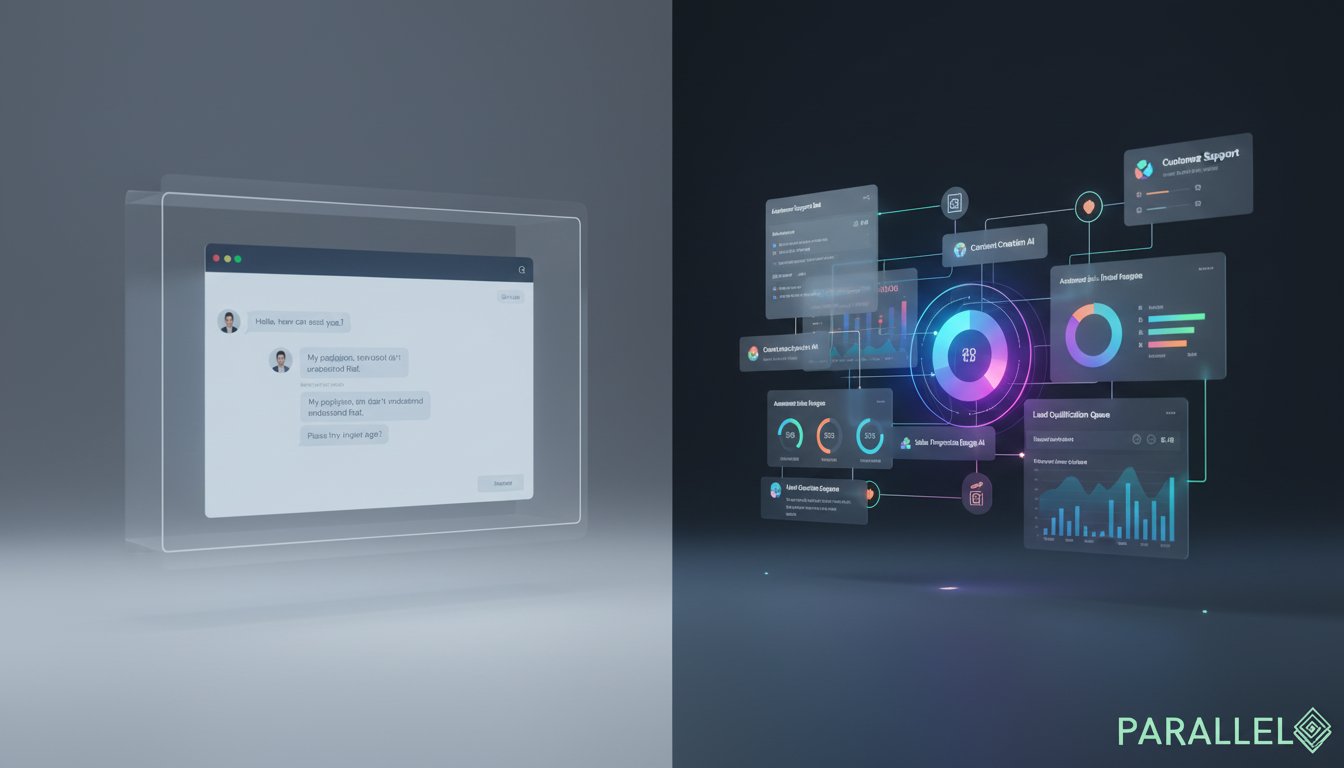
You’ve just landed a dream client—a growing e-commerce brand that needs everything: AI-powered customer support, content marketing automation, sales prospecting, and lead qualification. They want it all under one roof, branded as your solution. You have two platforms on your shortlist: Chatbase and Parallel AI.
On paper, both offer white-label capabilities and AI automation. But here’s the brutal reality most agencies discover too late: one platform will turn you into a premium AI automation partner generating $2,000-5,000 monthly retainers per client, while the other will pigeonhole you as “just another chatbot vendor” competing on price in an increasingly commoditized market.
This isn’t a typical feature comparison. This is a strategic analysis of two fundamentally different approaches to AI automation—and why choosing the wrong one could cost you six figures in lost revenue over the next 12 months. Whether you’re a solopreneur building your first AI offering or an established agency expanding your service stack, the platform you choose today will determine whether you’re selling $199/month chatbots or $3,500/month comprehensive AI automation solutions.
The Fundamental Difference Nobody Talks About
Before diving into features and pricing, let’s address the elephant in the room: Chatbase and Parallel AI aren’t really competitors—they’re built for entirely different business models.
Chatbase is a specialized customer support automation platform. It excels at one thing: building AI chatbots that handle customer inquiries, integrate with support tools like Zendesk and Salesforce, and provide analytics on customer interactions. If your primary service offering is “AI-powered customer support,” Chatbase delivers exactly that.
Parallel AI is a comprehensive business automation ecosystem. It consolidates six premium AI models (OpenAI GPT-4, Claude 3 Opus, Gemini Pro, Grok, DeepSeek, and more), content creation engines, sales prospecting tools, omni-channel agents, and knowledge base integration into a single white-label platform. If you’re selling “AI transformation” rather than just chatbots, Parallel AI provides the infrastructure to deliver it.
Here’s why this distinction matters: the average agency using Chatbase charges clients $199-499/month for chatbot deployment and management. The average agency using Parallel AI charges $1,500-5,000/month for comprehensive AI automation that includes content creation, lead generation, customer engagement, and strategic consulting. Same effort. Wildly different revenue.
White-Label Capabilities: The $2,388 Annual Difference
Let’s talk about what “white-label” actually costs on each platform—because the pricing structures reveal fundamentally different philosophies about who should access enterprise branding.
Chatbase’s White-Label Economics:
– Custom domains: $59/month ($708/year)
– Removing “Powered by Chatbase” branding: $199/month ($2,388/year)
– Total annual cost for full white-label: $3,096 per year
– Applies only to chatbot widgets and customer-facing interfaces
This pricing model makes sense if you’re deploying chatbots for Fortune 500 companies with deep pockets. But for solopreneurs and micro-agencies serving 5-15 small business clients, paying $258/month just for branding removal creates a difficult margin equation. You’re forced to either absorb the cost (killing profitability) or pass it to clients (making you less competitive).
Parallel AI’s White-Label Economics:
– Full white-label branding included in standard plans
– Custom logos, colors, and domains at no additional cost
– Clients never see “Parallel AI”—only your brand
– Applies to entire platform: content engine, sales tools, chatbots, dashboards, and client portals
The economic implications are profound. A solopreneur serving eight clients saves $3,096 annually with Parallel AI’s included white-label features—money that can fund marketing, hire contractors, or simply improve profit margins. More importantly, you’re not making margin-killing decisions about which clients “deserve” the branded experience.
The Multi-Model Advantage: Why One AI Isn’t Enough Anymore
Here’s a reality that became painfully clear in 2024: different AI models excel at different tasks. GPT-4 Turbo delivers superior reasoning for complex analysis. Claude 3 Opus excels at nuanced writing and content creation. Gemini Pro offers the best price-performance ratio for high-volume tasks. Grok brings real-time information access. DeepSeek provides specialized capabilities for technical content.
Clients don’t care about the underlying models—they care about results. But you should care deeply, because model selection directly impacts quality, speed, and cost.
Chatbase’s Model Approach:
– Allows comparison between different AI models for chatbot optimization
– Primary focus on customer support conversation quality
– Model selection optimizes for response accuracy and escalation reduction
– Limited visibility into which models power which interactions
This approach makes sense for Chatbase’s use case. Customer support chatbots need consistency and accuracy, not necessarily the bleeding-edge capabilities of six different AI models.
Parallel AI’s Multi-Model Infrastructure:
– Access to 6+ premium AI models: OpenAI GPT-4 & GPT-4 Turbo, Claude 3 Opus & Sonnet, Gemini Pro, Grok, DeepSeek
– Switch models per task for optimal results
– Use Claude for blog writing, GPT-4 for strategic analysis, Gemini for social media content, Grok for trending topic research
– Context windows up to 1 million tokens enable unprecedented document analysis
Real-world impact: An agency using Parallel AI can generate a client’s monthly content calendar (12 blog posts, 60 social posts, 8 email sequences) by routing tasks to the optimal model for each format. Total cost: approximately $40-60 in AI credits. Total client charge: $1,200-2,000 for “managed content service.” The multi-model approach isn’t just about quality—it’s about margin optimization.
A Chatbase-only agency would need to contract with separate content creation tools, social media schedulers, and email marketing platforms—each with their own costs, learning curves, and integration headaches. The operational complexity alone limits how many clients you can serve profitably.
Beyond Chatbots: The Revenue Ceiling Problem
Let’s run a scenario that plays out in agencies every month:
A marketing consultant lands a $50,000/year retainer client who needs comprehensive digital transformation: customer support automation, content marketing, lead generation, sales enablement, and strategic reporting.
With Chatbase (Chatbot-Focused Approach):
– Deploy AI customer support chatbot: $399/month
– Contract with Jasper or Copy.ai for content: $199/month
– Use HubSpot or similar for lead generation: $800/month
– Hire VA for social media management: $500/month
– Use Zapier for workflow automation: $99/month
– Total monthly tool stack cost: $1,997
– Monthly retainer needed to maintain 50% margin: $3,994
– Services you can credibly deliver: Customer support automation + basic content
You’ve assembled a Frankenstein tech stack with five different logins, inconsistent branding, integration challenges, and limited cross-platform intelligence. When the client asks, “Can your AI chatbot learn from our blog content to give better answers?” you’re explaining why that requires another integration project.
With Parallel AI (Comprehensive Automation Approach):
– Complete platform cost: $40-200/month (depending on usage)
– AI customer support with knowledge base integration: Included
– Content creation engine (blogs, social, emails): Included
– Sales prospecting and lead enrichment: Included
– Workflow automation: Included
– White-label client dashboards: Included
– Total monthly tool stack cost: $40-200
– Monthly retainer needed to maintain 50% margin: $80-400
– Services you can credibly deliver: Everything
The same consultant can charge $2,500-4,000/month and maintain 85-95% margins while delivering genuinely integrated AI automation. When the client asks about chatbot-content integration, the answer is, “Already built in—your chatbot is trained on every blog post, case study, and FAQ in your knowledge base.”
This isn’t just about profit margins. It’s about the strategic positioning that unlocks premium pricing. Chatbot vendors compete on features and price. AI transformation partners compete on business outcomes and ROI. The market pays dramatically different rates for these positions.
Knowledge Base Integration: The Intelligence Multiplier
Every AI platform claims “knowledge base integration.” But the implementation details determine whether this feature is a game-changer or checkbox marketing.
Chatbase’s Knowledge Base Approach:
– Designed primarily for customer support documentation
– Integrates with support tools like Zendesk and help desk platforms
– Focus on reducing support ticket volume and improving response accuracy
– Analytics emphasize containment rate and escalation metrics
This is exactly what you want if you’re deploying support chatbots. The knowledge base exists to answer customer questions more accurately and reduce the load on human support teams.
Parallel AI’s Knowledge Base Architecture:
– Enterprise knowledge base with persistent memory across all platform features
– Integrates Google Drive, Confluence, Notion, and custom document repositories
– Context windows up to 1 million tokens process entire document libraries
– Knowledge informs: content creation, sales outreach, chatbot responses, strategic analysis, client reporting
– Train AI on client brand guidelines, voice, competitive intelligence, and historical data
The strategic difference: Chatbase’s knowledge base makes your chatbot smarter. Parallel AI’s knowledge base makes your entire service offering smarter.
Consider a real estate agency client. With Chatbase, you upload property listings and FAQs so the chatbot can answer prospect questions. With Parallel AI, you upload the same documents plus neighborhood demographic reports, historical sales data, and marketing guidelines. Now the platform can:
- Generate property description blog posts that match the client’s brand voice
- Create neighborhood spotlight social media content based on demographic insights
- Draft personalized email sequences referencing comparable sales in the prospect’s target area
- Power a chatbot that answers questions about specific properties
- Produce monthly market analysis reports comparing current listings to historical trends
One knowledge base. Six revenue-generating applications. That’s the difference between a feature and an ecosystem.
Sales and Marketing Automation: The Expansion Revenue Opportunity
Here’s a pattern successful agencies discovered in 2024: the initial chatbot deployment is the entry point, but the real revenue comes from expanding into content creation, lead generation, and sales automation.
The challenge? If your platform can’t deliver these capabilities, you’re either leaving money on the table or cobbling together additional tools (destroying your margins and operational efficiency).
Chatbase’s Service Expansion Path:
– Core strength: Customer support automation
– Expansion opportunities: Additional chatbot deployments, advanced analytics, deeper CRM integration
– Content and sales tools: Require separate platforms
– Typical expansion revenue: 20-30% increase through upselling chatbot features
Agencies often hit a revenue ceiling around $800-1,200/month per client. To grow, you’re acquiring more clients rather than expanding account value—a much more expensive growth strategy.
Parallel AI’s Service Expansion Path:
– Entry point: Often customer support or content automation
– Expansion opportunities: Content marketing, social media management, sales prospecting, lead qualification, strategic reporting, multi-channel agents
– Everything included in one platform
– Typical expansion revenue: 200-400% increase through service expansion
Real example from the Parallel AI knowledge base: A HighLevel agency starts with a $500/month “Managed Content Service” (weekly blogs, social posts, email campaigns). After demonstrating value, they expand to:
- Month 3: Add “Hyper-Personalized Email Sequences” (+$400/month)
- Month 5: Deploy “AI-Powered Lead Intelligence” (+$600/month)
- Month 7: Implement “Strategic Reporting & Insights” (+$800/month)
- Month 9: Launch “Multi-Channel Conversational Agents” (+$500/month)
Total account value grows from $500 to $2,800/month with the same client—without switching platforms, learning new tools, or managing integration headaches. The expansion path is built into the platform architecture.
The Pricing Reality Check: Total Cost of Ownership
Marketing websites show you monthly subscription prices. But smart agencies calculate total cost of ownership: platform fees + integration costs + training time + operational overhead + opportunity cost of limitations.
Chatbase Total Cost Analysis (Annual):
– Base subscription: Varies by tier (free to enterprise)
– White-label branding: $3,096/year
– API access: Included in higher tiers
– Additional tools needed for complete service delivery:
– Content creation platform: $2,388/year
– Email marketing: $3,600/year
– Social media management: $1,800/year
– Sales automation: $4,800/year
– Integration and workflow management (Zapier, etc.): $1,200/year
– Training time for multiple platforms: 40-60 hours
– Total annual cost: $16,884+ plus base subscription
This doesn’t include the operational overhead of managing five different platforms, troubleshooting integration failures, or explaining to clients why their chatbot can’t access information from their content marketing system.
Parallel AI Total Cost Analysis (Annual):
– Base subscription: $0-2,400/year (depending on tier)
– White-label branding: Included
– All business automation features: Included
– Additional tools needed: None for core service delivery
– Integration management: Minimal (single platform)
– Training time: 8-12 hours for comprehensive platform mastery
– Total annual cost: $0-2,400
The $14,000+ annual difference is just the beginning. The real cost is operational: context-switching between platforms, managing integration failures, reconciling data across systems, and explaining to clients why their “integrated AI solution” requires five different logins.
For a solopreneur serving eight clients, that’s 320-480 hours annually (8-12 weeks of full-time work) saved by using a unified platform. At a $150/hour billing rate, that’s $48,000-72,000 in additional capacity you can sell.
Who Should Choose Chatbase
Despite this comparison’s focus on Parallel AI’s advantages, Chatbase is genuinely the better choice for specific use cases. Let’s be honest about when it makes sense:
Choose Chatbase if you:
– Specialize exclusively in customer support automation
– Serve enterprise clients with dedicated support teams and $10,000+ monthly budgets
– Need deep integrations with enterprise support tools like Zendesk, Salesforce Service Cloud, or Freshdesk
– Have clients willing to pay premium prices specifically for best-in-class chatbot optimization
– Already have separate tools for content, marketing, and sales that you’re committed to maintaining
– Value specialized depth in one area over platform breadth
Chatbase’s laser focus on customer support creates genuine advantages for agencies positioned in this niche. If you’re selling to VP-level decision makers at companies with 500+ employees who need SOC 2 Type II compliance and advanced support analytics, Chatbase’s enterprise positioning and specialized features justify the premium pricing.
The platform’s analytics are genuinely sophisticated, offering insights into containment rates, escalation patterns, customer satisfaction, and chatbot performance optimization that general-purpose platforms can’t match. For large support operations processing thousands of conversations daily, these analytics drive meaningful cost savings.
Who Should Choose Parallel AI
Parallel AI is built for a different business model—one that’s increasingly dominant among successful solopreneurs and micro-agencies in 2025:
Choose Parallel AI if you:
– Want to offer comprehensive AI automation, not just chatbots
– Serve small to mid-size businesses (5-500 employees) that need multiple AI-powered services
– Value high profit margins (80-95%) over high absolute revenue per client
– Want to expand account value through service expansion rather than just client acquisition
– Need true white-label capabilities without premium upcharges
– Prefer a unified platform over managing multiple specialized tools
– Want to position as an “AI transformation partner” rather than a “chatbot vendor”
The platform’s comprehensive approach creates a fundamentally different business model. Instead of selling a single service (chatbots) and competing on features and price, you’re selling business transformation and competing on outcomes and ROI.
Real-world validation from the knowledge base: Solo consultants are using Parallel AI to deliver services previously requiring a team of specialists. One financial advisor compressed 32-hour comprehensive planning processes into 4.5 hours. A solo event planner reduced 35-hour conference builds to 5.5 hours. These aren’t incremental improvements—they’re business model innovations that create sustainable competitive advantages.
The Strategic Decision Framework
Here’s how to make this decision strategically rather than emotionally:
Step 1: Define Your Positioning
Are you a specialist or a generalist? Specialists command premium prices in narrow niches. Generalists scale by serving broader needs at slightly lower rates. Neither is wrong—they’re different strategies requiring different tools.
Chatbase supports specialist positioning in customer support automation. Parallel AI supports generalist positioning in comprehensive business automation.
Step 2: Calculate Your Revenue Model
How many clients can you realistically serve, and what’s your target revenue per client?
- If your model is 5-10 enterprise clients at $5,000-15,000/month each: Specialized tools like Chatbase (plus content, sales, and marketing platforms) make sense
- If your model is 15-50 small business clients at $1,500-3,500/month each: Unified platforms like Parallel AI maximize margin and operational efficiency
Step 3: Assess Your Expansion Strategy
How will you grow revenue? Through client acquisition or account expansion?
- Client acquisition growth requires sales and marketing investment; platform costs are secondary
- Account expansion growth requires service breadth; platform capabilities are primary
Step 4: Evaluate Your Technical Comfort
Be honest about integration complexity. Managing five platforms requires technical competence and troubleshooting patience.
- If you have development resources or enjoy technical challenges: Multi-platform stacks are manageable
- If you want to focus on client service and business development: Unified platforms reduce operational overhead
The 2025 Reality: Comprehensive Automation Wins
Here’s the uncomfortable truth for chatbot-focused platforms: the market is evolving beyond single-purpose tools.
Businesses don’t want to buy a chatbot, a content creation tool, a sales automation platform, and a marketing suite. They want integrated AI automation that solves multiple problems through a unified interface. They want one vendor, one contract, one support relationship, one source of truth.
Agencies that can deliver this integrated experience command premium pricing and experience dramatically lower churn. Those selling point solutions increasingly compete in commoditized markets where clients evaluate based on features and price rather than strategic value.
The data supports this shift. According to market trends in white-label AI platforms, agencies are increasingly seeking “comprehensive business automation” over “single-feature tools.” The pain points cited most frequently: “limited customization, lack of integration flexibility, and inability to serve broader automation purposes.”
This doesn’t mean chatbot-focused platforms are obsolete. It means they serve an increasingly narrow slice of the market—enterprises with specialized needs and budgets to match. For the vast majority of solopreneurs and micro-agencies serving small to mid-size businesses, comprehensive platforms deliver better business outcomes.
Making the Decision: Your 30-Day Evaluation Plan
Don’t choose based on this article alone. Here’s a structured 30-day evaluation process:
Week 1: Define Requirements
– List every service you currently offer or plan to offer in the next 12 months
– Calculate your current tool stack cost (subscriptions + integration + management time)
– Define your ideal client profile and revenue targets
– Identify your core differentiation: specialist expertise or comprehensive solutions?
Week 2: Platform Testing
– Sign up for free trials of both platforms
– Build a sample chatbot on Chatbase
– Create a sample content automation workflow on Parallel AI
– Evaluate ease of use, feature depth, and output quality
– Test white-label branding capabilities
Week 3: Economic Modeling
– Calculate total cost of ownership for each approach (platform + additional tools)
– Model profit margins at different client price points
– Estimate time savings from consolidated platforms vs. specialized tools
– Project 12-month revenue under each scenario
Week 4: Client Validation
– Present mock service offerings based on each platform to 3-5 ideal prospects
– Gauge reaction to pricing and scope
– Ask which services they’d prioritize: chatbots only or comprehensive automation?
– Validate whether your market pays premium for specialization or breadth
This process transforms an emotional decision (“Which platform feels better?”) into a strategic one (“Which platform enables my business model?”).
The Uncomfortable Truth About Platform Selection
Here’s what most comparison articles won’t tell you: your platform choice matters less than your business model clarity.
Agencies fail not because they chose the wrong tool, but because they chose a tool without first defining their positioning, pricing strategy, and ideal client profile. A specialized chatbot platform succeeds brilliantly for agencies with enterprise clients and specialist positioning. A comprehensive automation platform succeeds brilliantly for solopreneurs and micro-agencies serving small businesses with multiple needs.
The question isn’t “Which platform is better?” It’s “Which platform aligns with the business I’m actually building?”
Chatbase builds better chatbots with superior support analytics and enterprise integrations. If customer support automation is your core offering and you serve clients with dedicated support teams, that specialization creates defensible value.
Parallel AI builds better business automation ecosystems with comprehensive features, multi-model AI, and true white-label capabilities. If AI transformation is your core offering and you serve clients who need content, sales, marketing, and support automation, that breadth creates defensible value.
Neither approach is wrong. They serve different markets, solve different problems, and enable different business models.
Your Next Steps
By now, you likely have a sense of which platform aligns with your business model. But intuition isn’t enough—validate with data.
If you’re leaning toward Chatbase, your validation question is: “Can I realistically charge $5,000-10,000/month for specialized customer support automation, or will I compete on price in a commoditized market?” If you can command premium pricing for specialized expertise, Chatbase’s depth justifies its costs and limitations.
If you’re leaning toward Parallel AI, your validation question is: “Can I deliver comprehensive AI automation services profitably, or will operational complexity from managing multiple client needs create chaos?” If you can systematize service delivery across content, sales, marketing, and support, Parallel AI’s breadth creates sustainable competitive advantages.
For most solopreneurs and micro-agencies reading this—those serving small to mid-size businesses, seeking 80-95% profit margins, and positioning as AI transformation partners rather than chatbot vendors—Parallel AI delivers superior business outcomes. The economics simply work better: $0-200/month platform cost, complete white-label branding included, comprehensive automation features enabling $1,500-5,000/month client retainers, and operational simplicity that lets you serve more clients profitably.
The platform consolidates what would otherwise require 5-7 separate tools into a unified ecosystem, saving $14,000+ annually while eliminating integration headaches and operational overhead. More importantly, it enables a business model based on account expansion rather than perpetual client acquisition—a dramatically more profitable and sustainable growth strategy.
Ready to see if Parallel AI’s comprehensive automation approach fits your business model? The platform offers a free tier that lets you test the complete feature set, from content creation and sales prospecting to knowledge base integration and omni-channel agents, without credit card commitment.
Start your free Parallel AI account and build your first white-label automation workflow today, or schedule a demo call to see how agencies are generating $2,000-5,000 monthly retainers per client using the platform’s comprehensive business automation capabilities.
The question isn’t whether AI automation will define successful agencies in 2025—it’s whether you’ll deliver it as a commoditized chatbot vendor or a premium transformation partner. Your platform choice makes that decision for you.