
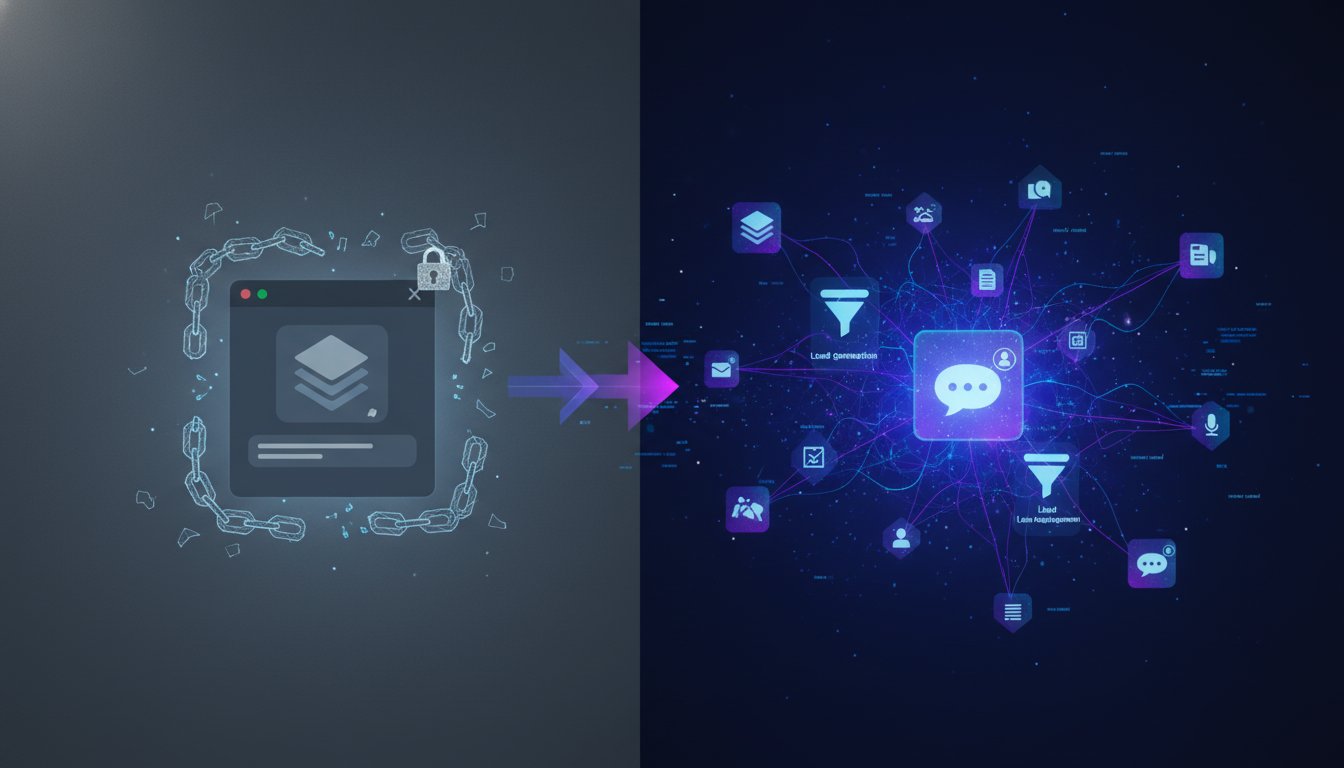
The chatbot revolution promised to transform how small businesses interact with customers. Yet thousands of solopreneurs and micro-agencies who invested in customer support chatbot platforms now face an uncomfortable truth: chatbots alone don’t build scalable service businesses. They answer questions, but they don’t create content. They engage visitors, but they don’t generate leads. They handle support tickets, but they don’t automate your entire workflow.
This realization has created a critical decision point for independent consultants in 2025. Should you invest in a specialized chatbot platform like Chatbase that excels at one specific function, or choose a comprehensive automation ecosystem like Parallel AI that consolidates content creation, lead generation, customer engagement, and white-label capabilities into a single platform? For service-based businesses operating on tight margins with limited resources, this choice will fundamentally shape your competitive positioning, profitability, and capacity to scale without adding headcount.
This comprehensive analysis cuts through the marketing noise to examine what each platform actually delivers for solopreneurs and micro-agencies building scalable consulting businesses. We’ll explore the hidden costs of single-purpose tools, the revenue implications of choosing narrow versus comprehensive automation, and the specific scenarios where each platform makes strategic sense.
The Chatbot Trap: Why Customer Support Automation Alone Won’t Scale Your Consulting Business
Chatbase has built a solid reputation as a customer support chatbot platform. Their core value proposition is straightforward: train an AI agent on your business data, deploy it across multiple channels (web, WhatsApp, Messenger, Slack), and automate customer support interactions in over 80 languages. For businesses receiving high volumes of repetitive customer inquiries, this delivers measurable efficiency gains.
The platform offers white-label customization, allowing agencies to remove Chatbase branding and create a seamless brand experience for clients. Their security credentials are enterprise-grade, with SOC 2 Type II and GDPR compliance, encryption protocols, and data privacy controls that satisfy even risk-averse clients. Integration capabilities connect to CRM systems and order management platforms, enabling chatbots to execute actions within client systems.
The Fundamental Limitation
Here’s the strategic problem: customer support chatbots represent just one narrow function in the complex ecosystem required to run a modern consulting business. Chatbase excels at reactive customer engagement—answering questions visitors already have about products or services that already exist. But solopreneurs and micro-agencies don’t primarily need better ways to answer customer questions. They need systems that create the content that attracts customers in the first place, qualify leads before they become conversations, and automate the entire client journey from discovery to conversion.
Consider the actual workflow of a typical marketing consultant or business strategist. You need to publish consistent thought leadership content across LinkedIn, blogs, and social platforms to demonstrate expertise and attract qualified prospects. You need lead generation systems that identify potential clients, personalize outreach sequences, and nurture relationships across email, social, and SMS. You need proposal generation tools that transform discovery conversations into professional service packages. You need workflow automation that handles client onboarding, project management, and reporting.
A customer support chatbot addresses none of these core business functions. It’s a valuable tool for businesses with high support volumes, but it doesn’t build your pipeline, create your content, or automate your service delivery. For independent consultants, this creates a problematic technology stack: you’ll still need separate subscriptions for content creation (Jasper, Copy.ai), lead generation (Instantly.ai, Lemlist), CRM and automation (HubSpot, ActiveCampaign), proposal software, and project management tools. The cost quickly exceeds $500-800 monthly, and you’re still manually coordinating between fragmented systems.
The Message-Based Pricing Uncertainty
Chatbase’s pricing model introduces another challenge for growing agencies: message-based or usage-based billing. While this appears cost-effective during initial deployment, it creates unpredictable expenses as usage scales. A successful chatbot that engages more customers generates higher monthly bills—penalizing you for success. For agencies managing multiple client chatbots, this variability complicates financial forecasting and margin protection, especially when clients expect fixed monthly retainers.
The Comprehensive Automation Alternative: Building Complete Business Systems
Parallel AI approaches the automation challenge from a fundamentally different perspective. Rather than optimizing one narrow function (customer support), the platform consolidates the entire technology stack required to run a scalable consulting business into a unified ecosystem. This architectural difference has profound implications for operational efficiency, total cost of ownership, and competitive capability.
Unified AI Model Access: The Foundation for Business Automation
At the platform’s core is uncapped access to every major AI model—OpenAI, Anthropic Claude, Google Gemini, Grok, DeepSeek, and Perplexity—with context windows reaching one million tokens. This isn’t a minor technical specification; it’s the foundation that enables sophisticated business automation across every function.
For independent consultants, this means you can leverage the most appropriate AI model for each specific task without managing multiple subscriptions or worrying about usage caps. Content creation for a B2B manufacturing client might perform best with Claude’s nuanced reasoning, while rapid social media content generation might leverage GPT-4’s speed. You’re not locked into a single model’s capabilities or paying $20-60 monthly for each individual AI subscription.
The cost savings alone are substantial. Where you’d previously pay for ChatGPT Plus ($20), Claude Pro ($20), Gemini Advanced ($20), and specialized tools like Jasper ($49-125), Parallel AI provides unlimited access to all models starting at $99 monthly for solopreneurs—immediately saving $60-170 monthly while expanding capabilities.
Content Engine: Automating the Entire Content Lifecycle
Here’s where the strategic difference becomes tangible. Parallel AI’s Content Engine doesn’t just generate individual pieces of content—it automates the complete content production workflow that consulting businesses need to maintain consistent market presence.
The system employs specialized AI agents working in concert. The Strategy Agent analyzes your business positioning, target audience, and goals to develop comprehensive content strategies aligned with platform algorithms and industry best practices. The Customer Profile Agent creates detailed ideal customer profiles ensuring every piece of content resonates with your specific audience segments. The Copywriting Agent produces platform-optimized content maintaining consistent brand voice across LinkedIn, Instagram, Facebook, Twitter, YouTube, and blogs. The Visual Agent generates on-brand imagery eliminating expensive photoshoot requirements.
The practical impact for a solo marketing consultant is transformative. Instead of spending 20-25 hours weekly creating content across platforms, you can generate 1-3 months of authentic, on-brand content in minutes. The platform includes integrated scheduling, enabling you to create, review, edit, and schedule complete content calendars without switching between tools. WordPress integration allows direct publishing, while RSS feed capabilities ensure content distribution across all channels.
For agencies serving multiple clients, the multiplication effect is even more dramatic. A two-person agency managing five client content programs would traditionally require 100-125 hours weekly of content production—essentially impossible without hiring additional staff or severely limiting client load. With automated content generation, that same agency can serve 15-20 clients with the same team, fundamentally changing unit economics and profitability.
Smart Lists and Sequences: Lead Generation That Actually Fills Your Pipeline
Chatbase doesn’t address lead generation—it assumes prospects already exist and are visiting your website. Parallel AI’s Smart Lists and Sequences functionality solves the more fundamental challenge: systematically identifying and engaging qualified prospects before they’re actively searching for your services.
The Smart Lists feature enables sophisticated lead identification based on industry, company size, role, technology stack, and behavioral signals. For a sales consultant targeting B2B SaaS companies with 20-100 employees in the Southeast, the system can build targeted prospect lists with contact information, company intelligence, and engagement triggers.
Sequences then automate multi-channel outreach across email, LinkedIn, SMS, and voice—the personalized, persistent engagement that converts cold prospects into qualified conversations. Rather than manually sending 30-40 personalized messages weekly (the realistic human limit), you can orchestrate sequences reaching 200-300 prospects weekly with contextually relevant messaging that adapts based on engagement signals.
The revenue implications are direct. A business strategist charging $7,500 for strategy engagements needs roughly 12-15 qualified conversations to close one client monthly. Traditional manual outreach might generate 3-4 qualified conversations weekly (12-16 monthly), barely supporting one new client. Automated sequences generating 12-15 qualified conversations weekly (48-60 monthly) support 3-4 new clients monthly—transforming a $90K annual business into a $270-360K operation without hiring sales staff.
Omni-Channel AI Agents: Beyond Chatbots to Complete Customer Engagement
When we examine customer engagement capabilities, the architectural difference between platforms becomes clear. Chatbase provides sophisticated chatbots for text-based conversations across web and messaging channels. Parallel AI’s Omni-Channel Agents extend far beyond text chat to include voice AI for inbound and outbound calls, SMS automation, website chat, and messaging platform integration—all maintaining conversation context across every touchpoint.
This matters because modern customer journeys are inherently multi-channel. A prospect might discover your content on LinkedIn, visit your website and engage with chat, receive an email sequence, respond via SMS, and eventually schedule a phone call. With single-purpose chatbots, each interaction exists in isolation—you’re manually coordinating information between systems and losing context at every transition.
Parallel AI’s agents maintain unified conversation history across all channels, syncing with your CRM to create coherent, context-aware interactions regardless of how prospects choose to engage. When that prospect calls after receiving three emails and two LinkedIn messages, your voice AI agent understands the complete relationship history and can continue the conversation naturally.
For service businesses, this enables sophisticated automation of the entire customer journey. Voice AI can handle inbound lead qualification calls, outbound appointment setting, customer onboarding, and routine check-ins—functions that traditionally require human staff or remain completely manual. A solo consultant can deliver Fortune 500-level responsiveness and engagement without hiring a team.
Knowledge Base Integration: AI That Actually Knows Your Business
Both platforms allow training AI on your business data, but the scope and application differ significantly. Chatbase focuses primarily on customer support knowledge—product information, FAQs, policies, and procedures that enable chatbots to answer customer questions accurately.
Parallel AI’s Knowledge Base integration connects to Google Drive, Notion, Confluence, and databases, but leverages this information across every platform function—not just customer support. Your brand guidelines, client case studies, service methodologies, industry research, and past project deliverables inform content creation, ensuring every blog post, social update, and email reflects your authentic expertise and voice. Lead generation sequences reference specific case studies relevant to each prospect’s industry. Proposal generation pulls from your service frameworks and pricing models.
The one-million-token context window enables uploading extensive company knowledge, client histories, and training materials that would exceed the limits of single-purpose tools. For consultants with deep subject matter expertise accumulated over years of practice, this transforms AI from a generic writing assistant into a system that authentically represents your specific knowledge and approach.
White-Label Capabilities: Building Scalable Agency Business Models
Both platforms offer white-label customization, but the scope determines what business models become possible. Chatbase’s white-label features focus on removing their branding from chatbot interfaces—valuable for agencies deploying customer support solutions for clients who want seamless brand experiences.
Parallel AI’s white-label approach enables agencies to rebrand the entire platform as their own proprietary technology. You can offer clients “your” AI platform complete with custom branding, delivering content automation, lead generation, customer engagement, and workflow automation under your agency’s name. This transforms your positioning from “consultant who uses various AI tools” to “technology-enabled agency with proprietary AI capabilities.”
The business model implications are substantial. Service-based consulting typically generates one-time project fees or hourly billing—valuable but not recurring or scalable. By white-labeling Parallel AI and offering it as a subscription product to clients, you add predictable monthly recurring revenue without building technology yourself. A marketing agency charging clients $497-997 monthly for “AI-powered content and lead generation platform access” creates $5,000-10,000 in monthly recurring revenue from just 10 clients—fundamentally changing business stability and valuation.
The Total Cost of Ownership Analysis: Beyond Subscription Pricing
Sticker price comparisons miss the strategic financial picture. Let’s examine the actual technology costs for a typical solopreneurship managing content creation, lead generation, customer engagement, and service delivery.
The Chatbase Technology Stack
Choosing Chatbase as your customer engagement solution means you’ll still need:
- Chatbase: $49-199/month (estimated based on usage)
- Content Creation (Jasper, Copy.ai, or similar): $49-125/month
- Lead Generation (Instantly.ai, Lemlist, Apollo): $79-147/month
- AI Model Access (ChatGPT Plus, Claude Pro): $40-60/month
- CRM/Automation (HubSpot, ActiveCampaign): $45-800/month
- Scheduling & Publishing (Buffer, Hootsuite): $15-99/month
- Proposal Software (PandaDoc, Proposify): $19-49/month
Total Monthly Cost: $296-1,479/month for fragmented tools requiring manual coordination between systems.
The Parallel AI Consolidated Approach
- Parallel AI Entrepreneur Plan: $99/month includes unlimited AI model access, content engine, lead generation (Smart Lists & Sequences), omni-channel agents, knowledge base, workflow automation, white-label capabilities, and API access
For solopreneurs managing multiple clients or agencies with small teams, the Business plan at $297/month includes 9,000 questions monthly and supports creating three separate organizations with nine total collaborator seats—enabling multi-client management within one subscription.
Total Monthly Cost: $99-297/month for comprehensive, integrated business automation.
Annual Savings: $2,364-14,184 by eliminating redundant subscriptions while expanding capabilities.
Beyond direct cost savings, consider the operational efficiency value. Fragmented tools require time coordinating between systems—exporting data from your lead generation tool to your CRM, copying content from your AI writing assistant to your scheduling platform, manually updating customer support chatbots with new product information from your knowledge base. Industry research suggests this “tool switching tax” consumes 15-20% of knowledge worker productivity. For a consultant billing $150/hour, recovering even 10 hours monthly of previously wasted coordination time generates $1,500 in additional billable capacity—far exceeding the platform subscription cost.
Strategic Fit: When Each Platform Makes Sense
Choose Chatbase If:
You operate an e-commerce business, SaaS product, or service with high volumes of repetitive customer support inquiries where automating responses delivers immediate cost savings. Your primary pain point is support team efficiency, not content creation, lead generation, or service delivery automation. You already have robust systems for content production, marketing automation, and CRM, and specifically need a sophisticated chatbot layer integrated into that existing stack. You’re managing support for products with extensive technical documentation and FAQs where chatbot accuracy is critical.
Chatbase excels in scenarios where customer support is the bottleneck and other business functions are already well-systematized. For businesses receiving hundreds of similar customer questions daily, the ROI from support automation alone justifies the investment.
Choose Parallel AI If:
You’re a solopreneur, consultant, or micro-agency where growth is limited by your personal time and capacity, not customer support volume. Your challenges include creating consistent content across multiple platforms, generating qualified leads without hiring sales staff, delivering client services that don’t scale linearly with hours worked, and competing against larger competitors with more resources. You need technology that consolidates multiple business functions rather than optimizing one narrow capability.
Parallel AI is purpose-built for independent professionals and small agencies seeking to punch above their weight class—delivering enterprise-level capabilities in content, leads, and customer engagement without enterprise-level teams or budgets. The platform transforms the fundamental economics of service businesses by decoupling revenue from hours worked.
Implementation Realities: Getting to Value
Theoretical capabilities matter less than practical implementation speed and complexity. Both platforms emphasize ease of deployment, but the scope of what you’re implementing differs substantially.
Chatbase offers rapid chatbot deployment—you can train an AI agent on your support documentation and deploy it to your website within hours. The learning curve is minimal for basic implementations, though sophisticated integrations with CRM and order management systems require more technical configuration.
Parallel AI’s broader scope means implementation touches more business functions, but the platform is architected for solopreneurs without technical teams. The quickstart process can have your first content campaign running within 24 hours. Knowledge base connection to Google Drive or Notion is straightforward. Lead generation sequences use templates you can customize with your messaging. The platform provides migration guides for transitioning current clients to AI-enhanced services and addresses common implementation challenges.
The key difference is that Chatbase implementation is narrow but deep (one function optimized extensively), while Parallel AI implementation is broad but modular (multiple functions you can activate progressively as you’re ready).
The Competitive Positioning Question
Perhaps the most strategic consideration is how your technology choices position you competitively in increasingly AI-saturated markets. Every consultant and agency now claims to “use AI” in their work. What differentiates you?
Deploying customer support chatbots using Chatbase is increasingly commoditized—thousands of agencies offer this service. The competitive differentiation is limited because the underlying capability is widely available. You’re competing primarily on price and implementation quality.
Offering white-labeled, comprehensive AI automation that handles content, leads, customer engagement, and workflow automation positions you differently. You’re not an agency that uses some AI tools; you’re providing clients with proprietary AI technology (under your brand) that transforms their entire business operations. This shifts conversations from “how much do you charge for chatbot setup?” to “how can your AI platform help us scale without adding headcount?”—a fundamentally different value proposition commanding different pricing.
For solopreneurs, the positioning shift is equally dramatic. You’re not a consultant who happens to use AI for efficiency; you’re an AI-augmented professional delivering capabilities that traditionally required teams. This explains how solo strategists compete successfully against firms with 10-15 staff members.
Making the Strategic Decision
The Chatbase versus Parallel AI decision ultimately isn’t a feature comparison—it’s a strategic question about what business you’re building. Are you optimizing an existing, well-functioning operation where customer support is the specific bottleneck? Or are you building a scalable consulting business where your personal time is the constraint and you need technology that multiplies your capabilities across every function?
For the vast majority of solopreneurs and micro-agencies reading this comparison, the honest answer is the latter. You don’t primarily need better customer support automation—you need systems that create the content attracting customers, qualify and engage leads, deliver client services efficiently, and position you competitively against larger competitors. You need technology that changes your business model from trading hours for dollars to delivering scalable value.
The financial analysis reinforces this strategic reality. Saving $2,400-14,000 annually while expanding from one narrow capability to comprehensive business automation isn’t a marginal improvement—it’s a fundamental shift in operational efficiency and competitive positioning.
Chatbase is an excellent customer support chatbot platform serving a specific, valuable function. For businesses where that function is the priority, it delivers meaningful ROI. But for independent consultants and agencies building scalable service businesses, comprehensive automation platforms like Parallel AI address the actual challenges limiting growth: content production capacity, lead generation systematization, multi-channel customer engagement, and service delivery efficiency.
The question isn’t which platform has better chatbot technology—it’s whether chatbot technology alone solves the problems actually constraining your business growth. For most solopreneurs and micro-agencies, the answer is definitively no.
Your Next Step
If you’re ready to move beyond fragmented AI tools and build a genuinely scalable consulting business, Parallel AI offers a free plan to explore the platform’s capabilities firsthand. Experience how unified access to all major AI models, automated content creation, lead generation sequences, and omni-channel engagement work together as an integrated business system rather than disconnected point solutions.
For agencies interested in white-label opportunities, schedule a demo to discuss how you can rebrand Parallel AI as your proprietary technology and add recurring revenue to your business model. The conversation focuses on your specific business model, client needs, and growth objectives—not generic product features. Book your agency demo here.