
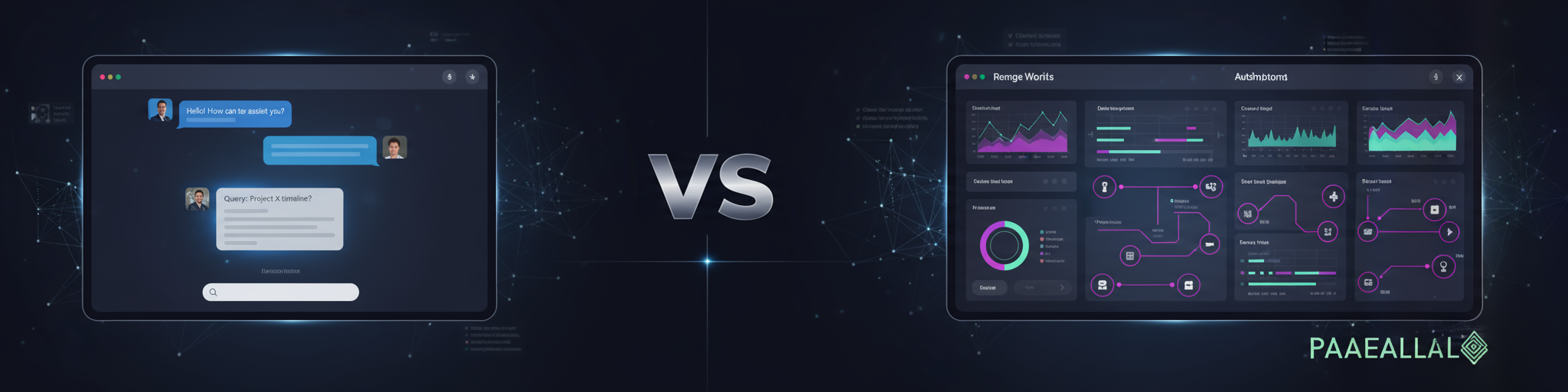
The white-label AI market has reached a defining moment. As independent consultants and micro-agencies scramble to integrate artificial intelligence into their service offerings, two platforms consistently surface in evaluation conversations: Chatbase and Parallel AI. Both promise to transform how small businesses deliver AI-powered solutions, but their fundamental approaches differ in ways that dramatically impact long-term success.
For solopreneurs building AI service businesses, this choice carries enormous weight. The right platform can multiply your output, enhance client deliverables, and create competitive advantages that help you win against larger competitors. The wrong choice means wasted resources, implementation headaches, and missed opportunities in a rapidly evolving $40 billion market projected to reach that valuation by 2030.
This comprehensive comparison examines both platforms across dimensions that matter most to independent consultants: feature breadth, customization depth, pricing transparency, implementation complexity, and scalability potential. Rather than relying on marketing promises, we’ve analyzed actual platform capabilities, user feedback, and real-world applications to help you make an informed decision that positions your business for sustainable growth.
Platform Philosophy: Specialized Chatbots vs. Comprehensive AI Automation
Understanding the fundamental philosophy behind each platform reveals much about their practical applications and strategic limitations.
Chatbase positions itself as a custom AI chatbot builder that trains on your specific data. The platform’s core value proposition centers on creating intelligent chatbots that can answer questions based on documents, websites, and knowledge bases you provide. This data-training approach appeals to businesses seeking to automate customer support, provide instant information access, or create interactive knowledge repositories.
The platform excels at transforming static information into conversational experiences. Upload product documentation, training materials, or FAQ databases, and Chatbase creates chatbots that can field questions about that content. For businesses whose primary pain point is information accessibility or basic customer support automation, this focused approach delivers clear value.
However, this specialization also reveals inherent limitations. Chatbase chatbots are fundamentally reactive tools—they respond to questions about existing information but don’t create new content, generate leads proactively, execute sales sequences, or automate complex business workflows. The platform treats AI as a better search interface rather than a comprehensive business automation system.
Parallel AI takes a fundamentally different approach, positioning itself as a complete AI automation platform that consolidates multiple business functions into a single ecosystem. Rather than specializing in chatbots, Parallel AI provides an integrated suite of AI capabilities spanning content creation, lead generation, sales automation, customer engagement, workflow management, and knowledge synthesis.
This comprehensive philosophy reflects recognition that modern service businesses need more than information retrieval chatbots—they need complete AI-powered systems that can handle diverse tasks while maintaining coherence across all business functions. For consultants and agencies, this means offering clients unified solutions rather than cobbling together multiple specialized tools.
The philosophical difference manifests in practical terms: Chatbase helps you answer questions more efficiently, while Parallel AI helps you run your entire business more intelligently.
Feature Comparison: Information Retrieval vs. Business Automation
The feature sets of these platforms reflect their different philosophical approaches, with significant implications for what you can actually deliver to clients.
Conversational AI Capabilities
Chatbase excels in its core domain of data-trained chatbots. The platform allows you to upload documents (PDFs, Word files, text files), scrape website content, import data from various sources, and train chatbots on this information to provide accurate, context-aware responses.
The training process is straightforward: provide your data sources, customize the chatbot’s appearance and behavior, test conversation quality, and deploy across your website or applications. The platform handles natural language processing, context retention, and response generation based on the information you’ve provided.
For businesses with extensive documentation, product catalogs, or knowledge bases, this creates immediate value. Customer support teams can deflect routine inquiries, sales teams can provide instant product information, and training departments can create interactive learning experiences—all without human intervention.
However, these chatbots remain fundamentally limited to the information you’ve provided. They can retrieve, summarize, and explain existing content, but they cannot create new strategies, generate original marketing copy, identify prospects, execute outreach campaigns, or automate complex workflows. The chatbot’s intelligence is bounded by your documentation.
Parallel AI includes conversational AI capabilities but positions them as one component of a broader automation ecosystem rather than the central focus. The platform’s AI employees can handle customer conversations, but they’re also capable of content creation, data analysis, lead qualification, sales automation, and workflow management.
This difference matters profoundly when serving clients with diverse needs. If a client requires only FAQ automation, Chatbase’s specialized approach might suffice. However, most businesses need multiple AI capabilities—content marketing, lead generation, sales follow-up, customer engagement, and operational automation. Parallel AI’s comprehensive approach serves these varied needs through a single platform rather than requiring separate tools for each function.
Moreover, Parallel AI’s conversational capabilities extend beyond information retrieval to include proactive engagement, personalized outreach, multi-step sales conversations, and intelligent routing based on conversation context—capabilities that fundamentally exceed reactive FAQ chatbots.
Content Creation and Marketing Automation
Content creation capabilities reveal a stark divergence between these platforms.
Chatbase provides no native content creation tools. The platform focuses exclusively on making existing content more accessible through conversational interfaces, not generating new marketing materials, social media posts, blog articles, or email campaigns.
For consultants offering content marketing services, this creates immediate friction. You’ll need separate tools for content generation, strategy development, and campaign execution—fragmenting your tech stack, complicating client deliverables, and increasing operational complexity.
Parallel AI’s Content Engine represents a fundamentally different approach to content automation. The platform includes specialized AI employees for strategy development, copywriting, customer profiling, and visual creation. These AI workers collaborate to produce comprehensive, multi-platform content strategies that extend far beyond individual pieces.
The Content Engine maintains brand voice consistency through advanced fine-tuning capabilities, allowing you to train AI models on your clients’ specific communication styles, industry terminology, tone preferences, and messaging frameworks. This creates content that genuinely reflects each client’s unique identity rather than generic AI output.
Crucially, Parallel AI’s content capabilities include complete content calendars spanning 1-3 months, platform-specific optimization for LinkedIn, Instagram, Facebook, Twitter, and other channels, strategic content planning aligned with business objectives, visual asset creation coordinated with written content, and performance analytics that inform continuous improvement.
For agencies building content marketing practices, this integrated approach eliminates the need for multiple tools like Jasper, Copy.ai, or ContentStudio. You can deliver comprehensive content strategies through a single platform, creating operational efficiency and stronger client relationships.
The content automation advantage extends to white-label positioning. With Parallel AI, you can present sophisticated content generation as your proprietary capability, justifying premium pricing and creating competitive differentiation. With Chatbase, you’re limited to chatbot deployment—a capability increasingly commoditized as more platforms offer similar functionality.
Lead Generation and Sales Automation
Sales automation capabilities determine whether platforms can actually drive revenue results or merely improve efficiency.
Chatbase focuses on lead qualification through conversational interfaces. Chatbots can ask qualifying questions, gather contact information, assess prospect fit, and route promising leads to sales teams. For businesses with established inbound lead flow, this can improve qualification efficiency and reduce sales team workload.
However, the platform lacks sophisticated prospecting tools, contact enrichment capabilities, or multi-channel outreach sequences—features essential for proactive lead generation rather than reactive qualification. Chatbase chatbots wait for prospects to initiate conversations; they don’t identify ideal customers, research decision-makers, or execute personalized outreach campaigns.
This reactive limitation matters enormously for consultants serving clients in competitive B2B markets. The businesses that grow fastest don’t just qualify inbound leads more efficiently—they proactively identify and engage ideal prospects before competitors do.
Parallel AI includes Smart Lists and Sequences specifically designed for comprehensive AI-powered prospecting and outreach. The platform can identify ideal prospects based on custom criteria (industry, company size, job titles, technologies used), enrich contact data with business intelligence and decision-maker information, qualify leads using sophisticated scoring models, execute personalized multi-channel campaigns across email, social media, SMS, chat, and voice, track engagement and automatically adjust outreach strategies, and seamlessly transition qualified prospects to sales conversations.
These capabilities typically require expensive standalone sales automation platforms like Outreach.io, SalesLoft, or Apollo—tools that cost thousands per month and require separate implementation, training, and management. Having them integrated into a comprehensive AI platform creates significant value and eliminates tool sprawl.
For consultants serving clients in competitive markets, these proactive sales capabilities often prove more valuable than reactive chatbots. The ability to identify and engage prospects before competitors creates measurable revenue impact that justifies platform investment and demonstrates clear ROI.
The sales automation difference also affects your positioning as a consultant. Offering chatbot deployment positions you as an efficiency provider—helpful but not essential. Offering comprehensive lead generation and sales automation positions you as a revenue partner—strategically valuable and difficult to replace.
Knowledge Base Integration and Contextual Intelligence
How platforms handle business knowledge and context determines whether they deliver generic AI responses or genuinely intelligent assistance.
Chatbase’s entire value proposition centers on knowledge base integration. The platform excels at ingesting documents, websites, and structured data to create chatbots that understand specific business contexts. This depth of integration for conversational purposes represents the platform’s core strength.
The training process allows significant customization: you can specify which documents to prioritize, adjust response formality, control answer length, and define conversation boundaries. For businesses with extensive documentation requiring conversational access, this creates genuine value.
However, this knowledge integration serves only conversational purposes. The chatbot can retrieve and explain information from your knowledge base, but it cannot use that knowledge to create marketing content, develop sales strategies, analyze customer patterns, or automate workflows. The intelligence remains siloed within the chatbot application.
Parallel AI’s knowledge base system serves a fundamentally different purpose. The platform integrates seamlessly with Google Drive, Notion, Confluence, and other business tools not just for conversational retrieval but for active knowledge application across all platform capabilities.
When you connect your clients’ knowledge bases to Parallel AI, the AI employees can reference that information for content creation (ensuring brand consistency and factual accuracy), lead qualification (understanding product fit and objection handling), sales conversations (providing personalized recommendations), customer support (accessing complete product knowledge), and strategic planning (analyzing historical patterns and performance data).
This comprehensive knowledge integration creates stickiness—once clients experience AI that understands their specific business context across all functions, switching to another provider becomes exponentially more difficult. The knowledge becomes embedded in workflows, not just accessible through chatbots.
For consultants building long-term client relationships, this deep integration creates sustainable competitive advantages. You’re not just deploying a chatbot that can be easily replaced; you’re embedding intelligence throughout their business operations.
White-Label and Customization Options
White-label capabilities determine whether you can position AI solutions as proprietary technology or merely resell branded commodities.
Chatbase offers basic white-labeling in higher-tier plans, allowing you to remove Chatbase branding from chatbot interfaces, customize chatbot appearance with your colors and logos, deploy chatbots under custom domains, and adjust conversation flows and responses.
These customization options enable you to present chatbots as your own technology rather than obviously third-party tools. For consultants focused specifically on chatbot deployment services, this branding control creates some differentiation.
However, the customization remains limited to chatbot interfaces. You cannot rebrand the broader platform, create custom AI employee types beyond conversational interfaces, or present comprehensive automation capabilities as proprietary technology—because those capabilities don’t exist within Chatbase’s specialized focus.
Parallel AI provides true white-label capabilities that extend across the entire platform ecosystem. You can create completely branded experiences with custom domains, logos, and color schemes, develop proprietary AI employee types tailored to specific industries or use cases, train AI models on client-specific data and terminology, customize workflows and automation sequences, build client-facing interfaces that reflect your brand identity, and position the entire platform as your proprietary technology stack.
This depth of customization means you’re not simply rebranding chatbots—you’re creating genuinely proprietary solutions that differentiate your service offerings. An AI employee you build for a marketing client can be completely different from one you build for a sales client, even though both leverage the same underlying platform infrastructure.
The white-label approach also fundamentally changes client perception. With Chatbase, you’re deploying chatbots—a service increasingly commoditized as chatbot platforms proliferate. With Parallel AI, you can present yourself as an AI platform provider offering comprehensive automation capabilities, justifying premium pricing beyond simple tool markup.
For consultants building substantial service businesses, this positioning difference creates dramatic impact on pricing power, client perception, and competitive differentiation. You’re not reselling chatbots; you’re providing proprietary AI automation platforms.
Pricing and Value Analysis
Pricing structures reveal much about platform economics and long-term sustainability.
Chatbase uses a tiered subscription model based on message volume, number of chatbots, and feature access. Plans typically range from free tiers with limited messages and basic features to higher tiers offering more messages, advanced customization, white-labeling, and API access.
This message-based pricing creates predictable costs for businesses with stable conversation volumes but introduces uncertainty as usage scales. More successful chatbots (generating more conversations) create higher costs, potentially eroding margins as you grow client deployments.
For consultants offering chatbot services, this pricing structure complicates client pricing. Do you absorb increasing message costs or pass them through to clients? If you pass costs through, how do you justify markup beyond simple transaction fees? The economics can become challenging, particularly