
Category: Lead Generation
Guides, comparisons and playbooks on Lead Generation, written for teams putting AI employees to work in sales, marketing and support. Every article below explains what to do, what it costs and where the approach breaks down.
Use this section if you are evaluating a platform, planning an automation, or trying to work out whether a task is worth handing to an agent at all. We publish the specific numbers and the trade-offs rather than the summary that vendors usually give. Start with the most recent piece, or browse all Parallel AI articles, see what the platform costs, or book a walkthrough against your own data.
Most of these pieces follow the same shape: the problem in plain terms, the options that exist, the one we would pick and why, and the failure mode to watch for in the first month. Where a competitor does something better, the article says so, because a recommendation you cannot verify is worth very little. Where our own product is the wrong fit, the article says that too.
If you only read one thing, read the article that matches the job you are trying to remove this week, not the one that sounds most strategic. Automation pays back fastest when it starts from a task someone is already dreading, has a clear definition of done, and produces an output you can check in a minute. Everything else can wait until that first one is running.
Each guide assumes you are the person doing the work, not a procurement team. That means the advice is written for a solo operator or a team of five, with budgets in the hundreds rather than the hundreds of thousands, and tools you can set up on a Tuesday afternoon. Where a recommendation only makes sense at larger scale, the article says so plainly.
What Is AI Lead Generation? The Plain-English Guide That Wins Back Your Prospecting Time
AI lead generation in plain English: how AI finds, enriches, scores, and follows up with prospects, and how to launch your first workflow this week.
AI Lead Generation Tools: How to Build a Stack That Works
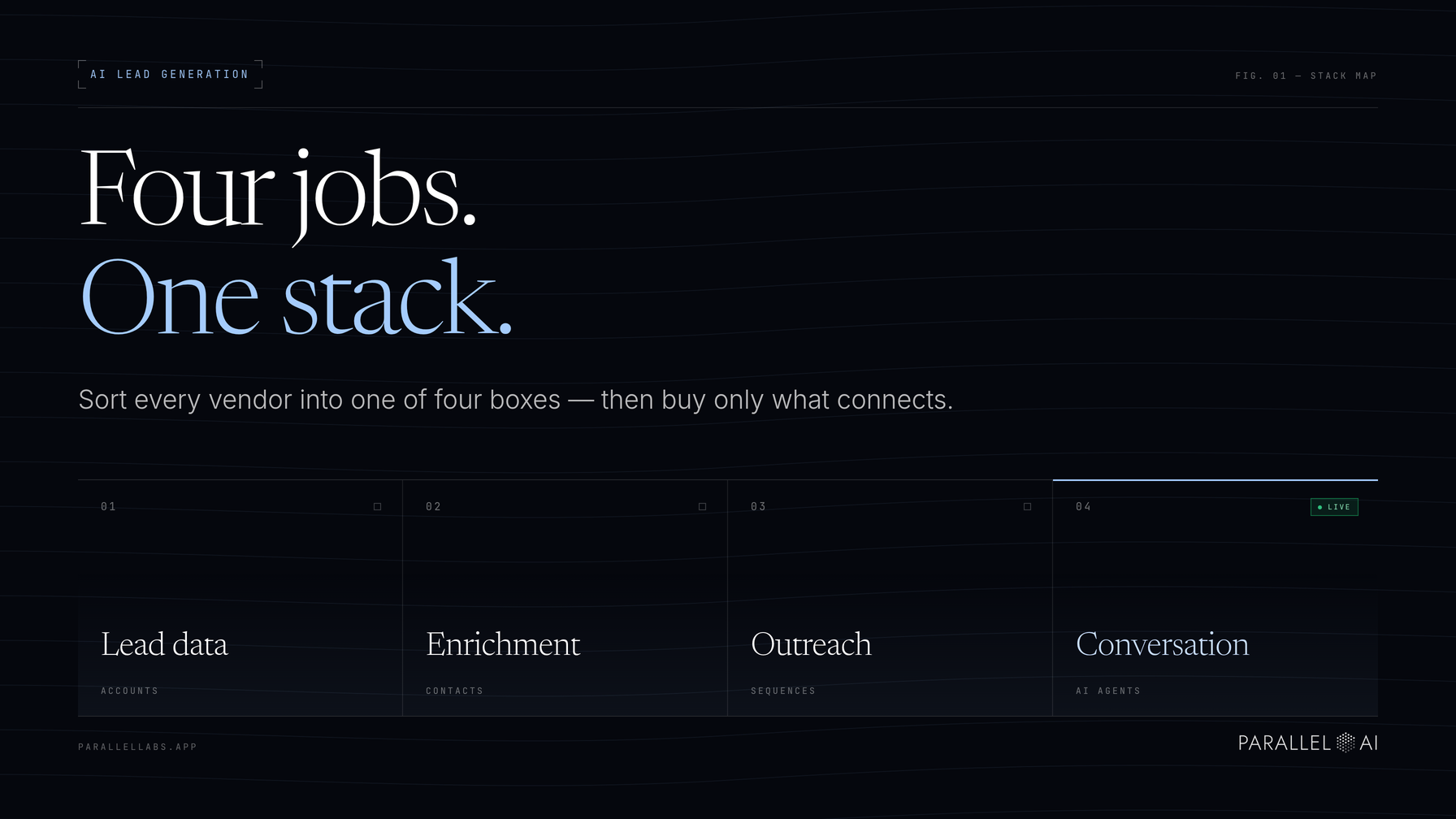
The four categories of AI lead generation tools, how to connect them into one stack, and when point tools beat an all-in-one platform for lean teams.

AI Lead Generation: Replace Manual Research with Enrichment & Scoring
An AI lead generation tool automates the complete process of finding, enriching, scoring, and qualifying potential customers. It replaces hours of manual spreadsheet work with a consistent workflow based on real data. Instead of an SDR hunting for LinkedIn profiles, copying data, guessing fit, and typing into a CRM, the tool handles four stages in…

AI Lead Generation: Complete Guide 2026
Lead generation has entered a new era. In 2026, AI doesn’t just assist sales teams. It runs the top of the funnel with intelligence that rivals a human SDR, but at machine scale. Growth leaders face a pivotal choice: continue juggling a dozen disconnected point solutions or consolidate everything into one intelligent revenue engine that…

Questions about these guides.
Who writes the guides in this section?
Every article here is written by the team that builds Parallel AI: the people who run the product, onboard customers and test the workflows themselves. We do not publish guest posts, and we do not accept paid placements in comparisons.
How do you decide what to cover?
Topics come from the questions customers ask on calls: what a tool actually costs, whether a task is worth handing to an agent, and what breaks in the first month. When a question keeps coming up and we have a real answer, it becomes an article.
Are the comparisons biased toward your product?
Where a competitor does something better, the article says so. Where Parallel AI is the wrong fit for the job you describe, the article says that too. A recommendation you cannot verify is worth very little, so each piece names its sources and its limits.
Want the short version instead? See what the platform costs, or book a walkthrough against your own data.