
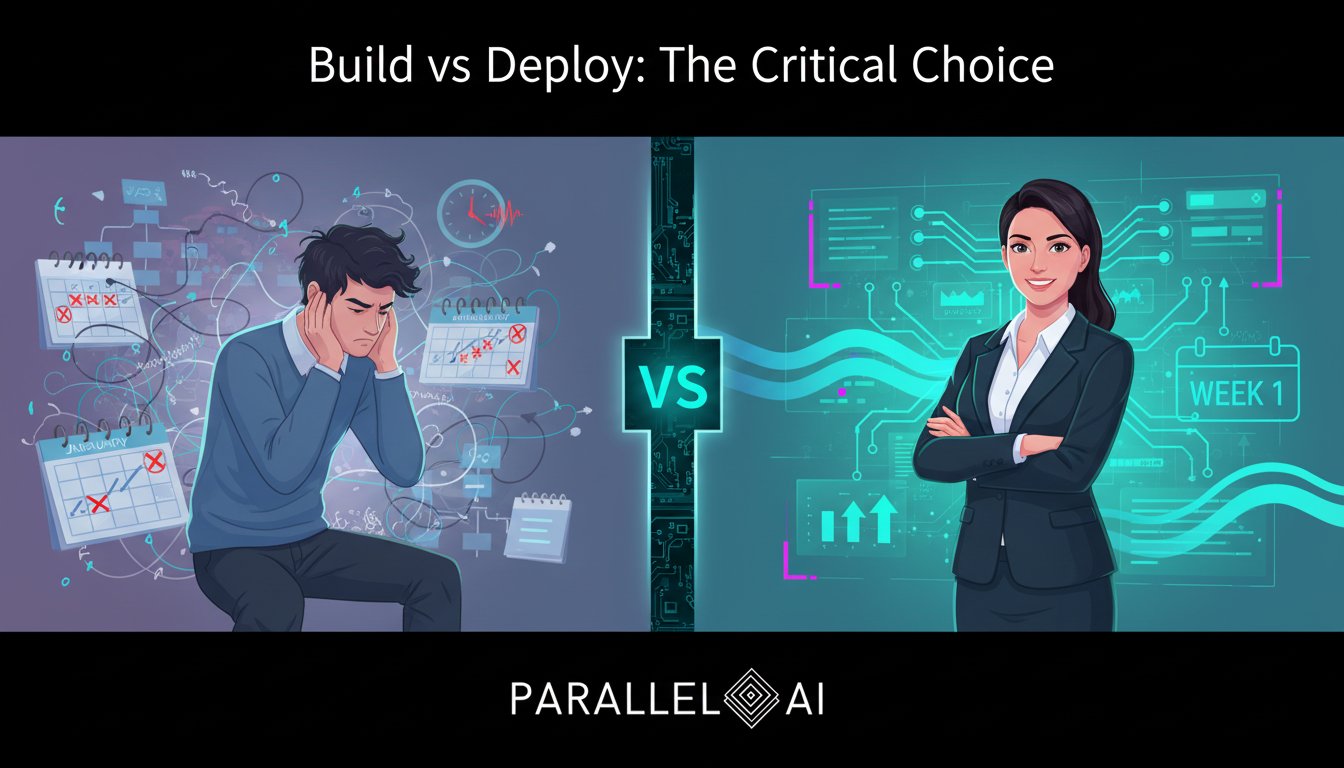
When Sarah Chen launched her marketing consultancy in early 2025, she faced the same dilemma countless solopreneurs encounter: clients were demanding AI-powered solutions, but building custom applications from scratch would require either a six-figure development budget or months of technical learning. She initially chose Bubble.io, attracted by its no-code promise and white-label potential. Three months and $4,800 later, she was still wrestling with workflows instead of serving clients.
The platform decision for micro-agencies and solopreneurs isn’t just about features—it’s about time-to-revenue. Every week spent building infrastructure is a week you’re not billing clients. According to recent market analysis, the white-label AI market is projected to reach $42.7 billion by 2030, creating unprecedented opportunities for consultants who can deliver AI solutions quickly. But here’s the brutal reality: choosing a platform that requires extensive development work fundamentally contradicts the resource constraints that define small agencies.
This analysis examines two distinct approaches to white-label AI: Bubble.io’s flexible application builder versus Parallel AI’s ready-to-deploy automation ecosystem. Understanding which architecture aligns with your business model will determine whether you’re selling AI services next month or still building your platform next year.
The Fundamental Architecture Difference: Build vs. Deploy
Bubble.io and Parallel AI represent fundamentally different philosophies about how agencies should access AI capabilities. This distinction matters more than any individual feature comparison.
Bubble.io: The Application Development Platform
Bubble.io positions itself as a no-code platform for building web and mobile applications from the ground up. The platform combines drag-and-drop visual editing with AI-powered suggestions to accelerate development. For agencies, this means:
What You Actually Build: Bubble.io provides the construction materials—visual editors, database structures, workflow automation tools, and AI integration capabilities. You describe your desired application in natural language, and Bubble’s AI generates data types, workflows, and basic functionality. From there, you customize interfaces, connect APIs, and build the specific application your clients need.
The Development Reality: Even with AI assistance, creating a production-ready application requires substantial time investment. You’re responsible for designing user interfaces, structuring databases, mapping workflow logic, integrating third-party services, and testing functionality. Industry practitioners report that building even relatively simple SaaS products on Bubble.io typically requires 40-120 hours of development time.
White-Label Implementation: Bubble.io supports white-labeling through sub-apps and branding customization features. You can create branded instances of applications for different clients, but each instance requires configuration, testing, and maintenance. The platform excels when you need highly customized applications that differ significantly across clients.
Parallel AI: The Ready-to-Deploy Automation Ecosystem
Parallel AI takes a completely different approach: providing a fully-built AI automation platform that agencies can white-label and deploy immediately. The platform consolidates content creation, sales automation, knowledge management, and workflow capabilities into a single ecosystem.
What You Actually Get: A complete AI business operating system with six premium AI models (OpenAI GPT-4, Anthropic Claude, Google Gemini, Grok, DeepSeek, and more), enterprise knowledge base integration, content automation engines, sales prospecting tools, and omnichannel customer interaction capabilities. The infrastructure is production-ready on day one.
The Deployment Reality: According to Parallel AI’s documentation, agencies can launch their white-labeled platform in 3-5 days. This timeline includes branding customization, client portal setup, and initial configuration. You’re not building functionality—you’re configuring existing capabilities to match your service offerings and client needs.
White-Label Implementation: The platform provides branded dashboards, custom domain mapping, client management portals, and flexible billing through your own Stripe account. You set your pricing (typically 1.5-2x markup on base costs), and clients access the platform through your branded interface with no indication it’s powered by Parallel AI.
AI Model Access: Single Integration vs. Model Marketplace
The AI models available through your platform directly impact the quality and versatility of solutions you can deliver to clients.
Bubble.io’s Integration Approach
Bubble.io enables AI integration through its API connector and plugin ecosystem. You can integrate services like OpenAI, Anthropic, or other AI providers by connecting their APIs to your Bubble application. This approach offers maximum flexibility but requires:
Technical Implementation: Setting up API connections, managing authentication, handling rate limits, structuring prompts, and processing responses all fall to you. Each AI service integration requires separate configuration and testing.
Cost Structure: You pay AI providers directly for API usage, then need to mark up those costs when billing clients. This requires careful tracking to ensure profitability, especially when different clients use varying volumes.
Model Switching Limitations: Switching between AI models for different tasks requires building that logic into your application. If you want to use GPT-4 for content generation but Claude for analytical tasks, you need to architect that decision-making process.
Parallel AI’s Unified Model Access
Parallel AI provides immediate access to six premium AI models through a single interface, with model switching built into the platform architecture.
Seamless Model Selection: Users (including your clients) can switch between OpenAI GPT-4, Anthropic Claude 3 Opus and Sonnet, Google Gemini Pro, Grok, and DeepSeek based on the specific task at hand. The platform handles authentication, rate limiting, and API management automatically.
Context Window Advantages: The platform supports context windows up to 1 million tokens, enabling sophisticated applications like analyzing entire document sets, maintaining extended conversation history, or processing comprehensive data compilations. This capability matters significantly for enterprise clients with complex requirements.
Predictable Pricing: AI model access is included in platform pricing tiers, eliminating the need to track and bill API usage separately. This simplification reduces administrative overhead and makes pricing conversations with clients more straightforward.
For agencies selling AI services, this difference is crucial. Bubble.io gives you the flexibility to integrate any AI service you want, but you’re responsible for making it work. Parallel AI gives you immediate access to the industry’s leading models with zero integration work.
Time-to-Revenue: The Metric That Actually Matters
For solopreneurs and micro-agencies, the most important question isn’t “What can this platform eventually do?” but rather “When can I start billing clients?”
The Bubble.io Timeline
Let’s examine a realistic timeline for launching white-label AI services using Bubble.io:
Weeks 1-2: Learning and Planning (20-30 hours)
Even with no-code tools, you need to understand Bubble’s interface, workflow logic, database structure, and plugin ecosystem. Most agencies spend this phase watching tutorials, exploring templates, and planning their application architecture.
Weeks 3-6: Building Core Functionality (40-60 hours)
Developing your application’s primary features—whether that’s content generation, customer chatbots, or data analysis tools. This includes designing interfaces, connecting AI APIs, building workflows, and initial testing.
Weeks 7-8: White-Label Configuration (15-25 hours)
Setting up branding elements, creating client onboarding flows, configuring billing systems, and building administrative dashboards for managing multiple client instances.
Weeks 9-10: Testing and Refinement (20-30 hours)
Comprehensive testing across different use cases, bug fixes, performance optimization, and creating documentation for clients.
Total Time Investment: 95-145 hours over 10-12 weeks before you can confidently sell to your first client. For a consultant billing at $150/hour, that’s $14,250-$21,750 in opportunity cost before generating the first dollar of revenue.
The Parallel AI Timeline
Days 1-2: Platform Familiarization (4-6 hours)
Exploring Parallel AI’s features, understanding automation capabilities, testing different AI models, and identifying which functionalities align with your target clients’ needs.
Days 3-4: White-Label Setup (3-5 hours)
Customizing branding elements (logo, colors, domain), configuring client portal, setting up billing through your Stripe account, and establishing pricing tiers.
Day 5: Service Package Definition (2-4 hours)
Defining what you’ll sell—platform subscriptions, bundled services, or hybrid models. Creating service descriptions and pricing structures.
Days 6-7: First Client Onboarding (3-5 hours)
Onboarding your first client, configuring their knowledge base, setting up automations specific to their needs, and training them on platform usage.
Total Time Investment: 12-20 hours over one week before landing and serving your first paying client. At $150/hour, that’s $1,800-$3,000 in opportunity cost—a dramatically different equation than Bubble.io’s timeline.
This 7-14x difference in time-to-revenue fundamentally changes the economics of launching AI services. The faster you can start generating revenue, the more resources you have to invest in client acquisition, service refinement, and business growth.
Business Model Flexibility: What Can You Actually Sell?
White-label platforms should enable multiple revenue models, allowing you to align pricing with client preferences and maximize profit margins.
Bubble.io Revenue Models
Custom Application Development: Your primary offering is building bespoke AI-powered applications for clients. You charge development fees (typically $5,000-$25,000+ depending on complexity) plus optional monthly maintenance retainers.
SaaS Product Creation: You can build a single SaaS product on Bubble.io and sell subscriptions to multiple clients. This model works well if you’ve identified a specific niche need that multiple clients share. However, you’re responsible for all ongoing development, feature additions, and technical support.
Template-Based Solutions: Create application templates for common use cases, then customize them for individual clients. This reduces development time for subsequent clients but still requires configuration work for each new customer.
Revenue Limitations: Bubble.io’s business model centers on you doing the building. Even with templates and reusable components, each client engagement requires technical work. This creates a ceiling on how many clients you can serve without hiring developers.
Parallel AI Revenue Models
Parallel AI’s documentation outlines three primary revenue approaches that agencies actually use:
Direct Platform Subscriptions: Clients subscribe to your white-labeled platform at pricing you set (recommended 1.5-2x markup). Example: Base cost $387/month → Charge clients $697/month → $310/month profit per client. The platform handles billing through your Stripe account, and you manage client relationships.
Bundled Service Packages: Purchase bulk platform seats and include access as part of comprehensive service retainers. Charge setup fees ($1,500-$5,000 one-time) plus monthly retainers that include platform access and your consulting services. Example: $3,000/month retainer includes platform access + implementation support + ongoing optimization.
Hybrid Model (Most Popular): Combine platform subscriptions with professional services. Clients pay for platform access at your markup, and you sell additional services like onboarding, training, custom automation setup, and strategic consulting. This approach generates both recurring subscription revenue and high-margin service income.
Margin Analysis: According to Parallel AI’s white-label documentation, agencies typically maintain 30-70% margins on subscriptions, depending on pricing strategy and service bundling. The elimination of development and maintenance costs means these margins go directly to profit rather than covering technical debt.
The fundamental difference: Bubble.io enables you to build and sell custom solutions (high initial revenue, ongoing development obligation), while Parallel AI enables you to deploy and sell existing capabilities (faster revenue, predictable delivery, scalable operations).
Integration Ecosystems: Building vs. Connecting
Modern businesses require AI platforms that work seamlessly with existing tools rather than creating isolated systems.
Bubble.io Integration Architecture
Bubble.io provides extensive integration capabilities through its API Connector and plugin marketplace. You can theoretically connect to any service with an API, including:
Native Integrations: Popular services like Stripe, SendGrid, Twilio, and authentication providers have pre-built plugins that simplify connection.
Custom API Connections: The API Connector allows you to integrate virtually any service by configuring endpoints, authentication, and data mapping. This flexibility is powerful but requires understanding API documentation and troubleshooting connection issues.
Integration Reality: Each integration you add increases complexity. You’re responsible for maintaining these connections, handling API changes, managing authentication tokens, and troubleshooting when services update their endpoints. For agencies serving multiple clients, this maintenance burden multiplies.
Client Data Management: When building on Bubble.io, you control the database architecture. This gives you complete flexibility in how you structure and store client data, but you’re also responsible for security, backups, and compliance with data protection regulations.
Parallel AI Integration Approach
Parallel AI focuses on business-critical integrations that agencies and their clients actually use daily:
Knowledge Base Integration: Direct connections to Google Drive, Confluence, and Notion enable clients to train AI on their existing documentation, brand guidelines, and institutional knowledge. This integration is production-ready, requiring only authentication.
Workflow Automation: Custom n8n integrations allow sophisticated automation sequences connecting Parallel AI to CRM systems, marketing platforms, communication tools, and business applications. These integrations are built and maintained by Parallel AI’s development team.
API Access: Enterprise plans include API access, enabling technical clients to integrate Parallel AI capabilities into their own applications or workflows. This provides flexibility for advanced use cases without requiring you to build integration infrastructure.
Security Infrastructure: The platform includes enterprise-grade security (AES-256 encryption, TLS protocols, SSO) and commits to never using client data for model training. For agencies serving regulated industries, these security certifications eliminate significant compliance burden.
The practical difference: Bubble.io gives you unlimited integration potential if you’re willing to do the technical work. Parallel AI provides business-ready integrations that work immediately, allowing you to focus on client success rather than API troubleshooting.
The Hidden Costs: What You’re Not Seeing in Pricing Pages
Platform subscription fees tell only part of the total cost story. Understanding the complete financial picture prevents expensive surprises after commitment.
Bubble.io Cost Structure
Platform Subscription: Bubble.io operates on tiered pricing (exact figures vary by plan selection). Entry-level plans support development and testing, while production applications require higher tiers for custom domains, increased capacity, and professional features.
AI Service Costs: Every AI model you integrate (OpenAI, Anthropic, etc.) bills you separately based on API usage. These costs vary dramatically based on application usage patterns. A content generation tool might incur $200-$2,000+ monthly in AI API costs depending on volume.
Plugin and Extension Costs: Many advanced capabilities require premium plugins with their own subscription fees. Integration tools, advanced UI components, and specialized functionality often carry additional monthly costs.
Development Time: The most significant hidden cost is your time (or hired developer time). Every hour spent building, testing, fixing bugs, and maintaining your application has an opportunity cost. At consultant rates of $100-$250/hour, development time easily becomes the largest cost factor.
Maintenance and Updates: Applications built on Bubble.io require ongoing maintenance. When Bubble updates its platform, when integrated APIs change, when clients request features, or when bugs emerge, you’re responsible for addressing these issues. Industry estimates suggest maintenance requires 10-20% of original development time annually.
Total First-Year Cost Example: Platform subscription ($300-$600/month) + AI API costs ($200-$2,000/month) + plugins ($50-$200/month) + development time (100 hours × $150/hour = $15,000) + maintenance (20 hours × $150/hour = $3,000) = $22,600-$36,200 before generating significant client revenue.
Parallel AI Cost Structure
Platform Subscription: White-label pricing starts with base costs that you mark up for clients. According to documentation, base costs begin at $387/month for comprehensive access to all AI models, automation features, and white-label capabilities.
All-Inclusive AI Access: Unlike Bubble.io, AI model usage is included in platform pricing. You’re not separately tracking and billing for OpenAI, Claude, or Gemini API calls. This dramatically simplifies cost prediction and client billing.
No Development Costs: The platform is production-ready, eliminating development time investment. Configuration and customization require hours rather than weeks, fundamentally changing the cost equation.
Minimal Maintenance: Platform updates, AI model improvements, and feature additions are handled by Parallel AI’s development team. Your maintenance responsibility is limited to client-specific configurations rather than core platform functionality.
Revenue Model: The key distinction is that Parallel AI costs are directly tied to revenue generation. You purchase capacity as you acquire clients, maintaining predictable margins. Example: Client pays $697/month → Your base cost $387/month → $310/month profit = 44% margin with zero development overhead.
Total First-Year Cost Example: Platform base cost ($387/month × 12 = $4,644) + configuration time (15 hours × $150/hour = $2,250) + ongoing account management (5 hours/month × 12 × $150/hour = $9,000) = $15,894 with immediate revenue generation from month one.
The difference becomes even more stark when you consider scaling. Adding clients on Bubble.io often means additional development work, increased maintenance burden, and complex cost tracking. Adding clients on Parallel AI means purchasing additional seats at predictable costs with consistent margins.
Real-World Use Cases: Who Actually Succeeds with Each Platform?
Understanding which agencies thrive with each platform reveals whether your business model aligns with the platform architecture.
Agencies Succeeding with Bubble.io
Software Development Agencies with Technical Teams: Agencies that already employ developers and designers can leverage Bubble.io to accelerate application development compared to traditional coding. The no-code approach reduces development time from months to weeks, creating competitive advantages.
Vertical-Specific Solution Providers: Consultants serving highly specialized niches with unique requirements often need custom-built applications. If you’re building workflow tools for dental practices or inventory management for art galleries, Bubble.io’s flexibility enables precise customization.
Product Companies Building Proprietary SaaS: Entrepreneurs creating their own SaaS products (rather than white-labeling for clients) benefit from Bubble.io’s development environment. You’re building once and selling to many, amortizing development costs across your entire customer base.
Agencies with Patient Capital: If you have 3-6 months of runway before needing revenue and can invest 100+ hours in development, Bubble.io’s flexibility might justify the timeline. This scenario typically applies to funded startups rather than bootstrapped consultancies.
Agencies Succeeding with Parallel AI
Marketing Consultancies Adding AI Services: Digital marketing agencies can immediately add AI-powered content creation, social media automation, and SEO optimization to service packages without building infrastructure. They focus on marketing strategy while the platform handles technical execution.
Business Consultants Scaling Through Automation: Strategy consultants use Parallel AI to automate client deliverables—competitive analysis, market research, business planning documents—allowing them to serve more clients without hiring analysts.
Solopreneurs Launching AI-Powered Agencies: Individual consultants can launch full-service AI agencies in days rather than months, competing effectively against larger firms by leveraging enterprise-grade technology under their own brand.
Service Providers Transitioning to Recurring Revenue: Agencies currently selling project-based services can add recurring revenue streams by offering white-labeled AI platform access, creating predictable monthly income alongside consulting engagements.
HighLevel Agencies Expanding Capabilities: Marketing agencies already using platforms like GoHighLevel can integrate Parallel AI to add sophisticated AI automation, content generation, and knowledge management capabilities their current platform doesn’t provide.
The pattern is clear: Bubble.io succeeds when customization justifies development time. Parallel AI succeeds when speed-to-market and operational scalability determine business viability.
The Decision Framework: Which Platform Aligns with Your Business Reality?
Choosing between Bubble.io and Parallel AI isn’t about which platform has superior technology—it’s about which architecture matches your business model, resource constraints, and growth strategy.
Choose Bubble.io If:
You have significant development resources: Either you’re a developer yourself, you have developers on staff, or you can afford to hire development talent for 100+ hours of initial building plus ongoing maintenance.
Your clients need highly customized applications: The solutions you’re selling differ dramatically from client to client, requiring unique user interfaces, specialized workflow logic, or industry-specific functionality that generic platforms can’t address.
You’re building a proprietary SaaS product: Rather than white-labeling for multiple clients, you’re creating your own software product that you’ll sell under your brand to many customers, justifying the upfront development investment.
You have extended timeline flexibility: You can afford to invest 3-6 months in development before generating meaningful revenue, either because you’re funded, have other income sources, or are treating this as a long-term investment.
You need unlimited integration flexibility: Your use cases require connecting to obscure or proprietary systems with complex integration requirements that pre-built platforms don’t support.
Choose Parallel AI If:
You need revenue within weeks, not months: Your business model requires quick time-to-market, either because you’re bootstrapped, have immediate client demand, or can’t justify extended development timelines.
You want to sell AI services, not build AI infrastructure: Your expertise and passion lie in client relationships, business strategy, and service delivery rather than application development and technical troubleshooting.
You’re operating with limited technical resources: You’re a solopreneur or micro-agency without developers on staff, and you need solutions that work immediately without extensive technical configuration.
You prefer predictable costs and margins: The business model of marking up existing capabilities at consistent margins appeals more than the variable costs and timeline risks of custom development.
You want to scale client count without scaling complexity: Adding clients should mean straightforward onboarding and configuration, not rebuilding applications or managing increasingly complex technical infrastructure.
You value comprehensive capabilities over unlimited flexibility: Having immediate access to content automation, sales prospecting, knowledge management, and multi-model AI outweighs the theoretical advantage of building exactly what you envision.
The most telling question: Are you building a software development company or an AI services agency? Bubble.io positions you as the former; Parallel AI enables you to focus on being the latter.
Making the Platform Decision That Actually Serves Your Clients
The wrong platform choice doesn’t just cost you time and money—it delays your ability to deliver value to clients who need AI solutions now, not next quarter.
Sarah Chen, the marketing consultant from our opening example, eventually made the switch from Bubble.io to Parallel AI six months into her journey. Despite investing significant time learning Bubble’s platform and building custom applications, she found herself constantly explaining to prospects why her solutions weren’t ready yet. Three weeks after switching to Parallel AI, she had onboarded her first four clients at $897/month each, generating $3,588 in monthly recurring revenue with platform costs of $1,548—a 56% margin with minimal ongoing operational burden.
Her reflection captures the essential insight: “I was so focused on building the perfect custom solution that I forgot my clients just needed AI capabilities that worked reliably. They didn’t care that I built it myself—they cared that it solved their problems quickly.”
For most solopreneurs and micro-agencies, the competitive advantage isn’t in building proprietary technology—it’s in understanding client needs deeply, delivering solutions quickly, and providing exceptional service. Parallel AI’s white-label approach enables you to focus on those differentiators while leveraging enterprise-grade AI infrastructure that would cost hundreds of thousands to build independently.
The agencies that thrive in the AI revolution won’t be those that build the best technology—they’ll be those that deploy proven capabilities most effectively to solve real business problems. The question isn’t which platform is objectively superior, but which enables you to serve clients profitably starting next week rather than next quarter.
If you’re ready to launch AI services that generate revenue within days rather than months, explore Parallel AI’s white-label solutions and discover how agencies are building profitable AI practices without writing a single line of code. Your clients are already asking for AI capabilities. The only question is whether you’ll be ready to deliver them before your competitors.