
The white-label AI platform decision facing solopreneurs and micro-agencies in 2025 isn’t just about feature lists or pricing tiers—it’s about choosing between a specialized tool that does one thing exceptionally well versus a comprehensive ecosystem that transforms your entire business operation. This distinction matters more than most comparison articles acknowledge, particularly when your growth trajectory, client retention, and competitive positioning hang in the balance.
Botpress has built a formidable reputation as a customizable, developer-friendly chatbot platform with genuine white-label capabilities. Parallel AI positions itself as an all-in-one AI automation ecosystem that consolidates content creation, sales prospecting, workflow automation, and conversational AI into a single platform. Both offer white-labeling. Both target agencies and consultants. But the strategic implications of choosing one over the other will shape your business for years to come.
The critical question isn’t which platform has more features—it’s which platform architecture aligns with how solopreneurs and micro-agencies actually generate revenue, serve clients, and scale operations without proportionally increasing headcount. A chatbot-first platform optimized for conversational AI delivers fundamentally different business outcomes than a comprehensive automation ecosystem designed to replace 6+ separate tools. Understanding this distinction before committing thousands of dollars and months of implementation time could mean the difference between sustainable growth and operational fragmentation.
This analysis examines both platforms through the lens of real-world consulting business requirements: white-label depth, revenue model flexibility, implementation complexity, total cost of ownership, and the specific automation capabilities that actually move the profitability needle for service-based businesses. We’ll explore not just what each platform can do, but what each platform architecture enables you to become.
The Fundamental Architecture Difference That Shapes Everything Else
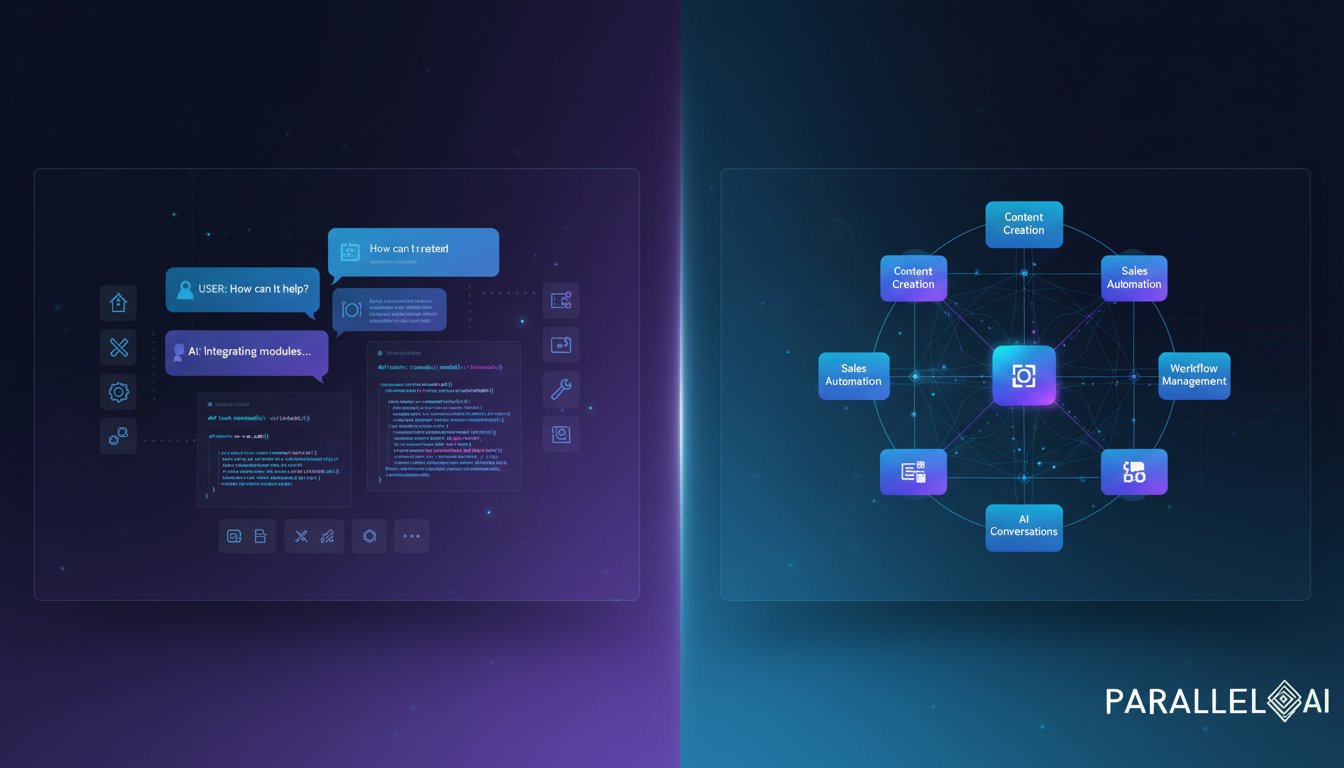
Botpress and Parallel AI represent two distinctly different philosophies about how AI should integrate into consulting businesses. Botpress follows the “best-of-breed” approach—deliver exceptional conversational AI capabilities, then rely on users to integrate additional tools for content creation, sales automation, and workflow management. Parallel AI follows the “unified ecosystem” approach—consolidate multiple business functions into a single platform to eliminate tool fragmentation and integration overhead.
This architectural difference cascades into every aspect of how you’ll build, deliver, and scale your services.
Botpress: Chatbot Excellence with Integration Requirements
Botpress excels at what it was designed to do: create sophisticated, customizable conversational AI agents. The platform supports multiple AI models from OpenAI, Anthropic, Hugging Face, and Groq, giving you flexibility in model selection based on accuracy, cost, and privacy requirements. The autonomous engine and knowledge base capabilities enable chatbots that maintain context and deliver intelligent responses across channels like WhatsApp, Instagram, Messenger, Slack, and website chat widgets.
For agencies that generate revenue primarily through conversational AI implementations—customer support automation, lead qualification chatbots, or appointment scheduling agents—Botpress delivers the customization depth that generic chatbot builders can’t match. Recent comparisons highlight Botpress as significantly more powerful than simple AI agent platforms, particularly for scenarios requiring complex reasoning and extended context retention.
The white-label capabilities allow full UI rebranding, custom domains, and client-specific deployments. An agency could theoretically build a branded “ConversationalAI Pro” platform powered by Botpress, charge clients $200-400/month for chatbot services, and maintain healthy margins on the $79-495/month Botpress subscription tiers.
But here’s where the architectural limitation emerges: Botpress doesn’t generate content calendars, write blog posts, create email sequences, qualify sales leads beyond conversations, or automate workflow tasks outside the conversational context. If your clients need weekly blog content, social media posts, lead nurturing email campaigns, or automated reporting—all standard requirements for modern consulting engagements—you’ll need to integrate separate tools.
Parallel AI: Comprehensive Business Automation with Embedded Conversational Capabilities
Parallel AI takes the opposite approach: build a unified platform that handles content creation, sales prospecting, conversational AI, workflow automation, and knowledge management in a single ecosystem. The platform provides access to 6+ premium AI models (GPT-4 Turbo, Claude 3 Opus, Gemini Pro, Grok, DeepSeek) with the ability to switch models per task for optimal results.
The content automation engine generates articles, blogs, marketing copy, social media posts, and email campaigns at scale. The sales prospecting toolkit includes Smart Lists for targeted lead generation and Sequences for multi-channel outreach across email, social media, SMS, and voice. The knowledge base integrates with Google Drive, Confluence, and Notion, supporting up to 1 million token context windows for training AI on client-specific brand guidelines and data.
Conversational AI capabilities exist within this broader ecosystem as omni-channel customer interaction agents—not as the platform’s sole focus, but as one component of comprehensive business automation. For agencies selling “Managed AI Services” or “AI-Powered Marketing Packages,” this consolidation means delivering content creation, lead generation, customer engagement, and workflow automation through a single branded platform rather than stitching together 5-6 separate tools.
The white-label implementation allows complete platform branding, custom domains, and client billing through your own Stripe account. Agencies typically purchase platform access at base cost ($387/month for comprehensive tiers) and resell at $697-997/month, generating $310-610/month profit per client while delivering services that would cost $2,000+/month if clients subscribed to individual tools separately.
The Tool Fragmentation Tax Most Agencies Don’t Calculate
The architectural difference creates a hidden cost structure that only becomes apparent after implementation. Running a chatbot-first platform like Botpress alongside the other tools your clients actually need—content creation (Jasper, $49-125/month), social media management (Buffer, $6-120/month), email marketing (ActiveCampaign, $29-149/month), lead enrichment (Apollo, $49-79/month), and workflow automation (Zapier, $20-70/month)—quickly accumulates to $153-543/month in tool costs before you’ve marked up a single service.
Each additional tool introduces integration complexity, separate login credentials, data synchronization challenges, and support ticket fragmentation. When a client reports an issue with their automated content workflow, you’re troubleshooting across 4-5 different platforms to identify whether the problem originates in the chatbot, content generator, scheduler, or automation connector.
Parallel AI’s consolidated architecture eliminates this fragmentation tax. The platform cost covers content automation, sales prospecting, conversational AI, and workflow management in a single subscription. When clients need support, you’re working within one ecosystem with unified data architecture and consistent AI model access across all functions.
For solopreneurs managing 5-10 clients, this difference translates to 8-12 hours monthly saved on tool management, integration troubleshooting, and cross-platform data synchronization—time that could be redirected toward revenue-generating client acquisition or service delivery.
White-Label Depth and Revenue Model Implications
Both platforms offer white-labeling, but the depth of customization and revenue model flexibility differ in ways that significantly impact how you’ll package and price your services.
Botpress White-Label Implementation
Botpress supports custom workflow design, UI rebranding, and flexible deployment (cloud or on-premises for compliance-sensitive clients). You can create tailored chatbot workflows for each client, rebrand the interface with your logo and colors, and deploy under your custom domain.
The pricing structure works well for agencies selling chatbot-specific services:
- Free tier for testing and small deployments
- Plus tier at $79/month for small teams
- Team tier at $495/month for growing organizations
- Enterprise pricing for large-scale deployments with custom requirements
An agency could build packages like:
- Basic Chatbot Service: $297/month (powered by Botpress Plus at $79/month = $218 margin)
- Advanced Conversational AI: $897/month (powered by Botpress Team at $495/month = $402 margin)
- Enterprise Chatbot Solutions: $2,500+/month (custom pricing with healthy margins)
The challenge emerges when clients need services beyond conversational AI. If you’re selling “Managed AI Marketing Services” that include content creation, social scheduling, email campaigns, and chatbot support, you’re either:
- Maintaining separate tool subscriptions ($200-600/month in additional costs per client)
- Referring clients to other tools (fragmenting the experience and losing revenue)
- Building custom integrations (requiring development resources most solopreneurs lack)
This limits your ability to scale into comprehensive service packages without proportionally increasing tool costs and integration complexity.
Parallel AI White-Label Implementation
Parallel AI’s white-label depth extends across the entire platform ecosystem—content automation, sales prospecting, conversational agents, workflow tools, and knowledge bases all rebrand under your identity. Clients log into your branded portal, pay through your Stripe account, and experience the entire platform as your proprietary technology.
The revenue model flexibility accommodates three distinct approaches agencies actually use:
Direct Platform Subscriptions: Clients subscribe to your branded platform at your markup. You set pricing (typically 1.5-2x base cost). Base cost of $387/month → Charge $697/month → $310/month profit per client. Best for agencies wanting recurring revenue without service delivery labor.
Bundled Service Packages: Purchase bulk platform seats, include access as part of monthly retainers. Charge $1,500-5,000 setup fees, bill platform access within $3,000-5,000/month service retainers. Best for agencies selling done-for-you services where the platform enables faster, more profitable delivery.
Hybrid Model (most popular): Combine platform subscriptions at markup with professional services. Clients pay platform fees plus onboarding ($1,500-5,000), training, custom automation setup, and ongoing consulting for advanced implementations. This model generates both recurring subscription revenue and higher-margin consulting income.
The comprehensive platform architecture enables service packages that would require 5-6 separate tools with Botpress:
- AI Content Studio: $697/month for automated content calendars, blog generation, social posts, and email campaigns
- Sales Acceleration Suite: $897/month for lead prospecting, multi-channel outreach sequences, and conversation management
- Complete Business Automation: $1,497/month for content, sales, customer engagement, and workflow automation
Your cost for delivering all three tiers? A single Parallel AI subscription at $387/month base cost. The margin expansion compared to managing separate tools for each function fundamentally changes the economics of scaling your consulting business.
Implementation Complexity and Time-to-Revenue
The speed at which you can launch white-label services, onboard clients, and generate revenue varies significantly between chatbot-specialized platforms and comprehensive automation ecosystems.
Botpress Implementation Journey
Botpress’s strength—deep customization and developer-friendly architecture—creates a double-edged sword for non-technical solopreneurs. Building sophisticated conversational flows requires understanding the platform’s logic system, designing conversation paths, integrating knowledge bases, and testing across multiple scenarios.
Typical implementation timeline:
- Platform setup and branding: 3-5 days
- Learning conversation design: 1-2 weeks
- Building first client chatbot: 1-2 weeks
- Testing and refinement: 3-7 days
- Client training and launch: 3-5 days
Total time from platform signup to first paying client: 4-6 weeks for technically proficient users, 6-10 weeks for those new to conversational AI development.
The learning curve is steeper than simple drag-and-drop chatbot builders, which is precisely why Botpress delivers more sophisticated results. But for solopreneurs seeking rapid time-to-revenue, this represents 1-2 months of investment before generating your first subscription dollar.
Integrating additional tools for content creation, social scheduling, and email automation adds another 1-2 weeks per tool, plus ongoing maintenance overhead as APIs change and integrations break.
Parallel AI Implementation Journey
Parallel AI’s unified ecosystem approach prioritizes rapid deployment. The platform includes pre-built templates for common consulting use cases—content calendars, email sequences, lead qualification workflows, and customer engagement automations.
Typical implementation timeline:
- Platform setup and white-label branding: 3-5 days
- Configuring first client workspace: 1-3 days
- Customizing content and sales templates: 2-4 days
- Client training and launch: 2-3 days
Total time from platform signup to first paying client: 8-15 days.
The dramatically compressed timeline stems from not needing to integrate multiple tools, learn separate platform interfaces, or troubleshoot cross-platform data synchronization. Everything operates within a single ecosystem with consistent AI model access and unified data architecture.
For the HighLevel agency example referenced in the knowledge base, Parallel AI integration with existing client management systems reduces onboarding from 8 hours to 45 minutes per client. When you’re managing 10-20 clients, this represents 75-160 hours saved annually—equivalent to 2-4 weeks of full-time work redirected toward revenue-generating activities.
The 30-Day Revenue Test
A useful framework: What could you realistically accomplish in 30 days starting from platform signup?
With Botpress: Learn the platform, build your first chatbot, white-label the interface, potentially land and launch one early-adopter client willing to work through your learning curve. Monthly recurring revenue: $200-400 from one chatbot client, plus ongoing learning investment for additional service offerings.
With Parallel AI: Complete platform setup, configure white-label branding, launch 2-3 client projects using pre-built templates for content automation and sales prospecting, generate $1,400-2,800 in monthly recurring revenue from comprehensive service packages. Additional time available for client acquisition since implementation is faster.
The difference compounds monthly. Faster time-to-revenue and lower implementation complexity mean more clients served with the same time investment, accelerating your path to sustainable consulting income.
Total Cost of Ownership Across Realistic Client Scenarios
Pricing transparency becomes murky when comparing a specialized tool against a comprehensive platform. The relevant metric isn’t the platform subscription cost—it’s the total cost to deliver the services your clients actually need.
Scenario 1: Marketing Consultant Serving 5 Clients
Client needs: Monthly blog content, social media posts, email campaigns, lead qualification chatbot, basic workflow automation.
Botpress Approach:
– Botpress Team: $495/month
– Content creation (Jasper): $125/month
– Social scheduling (Buffer Business): $120/month
– Email marketing (ActiveCampaign): $149/month
– Workflow automation (Zapier): $70/month
– Total tool cost: $959/month
– Client revenue at $697/month each: $3,485/month
– Net profit: $2,526/month (72% margin)
Parallel AI Approach:
– Parallel AI platform: $387/month
– Total tool cost: $387/month
– Client revenue at $697/month each: $3,485/month
– Net profit: $3,098/month (89% margin)
Difference: $572/month higher profit ($6,864 annually) with Parallel AI
The margin difference stems from platform consolidation eliminating $572/month in redundant tool subscriptions. Over 3 years, this represents $20,592 in retained profit—equivalent to hiring a part-time contractor for client acquisition without reducing margins.
Scenario 2: Sales Consultant Serving 10 Clients
Client needs: Lead prospecting, multi-channel outreach sequences, conversation management, performance reporting, some content support.
Botpress Approach:
– Botpress Team: $495/month
– Lead enrichment (Apollo): $79/month
– Email outreach (Lemlist): $99/month
– Social outreach (LinkedHelper): $45/month
– Content support (Jasper): $125/month
– Total tool cost: $843/month
– Client revenue at $897/month each: $8,970/month
– Net profit: $8,127/month (91% margin)
Parallel AI Approach:
– Parallel AI platform: $387/month
– Total tool cost: $387/month
– Client revenue at $897/month each: $8,970/month
– Net profit: $8,583/month (96% margin)
Difference: $456/month higher profit ($5,472 annually) with Parallel AI
At this scale, the tool consolidation advantage delivers an additional $5,472 annually in retained profit despite serving the same number of clients at identical pricing. The higher margin percentage (96% vs 91%) means more of each client payment flows to your bottom line rather than tool subscriptions.
Scenario 3: Full-Service Agency Managing 20 Clients
Client needs: Comprehensive AI automation including content, sales, customer engagement, workflow automation, and conversational AI.
Botpress Approach:
– Botpress Enterprise: $1,500/month (estimated)
– Content creation (Jasper Teams): $249/month
– Social management (Buffer Business): $120/month
– Email marketing (ActiveCampaign Plus): $219/month
– Lead enrichment (Apollo): $79/month
– Workflow automation (Zapier Teams): $120/month
– Additional tools and integrations: $200/month
– Total tool cost: $2,487/month
– Client revenue at $1,497/month each: $29,940/month
– Net profit: $27,453/month (92% margin)
Parallel AI Approach:
– Parallel AI Enterprise: $800/month (estimated for 20+ clients)
– Total tool cost: $800/month
– Client revenue at $1,497/month each: $29,940/month
– Net profit: $29,140/month (97% margin)
Difference: $1,687/month higher profit ($20,244 annually) with Parallel AI
At agency scale, the consolidation advantage becomes transformative. An additional $20,244 annually funds significant growth initiatives—hiring a sales development representative, investing in paid acquisition, or building productized offerings that further scale revenue without proportional cost increases.
The total cost of ownership analysis consistently favors comprehensive platforms when your service offerings extend beyond a single function. If you’re exclusively selling chatbot implementations with no content, sales, or workflow components, Botpress’s specialized capabilities may justify the additional integration overhead. But most consulting businesses serve clients who need multiple AI-powered functions, making platform consolidation a strategic advantage.
When Botpress Makes Strategic Sense (And When It Doesn’t)
Despite the advantages of comprehensive platforms, specific scenarios exist where Botpress’s specialized architecture delivers superior outcomes.
Botpress Excels When:
1. Conversational AI is Your Core Revenue Driver
If you’ve built a consulting practice exclusively around sophisticated chatbot implementations—complex customer support automation, multi-step troubleshooting agents, or appointment scheduling systems with intricate logic—Botpress’s deep customization capabilities justify the focused investment. The platform’s support for multiple AI models, autonomous engine, and extensive integration options enable chatbot sophistication that general-purpose platforms may not match.
2. You Have Development Resources
Agencies with in-house developers or technical co-founders can leverage Botpress’s open-source architecture and API access to build custom implementations that differentiate their offerings. The technical flexibility becomes a competitive advantage rather than an adoption barrier.
3. Client Needs Are Genuinely Chatbot-Specific
Some industries and use cases genuinely require conversational AI as the primary (or only) automation function. Healthcare appointment scheduling, legal consultation intake, or technical support triage may not need comprehensive content creation or sales automation, making a specialized chatbot platform more appropriate than a broad ecosystem.
4. Integration Overhead Isn’t a Constraint
Larger agencies with dedicated operations teams can absorb the integration and maintenance overhead of managing 5-6 separate tools. When you have a technical operations manager handling platform integrations, the fragmentation tax decreases relative to solopreneurs managing everything themselves.
Botpress Struggles When:
1. Clients Need Multi-Function AI Services
The moment client requirements expand beyond conversational AI to include content creation, social media management, email campaigns, or sales prospecting, Botpress requires additional tool integrations that increase complexity and cost.
2. You’re a Non-Technical Solopreneur
The learning curve and implementation complexity create meaningful adoption barriers for consultants without development backgrounds. While Botpress documentation is solid, building sophisticated conversation flows requires more technical comfort than using pre-built automation templates.
3. Rapid Scaling is the Priority
If your business model depends on quickly onboarding multiple clients and generating recurring revenue within 30-60 days, the implementation timeline and integration overhead slow your growth trajectory compared to unified platforms with faster time-to-value.
4. Margin Maximization Drives Strategy
When platform costs directly impact profitability—particularly at the solopreneur and micro-agency scale—the tool consolidation economics of comprehensive platforms deliver higher profit margins on identical service pricing.
The Strategic Decision Framework for Solopreneurs and Micro-Agencies
Choosing between Botpress and Parallel AI isn’t about which platform has more features—it’s about which architecture aligns with your business model, technical capabilities, service offerings, and growth trajectory.
Choose Botpress If:
- Conversational AI represents 80%+ of your revenue and will remain your core focus
- You have development resources or strong technical comfort with API integrations
- Your clients specifically need sophisticated, highly-customized chatbot implementations
- You’re building a specialized consulting practice around a single, deep capability
- You have operational capacity to manage multiple tool integrations and maintenance
Choose Parallel AI If:
- Your clients need comprehensive AI automation beyond chatbots (content, sales, workflows)
- You’re a solopreneur or micro-agency seeking maximum margin on service delivery
- Rapid implementation and time-to-revenue are strategic priorities
- You want to offer full-service AI packages without managing 5-6 separate tools
- Platform consolidation and operational simplicity enable faster scaling
- You’re building a white-label business model around comprehensive AI automation
The decision ultimately comes down to specialization versus consolidation. Botpress delivers exceptional depth in conversational AI with the trade-off of requiring additional tools and integrations for comprehensive service delivery. Parallel AI delivers breadth across multiple business functions with the trade-off of potentially less customization depth in any single area.
The Hidden Opportunity Cost Most Consultants Ignore
Beyond features, pricing, and implementation timelines lies a strategic consideration that rarely appears in comparison articles: opportunity cost. Every hour spent integrating tools, troubleshooting cross-platform issues, and managing multiple subscriptions is an hour not spent on client acquisition, service delivery, or business development.
For solopreneurs managing 8-12 clients while simultaneously trying to grow their business, the 8-15 hours monthly saved by eliminating tool fragmentation represents a transformative reallocation of time. Those hours could fund:
- Client acquisition: 10-12 additional outreach conversations monthly, potentially adding 1-2 new clients quarterly
- Service quality: Deeper client engagements and more strategic consulting, improving retention and referrals
- Product development: Building proprietary methodologies, templates, or training that differentiate your offerings
- Business systems: Developing scalable processes that enable you to serve more clients without proportional time increases
The compound effect over 12-24 months transforms businesses. An agency that redirects 12 hours monthly from tool management to client acquisition could realistically add 4-8 additional clients annually at $697-1,497/month recurring revenue—$33,456-143,712 in additional annual revenue from time reallocation alone.
This opportunity cost consideration favors platforms that minimize operational overhead. Botpress’s specialized architecture creates ongoing integration maintenance and troubleshooting requirements that comprehensive platforms eliminate through unified data architecture and consistent AI model access.
Making the Decision That Aligns With Your Three-Year Vision
The platform you choose today shapes the business you’ll operate in 2027. If your vision involves building a specialized conversational AI consultancy serving enterprise clients with complex chatbot requirements, Botpress’s deep customization capabilities position you for that future. The technical depth becomes a moat that generic platforms can’t easily replicate.
If your vision involves scaling a multi-service AI consulting practice that helps solopreneurs and small businesses automate content, sales, and customer engagement without hiring additional staff, Parallel AI’s comprehensive ecosystem architecture enables that trajectory. The platform consolidation becomes a competitive advantage in service delivery speed, pricing flexibility, and operational efficiency.
Neither vision is inherently superior—they’re simply different paths requiring different tools. The critical error is choosing a specialized tool when you need a comprehensive ecosystem, or choosing a broad platform when you need deep customization in a single function. Alignment between your business model and platform architecture determines whether your technology investment accelerates growth or creates operational drag.
For most solopreneurs and micro-agencies reading this analysis, the honest assessment points toward comprehensive platforms. The reality of consulting businesses is that clients rarely need just one thing—they need content and sales support, workflow automation and customer engagement, strategic guidance and tactical implementation. Serving those multi-dimensional needs through a unified platform delivers better client experiences, higher profit margins, and faster scaling compared to stitching together specialized tools.
But if conversational AI truly is your singular focus and deep technical customization creates your competitive differentiation, Botpress deserves serious consideration despite the integration overhead and tool fragmentation trade-offs.
The platform decision isn’t permanent—you can switch if your initial choice proves misaligned. But switching costs (migration time, client disruption, learning curve investment) are high enough that making the right choice initially saves months of operational chaos and thousands in sunk costs. Invest the time to honestly assess your business model, technical capabilities, service offerings, and three-year vision before committing to either platform.
Your white-label AI platform should amplify your strengths and compensate for your constraints, not create new operational burdens that slow your growth trajectory. Choose accordingly, and the platform becomes a strategic asset that compounds your consulting business value year after year.