
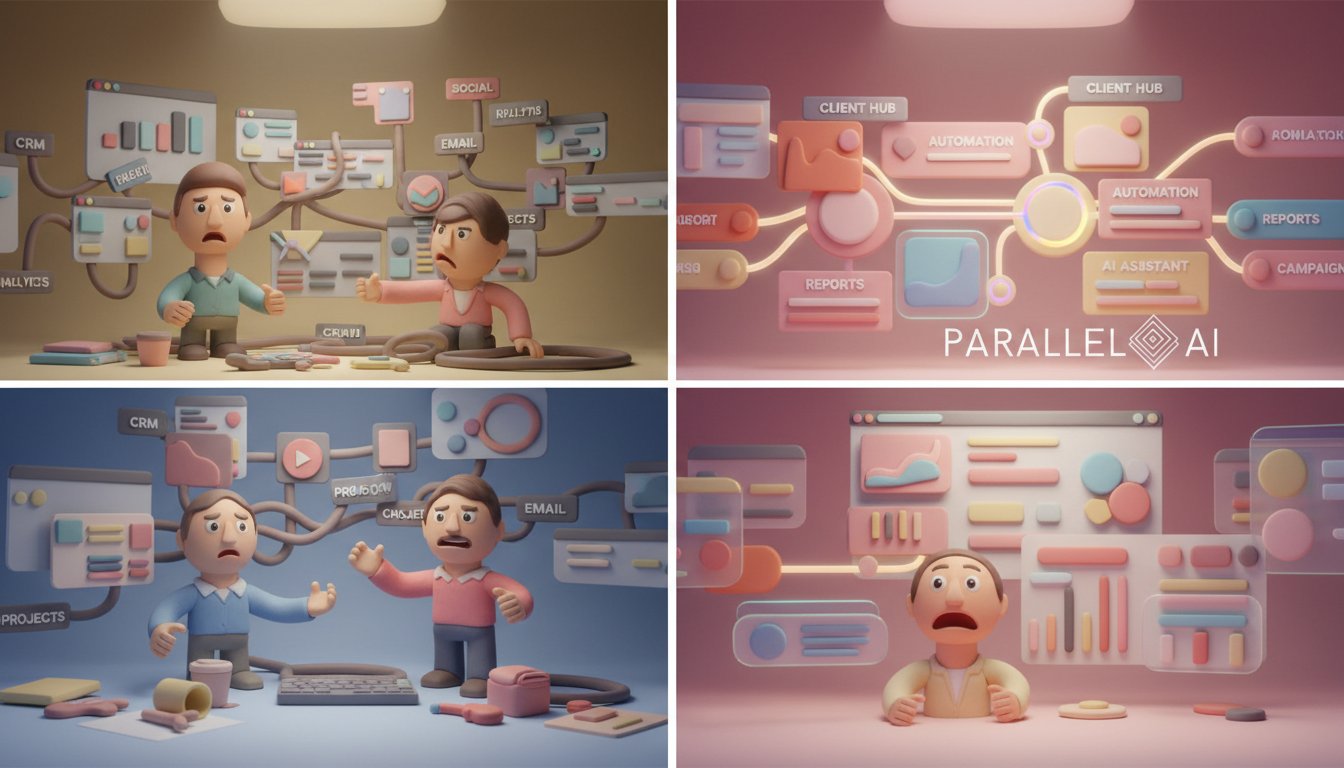
You’ve built your agency around client relationships. You’re profitable. You’re growing. But there’s a problem lurking beneath the surface: your technology stack is bleeding money.
Every month, you’re paying for ChatGPT Plus ($20), Claude Pro ($20), a chatbot platform ($99+), a content creation tool ($49), lead generation software ($150), and half a dozen other subscriptions. The total? Somewhere between $400 and $800 monthly—and that’s before you factor in the 10+ hours your team spends switching between platforms, copy-pasting data, and trying to make these disconnected tools talk to each other.
Meanwhile, your clients are asking for more sophisticated AI solutions. They want chatbots, yes—but they also want AI-powered content, automated lead generation, and intelligent customer engagement across every channel. And you’re stuck choosing between specialized tools that do one thing well or cobbling together a Frankenstein stack that does everything poorly.
This is the exact crossroads where agencies are evaluating platforms like BotPenguin and Parallel AI. Both offer white-label capabilities. Both promise to scale your agency. But one is a chatbot platform trying to expand beyond its core, while the other is a comprehensive AI automation platform designed to replace your entire stack from day one.
Let’s examine which approach actually delivers ROI for agencies in 2026—and why the answer might surprise you.
The Fundamental Architecture Difference: Specialized vs. Comprehensive
Before we dive into features and pricing, we need to understand a critical distinction that most comparison articles gloss over: BotPenguin and Parallel AI are solving fundamentally different problems.
BotPenguin positions itself as an AI chatbot maker platform. It excels at creating conversational interfaces across WhatsApp, Facebook Messenger, Instagram, Telegram, and website chat. You can build bots without coding, integrate with 80+ platforms, and customize the experience with your branding. For agencies whose primary need is client-facing chatbots, this focused approach has merit.
Parallel AI takes a different approach entirely. It’s architected as an all-in-one AI automation platform that consolidates chatbots, content creation, lead generation, AI agents, and workflow automation into a single ecosystem. Instead of replacing one tool in your stack, it’s designed to replace 8-12 tools simultaneously.
This architectural difference creates a cascading impact on everything from pricing to implementation to long-term scalability. Let’s break down what this means in practice.
Multi-Model Access: Why Your Agency Needs More Than One AI Brain
Here’s where the comparison gets interesting—and where many agencies make a costly mistake.
BotPenguin offers integration with ChatGPT-4o and allows you to train chatbots on custom data sources like PDFs, Google Sheets, and documentation. That’s solid functionality for conversational AI. But you’re essentially locked into one AI model provider for your core intelligence.
Parallel AI provides uncapped access to 6+ premium AI models: OpenAI’s GPT-4, Anthropic’s Claude, Google’s Gemini, Grok, DeepSeek, and Perplexity. This isn’t just feature bloat—it’s strategic flexibility that directly impacts your bottom line.
Consider these real-world scenarios:
Scenario 1: Complex Legal Content
Your law firm client needs detailed, nuanced content about estate planning regulations. Claude excels at long-form, context-heavy writing with superior reasoning capabilities. GPT-4 might produce more generic output for this specific use case.
Scenario 2: Technical Documentation
Your SaaS client requires API documentation and developer guides. DeepSeek’s specialized training on technical content produces more accurate, developer-friendly output than general-purpose models.
Scenario 3: Multilingual Customer Support
Your e-commerce client serves 15 countries. Gemini’s multilingual capabilities often outperform other models for non-English languages, particularly for Asian markets.
A 2026 study on multi-model AI strategies found that organizations leveraging multiple AI models achieved higher efficiency, better task-specific performance, and 23-40% cost optimization compared to single-model approaches. Why? Because different models have different strengths, and routing tasks to the optimal model delivers superior results.
With BotPenguin, you’re making a procurement decision: “Which single AI model can handle most of our needs?” With Parallel AI, you’re making an architectural decision: “How do we leverage the best AI model for each specific task?”
For agencies serving diverse clients across multiple industries, this flexibility isn’t a luxury—it’s a competitive necessity.
The Tool Consolidation Math: What You’re Actually Saving
Let’s talk about the elephant in the room: cost. But not just subscription cost—total cost of ownership.
The BotPenguin Stack Approach
Let’s say you choose BotPenguin for your chatbot needs. Here’s what your typical agency stack still looks like:
- BotPenguin: ~$99-299/month (estimated based on typical white-label chatbot pricing)
- ChatGPT Plus: $20/month (for content creation)
- Claude Pro: $20/month (for advanced reasoning tasks)
- Jasper or Copy.ai: $49-99/month (for marketing content)
- Clay or Apollo: $149-349/month (for lead generation)
- Instantly.ai: $97/month (for email outreach)
- Zapier/Make: $29-99/month (for workflow automation)
Monthly Total: $463-983/month
Annual Total: $5,556-11,796/year
But there’s a hidden cost that’s even more insidious: integration overhead. Your team spends 8-15 hours monthly managing these disconnected tools, troubleshooting integration failures, and manually transferring data between platforms. At a conservative $50/hour blended rate, that’s $400-750 in monthly labor costs.
Total True Cost: $863-1,733/month or $10,356-20,796/year
The Parallel AI Consolidation Approach
Parallel AI’s pricing starts at the Pro tier for agencies looking to white-label:
- Parallel AI Pro: Estimated at $387-697/month (based on white-label recommendations of 1.5-2x markup on base costs)
- Replaces: ChatGPT, Claude, Jasper, Clay, Instantly.ai, chatbot platforms, and workflow tools
- Integration Overhead: Minimal—everything operates within one ecosystem
Monthly Total: $387-697/month
Annual Total: $4,644-8,364/year
Net Annual Savings: $5,712-12,432/year
That’s not accounting for the value of your team’s reclaimed time. When you consolidate 8-12 tools into one platform, you eliminate:
- Platform-switching cognitive overhead
- Duplicate data entry across systems
- Integration troubleshooting and maintenance
- Multiple vendor relationships and support tickets
- Training team members on multiple interfaces
For a solo consultant or micro-agency with 1-3 team members, those 8-15 hours monthly represent 10-20% of your total productive capacity. Reclaiming that time is the equivalent of hiring a fractional team member—without the salary.
White-Label Capabilities: What Can You Actually Brand?
Both platforms offer white-label solutions, but the depth and breadth differ significantly.
BotPenguin White-Label Features:
– Custom logo, color themes, and branding
– Domain hosting under your brand
– Branded chatbot interfaces across channels
– Reseller and affiliate programs available
– Client-facing dashboards with your branding
BotPenguin’s white-label offering is comprehensive for what it does: chatbots. You can fully brand the chatbot experience, customize the interface, and present it as your proprietary solution. For agencies exclusively focused on conversational AI, this delivers what you need.
Parallel AI White-Label Features:
– Complete platform rebranding (logo, colors, domain)
– Custom client dashboards and portals
– White-label setup completed in 48 hours (they handle it)
– Clients never see “Parallel AI”—only your brand
– API access for custom integrations
– Embeddable AI assistants in your client portals
– Your Stripe account for direct billing (you control revenue)
The critical difference? Parallel AI’s white-label extends across content creation, lead generation, AI agents, workflow automation, and chatbots. You’re not just white-labeling a chatbot—you’re white-labeling an entire AI operations platform.
This creates a different value proposition for your clients. With BotPenguin, you’re selling “our proprietary chatbot solution.” With Parallel AI, you’re selling “our complete AI automation platform that handles your content, leads, and customer engagement.”
Which positioning commands higher monthly retainers? Which creates more client lock-in and reduces churn?
Revenue Generation Models: How Agencies Actually Make Money
Let’s get tactical about monetization because this is where theoretical features meet real-world profitability.
BotPenguin Revenue Model:
Agencies typically monetize BotPenguin through:
- Monthly chatbot subscriptions: $297-797/month per client
- Setup and customization fees: $1,500-3,500 one-time
- Ongoing optimization and training: $500-1,000/month
Example Agency Math (20 Clients):
– Platform cost: ~$299/month for white-label tier
– Average client charge: $497/month
– Gross monthly revenue: $9,940
– Net monthly revenue: $9,641
– Annual profit: $115,692
That’s respectable. But you’re still paying for separate content, lead gen, and automation tools—cutting into those margins.
Parallel AI Revenue Model:
Parallel AI documentation suggests agencies can “add $30-50K monthly revenue per 20 clients” through:
- Platform subscriptions at 1.5-2x markup: $697-997/month per client
- Onboarding and setup fees: $1,500-5,000 one-time
- Content creation services: $1,000-2,500/month (delivered through the platform)
- Lead generation campaigns: $1,500-3,000/month (managed through Smart Lists)
- AI agent deployment: $500-2,000/month for voice/chat agents
Example Agency Math (20 Clients):
– Platform cost: ~$387/month base
– Average client charge: $1,497/month (platform + services)
– Gross monthly revenue: $29,940
– Platform cost: $387/month
– Net monthly revenue: $29,553
– Annual profit: $354,636
The difference? $238,944 in additional annual revenue—because you’re selling a comprehensive solution instead of a point solution.
But here’s what the math doesn’t show: client stickiness. When you’re providing a client’s chatbot, they can switch providers relatively easily. When you’re providing their chatbot AND content engine AND lead generation AND AI agents, you’ve become embedded infrastructure. Replacing you means replacing their entire AI operations—a much higher switching cost.
Implementation Reality Check: Setup Time and Technical Complexity
Feature lists look great in comparison charts. But what actually happens when you’re trying to launch your first white-labeled client?
BotPenguin Implementation:
BotPenguin offers a no-code chatbot builder, which is genuinely accessible for non-technical users. Typical implementation timeline:
- Day 1-2: Account setup, white-label branding configuration
- Day 3-5: Build first chatbot using drag-and-drop interface
- Day 6-7: Train AI on client data sources (PDFs, website content)
- Day 8-10: Integration with client’s messaging platforms
- Day 11-14: Testing, refinement, deployment
Total timeline: 2-3 weeks for first client
The learning curve is reasonable. The platform is designed for marketers and agency owners without deep technical backgrounds. However, you’re still managing separate platforms for everything beyond chatbot functionality.
Parallel AI Implementation:
Parallel AI claims “most teams are up and running in under 30 minutes” for basic functionality, with white-label setup “complete in 48 hours (we handle it).” Reality check:
- Hours 1-48: Parallel AI team configures white-label branding, domain, client portal
- Day 3: Connect knowledge base (Google Drive, Notion, Confluence)
- Day 3-4: Configure AI models, create first AI assistants
- Day 4-5: Set up content automation workflows and publishing calendar
- Day 5-7: Deploy Smart Lists for lead generation
- Day 7-10: Configure AI agents (voice/chat) with client use cases
- Day 10-14: Training and optimization
Total timeline: 10-14 days for comprehensive deployment
The difference? BotPenguin gets you to “chatbot live” faster. Parallel AI gets you to “complete AI operations platform live” in roughly the same timeframe—but you’re deploying significantly more functionality.
For agencies, the relevant question isn’t “How fast can I launch a chatbot?” It’s “How fast can I start generating revenue across multiple AI services?” Parallel AI’s comprehensive approach means you can sell content services, lead generation, and customer engagement simultaneously—not sequentially.
The Specialization vs. Platform Debate: Which Wins in 2026?
This brings us to the strategic question every agency faces: Should you specialize in one thing or offer a comprehensive platform?
There’s a compelling case for specialization. BotPenguin’s focus on chatbots means they’ve likely invested more engineering resources into conversational AI features—things like:
- Advanced conversational flow builders
- Nuanced WhatsApp Business API integration
- E-commerce specific features like abandoned cart recovery
- Industry-specific chatbot templates (healthcare, education, real estate)
If your agency exclusively serves e-commerce clients and chatbots are your primary deliverable, BotPenguin’s specialized feature set might serve you better.
But here’s what the market data shows for 2026:
Client Expectations Are Shifting
Agencies report that 73% of clients now expect AI capabilities beyond just chatbots. They want content automation, lead intelligence, and omnichannel engagement—not just conversational interfaces.
Tool Fatigue Is Real
A study on AI adoption found that organizations using 6+ separate AI tools experienced 34% higher abandonment rates and 47% lower team adoption compared to those using 1-2 comprehensive platforms. Complexity kills execution.
The “AI Factory” Model
MIT Sloan Review’s 2026 AI trends report highlights the rise of “AI factories”—integrated platforms that accelerate AI development and deployment using standardized tools and efficient data management. This mirrors what Parallel AI offers: a unified environment for all AI operations.
The trend is clear: consolidation is winning. Clients don’t want to manage multiple AI vendors. They want one trusted partner who can handle their entire AI strategy.
BotPenguin’s specialization made perfect sense in 2022-2023 when chatbots were the primary AI use case businesses understood. In 2026, when businesses expect AI to power their content calendar, lead pipeline, and customer engagement simultaneously, specialized tools create friction.
Real-World Use Case Comparison
Let’s make this concrete with three typical agency scenarios:
Scenario 1: Solo Marketing Consultant
Client Mix: 5-8 small business clients across diverse industries
With BotPenguin:
– Deploy custom chatbots for each client’s website and Facebook
– Separately manage content creation using Jasper ($99/month)
– Use Clay for lead research ($349/month)
– Total monthly tools: $747+
– Revenue potential: ~$2,500/month from chatbot services
With Parallel AI:
– Deploy chatbots, content automation, and lead generation for all clients
– Single platform at ~$387/month
– Revenue potential: ~$6,000-8,000/month from comprehensive AI services
– Additional monthly profit: $3,500-5,500
Scenario 2: Digital Marketing Agency
Client Mix: 15-20 mid-market clients, 3-5 team members
With BotPenguin:
– White-label chatbot offering for interested clients (~40% adoption = 8 clients)
– Still need separate content, lead gen, and automation tools
– Team spends 12+ hours weekly managing tool stack
– Revenue: ~$4,000/month from chatbot services
With Parallel AI:
– Comprehensive AI platform offered to all clients (70% adoption = 14 clients)
– Team manages everything in one interface
– Reclaim 12 hours weekly = equivalent to 0.3 FTE
– Revenue: ~$20,000/month from AI services
– Additional monthly profit: $16,000
Scenario 3: HighLevel Agency
Client Mix: 30+ clients, specialized in service businesses
With BotPenguin:
– Chatbots integrated alongside HighLevel CRM
– Separate AI tools for content and lead generation
– Complex integration requirements
– Revenue: ~$9,000/month from chatbot upsells
With Parallel AI:
– Native HighLevel integration (connect via API in 10 minutes)
– Trigger Parallel AI actions from HighLevel workflows
– Sync data between HighLevel custom fields and Parallel AI knowledge base
– White-label AI embedded in HighLevel client portals
– Revenue: ~$30-50K/month from comprehensive AI services
– Additional monthly profit: $21,000-41,000
The pattern is consistent: specialized chatbot solutions serve a narrower use case, while comprehensive platforms enable multiple revenue streams.
Integration Ecosystem: Playing Well With Others
No platform exists in isolation. Let’s examine how each integrates with your existing tech stack.
BotPenguin Integrations:
– 80+ direct integrations including HubSpot, Zoho CRM, Trello, Acuity Scheduling, Pabbly, Zapier, and Pipedrive
– Native messaging platform connections (WhatsApp Business API, Facebook Messenger, Instagram, Telegram)
– Payment gateway integrations for e-commerce
– CRM data sync capabilities
BotPenguin’s integration ecosystem is solid and focused on chatbot-adjacent functionality. If your chatbot needs to pull data from your CRM or trigger actions in your project management tool, BotPenguin likely has you covered.
Parallel AI Integrations:
– Native HighLevel integration via API
– Google Drive, Notion, Confluence, and database connections for knowledge base
– Content publishing to WordPress, LinkedIn, Instagram, Facebook, YouTube, TikTok, X, and RSS feeds
– Email integration (IMAP/Gmail/365) for AI-powered inbox management
– Custom n8n nodes for advanced workflow automation
– Stripe integration for direct client billing under your white-label
– CRM integration for closed-loop tracking of leads and sequences
The difference in integration philosophy is telling. BotPenguin integrates chatbots into your existing workflow. Parallel AI integrates your entire AI operations into one workflow—then connects that workflow to your existing tools.
For agencies, this distinction matters when you’re trying to demonstrate ROI to clients. With fragmented tools, showing attribution from “AI content creation” → “lead generation” → “customer conversation” requires stitching together data from 4-5 platforms. With Parallel AI, that attribution lives in one system.
The Security and Compliance Question
When you’re white-labeling AI solutions, you’re putting your brand reputation on the line. If the platform experiences a data breach or compliance failure, your clients blame you—not the underlying vendor.
BotPenguin Security:
While specific security certifications aren’t prominently published, BotPenguin handles customer data across messaging platforms and maintains integrations with enterprise CRMs, suggesting baseline security standards. For full details, agencies should request their security documentation directly.
Parallel AI Security:
– AES-256 encryption for data at rest
– TLS protocols for data in transit
– SOC 2 compliance commitment
– GDPR compliant data handling
– Optional on-premise deployment for enterprise clients
– SSO (Single Sign-On) for enterprise accounts
– Explicit privacy policy: data not used for model training
For agencies serving clients in regulated industries (healthcare, finance, legal), these compliance certifications aren’t optional—they’re table stakes. The ability to point to SOC 2 compliance and GDPR adherence becomes a competitive differentiator when competing for enterprise deals.
Parallel AI’s commitment to not using client data for model training is particularly significant in 2026, as data privacy concerns have escalated. Your clients’ proprietary information remains proprietary—it doesn’t become training data for the next iteration of GPT-5.
What Users Are Actually Saying: The Feedback Reality
BotPenguin User Sentiment:
Based on reviews from G2, Capterra, Trustpilot, and Good Firms, BotPenguin earns consistent praise for:
– Intuitive interface and ease of use
– Responsive customer support
– Robust multi-channel deployment
– No-code customization capabilities
Common criticisms include:
– Limited advanced AI capabilities compared to dedicated AI platforms
– Pricing opacity (need to contact sales for white-label pricing)
– Occasional integration bugs with third-party platforms
Parallel AI User Sentiment:
Parallel AI’s positioning as a newer, comprehensive platform means fewer public reviews but strong testimonials around:
– Significant time savings (20+ hours weekly reported)
– Tool consolidation value ($400-800/month savings)
– Quality of AI outputs across multiple models
– Speed of white-label deployment (48-hour setup)
Areas for improvement mentioned:
– Learning curve for comprehensive feature set
– Desire for more industry-specific templates
– Requests for additional publishing platform integrations
The pattern? BotPenguin earns high marks for doing one thing well. Parallel AI earns high marks for eliminating the need to use multiple platforms—but requires more upfront learning investment.
The Pricing Transparency Problem
Here’s a frustration point worth addressing: neither platform publishes white-label pricing openly.
BotPenguin’s website lists basic chatbot plans but requires you to contact sales for white-label and reseller pricing. Industry research suggests white-label tiers likely start around $99-299/month, but exact pricing remains opaque.
Parallel AI similarly doesn’t publish white-label pricing directly but provides more guidance in their marketing materials. They recommend agencies markup costs by 1.5-2x, suggesting base costs in the $387-500/month range for comprehensive access.
For agencies evaluating platforms, this lack of transparency is frustrating. You can’t build a business model without knowing your cost structure. Both platforms should publish clear, public pricing tiers for their white-label offerings.
Practical Recommendation: Request detailed pricing breakdowns from both vendors, including:
– Base white-label platform fees
– Per-client seat costs (if applicable)
– Usage limits (messages, AI queries, content pieces)
– Overage pricing
– Setup and onboarding fees
– Support tier options and costs
Don’t commit until you understand the complete financial picture.
The “What Happens When” Scenarios
Let’s address the practical questions that keep agency owners up at night:
What happens when a client needs a custom integration?
– BotPenguin: You’re working within their 80+ integrations or using Zapier/Make as middleware. Custom API work likely requires development resources.
– Parallel AI: Custom n8n nodes available, plus API access for building proprietary integrations. More flexibility but requires technical capability.
What happens when the platform experiences downtime?
– BotPenguin: Your client’s chatbots go offline. Customer support requests go unanswered. You field angry calls.
– Parallel AI: Your client’s chatbots, content publishing, lead generation, and AI agents all go offline simultaneously. Higher impact but also higher incentive for platform reliability.
What happens when you want to switch platforms?
– BotPenguin: Export chatbot conversation data, rebuild conversation flows on new platform. Painful but contained to one function.
– Parallel AI: Migrating off a comprehensive platform means reconstructing your entire AI operations infrastructure. Extremely high switching cost (which benefits retention but increases risk).
What happens when a client outgrows the platform?
– BotPenguin: Client might need more sophisticated NLP, enterprise integrations, or AI capabilities beyond chatbots. Migration risk is real.
– Parallel AI: Client has access to 6+ AI models, advanced automation, and enterprise features from day one. More room to scale within the platform.
These scenarios highlight an important truth: comprehensive platforms create more client lock-in (good for retention, higher switching risk) while specialized platforms create easier entry/exit (good for flexibility, higher churn risk).
The Verdict: Which Platform Wins for Your Agency?
After examining features, pricing, implementation, and real-world use cases, here’s the honest assessment:
Choose BotPenguin if:
– Your agency specializes exclusively in conversational AI and chatbot deployment
– Your clients specifically need robust WhatsApp Business, Facebook Messenger, or Telegram bots
– You prefer best-of-breed specialized tools over all-in-one platforms
– You’re already satisfied with your content, lead gen, and automation tools
– Your clients are primarily e-commerce businesses needing abandoned cart recovery and sales bots
– You want the simplest possible learning curve for your team
Choose Parallel AI if:
– You want to consolidate 8-12 separate AI tools into one platform
– Your clients need content creation, lead generation, AND customer engagement
– You’re building a comprehensive AI service offering for your agency
– You value access to multiple AI models (GPT-4, Claude, Gemini, etc.) over single-model solutions
– You want to maximize revenue per client through bundled AI services
– You’re willing to invest upfront learning time for long-term operational efficiency
– You serve diverse clients across multiple industries who need varied AI capabilities
– You want to save $400-800/month on tool subscriptions while reducing integration overhead
For most solopreneurs and micro-agencies in 2026, Parallel AI offers superior economics and strategic positioning. The ability to white-label a comprehensive AI platform—replacing ChatGPT, Claude, Jasper, Clay, Instantly.ai, and chatbot tools simultaneously—creates multiple revenue streams from a single platform relationship.
But there’s a legitimate use case for BotPenguin: if you’ve built your entire agency brand around conversational AI expertise, and chatbots represent 80%+ of your revenue, BotPenguin’s specialized feature set and focused development roadmap might serve you better.
Three Action Steps to Make Your Decision
Don’t choose based on this article alone. Here’s how to make an informed decision:
1. Map Your Current Tool Stack
List every AI-related subscription you’re currently paying for:
– AI model access (ChatGPT Plus, Claude Pro, etc.)
– Content creation tools
– Lead generation platforms
– Chatbot software
– Workflow automation
– Email outreach tools
Calculate your true monthly cost including labor for managing integrations.
2. Define Your Ideal Service Offering
What do you want to sell to clients 12 months from now?
– Just chatbots?
– Chatbots + content?
– Comprehensive AI operations?
Your platform choice should enable your vision, not limit it.
3. Request Demos from Both Platforms
Don’t just watch the marketing demo. Request a technical demo where you:
– See the white-label customization process
– Test the actual AI output quality
– Understand the real implementation timeline
– Get transparent pricing for your agency size
– Ask about client migration support
– Clarify support SLAs and response times
Then build a real ROI model with actual numbers—not hypothetical scenarios.
The Bottom Line: Tool Consolidation Is Winning in 2026
The broader trend in AI adoption is unmistakable: businesses are consolidating fragmented AI tools into unified platforms. The “best-of-breed” approach that dominated 2020-2023 is giving way to integrated ecosystems that reduce complexity, lower costs, and improve execution.
BotPenguin offers a strong, focused solution for conversational AI. For agencies whose entire business model revolves around chatbots, it’s a legitimate choice. But for the majority of solopreneurs and micro-agencies trying to build comprehensive AI service offerings in 2026, the economics and strategic positioning favor platforms like Parallel AI.
When you can replace 8+ tools with one platform, save $400-800/month, reclaim 10-20 hours weekly, and offer clients a complete AI solution under your brand—the calculus shifts dramatically. You’re not just saving money on subscriptions. You’re transforming your agency’s scalability and revenue potential.
The question isn’t really “BotPenguin vs Parallel AI.” The question is: “Do I want to specialize in one AI capability or offer comprehensive AI operations to my clients?”
Your answer to that question should drive your platform decision. Just make sure you’re choosing the approach that aligns with where your market is headed—not where it’s been.
Because in 2026, your clients aren’t asking for chatbots. They’re asking for AI that knows their business, automates their workflows, and scales their impact. The platform you choose should deliver that—completely branded as your own.
Ready to see if Parallel AI can replace your entire tool stack? Start with their free plan to test AI output quality across multiple models, then request a white-label demo to see the complete agency offering. Compare the total cost of ownership against your current subscriptions—the numbers might surprise you.
And if chatbots truly are your singular focus? BotPenguin deserves a serious evaluation. Just make sure you’re not limiting your agency’s growth potential by choosing specialized tools in a market that’s demanding comprehensive solutions.