
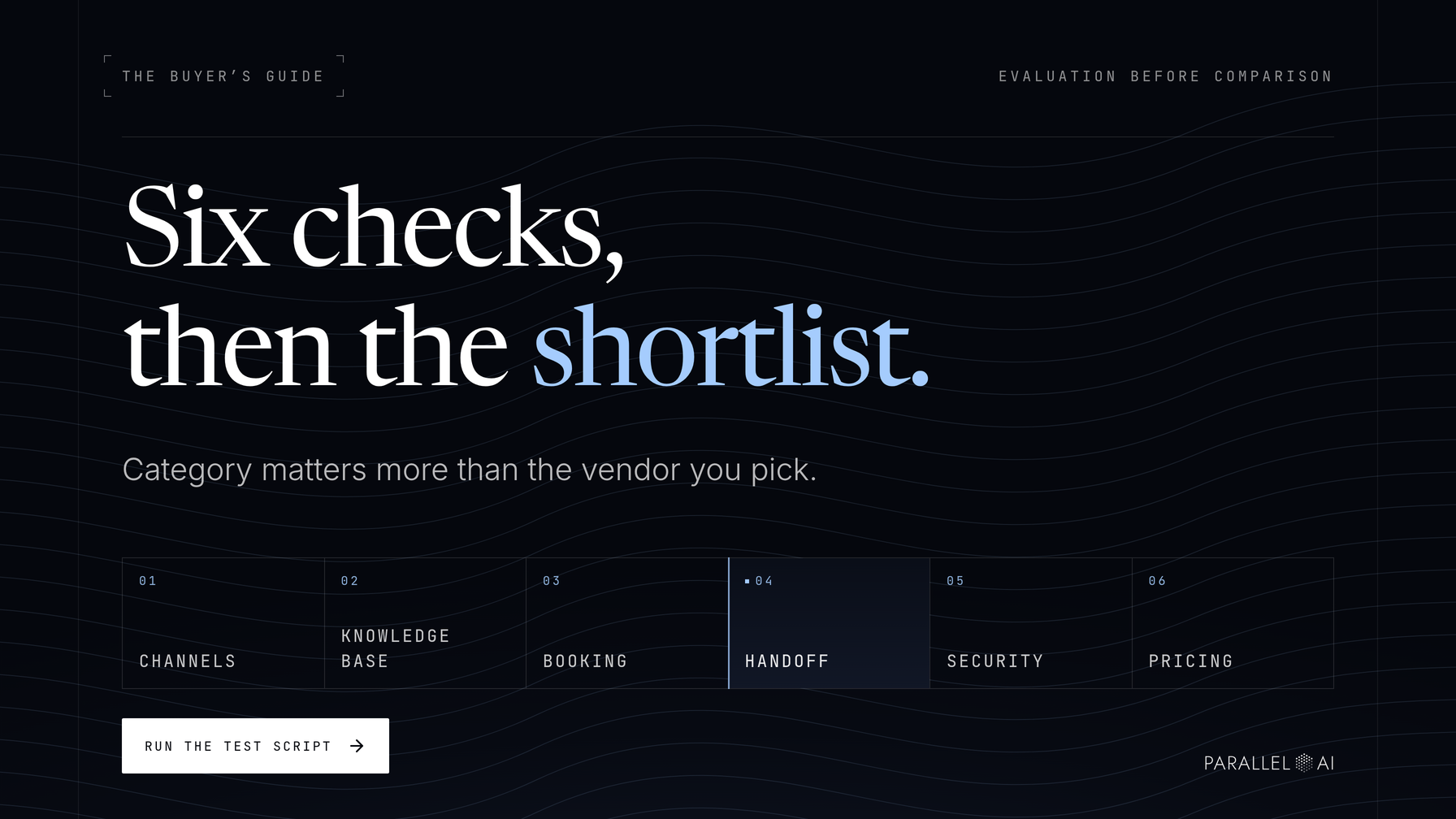
The best AI chatbot for business covers the channels your customers actually use, answers from your own knowledge base, qualifies and books meetings, and hands off to a human without losing context. Most chatbot roundups can't tell you which tools do that, because they compare feature lists instead of deployment realities. This guide flips the order: evaluation framework first, then an honest comparison of the three tool categories, so you can build a shortlist in one sitting. It's written for agency owners, founders, and marketing leaders comparing platforms right now, and it ends with a test script you can run against every finalist today.
Before the framework, a quick map: nearly every business chatbot falls into one of three categories, and the category matters more than the vendor you pick.
| Category | Best for | Strengths | Trade-offs |
|---|---|---|---|
| Standalone chatbot builders | Getting web chat live fast on a marketing site | Quick setup, visual conversation builders, low starting cost | Another subscription; disconnected from lead data, outreach, and content workflows |
| CRM-embedded chat | Teams already running sales and support inside a CRM | Conversations tied to contact records and pipelines | Chat is an add-on; per-seat pricing scales poorly; limited AI model choice |
| All-in-one GTM platforms | Teams that want chat connected to content, lead generation, and outreach | One platform, multiple AI models, context-rich handoffs, white-label options | Broader scope takes more upfront configuration; overkill if you only need a website widget |
What Separates the Best AI Chatbot for Business From the Ones That Just Demo Well?
Six checks cut most of the market fast: channels, knowledge base training, qualification and booking, handoff quality, security, and pricing. Most tools that survive the first two checks fail the handoff test, so verify rather than trust a demo.
Channel coverage beyond the website widget
Web chat is the minimum. If your leads arrive by SMS, WhatsApp, email, or phone, the platform needs to handle those channels natively. Otherwise you're buying a second tool to cover the gap, then syncing data by hand. Voice is now the clearest dividing line. A platform with real voice agents can take calls and act on them. Tools that only transcribe voicemails can't.
Training on your knowledge base, not generic data
A chatbot is only as accurate as the material it can reach. Insist on training against your real documents. That means pricing pages, help center articles, and service terms. Ask for native connectors to wherever that content lives: Google Drive, Notion, Confluence. Context window size matters too. A one-million-token window lets an assistant work from entire document sets instead of summaries. Also ask: does your data train the underlying models? If you handle client data, the answer needs to be no.
Lead qualification and meeting booking
Answering questions is the floor, not the ceiling. The best AI chatbot for business asks qualifying questions, scores the lead, and books the meeting onto a calendar. If the bot's final move is emailing an address for a human to chase, you've bought a contact form with better copy.
Human handoff with full context
Handoffs are where chatbots quietly fail. When the bot escalates, the person picking it up should see the full transcript, plus what the visitor has already been told and asked. If the conversation restarts from zero, the customer repeats themselves and your team looks disorganized. Vendors rarely demo this unprompted, so audit it deliberately.
Security, compliance, and data ownership
Ask for specifics, not assurances. You want AES-256 encryption at rest, TLS in transit, and SOC 2 and GDPR readiness. You also want clear answers on where data lives and what happens if you leave. A vendor who can't answer these questions quickly is telling you something.
Pricing structure and white-label capability
Two details matter at decision time: how pricing scales, and whether you can rebrand the platform. Per-seat pricing punishes growth. Per-conversation pricing punishes success. Favor predictable platform-level pricing as volume grows. If you run an agency, white-label is the difference between adding another tool cost and launching a productized AI service under your own brand.
Which Category of Chatbot Platform Should Make Your Shortlist?
The right category depends on where chat sits in your operation, not on which vendor demos best.
When standalone builders are the right pick
Standalone builders make sense when you need web chat live this week and genuinely nothing more. You're adding one more subscription to a fragmented stack, disconnected from your lead data, outreach sequences, and content production.
When CRM-embedded chat is the right pick
CRM-embedded chat makes sense when your team already lives inside the CRM for every deal and ticket. The convenience of conversation and record in one place is real. So is the caution: chat is usually an add-on with per-seat pricing and limited model choice. Pressure-test output quality at your real conversation volume, not the entry tier.
When an all-in-one platform is the right pick
All-in-one platforms make sense when chat is part of a bigger go-to-market motion, with content, lead generation, outreach, and support working from one data layer. You trade a longer setup for consolidating several subscriptions into one. You also get a chatbot that acts on what it learns: updating lead records, drafting follow-ups, and feeding real conversations back into your marketing instead of letting them evaporate.
How Do You Test a Chatbot Before You Commit?
A structured test takes an afternoon and prevents a year of regret. Run one identical, scripted conversation through every finalist, then audit the handoff deliberately.
- Write the script first. A realistic prospect asks about pricing for a specific use case, then throws two curveballs. One is an off-topic question; the other is a request the bot should politely refuse. Then they ask to book a meeting. Use the exact same script everywhere. Comparing different conversations teaches you nothing.
- Connect your real knowledge base. Sample docs hide problems. Test with your actual pricing page and help center, including the awkward questions customers ask about refunds, competitors, and edge cases.
- Break the handoff on purpose. Trigger an escalation mid-script and check what the human sees. Do they get the full transcript and the qualifying data, or a blank slate?
- Test the channel you'll actually use. If most leads arrive by SMS or WhatsApp, test there, not on the vendor's polished web demo.
- Pilot on real traffic before annual terms. A two-to-four-week pilot on one channel, with your own team answering escalations, reveals more than any sales call.
Four mistakes bias an evaluation toward tools that demo best rather than deploy best. Avoid judging by demo polish, testing only clean inputs, skipping the handoff audit, and letting the vendor choose the script.
Where Parallel AI Fits, and Where It Doesn't
Parallel AI sits in the all-in-one category. Its chat and voice agents behave like AI employees: they answer from your knowledge base, qualify the lead, and then do the follow-on work. That means updating records, drafting the follow-up email, running multi-channel outreach sequences, and feeding the content engine that produces the campaigns those leads see next.
Five specifics matter here.
OpenAI, Claude, Gemini, Grok, and DeepSeek all run in one platform, so you match the model to the task instead of betting on one vendor's strengths and blind spots.
Context windows reach one million tokens. Agents work from entire document sets rather than summaries.
Knowledge integrations are native. Google Drive, Notion, and Confluence connect directly, so your existing knowledge base becomes the agent's knowledge base.
Security holds up too. You get AES-256 encryption and a clear policy that your data never trains models, which is what makes it safe for client-facing work.
White-label rounds it out. Agencies can run the whole platform under their own brand and turn it into a recurring revenue line rather than a tool expense.
For honesty's sake, if you need nothing but a simple website widget this quarter, a standalone builder may serve you fine. Parallel AI earns its keep when chat connects to the rest of your go-to-market engine, or when you want to resell AI services under your own brand.
Decide by Category, Verify by Script, Then Commit
- Category first, vendor second. Standalone builders for fast web chat, CRM-embedded chat for CRM-first teams, all-in-one platforms when chat must connect to content, lead generation, and outreach.
- Six checks eliminate most of the market: channels, knowledge base training, qualification and booking, handoff quality, security, and pricing. Add white-label if you run an agency.
- A scripted test conversation and a deliberate handoff audit tell you more in an afternoon than a month of demos.
- For agencies, white-label capability converts a tool subscription into a service offering.
Start your 7-day free trial of Parallel AI and run the protocol from this guide. Connect your knowledge base, run the scripted conversation, and break the handoff on purpose. Watch the AI employees pick up the work after the conversation ends. Then decide whether Parallel AI belongs on your shortlist.