
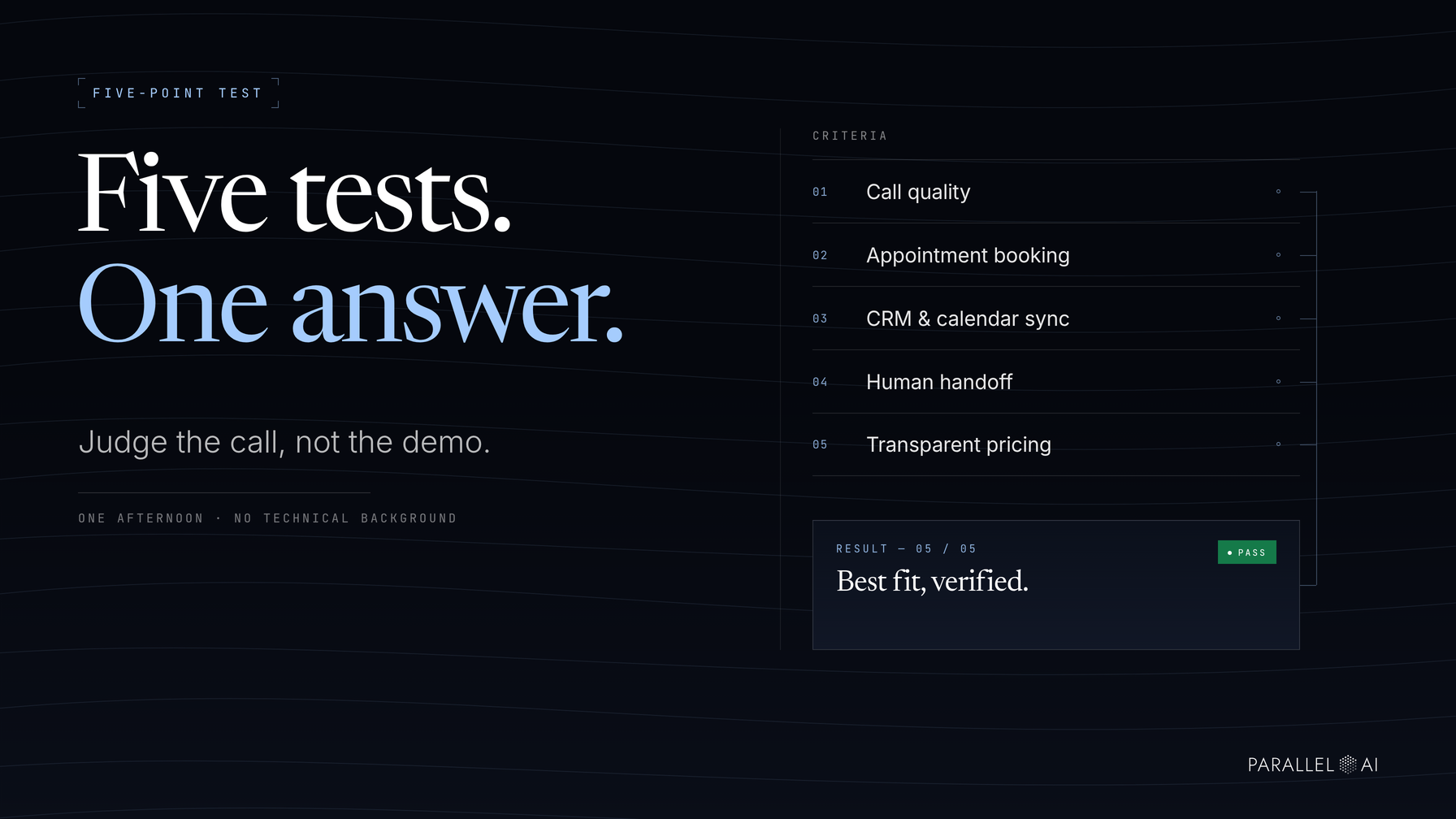
The best AI answering service is the one that passes five practical tests. It holds a natural conversation, books appointments on your real calendar, and syncs every interaction to your CRM. It hands off to a human when a caller needs one. Pricing is predictable enough that you can forecast next month's bill. Demo videos and feature lists matter far less than those five things.
If you run a small business and you're comparing vendors, this post gives you a framework instead of hype. You'll get the five criteria worth judging and a concrete way to test each one. There's also a scoring method you can run in a single afternoon. You don't need a technical background to use any of it.
| Criterion | What good looks like | How to test it |
|---|---|---|
| Call quality | Natural conversation, accurate answers, handles accents and interruptions | Call the line yourself with a tricky question |
| Appointment booking | Proposes real calendar times, confirms, sends details | Ask the agent to book you an appointment live |
| CRM and calendar sync | Calls and notes flow into tools you already use | Watch a test call create a CRM record |
| Human handoff | Transfers complex issues with full context | Ask for a live handoff mid-demo |
| Transparent pricing | Flat, predictable monthly cost | Request a sample invoice at your call volume |
What Separates a Real AI Answering Service From an Expensive Voicemail Robot?
An expensive voicemail robot takes messages. A genuinely useful AI answering service resolves the reason the customer called. That difference shows up in the first thirty seconds of any call. It's the gap between a tool that pays for itself and a subscription you cancel in month three.
A voicemail-style bot reads a script and breaks down the moment a caller goes off-script. It leaves you a transcript to handle on your own time. A real answering service listens and answers questions from your actual business information. It books the appointment during the call and escalates only the conversations that need a human. Before you open a single feature list, decide which of those two things you're paying for. Then run the tests below.
What the Best AI Answering Service Should Include: The Five-Point Test
The best AI answering service should include natural call quality, true appointment booking, native CRM and calendar sync, smooth human handoff, and transparent pricing. Each criterion below comes with a test you can run yourself, on any vendor, before you spend a dollar.
1. Call Quality That Survives Real Conversations
Call quality is the make-or-break criterion. Customers judge it within seconds, and they judge it as a reflection of your business. Listen for natural pacing, accurate answers, and graceful handling of accents, background noise, and interruptions.
Test it yourself. Call the service and ask a question a real customer would ask. Interrupt your own question mid-sentence. Speak quickly, mumble slightly, and use a piece of your industry jargon. If the agent stalls, repeats itself, or asks the caller to restate basic information, no other feature will compensate.
2. Appointment Booking, Not Lead Capture
Lead capture is not appointment booking. Plenty of services "capture" a name and number. The scheduling and the back-and-forth are left for your team to handle later. That's a voicemail with extra steps.
A service worth paying for reads your real availability and offers concrete times. It confirms the booking and sends the details to both sides.
To test this one, ask the agent during a demo to book you an appointment for next Tuesday. Watch whether it proposes actual times from a live calendar or just takes your number and ends the call. The first behavior saves you an hour. The second creates one.
3. CRM and Calendar Sync That Ends Manual Entry
Every call your AI takes should end up in the tools you already run your business on. If the "integration" is an emailed transcript you copy into your CRM by hand, you've added a chore, not removed one.
Ask the vendor which integrations are native, for example Salesforce, HubSpot, or your calendar, and which ones require workarounds. Then place a test call and watch the record appear in your system. If the salesperson can't show this live, treat that as your answer.
4. Human Handoff That Carries Context
Some conversations genuinely need a person: an upset customer, a complex quote, an edge case your knowledge base doesn't cover. What matters is whether the AI recognizes that moment and transfers cleanly.
Mid-demo, say "I'd rather talk to a person." The agent should bring a human into the conversation with a summary of everything discussed. Your caller never has to repeat themselves. If the handoff is a promise that "someone will call you back," you'll lose exactly the customers you were trying to keep.
5. Transparent Pricing With No Per-Minute Surprises
Per-minute pricing looks cheap in a sales deck and gets expensive in a busy month. A flat, predictable cost lets a small business budget with confidence. It also separates vendors confident in their value from vendors counting on overage fees.
Request a sample invoice at your expected call volume, and ask what happens when you exceed the plan's limits. A good vendor answers in one sentence. If the answer takes a paragraph, assume your bill will too.
How Do You Score a Vendor in One Afternoon?
Scoring works because it forces every vendor through the same five questions instead of the same polished demo. Give each vendor one point per criterion, run all five tests in a single sitting, and compare the totals.
- A 5 out of 5 is a shortlist candidate. The vendor can do the job.
- A 3 or 4 is workable, but ask hard follow-up questions about the failed criteria before you commit.
- A 0 to 2 means keep shopping, whatever the demo looked like.
Picture a busy salon where calls pile up whenever the stylists are with clients. Vendor A answers naturally but only takes messages. That's two points, and two jobs the AI should be doing. Vendor B books appointments but quotes per-minute pricing it can't cap, so it earns four points and one hard follow-up question before you sign. Vendor C passes all five tests live on your own line. That's five points and an easy decision. Scoring turns a confusing sales conversation into a clear one.
Three mistakes trip up most small business buyers. First, they test only with easy questions a scripted bot could handle. Second, they judge based on the vendor's own rehearsed demo instead of calls they place themselves. Third, they forget to test what happens after the call: where the information goes and whether anyone has to re-enter it. A vendor that resists live testing is telling you something. Believe it.
What Does Passing All Five Tests Look Like?
Parallel AI is built to pass this exact test. Voice and chat agents answer customers on the phone, SMS, WhatsApp, web chat, and email. One tool covers every channel your customers use.
Each AI employee is trained on your own knowledge base: your services, hours, policies, and FAQs. That's what makes call quality hold up under the tricky-question test, because answers come from your business instead of generic guesses. Meeting booking runs against your real calendar. Native integrations include Salesforce and HubSpot, so every conversation lands in your CRM without manual entry. When a caller needs a person, the agent hands off with the full context of the conversation.
Plans start at $29 a month. The 7-day free trial lets you run the entire five-point test on your own business line before you commit to anything.
Score First, Sign Second
The best AI answering service sounds natural on a difficult call. It books real appointments, syncs to your CRM, hands off with context, and prices without surprises. Any vendor can be scored against those five criteria in one afternoon. The fastest way to know is to hear it yourself.
Start your 7-day free trial of Parallel AI, connect it to your business line, and place a call with your trickiest customer question. If the voice agent handles that one, the rest of your calls will take care of themselves.