
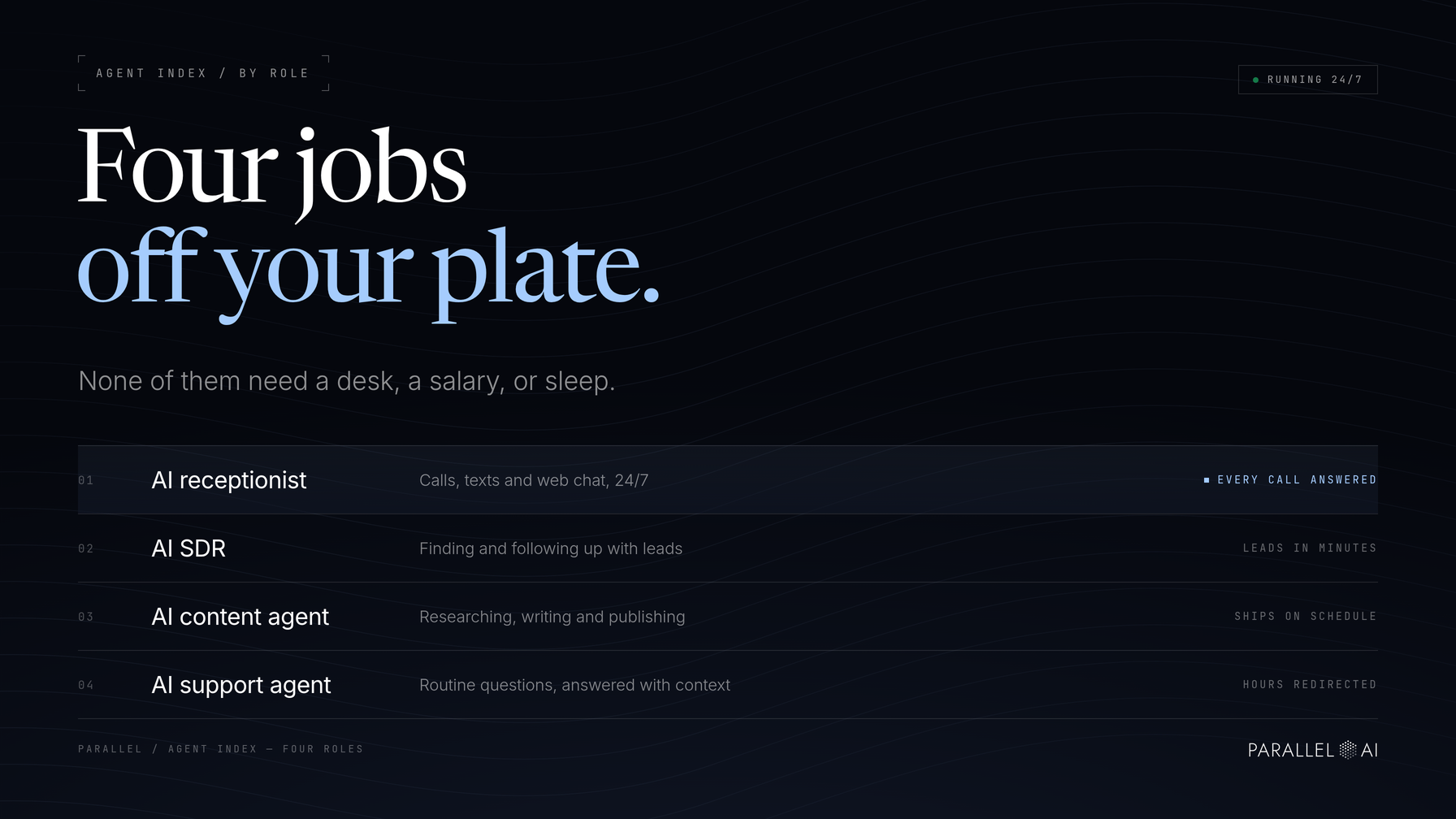
The best AI agents for small business owners to adopt first are the ones that take over work you're currently doing badly or not at all. That usually means four roles: an AI receptionist answering calls, texts, and web chat around the clock; an AI SDR finding and following up with qualified leads; an AI content agent researching, writing, and publishing marketing content; and an AI support agent resolving routine customer questions. Start with these four because each one attacks a job that either eats an owner's evenings or quietly leaks revenue. This guide covers what each agent takes off your plate, what it looks like in a real business, and the practical first steps, plus a framework for evaluating any AI tool before you spend a dollar. No technical skills required.
Here is how the four roles compare:
| AI agent | What it handles | What it takes off your plate | Where payback shows up first |
|---|---|---|---|
| AI receptionist | Calls, texts, and web chat, 24/7 | Missed calls, voicemail backlog, appointment booking | Every call answered instead of lost |
| AI SDR | Finding and following up with qualified leads | Lead research, outreach, follow-up cadence | Leads contacted in minutes, not days |
| AI content agent | Researching, writing, and publishing marketing content | Blog posts, newsletters, social updates | Marketing that ships on schedule |
| AI support agent | Routine customer questions, with full context | FAQs, order status, returns | Staff hours redirected to real problems |
Which AI agent should you start with?
For most small businesses, the first agent to deploy is the AI receptionist. The phone is both your most valuable channel and your most neglected one. A receptionist agent answers calls, texts, and website chat around the clock, whether you're on a job, in a meeting, or asleep, so no caller ever lands on voicemail.
What it takes off your plate
Every missed call is a customer who may be dialing a competitor next. The agent handles the full front-desk loop. It answers questions about hours, services, and pricing. It books appointments directly on your calendar. And it escalates anything sensitive to a human, with a summary attached.
Example: a real estate brokerage
Agents at a five-person brokerage spend every afternoon showing homes, so the office line hits voicemail at the exact moment buyers are calling. The AI receptionist answers every call. It identifies whether the caller is a buyer, seller, or renter, books a viewing on the listing agent's calendar, and texts the broker when a serious seller lead comes in. The follow-up list builds itself instead of evaporating.
First steps
- Train the agent on your knowledge base: service areas, hours, pricing ranges, and your most common questions.
- Define escalation rules. What gets booked automatically versus what gets flagged for a human.
- Test it from your own phone before pointing customers at it.
How do you follow up with every lead when you're the whole sales team?
An AI SDR closes the follow-up gap. It finds leads that match your criteria, reaches out across channels, and keeps nudging until a human takes over. Most leads don't go cold because they were unqualified. They go cold because nobody called back within a day. The SDR agent makes that delay disappear.
What it takes off your plate
Lead research, list building, first-touch outreach, and the thankless follow-up cadence. The agent qualifies leads against rules you set, sends personalized messages, and hands warm conversations to you at exactly the right moment.
Example: a local service business
A two-person HVAC company can't cold-call between jobs. The AI SDR works from your definition of a good customer, say property managers within fifteen miles. It builds the list, sends the first message, follows up twice, and books interested prospects onto the owner's calendar. The owner only touches conversations that are already warm.
First steps
- Write down what a qualified lead looks like in plain language.
- Draft your outreach templates and the follow-up sequence.
- Require human approval before anything is sent. Review the first batch, then loosen the leash as trust builds.
Who keeps your marketing running while you run the business?
An AI content agent researches, writes, and publishes marketing content on a schedule: the blog posts, newsletters, and social updates everyone knows they should produce and nobody has time to produce. Marketing at small businesses rarely fails on strategy. It fails on consistency. A content agent removes the human bottleneck.
What it takes off your plate
Topic research, first drafts, editing, formatting, and publishing logistics. You shift from writing everything to reviewing and approving, which takes a fraction of the time.
Example: a health and wellness studio
A yoga and nutrition studio wants to rank locally and stay connected with clients between visits. The content agent drafts a weekly blog post targeting local search terms, a monthly newsletter, and social captions in the studio's own voice, because it was trained on the studio's existing materials. The owner approves everything in a single Sunday-evening pass instead of writing all week.
First steps
- Feed the agent your existing content so it learns your voice.
- Schedule recurring tasks: a blog draft every Monday, a newsletter on the first of the month.
- Keep an approval step before anything is published. Then automate the routine pieces once quality is proven.
How do you answer routine questions without burning staff hours?
An AI support agent resolves the repetitive questions that fill a small team's inbox: order status, return policies, hours, sizing. It does this with full context on each customer, and it passes the genuinely hard cases to a human. The payoff is twofold. Customers get instant answers, and your staff gets hours back for work that actually needs a person.
What it takes off your plate
The question queue. Because the agent pulls from your knowledge base and the customer's own history, it doesn't answer generically. It answers accurately: "Your order shipped Tuesday and arrives Thursday," not "Please check your confirmation email."
Example: an e-commerce brand
A five-person e-commerce brand drowns in "where is my order" messages every holiday season. The support agent answers those instantly with real order status and handles returns questions from the published policy. It escalates the two messages a day that genuinely need a human, like a damaged shipment or a wholesale inquiry. Response times drop from hours to seconds, and the founder stops working the queue at 11 p.m.
First steps
- Load your FAQs, policies, and help docs into the knowledge base.
- Set escalation triggers for anything involving money, complaints, or account changes.
- Review a sample of transcripts weekly and patch the gaps you find.
How to evaluate the best AI agents for small business before you buy
Judge any AI agent, including the four above, against the criteria that matter for a one-to-ten-person company.
- Ease of setup. You should get real value in an afternoon, with no technical skills and no consultant. If setup feels like an IT project, walk away.
- Minimal disruption. The agent should work with your existing phone number, inbox, and website, not force you to change how you operate.
- Visible time and cost savings. Demand concrete outputs: calls answered, leads contacted, posts published, tickets resolved. You should be able to point at what changed.
- Start small, expand later. The right tool lets you deploy one agent this month and add a second next quarter. Never bet the business on day one.
Before you buy, also confirm the vendor offers real support for non-technical users and can show testimonials from businesses that look like yours: a salon or a brokerage, not a software company.
Why one platform beats four separate tools
You can buy four point solutions and stitch them together, or run all four roles on one platform. Parallel AI covers the receptionist, SDR, content, and support roles through AI Employees, chat and voice agents, the content engine, and Lead Data and Sequences. Every agent shares one knowledge base and one contact record.
That shared foundation is the difference. Train the knowledge base once and every agent draws on it, so the receptionist answers pricing questions exactly the way the support agent does. Because agents share a contact record, the conversation a caller had with the receptionist on Tuesday informs the SDR's follow-up on Wednesday. No copy-pasting between tools, no fragmented subscriptions to manage. For agencies serving small-business clients, Parallel AI's white-label program lets you deliver all of it under your own brand.
Start with one agent, expand as it pays off
- Begin with the agent that fixes your most expensive gap. For most small businesses, that's the phone.
- Train every agent on a single knowledge base so answers stay consistent across roles.
- Keep a human approval step before anything is sent or published, then automate as trust builds.
- Evaluate any tool on setup time, workflow fit, visible savings, and room to grow.
The next step is small by design. Start a 7-day free trial of Parallel AI and set up one AI Employee, whether that's a receptionist, an SDR, a content agent, or a support agent, with plans starting at $29/month. Point it at your knowledge base, run it on your real work for a week, and let the results make the case for the second agent.