
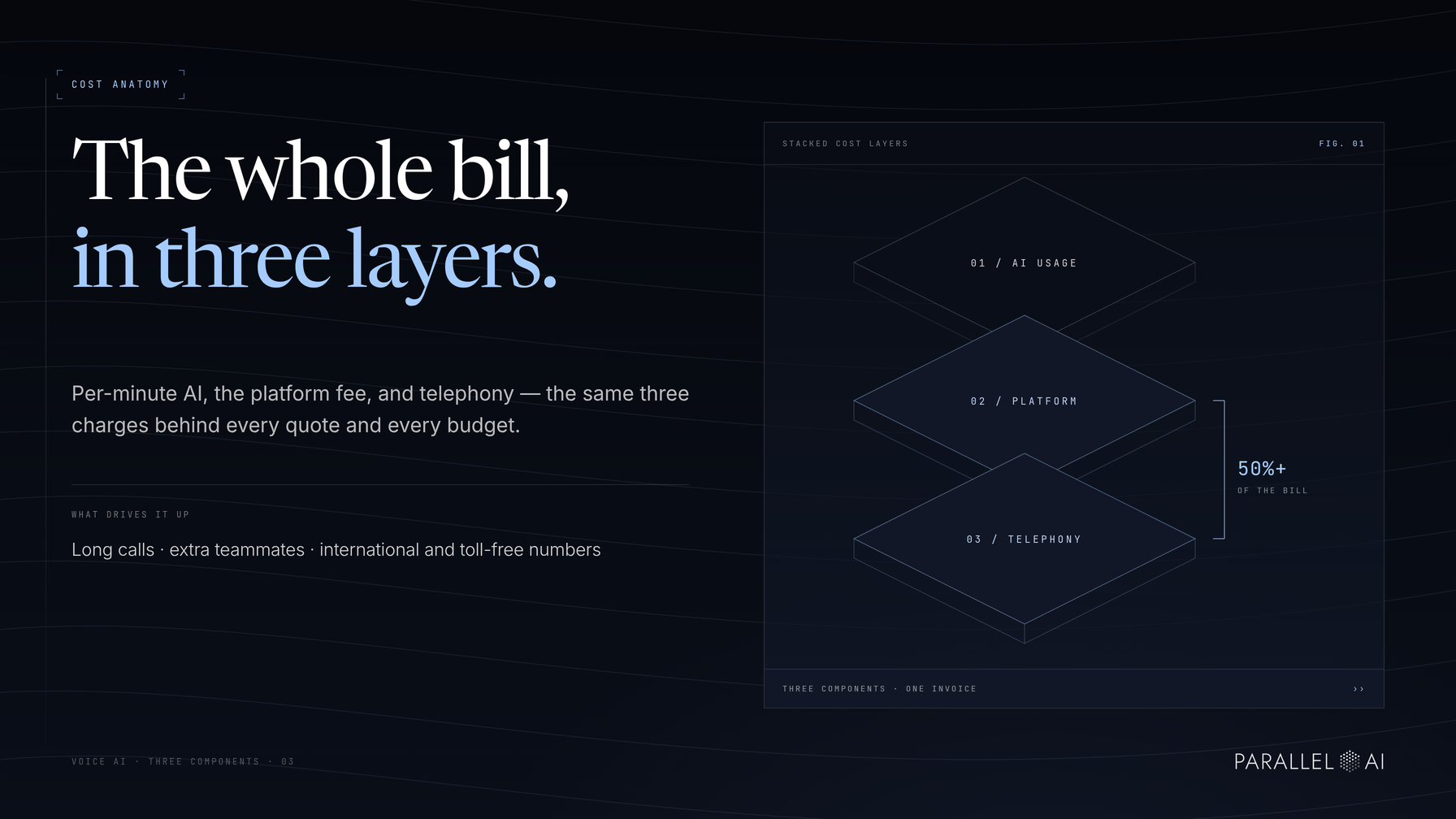
AI voice agent pricing breaks down into three parts: a per-minute AI model and usage cost, a platform or subscription fee, and telephony charges for every call and SMS the agent handles. Most buyers shop on the headline per-minute rate. Then they find out the other two components make up half or more of the bill. This guide is for agency founders, marketers, and operations leaders comparing voice AI platforms right now. It explains each cost component, walks through sample monthly budgets for three common use cases, and covers the hidden costs and vendor questions that protect you before you sign.
Here is how the three components compare at a glance:
| Cost component | What it covers | How vendors charge it | What drives it up |
|---|---|---|---|
| Per-minute AI usage | The AI models that listen, reason, and speak during a conversation | Per conversation minute, sometimes split by model tier | Long calls, premium models, verbose agents |
| Platform or subscription fee | The builder, dashboard, contact management, and workflow tools | Flat monthly fee or per-seat charge | Extra teammates, extra workspaces |
| Telephony charges | The actual phone calls and SMS messages | Per call minute by destination, per SMS message | International calls, SMS-heavy sequences, toll-free numbers |
What makes up AI voice agent pricing?
Every AI voice agent price combines the same three charges. What differs is how vendors structure each one, and those differences are what let you compare two quotes on equal footing.
1. Per-minute AI model and usage costs
Each minute a voice agent listens, reasons, and speaks, it consumes AI model processing, and vendors bill for it by the conversation minute. Two structural differences matter:
- Blended vs. tiered rates. Some platforms charge one rate no matter which model powers the agent. Others price by tier, so a premium model like GPT-4 or Claude costs more per minute than a lightweight one.
- When billing starts. Ask whether the clock starts when the phone connects or when the AI first speaks. A few seconds per call adds up fast across thousands of calls.
A practical move: run simple tasks like call routing on a cheaper model, and save the premium models for complex conversations like lead qualification.
2. Platform or subscription fees
The platform fee pays for the tools around the agent: the builder, dashboard, contact management, and workflows. Vendors charge it either as a flat monthly subscription or as a per-seat fee that grows with every teammate who needs access. Per-seat pricing is the one that quietly inflates budgets. A ten-person agency pays ten times what a solo founder pays, even if only two people ever touch the voice tools.
3. Telephony charges for calls and SMS
Telephony is the cost of the actual phone calls and SMS messages, and it sits separately from AI usage. Calls are billed per minute and priced by destination. SMS is billed per message. Watch how vendors handle it: some bundle telephony into their per-minute rate, some pass carrier costs through at cost, and some mark them up. Ask which. It changes your effective rate more than any negotiation.
What does AI voice agent pricing look like in practice? Three sample budgets
Sample budgets make the three components concrete. The scenarios below use illustrative rates, so swap in the rates from your shortlisted vendors and redo the math. We assume a $0.15 per-minute AI rate, a $99 platform tier, and $0.01 per telephony minute.
Sample budget 1: an AI receptionist answering inbound calls
A five-person agency wants every inbound call answered, including during lunch breaks and meetings.
- Call volume: 300 inbound calls per month
- Average handle time: 2 minutes
- AI usage: 600 minutes × $0.15 = $90
- Platform fee: $99
- Telephony: 600 inbound minutes × $0.01 = $6, plus 300 SMS confirmations × $0.01 = $9
- Estimated total: $198 per month
At moderate volume, the platform fee is half the bill. Generous or unlimited usage tiers usually beat pure pay-as-you-go for steady inbound work.
Sample budget 2: a voice agent qualifying leads after hours
A B2B team adds an after-hours agent that answers, asks five qualification questions, and books demos.
- Call volume: 150 after-hours calls per month
- Average handle time: 3 minutes, since qualification takes longer than routing
- AI usage: 450 minutes × $0.20 (premium model for detailed questions) = $90
- Platform fee: $0 additional when it shares the platform above
- Telephony: 450 minutes × $0.01 = $4.50, plus 150 SMS follow-ups × $0.01 = $6
- Estimated total: $96 additional per month
Stacking a second use case onto a platform you already pay for is dramatically cheaper than buying a second tool. This is where consolidation pays off.
Sample budget 3: outbound voice follow-up sequences
A sales team adds voice to its follow-up sequence, calling every new lead and leaving a message when no one answers.
- Call volume: 1,000 outbound calls per month
- Connect rate: 60%, so 600 conversations at 1.5 minutes each
- AI usage: 900 minutes × $0.15 = $135
- Telephony: 900 conversation minutes plus roughly 200 minutes of ring time on the 400 unanswered calls, so 1,100 minutes × $0.01 = $11, plus 400 SMS retries × $0.01 = $15
- Estimated total: $150 per month, plus your platform share
Unanswered calls still consume telephony minutes while the phone rings, even though the AI never speaks. So estimate your connect rate before budgeting any outbound program.
How do you estimate your own total cost?
Estimating your own number takes five steps:
- Count conversations and handle time. Pull last month's call log or phone bill and multiply monthly calls by average handle time in minutes.
- Apply the AI rate for your model tier. Use the premium rate if the agent qualifies or negotiates. Use the standard rate if it routes calls and takes messages.
- Add the full platform fee. Include every seat that needs access, not just the admin.
- Add telephony and SMS. Estimate call minutes by destination, monthly SMS volume, and, for outbound, ring time on your non-connects.
- Add a 20% buffer. Long calls, retries, and volume spikes happen. A buffer keeps month two from surprising you.
One structural decision matters more than any line item: whether voice lives inside a platform you already pay for. In Parallel AI, voice agents run as AI employees in the same shared workspace as your chat agents, lead data, outreach sequences, and content tools, all drawing on a single credit balance. Voice stops being another per-minute tool stacked on top of the pile. It becomes one more capability inside one subscription.
What hidden costs do buyers miss?
Quotes rarely surface these four charges, and any one of them can double an otherwise reasonable price:
- Minimum commitments. Some vendors require a monthly minute minimum or an annual contract with a spend floor. If volume dips, you pay anyway.
- Per-seat charges for occasional users. A teammate who only views transcripts can cost the same as the person building agents. Count every seat before comparing.
- Overage rates. Minutes above your plan are often billed far above the included rate. Get the overage number in writing.
- Integration add-ons. Connecting the agent to your CRM, calendar, or knowledge base is sometimes a separate line item, and reselling or white-labeling is often reserved for a premium tier.
Check number provisioning, too. Some vendors charge monthly per phone number, and toll-free numbers carry higher per-minute telephony rates.
Which questions should you ask a vendor before signing?
Bring this shortlist to every demo:
- Is telephony bundled into your per-minute rate, passed through at cost, or marked up?
- What is the per-minute rate for each AI model, and can I assign different models to different agents?
- Are there minute minimums, spend floors, or contract terms?
- What counts as a seat, and do viewers pay the same as builders?
- What is the overage rate once included minutes run out?
- Are CRM, calendar, and knowledge base integrations included or add-ons?
- Is our data, and our clients' data, used to train models?
- Does billing start at phone connection or at the first AI response?
The last two questions matter most for agencies handling client data. Parallel AI, for example, encrypts customer data with AES-256 and never uses it for model training. That is the level of specificity you should expect from any vendor you sign with.
Budget for the stack, not just the minutes
Keep these conclusions from the budgets above:
- AI voice agent pricing always has three components: per-minute AI usage, platform fees, and telephony. Compare all three, never just the headline rate.
- Platform fees dominate at moderate volume; usage costs dominate at high volume. Match the pricing structure to your call volume.
- Unanswered outbound calls still burn telephony minutes, so budget ring time into every outbound estimate.
- Minute minimums, per-seat charges, overage rates, and integration add-ons are where quotes diverge from invoices.
- Consolidating voice into a platform you already use is usually the cheapest structure of all.
If voice is one of several AI capabilities on your roadmap, alongside content, outreach, lead data, and support, start a 7-day free trial of Parallel AI. Build your first voice agent inside the shared workspace, run it against the budgets above, and you'll know your true monthly cost before committing to anything.