
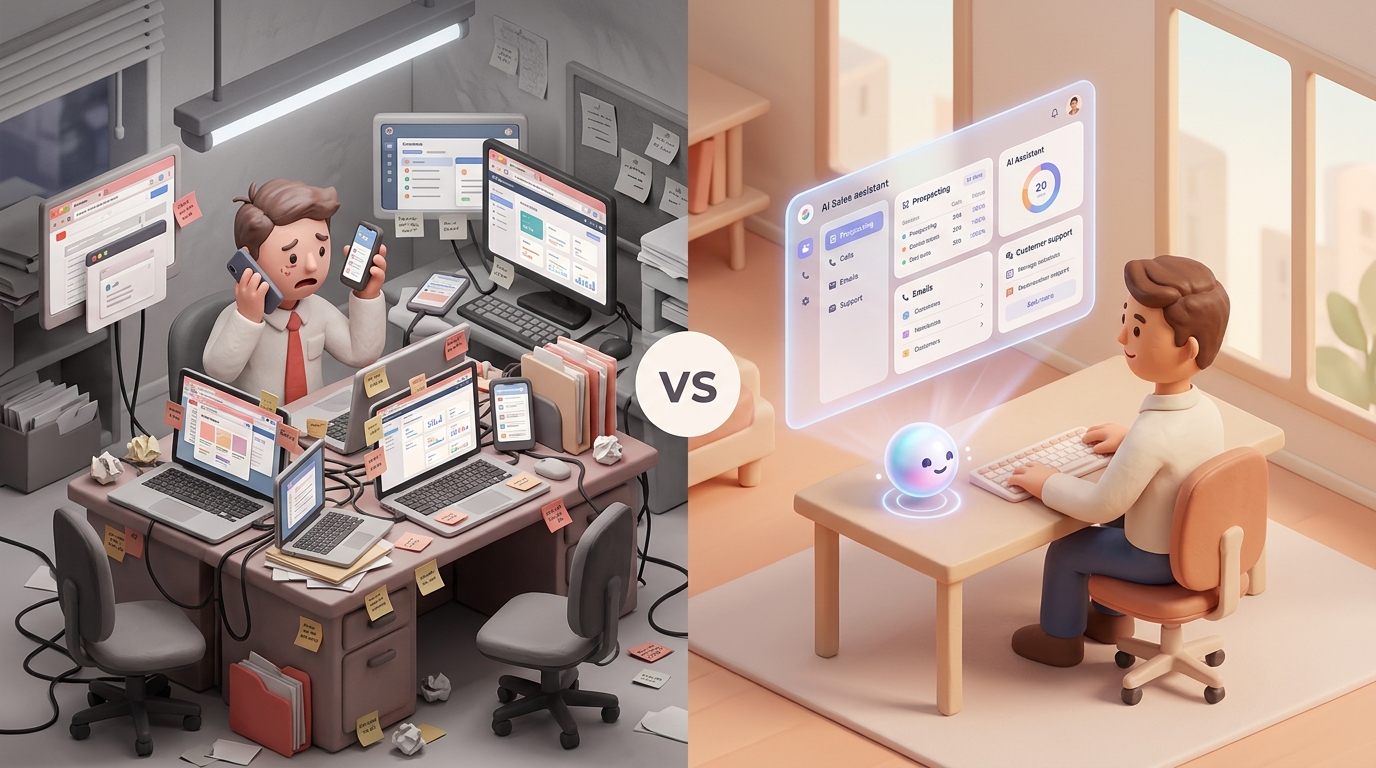
1. The Evolution from CRM to AI Assistant
Not so long ago, a CRM was the crown jewel of any go‑to‑market tech stack. It centralized contacts, tracked deals, and promised a single source of truth. But as sales motions grew more sophisticated, so did the tools around the CRM. Sequencers, dialers, chatbots, AI writers, lead databases, social schedulers, analytics – the stack ballooned. Today the average growth‑stage B2B team juggles 8–17 separate subscriptions, each solving a sliver of the workflow. The result isn’t efficiency; it’s tool sprawl, data silos, and an invisible integration tax that eats hours every week.
The next evolution isn’t another add‑on. It’s the AI sales assistant that replaces the sprawl – a unified platform that prospecting, writing, calling, emailing, publishing, and supporting from a single, intelligent core. This assistant doesn’t just log activities. It executes them. It’s the move from a system of record to a system of work. For growth‑stage GTM teams under pressure to do more with the team they already have, that shift is the difference between scaling revenue and scaling headcount – and the fastest path to pipeline velocity.
2. What Is an AI Sales Assistant?
An AI sales assistant is an intelligent, software‑based agent that automates and augments key parts of the sales process – from finding leads and personalizing outreach to summarizing calls and handling after‑hours support. Unlike a simple chatbot or a standalone AI writer, a full‑stack AI sales assistant functions as a multi‑tool platform, capable of executing prospecting, sequencing, voice conversations, content creation, and customer interaction within one connected environment.
Instead of asking a rep to jump between five windows, the assistant works across channels, remembers context, and keeps the entire go‑to‑market motion humming. It’s not a replacement for human sellers; it’s a force multiplier that eliminates the manual busywork that steals their time.
3. Key Capabilities That Actually Move the Needle
Most AI sales tools claim to help, but a true assistant must deliver four core capabilities in a unified experience:
Lead Capture and Enrichment
Pull from a refreshable B2B database of over 700 million contacts, automatically enrich CRM records, and identify buying signals without a separate research tool. The assistant surfaces prospects that fit your ICP and even generates pre‑drafted outreach based on their company, role, and recent activity.
Multi‑Channel Sequence Creation
Build and execute sequences across email, SMS, voice, LinkedIn, and even direct mail – all from one canvas. The AI assistant optimizes send times, personalizes each step with dynamic tokens (name, company, pain point), and handles reply detection so your reps only step in when a conversation is truly warm. No more gluing a sequencer to a CRM and hoping they stay in sync.
AI‑Powered Call Summaries and Voice Agents
After every meeting, the assistant transcribes, summarizes, and pushes action items directly into the CRM. It can also act as a 24/7 voice agent – handling inbound calls, qualifying leads, booking meetings, or even conducting outbound dials with natural, on‑brand conversation. Every interaction becomes searchable and attributable.
Chat Support That Knows Your Business
Embed an AI chat agent on your website that’s grounded in your knowledge base, product docs, and brand voice. It answers questions, qualifies visitors, and books meetings – day or night. Because it draws from the same data as your email and voice agents, prospects get a consistent experience from first touch to closed deal.
These capabilities aren’t separate modules with separate logins. They live inside one platform, sharing context and data. That’s the difference between a point solution and a real assistant.
4. Standalone Assistants vs. Platform‑Based AI Assistants
The market is flooded with “AI for sales” tools, but the vast majority are single‑purpose: a LinkedIn automation tool, an AI email writer, a call transcription service, a lead enrichment widget. Each one does one thing well, but stitching them together creates a fragile, expensive patchwork.
| Capability | Standalone Point Solution | Unified Platform Assistant |
|---|---|---|
| Prospecting | Separate lead database with CSV exports and manual CRM updates | Built‑in, refreshable database that auto‑syncs with CRM and sequences |
| Outreach | Standalone sequencer that may or may not integrate with your inbox | Native multi‑channel sequencer with reply management, AI personalization, and voice steps |
| Meetings & Voice | Third‑party dialer + separate transcription/notes app | Integrated AI voice agent and call summarizer that logs directly to the CRM |
| Support & Chat | Disconnected chatbot with separate training and no context of sales conversations | Unified chat agent grounded in your knowledge base and aware of the prospect’s journey |
| Content Creation | A separate AI copywriting tool (ChatGPT, Jasper) with copy‑paste workflows | On‑brand content engine that writes emails, social posts, and blog posts in your voice – no copy‑paste needed |
| Data & Analytics | Spreadsheets that combine exports from 6 tools | Single source of truth: pipeline analytics, rep performance, and AI‑generated insights in one dashboard |
| Total Cost | $300–$800/month in per‑seat subscriptions, plus hours of manual integration | Often less than the sum of the parts, with zero integration tax |
For B2B teams that have outgrown scrappy, founder‑led sales, the platform approach isn’t just more convenient – it’s more cost‑effective, more secure, and far more scalable. When the same AI powers prospecting, outreach, and support, the assistant learns your business holistically and applies that intelligence across every touchpoint.
5. How a Unified AI Sales Assistant Reduces Cognitive Load
Cognitive load is the silent killer of rep productivity. When a BDR or AE has to switch context between a CRM, a sequencer, a dialer, a notetaker, and a LinkedIn tab – plus a personal ChatGPT window for writing – their brain burns energy on tool management, not selling.
A unified assistant collapses all of those into one workspace. Reps log in and see their prioritized tasks, AI‑generated email drafts, suggested next steps, and live conversations – all in one place. The assistant even handles administrative follow‑up (logging calls, updating fields) automatically. This frees up 10–15 hours per rep per week that can be redirected toward high‑value conversations.
For RevOps leaders, the cognitive load also vanishes at the team level. Instead of monitoring integrations that break silently and data that drifts out of sync, they have a single source of truth. Reporting becomes real‑time, attribution becomes clear, and onboarding new reps takes minutes instead of days.
6. Implementation: Setting Up Your AI Sales Assistant in One Hour
The biggest objection to adopting a new platform is disruption. But a well‑designed AI assistant flips that – it’s built to go from signup to running in under an hour. Here’s what a typical implementation looks like:
- Connect your CRM and email (HubSpot, Salesforce, Pipedrive, Gmail/Outlook) via native one‑click integrations. All existing data is pulled in automatically; no CSV imports.
- Upload your brand guidelines, product docs, and customer-facing content into a knowledge base. The AI immediately learns your tone, terminology, and value props – so every email, chat, and voice conversation stays on brand.
- Define your ICP and set up a lead capture campaign using the built‑in B2B database. The assistant can begin enriching and scoring leads in minutes.
- Build your first outreach sequence with a drag‑and‑drop builder. Add AI personalization tokens; the platform suggests subject lines and body copy based on what’s working in your industry.
- Activate AI voice and chat agents with a few prompts. Point the chat agent to your knowledge base, set business hours, and define routing rules for live handoffs.
- Set up automated reporting – pipeline velocity, response rates, conversion metrics – and invite your team. Most reps need only 15 minutes of walkthrough because the interface unifies what they used to do across five tabs.
Because the assistant is a platform, not a collection of integrations, there’s no waiting for a developer to build a custom connector or debug a broken zap. The result is speed‑to‑value that matches the pace of a growth‑stage team.
7. Measuring Success: Time Saved, Pipeline Velocity, Conversion Rates
Once the assistant is live, the metrics that matter shift from tool‑centric (did the integration run?) to business‑centric. Track these three KPIs to gauge impact:
- Time saved per rep: Before and after measurement of administrative tasks. Top‑performing teams see a 60–70% reduction in non‑selling activities. For a team of five, that’s 50+ hours reclaimed each week.
- Pipeline velocity: Track the average number of days a deal spends in each stage. With AI‑led qualification and immediate follow‑up, many teams cut their sales cycle by 20–30%.
- Conversion rates: Measure meeting‑booked‑to‑opportunity and opportunity‑to‑close metrics. With consistent, multi‑channel nurture and no lead leakage, conversion rates often improve by 15–25%.
Because the assistant unifies prospecting, outreach, and support, you can finally see the full journey. No more guessing whether a lead fell through because the chatbot didn’t talk to the CRM, or a rep forgot to follow up. Everything is logged, attributable, and optimizable.
8. Conclusion: The Assistant That Never Sleeps
Most AI sales assistants are limited to one task – write an email, transcribe a call, answer a chat. But your sales process doesn’t happen in isolated tasks. It flows from list to conversation to meeting to close, and back. A fractured tool stack forces your team to manually stitch these stages together, leaving money on the table with every handoff.
A platform‑based AI sales assistant changes the equation. It consolidates the tools that have quietly bloated your SaaS spend, eliminates the integration tax, and gives your team a single, intelligent workspace that’s always on – prospecting, personalizing, responding, and supporting – even while they sleep. For growth‑stage GTM teams, it’s not just a productivity play; it’s a strategy for scaling revenue without scaling headcount, and for finally turning tool sprawl into a competitive advantage.
Frequently Asked Questions
What is an AI sales assistant?
An AI sales assistant is an intelligent software agent that automates and enhances core sales activities – prospecting, outreach, meetings, and support – within a unified platform. Rather than handling one narrow task, a full‑stack assistant works across channels and shares context, acting as a force multiplier for sales teams.
How does an AI sales assistant improve sales productivity?
It eliminates the manual, repetitive work that drains rep time: finding leads, writing repetitive emails, logging calls, switching between tools. By automating these tasks and surfacing next‑best actions, reps can spend 10–15 more hours per week on actual selling, boosting pipeline generation and close rates.
What are the best AI sales assistants for B2B?
The best AI sales assistants for B2B are those that function as a unified platform rather than a single‑purpose point solution. Look for a system that combines lead enrichment, multi‑channel sequencing, AI voice and chat agents, content creation, and CRM‑native workflow. Platforms like Parallel AI replace the fragmented stack – prospecting, writing, calling, emailing, publishing, and supporting – from one subscription.
Can an AI sales assistant integrate with my CRM?
Yes. A capable AI sales assistant offers native, bidirectional integrations with leading CRMs (HubSpot, Salesforce, Pipedrive, Zoho, etc.) plus email platforms like Gmail and Outlook. The best assistants also integrate with LinkedIn, social schedulers, and over 1,000 other business tools, ensuring data flows seamlessly without custom connectors.
How much does a good AI sales assistant cost?
Costs vary widely. Standalone point solutions can range from $20 to $150 per seat per month each, and a team often subscribes to 5–10 of them, totaling $200–$1,500/month. A unified platform assistant often costs less than the sum of the individual tools it replaces, with transparent pricing that includes the full suite – prospecting, sequences, voice, chat, and content – without hidden per‑module add‑ons. The ROI comes from both hard cost savings and the dramatic increase in rep productivity.
Related reading
- The Essential AI Resource Toolkit: 12 Free and Premium Tools Every Solo Consultant Needs in Their Stack
- 10 Agentic GTM Platforms Reshaping Sales in 2026
- 200+ Free n8n Workflow Templates That Save Solopreneurs 100+ Hours Monthly (Without Writing a Single Line of Code)
- 7 n8n Automations That Replace a $5K/Month Virtual Assistant