
AI receptionist services bundle several jobs into one always-on assistant. That assistant answers calls and messages around the clock across phone, SMS, WhatsApp, and web chat; qualifies leads; books appointments; takes messages; and hands off to a human teammate when a conversation gets complicated. If you run a dental practice, plumbing company, real estate office, salon, law firm, or retail shop, and you're comparing providers right now, this post gives you a level playing field for that comparison. You'll find what a typical service includes, the two ways providers deliver it, and a checklist of questions that separates providers who deliver from those who mostly sell.
What Do AI Receptionist Services Include?
Every credible provider builds on the same foundation: 24/7 answering across phone, SMS, WhatsApp, and web chat, paired with lead qualification, appointment booking, message taking, and warm handoffs to your staff when a conversation needs a human. Providers differ more in execution than in feature lists, so it pays to understand each piece before you compare.
Around-the-Clock Answering on Every Channel
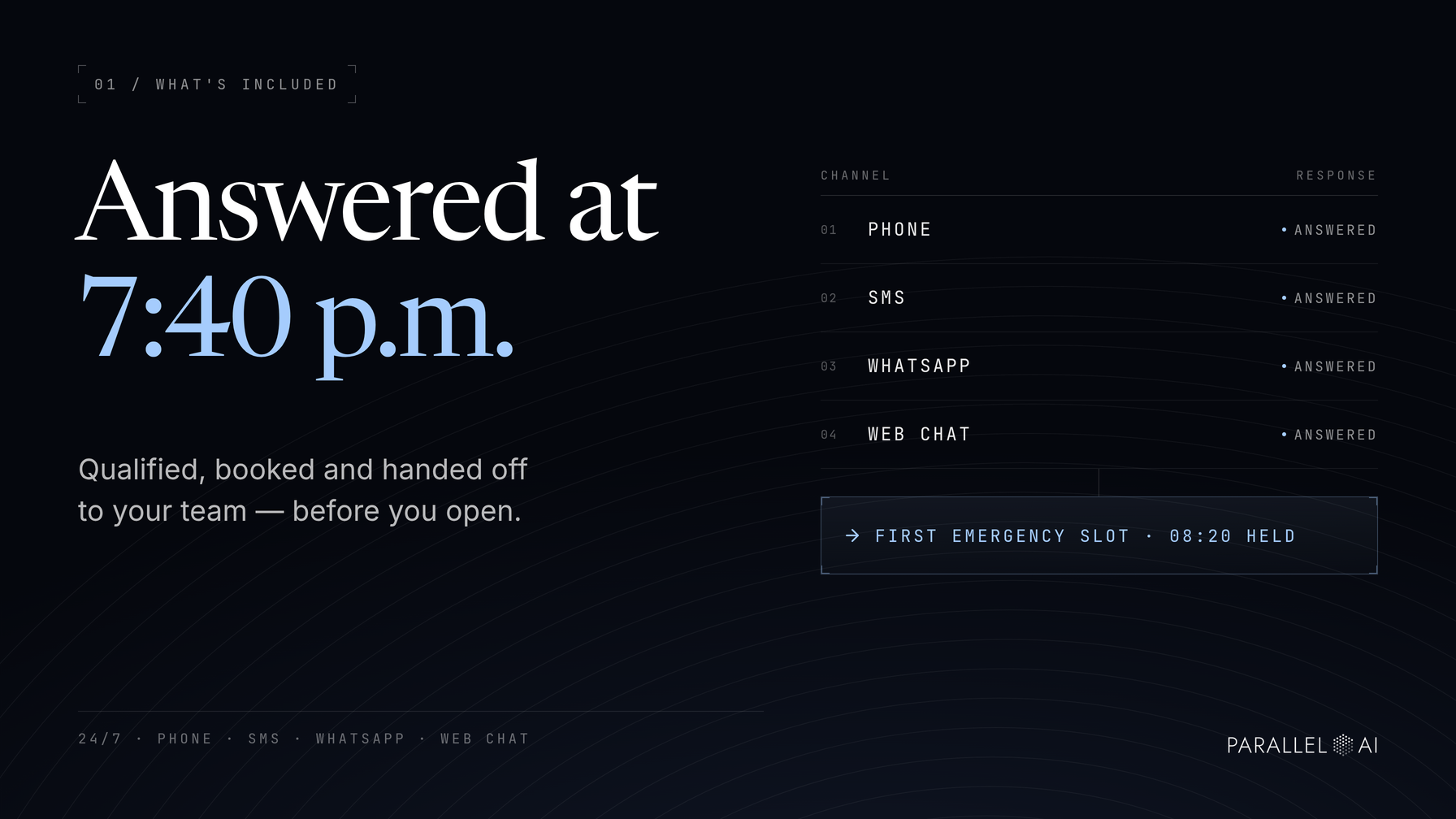
Picture a patient calling a dental office at 7:40 p.m. with a cracked tooth. An AI receptionist answers instantly, recognizes the urgency, offers the first emergency slot the next morning, and sends a confirmation the patient can hold onto. Without it, that caller reaches voicemail. Usually they try the next practice in the search results before yours even opens.
The same logic applies across every channel. A text from a prospective client, a WhatsApp message from a returning customer, a web chat from someone comparing prices: each gets an immediate, competent response instead of silence until business hours.
Lead Qualification and Message Taking
Now consider a plumbing company where a 9 p.m. call about a burst pipe goes unanswered. With an AI receptionist, the call gets answered. The AI asks the same questions you'd ask: where are you located, what happened, is water actively running? It captures every detail before alerting your on-call phone.
The practical result is that leads arrive pre-qualified instead of as raw voicemails you decipher between jobs. Message taking matters just as much for routine calls. The AI records who called, what they need, and how urgent it is, then routes it according to your rules.
Appointment Booking That Uses Your Real Calendar
Booking is where AI receptionist services either earn their keep or lose your trust. A strong service connects to your actual calendar and offers genuinely open slots. A weak one takes a "request" and promises someone will call back. When you're evaluating, listen for the phrase "someone will follow up." That's a message-taking service wearing a booking label.
Warm Handoffs When a Conversation Turns Complex
No AI should bluff its way through an upset patient or a tricky legal question. Strong services define escalation rules up front. When a conversation turns emotional, legally sensitive, or simply beyond the agent's knowledge, the AI hands off to a human with the full conversation attached, so nobody has to repeat themselves.
Done-for-You or Self-Serve: Which Fits a 1-10 Person Team?
Providers deliver AI receptionist services through two models. Done-for-you means a provider or agency configures everything for you: the agent, the scripts, the integrations. You simply receive the results. Self-serve means you set up the agent yourself in a dashboard. For a small team, the trade-off comes down to five factors:
| What to weigh | Done-for-you | Self-serve |
|---|---|---|
| Setup | Provider or agency configures everything | You build the agent yourself |
| Your time | Minimal; you just share how your business works | Significant; depends on your schedule and learning curve |
| Control | Changes often route through the provider | You adjust scripts and rules anytime |
| Cost structure | Typically a managed-service fee | Platform pricing only, but your hours are the hidden cost |
| Best fit | Overloaded, non-technical owners | Hands-on owners who want full control |
For most 1-10 person businesses, done-for-you wins on one simple ground: the owner's time is the scarcest resource in the company. If you're already working evenings, a setup project with a learning curve will slip for months while missed calls keep stacking up.
Self-serve suits a different owner: someone who enjoys tinkering, wants to test scripts themselves, and will log in weekly without being told. There's nothing wrong with that path. Just be honest about whether it describes you before you commit.
Watch for two failure modes as you compare. Some done-for-you providers lock you out of your own settings, so every small change requires a support ticket. Some self-serve tools quietly assume technical skills nobody on your team has. The strongest option is a platform where onboarding is done for you, but the steering wheel is always yours.
What Should You Ask a Provider Before Signing Up?
Five areas of questioning will tell you more than any sales page: onboarding, integrations, escalation, pricing, and how the AI learns your business. Ask them on a discovery call, and listen for specifics rather than enthusiasm.
"What do you need from me, and when will it be live?"
Onboarding answers reveal how a provider really operates. You want concrete responses: what information they collect, who configures it, and a realistic timeline to your first answered call. Vague answers like "it depends" or "usually pretty quick" are a warning sign, especially if you were sold a done-for-you experience and the setup work quietly lands on your plate.
"Does it book into my calendar and write to my CRM?"
Name your specific tools on the call: your calendar platform, your CRM, your industry software. The right answer is that leads and appointments land where your business already lives. The wrong answer is that your data sits inside the vendor's system, exportable only by request. Integration depth is the difference between a real teammate and another silo to check.
"What happens when the AI can't handle something?"
Escalation rules should be yours to define: transfer to your cell, text the owner, take a detailed message, or page the on-call tech. A real estate example shows the stakes. A caller asking a detailed question about a specific listing deserves a handoff or a careful capture, not an improvised answer. Ask how the AI knows the difference, and who configures those rules.
"What would my bill look like in a busy month?"
Pricing predictability is where small businesses get burned. Ask what's included and what costs extra: per-minute charges, per-conversation fees, add-ons for extra channels, premium pricing for integrations. Then ask the stress-test question: what does my bill look like in my busiest month? A provider who can't model that for you is guessing. You'll be the one paying for the guess.
"How does the AI learn my business, and who updates it when things change?"
Every business has specifics the AI must know: your services, your hours, your service area, your pricing policies, your most common questions. Ask how that information gets into the system, ideally through structured onboarding or a knowledge base rather than a generic script with your name swapped in. Then ask the follow-up that matters most. When you add a service or change your hours, who updates the AI, and how fast?
How Parallel AI Supports Both Paths
Parallel AI is built so you don't have to choose between done-for-you and self-serve at the platform level. You get AI employees and chat/voice agents that answer across phone, SMS, WhatsApp, and web chat, plus free onboarding that delivers done-for-you results without any technical skill on your side.
During onboarding, the Parallel AI team configures your agent with you: your services, your hours, your booking rules, your escalation preferences. The platform underneath is self-serve, so you can adjust anything yourself later. No support ticket, no change fee, no waiting.
If you're an agency serving local businesses, Parallel AI's white-label option lets you offer AI receptionist services under your own brand. That's a practical way to deliver this capability to clients without building the infrastructure yourself.
From Shortlist to First Answered Call
Here's what to hold onto as you compare providers:
- Every credible service combines 24/7 answering across phone, SMS, WhatsApp, and web chat with lead qualification, appointment booking, message taking, and warm handoffs to humans.
- Done-for-you trades a managed fee for your time back; self-serve trades your hours for control. For most 1-10 person teams, the owner's schedule decides.
- Five questions cut through the sales polish: onboarding, calendar and CRM integrations, escalation rules, pricing in a busy month, and how the AI learns your business.
- The strongest setup is free, done-for-you onboarding on a platform you can steer yourself, so you're never locked out of your own settings.
The next step is a low-risk one: start Parallel AI's 7-day free trial. Onboarding is free and done for you, so within days you can hear how the AI handles a real call to your business and make your decision with evidence instead of promises.