
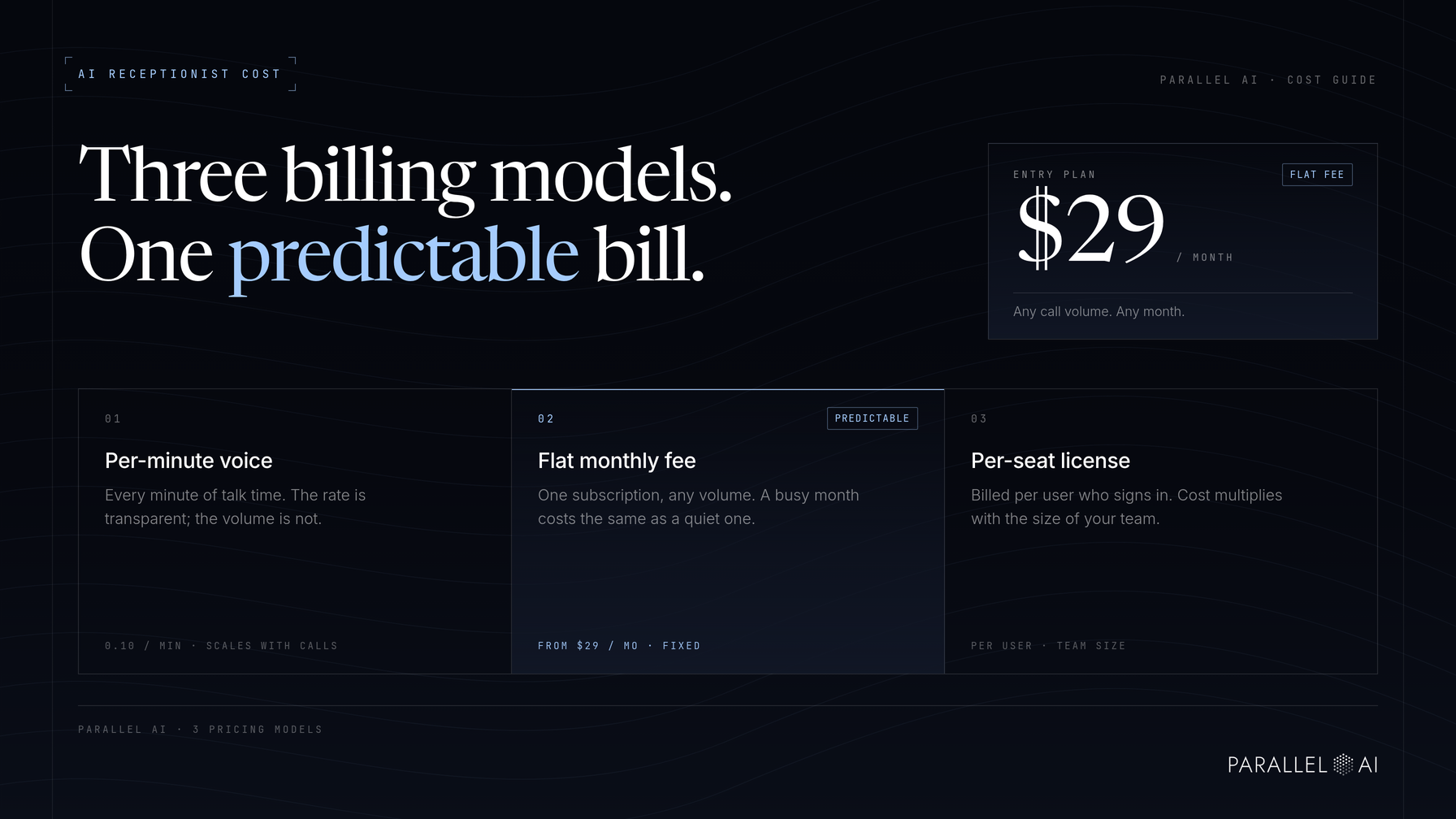
Pricing an AI receptionist comes down to one question: which billing model does the provider use? Flat monthly plans start as low as $29, and Parallel AI's entry plan is one example. Per-minute plans scale with your call volume, and per-seat plans multiply by headcount. Once you know the model, your total becomes predictable.
This guide compares all three models and explains what actually drives the price up or down. It also weighs AI receptionist cost against a full-time hire and a traditional answering service, with math you can adapt to your own numbers.
If you run a 1-10 person service business, you'll get a 10-minute method for estimating your monthly cost straight from your call log. It works for real estate, health and wellness, professional services, and local trades.
How much does an AI receptionist cost per month?
AI receptionists are sold under three pricing models: per-minute voice usage, a flat monthly subscription, or a per-seat license. For most 1-10 person service businesses, the flat monthly fee keeps AI receptionist cost predictable.
Parallel AI, for example, starts at $29 a month. The entry plan includes voice and chat agents covering phone, SMS, WhatsApp, and web chat around the clock, with lead qualification and meeting booking built in.
Here's how the three models compare:
| Pricing model | How you're billed | What changes your monthly total | Best suited for | Watch out for |
|---|---|---|---|---|
| Per-minute voice usage | Every minute of talk time | Call volume and average call length | Very low, steady call volume | Bills spike when marketing works; possible overage fees |
| Flat monthly fee | One fixed subscription | The feature tier you choose | Businesses that need predictable costs | Confirm what's included: booking, integrations, channels |
| Per-seat | Per user or agent license | Team size | Larger teams sharing dashboards | Paying for seats nobody uses |
Per-minute voice usage
You pay only for talk time. Your monthly cost equals your per-minute rate multiplied by total minutes handled.
If your provider charges 10 cents a minute and you log 300 minutes, you pay $30. Double the volume and the bill doubles. The math is transparent, but this model punishes success. The same campaign that doubles your inbound calls also doubles your phone bill, and some plans add overage fees once you cross a threshold.
Flat monthly fee
You pay one predictable subscription, no matter how many calls arrive. Parallel AI's flat plans start at $29 a month and bundle phone, SMS, WhatsApp, and web chat into a single price. A busy month costs exactly the same as a quiet one.
Verify one thing before signing: which features sit behind higher tiers. Appointment booking, CRM syncing, and extra channels are the usual ones, and you don't want to be upsold mid-contract.
Per-seat pricing
You pay per person who logs into the platform. This model is built for teams that want shared dashboards and role-based access. For a solo owner or a two-person front desk, per-seat pricing often means paying for licenses nobody touches. If one person manages your phones, one seat is all you need.
What actually drives the total price?
Three factors drive your total price: call volume, the features you switch on, and the setup the provider requires. None of them are mysterious. You can estimate all three before you ever talk to a salesperson.
Call volume
Volume is the biggest variable in usage-based plans. Estimate yours with simple math: monthly calls multiplied by average call length. Two hundred calls at two minutes each is 400 minutes. At four minutes, it's 800.
Under a flat-fee plan, volume affects nothing. That's exactly why flat pricing suits service businesses with seasonal swings.
Features
Appointment booking, CRM integrations, and multi-channel coverage are the features that push plans into higher tiers. They're also the ones that save the most time.
Pay for booking and integrations from day one if appointments are your lifeblood. Think salon visits, clinic slots, or real estate showings. Add the advanced extras later, once the basics are earning their keep.
Setup requirements
Some providers charge onboarding fees or require technical setup before your first call is answered. Others are self-serve. You point the agent at your business information, connect your number, and go live. There's no technical work involved.
Ask two questions before committing: Is setup included in the price? Can I try it before paying? Parallel AI runs a 7-day free trial so you can check the fit before the first invoice.
AI receptionist cost vs. human receptionist vs. answering service: which costs less?
Per hour of coverage, an AI receptionist costs a fraction of both alternatives. It works all 720 hours of a month, while a full-time human works roughly 170. Here's the honest comparison:
| Option | How you pay | Hours of coverage | What you get | Cost predictability |
|---|---|---|---|---|
| Full-time receptionist | Salary plus roughly 25-30% in payroll taxes and benefits | ~170/month, weekdays | Human judgment, in-person tasks | Fixed but high |
| Traditional answering service | Per call or per minute, often with a monthly minimum | Often 24/7, script-based | Live agents taking messages | Variable |
| AI receptionist | Flat monthly fee (Parallel AI from $29) | 24/7, ~720/month | Answers, qualifies, and books across phone, SMS, WhatsApp, web chat | Fixed |
To price a full-time hire, start with the monthly salary you'd pay in your area. Add about 25-30% for payroll taxes and benefits, then divide by 170. That gives you the true cost of one covered hour.
An answering service bill moves with call volume, so a busy month raises it. A flat-fee AI receptionist at $29 a month covering 720 hours works out to roughly four cents per covered hour. You could never buy that coverage from a person at that price.
Will an AI receptionist pay for itself?
For most service businesses, the answer is yes. You can measure the payback with three levers in about an afternoon: recovered missed calls, admin hours saved, and after-hours coverage.
Lever 1: Missed calls recovered
Every missed call is a potential customer who dialed a competitor next. Run the math with your own figures. Say your average job is worth $250 and you miss 20 calls a month. Winning back a quarter of them adds $1,250 in revenue, against a tool cost of $29 to a few hundred dollars.
Your break-even is one division problem: monthly price divided by the value of one average customer. If the answer is less than one, the receptionist pays for itself with a single saved call.
Lever 2: Admin hours saved
Routine calls are exactly the calls an AI agent absorbs: hours, directions, appointment questions, and "can you resend the quote." If it takes five hours a week off your plate, that's roughly 20 hours a month returned to billable work. Value those hours at what your time is actually worth. An owner who reclaims 20 hours and puts them into revenue-generating work has found the real ROI.
Lever 3: After-hours coverage
About three-quarters of a week's hours fall outside a 9-to-5 schedule. A human option needs overtime or a second shift to cover them. An AI receptionist includes them in the base price. Real estate and home-service callers often shop after work, so after-hours answering is where the return shows up first. Your phone stays quiet at dinner instead of ringing at the table.
How to estimate your monthly cost in about 10 minutes
You can put a real number on your monthly cost with your phone's call log and a calculator. Follow these steps:
- Pull 60-90 days of call logs from your phone app or carrier bill.
- Count inbound calls per month and note when they cluster: after hours, lunchtime, Mondays.
- Spot-check five recent routine calls and average their length to estimate minutes per call.
- Multiply monthly calls by average minutes to get your monthly volume.
- List the features you genuinely need in month one (booking, SMS follow-up, CRM sync), not everything a sales page suggests.
- Apply your volume to each model: flat fee stays flat; per-minute equals rate × minutes; per-seat equals price × people who'll actually log in.
- Compare the winning number to the value of one recovered customer.
Watch for three common mistakes. Budgeting for your average month instead of your busy season is the first. Forgetting that SMS and web chat may bill separately under some models is the second. The third is signing an annual contract before running a trial week. The plan that looks cheapest in February can be the most expensive one in June.
Get your exact number, then test it free for a week
Your AI receptionist cost comes down to the pricing model: per-minute, flat fee, or per-seat. Call volume, features, and setup requirements drive the total from there. That's the whole picture.
Flat-fee plans are the most predictable choice for small service businesses. Parallel AI covers phone, SMS, WhatsApp, and web chat, qualifies leads, and books meetings 24/7, starting at $29 a month. That works out to less per covered hour than any human alternative.
Your break-even check is simple: the plan should cost less than a single recovered customer. For most service businesses, it does, by a wide margin.
Run Parallel AI free for 7 days and test it against your own call log before paying anything. If it books one appointment you would have missed, it has already covered its next several months.