
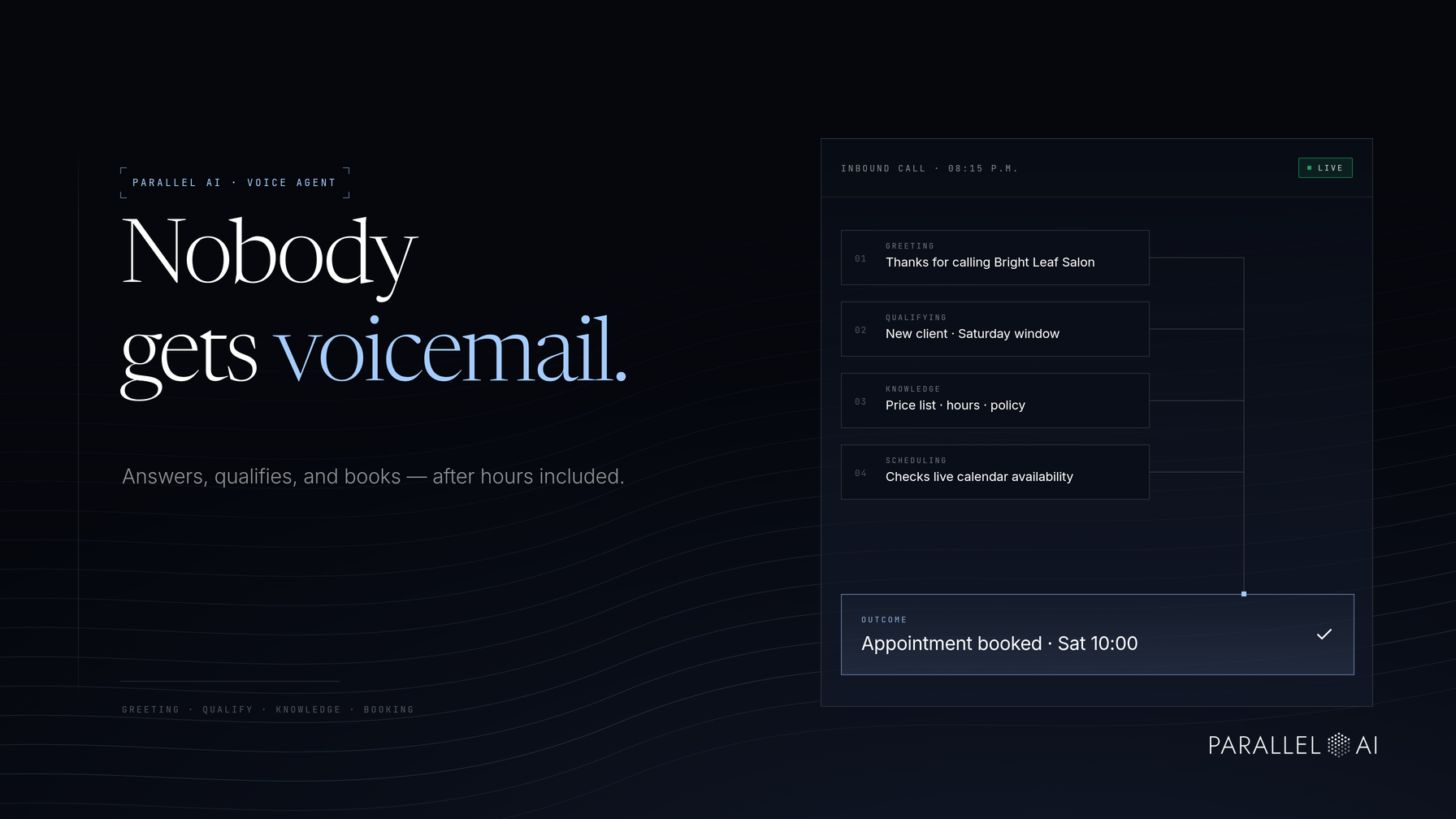
An AI phone answering service picks up every call. The 8 p.m. booking request, the Saturday emergency, the midday rush you can't get to, all of them. A voice agent greets the caller, asks a few qualifying questions, and answers common questions from your knowledge base. Then it books the appointment, sends a confirmation, or transfers the caller to a person who already has the full context. No caller gets voicemail. You don't need to hire a receptionist or learn code to make it happen.
If you run a salon, a plumbing company, a real estate office, or any small business where a missed call is a missed customer, this guide is for you. Here's how a call flows end to end, the setup steps a non-technical owner can finish in an afternoon, and the compliance basics worth knowing before you go live.
What Happens from the Moment a Customer Dials In?
Every AI-handled call follows the same predictable path: a greeting, a short qualification exchange, answers grounded in your knowledge base, and a resolution, usually a booking, a confirmation, or a transfer to a human. Walking through that path is the fastest way to judge whether a service fits your business.
The Greeting and First Qualification
The voice agent answers with your business's name and a natural opener, something like, "Thanks for calling Bright Leaf Salon, how can I help today?" Then it listens. Based on what the caller says, it classifies the intent: booking, pricing, hours, an emergency, or a sales call you'd rather not take. From there, it asks the two or three qualifying questions that matter for your workflow.
Picture a salon. A caller dials at 8:15 p.m., after the front desk has gone home, and asks whether Maria has anything open Saturday for a color appointment. The agent asks what service she's looking for, whether she's a new or returning client, and what time window works. Then it checks availability while she's still on the line.
Answers Pulled from Your Knowledge Base
Qualification is where traditional answering services stop. An AI phone answering service keeps going. It answers questions directly from the documents you've uploaded: your price list, service menu, hours, cancellation policy, and FAQs. Parallel AI's agents work this way, grounded in one shared knowledge base, so the answer a caller gets is the answer you gave.
That grounding matters in both directions. The agent won't invent a price or a promise when an answer isn't in the knowledge base; it says it will check with the team and captures the details instead. Callers get real answers, and you keep control of what your business says out loud.
Booking, Confirmation, or a Warm Transfer
The call ends in one of three ways, chosen by the rules you set:
- A booking. The agent checks your calendar, offers open slots, and books the appointment on the call. A confirmation text or email follows automatically, so the details are in writing.
- A captured lead. Sometimes a booking isn't possible. There's no availability, or the caller wants to think it over. The agent collects a name, number, and what they need, then logs it for follow-up.
- A transfer with context. When the caller asks for a person or the issue is complex, the agent transfers the call and passes along a summary of everything discussed. Your customer never repeats themselves.
A plumbing company shows how this works under pressure. A caller says water is spreading across the basement floor. The agent recognizes the emergency branch, captures the address and a callback number, and transfers straight to the on-call technician. If nobody picks up, it takes the details, flags the job as urgent, and alerts the team through your channel of record. Either way, the emergency is triaged in seconds, not the next morning.
How Do You Set One Up Without Technical Skills?
Setup looks less like configuring software and more like onboarding a new receptionist. You give the agent a role, the information it needs, and clear rules for what to do when it's unsure. Five steps cover it.
Step 1: Connect Your Business Number
Forward your existing number to the service, or assign a new one. Most small businesses forward their main line so nothing about their published contact information changes. Then choose whether the AI agent takes all calls or only after-hours ones.
Step 2: Define the Agent's Role and Instructions
Write the job description: who the agent is, the tone it uses, what it handles on its own, and what it must escalate. Upload the basics a new hire would need, including services, hours, pricing, and policies, into the knowledge base. Clearer instructions mean fewer edge cases landing on your desk.
Step 3: Build a Simple Call Flow
Map the branches the agent follows: one for FAQs, one for bookings, one for emergencies, one for transfers. Start with four or five. A common mistake is building twenty paths on day one. A simple flow you can test beats an elaborate one you can't.
Step 4: Set Transfer Rules and Business Hours
Decide who receives transferred calls, in what order, and what happens when nobody picks up. Set your hours so the agent knows when it's the after-hours line versus daytime backup. Add a rule so vendor calls never reach your team.
Step 5: Run Test Calls Before Going Live
Call your own number and role-play the scenarios you actually get: a booking, a price question, an unhappy customer, an emergency. Listen for wording that sounds off, questions the agent asks one time too many, and every "I don't know." Then fix the instructions or add the missing answer. A few rounds of testing is the difference between going live once, confidently, and going live twice.
What Small Businesses Need to Know About Compliance
Call compliance comes down to a handful of practices that protect your customers and your reputation. No lawyer required.
Call Recording Consent
If calls are recorded, disclose it in the greeting. "This call may be recorded for quality purposes" covers most situations. Consent rules vary by state, so the simplest safe practice is disclosing on every call rather than trying to track where each caller is located.
Outbound Follow-Up and Do-Not-Call Requests
If your agent follows up by text or phone, confirming appointments or nudging quotes, keep the practices TCPA-aware. Message only people who gave you their number or opted in. Honor "stop" and do-not-call requests immediately and permanently. Maintain a suppression list so opted-out contacts are never re-added. Small businesses get into trouble with automated outbound outreach, not with answering inbound calls.
Customer Data Security
Ask any provider where recordings and customer details are stored, who can access them, and whether your data trains their AI models. Look for encryption in transit and at rest, and a clear commitment that your business's data stays yours. Parallel AI encrypts customer data and never uses it for model training. Your callers' information powers your agent, not someone else's.
Is an AI Phone Answering Service Worth It for a Business Your Size?
For most small businesses, the decision comes down to how many calls you currently miss and what each one is worth. When you're on a job site, with a client, or simply closed at 6 p.m., every one of those calls is either captured by an AI agent or lost to whoever answers first. For a local service business, one recovered job can cover the month's cost.
When you evaluate a platform, check the four things that matter:
- Does it answer from your knowledge base, or does it improvise?
- Does it book directly into your calendar and send confirmations?
- Does it transfer to a human with the full context of the call?
- Does it work on the channels your customers use, beyond just voice?
That last point is where an all-in-one platform pays off. Parallel AI's AI employees answer on phone, SMS, WhatsApp, web chat, and email around the clock. They qualify leads, book meetings, and hand complex issues to your team, all grounded in the same shared knowledge base. You set the rules once, and every channel follows them.
Every Call Answered, Even When You Can't Pick Up
An AI phone answering service handles each call the same proven way: greet, qualify, answer from your knowledge base, then book, capture, or transfer with full context. Setup is five steps a non-technical owner can finish in an afternoon: connect your number, define the agent's role, build a simple call flow, set transfer rules and hours, and test before going live. Staying compliant is mostly common sense: disclose recording, honor opt-outs, and choose a platform that encrypts your data and never trains its models on it.
Start Parallel AI's 7-day free trial and put it to the test. Connect your number, upload your price list and policies, and run a few calls this week. Hear your business answer every call, then decide.